





Family Law
Legal Aid in Family Law – Who Qualifies and How it Works

Facing divorce or child arrangements can leave families in Romford feeling overwhelmed by legal complexities and uncertain costs. For those struggling financially, understanding legal aid is essential, as it exists to prevent money worries from denying anyone their right to justice. This overview clarifies what legal aid really means, clears up common myths, and shows how it supports families during turbulent times.
Table of Contents
- Legal Aid Explained: Definition And Misconceptions
- Types Of Legal Aid For Family Law Cases
- Eligibility Tests And Required Evidence
- Legal Aid Process And Solicitor’s Role
- Financial Implications Of Receiving Legal Aid
Key Takeaways
| Point | Details |
|---|---|
| Legal Aid Definition | Legal aid is a financial support system ensuring access to justice for those unable to afford legal representation, not a universal entitlement. |
| Eligibility Criteria | Qualification for legal aid is based on income, assets, case type, and potential contributions needed from the applicant. |
| Types of Support | Various forms of legal aid are available in family law cases, including initial advice, mediation, and court representation, tailored to client needs. |
| Financial Responsibilities | Recipients of legal aid may have upfront contributions and potential repayments depending on their financial situation and case outcome. |
Legal aid explained: definition and misconceptions
Legal aid represents a critical social support mechanism designed to ensure fair access to justice for individuals who cannot afford legal representation. At its core, legal aid provides financial assistance enabling vulnerable people to navigate complex legal challenges without being disadvantaged by economic limitations.
The UK government defines legal aid as financial support for legal representation that helps citizens access the court system. Contrary to popular belief, legal aid is not a universal entitlement but a carefully regulated support system with specific eligibility criteria:
- Income and assets determine qualification
- Support varies based on case type
- Some cases receive priority consideration
- Financial contributions might be required
Understanding legal aid’s broader purpose is crucial. International human rights provisions recognize legal assistance as fundamental to ensuring equality before the law. This means legal aid extends beyond criminal proceedings, encompassing critical areas like:
- Domestic abuse protection
- Child custody disputes
- Housing and welfare challenges
- Employment rights cases
Legal aid exists to prevent financial barriers from denying individuals their fundamental right to justice.
Common misconceptions about legal aid can discourage potential applicants from seeking essential support. Many people mistakenly believe that legal aid is either completely free or entirely unavailable, when the reality is far more nuanced. The system involves careful assessment of an individual’s financial circumstances, case merit, and potential outcomes.
Key eligibility factors typically include:
- Total household income
- Savings and capital assets
- Nature of the legal problem
- Potential case outcomes
- Vulnerability of the applicant
Pro tip: Always consult a legal professional or Citizens Advice Bureau to understand your specific legal aid eligibility, as individual circumstances can significantly impact qualification.
Types of legal aid for family law cases
Legal aid in family law represents a nuanced support system designed to help vulnerable individuals navigate complex legal challenges. Various types of legal support are available depending on the specific circumstances of each family law case.
The primary types of legal aid for family law matters encompass several critical support levels:
- Initial legal advice: Providing preliminary guidance on legal rights and potential strategies
- Mediation services: Facilitating constructive dialogue and conflict resolution
- Court application assistance: Help with preparing and submitting necessary legal documents
- Full court representation: Comprehensive legal support during formal proceedings
Specifically, legal aid advisers offer targeted support across different family law scenarios, including:
- Child custody disputes
- Domestic violence protection
- Divorce proceedings
- Financial settlement negotiations
- Adoption processes
- Forced marriage prevention
Legal aid aims to ensure that financial limitations do not prevent individuals from accessing crucial legal protections.
The support levels are typically categorised into two primary frameworks:
- Controlled legal aid: Focused on mediation and initial consultation
- Certificated legal aid: Providing comprehensive representation for complex cases
Each type of legal aid is carefully assessed based on the client’s financial circumstances, the urgency of the legal matter, and the potential impact on vulnerable parties, particularly children.
Below is a summary contrasting controlled and certificated legal aid for family law cases:
| Legal Aid Type | Scope of Support | Typical Use Cases | Assessment Method |
|---|---|---|---|
| Controlled legal aid | Early advice and mediation steps | Non-urgent family disputes | Preliminary financial eligibility |
| Certificated legal aid | Full legal representation | Complex or urgent family law matters | Detailed means and merits testing |
Pro tip: Gather all financial documentation and case details before your initial legal aid consultation to streamline the eligibility assessment process.
Eligibility tests and required evidence
Legal aid eligibility involves a comprehensive assessment of an applicant’s financial circumstances and case merits. Client qualification tests are designed to ensure that legal support reaches those most in need while maintaining a fair and transparent system.
The primary components of the legal aid eligibility assessment include:
- Income assessment: Detailed examination of total household earnings
- Capital and savings evaluation: Reviewing total financial resources
- Specific circumstance considerations: Accounting for vulnerable situations
- Case merit analysis: Determining the legal problem’s significance
Applicants must provide extensive documentation to demonstrate financial eligibility, including:
- Recent pay slips (last 3-6 months)
- Bank statements
- Proof of benefits
- Housing cost evidence
- Childcare expense documentation
- Information about savings and investments
The legal aid means test ensures that financial support is directed to those who truly cannot afford legal representation.
The eligibility criteria are structured with several key considerations:
- Income thresholds: Strict limits on total household earnings
- Capital limits: Maximum allowed savings and assets
- Benefit recipients: Simplified qualification process
- Vulnerability exceptions: Special considerations for domestic abuse survivors
Certain family law cases receive special treatment, with relaxed financial criteria for sensitive matters such as child protection, domestic violence, and safeguarding proceedings. These exceptions recognise the critical nature of protecting vulnerable individuals.

Pro tip: Compile a comprehensive financial portfolio before your legal aid assessment, including all recent financial documents to expedite the qualification process.
Legal aid process and solicitor’s role
Legal aid solicitors play a crucial role in navigating the complex landscape of legal support for vulnerable clients. Application processes involve multiple critical steps that require professional guidance and expertise.
The solicitor’s responsibilities in the legal aid process encompass several key areas:
- Initial case assessment: Evaluating the legal merit and potential outcomes
- Financial eligibility screening: Thoroughly examining client’s financial circumstances
- Documentation preparation: Gathering and organizing supporting evidence
- Client communication: Explaining legal aid scope and potential limitations
- Representation management: Advocating for client’s interests throughout proceedings
Legal aid advisers provide comprehensive support through intricate stages of legal proceedings:
- Conducting detailed financial assessments
- Completing complex application forms
- Negotiating with the Legal Aid Agency
- Representing clients in court or mediation
- Managing ongoing case documentation
The solicitor’s role extends far beyond simple legal representation — they are critical navigators of the legal aid system.
The legal aid process typically follows these structured stages:
- Initial consultation: Assess case viability and client needs
- Eligibility evaluation: Comprehensive financial and merit review
- Application submission: Detailed documentation to Legal Aid Agency
- Funding confirmation: Receive official legal aid authorization
- Ongoing case management: Continuous legal support and representation
Special considerations exist for family law cases, with solicitors providing additional support in sensitive areas like child arrangements, domestic violence, and financial settlements.
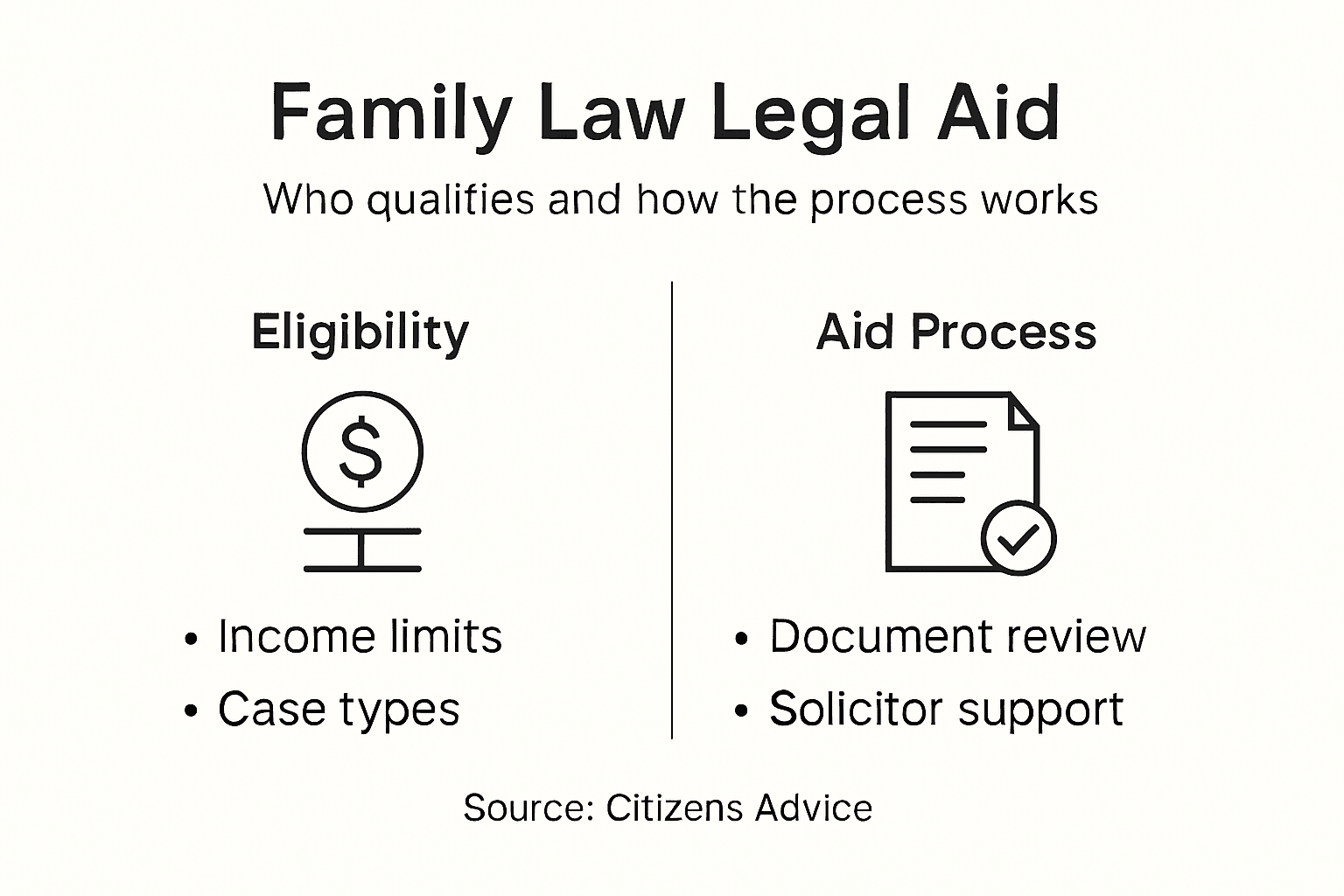
Pro tip: Maintain open and transparent communication with your solicitor, providing all requested financial documentation promptly to expedite the legal aid application process.
Financial implications of receiving legal aid
Legal aid comes with nuanced financial considerations that extend beyond simple free representation. Financial eligibility involves complex assessments that determine potential client contributions and future financial obligations.
The key financial implications for legal aid recipients include:
- Potential upfront contributions: Clients might need to pay initial fees
- Statutory charges: Possible repayment if case results in financial gain
- Income-based assessments: Sliding scale of financial responsibility
- Ongoing cost monitoring: Regular review of financial circumstances
The financial framework of legal aid operates through several critical mechanisms:
- Evaluating total household income
- Assessing capital and savings
- Determining potential client contributions
- Calculating potential future repayments
- Identifying exemption criteria
Legal aid balances access to justice with responsible financial management, ensuring those who can contribute do so appropriately.
Unique financial scenarios can significantly impact legal aid funding:
- Low-income applicants: Potentially full legal aid coverage
- Medium-income applicants: Partial funding with required contributions
- High-income applicants: Limited or no legal aid support
- Vulnerable groups: Special consideration and potential full support
Special provisions exist for sensitive family law cases, where financial barriers should not prevent individuals from accessing crucial legal protections. These provisions recognize that some legal challenges, particularly those involving child welfare or domestic abuse, require comprehensive support.
This table highlights how different financial circumstances affect legal aid support:
| Applicant Scenario | Likelihood of Aid | Typical Contribution Required | Special Considerations |
|---|---|---|---|
| Low-income household | Highly likely | Often no contribution | Fast-tracked for urgent needs |
| Medium-income household | Possible | Partial contributions | Dependent on case complexity |
| High-income household | Rarely eligible | Significant or full cost | Only for exceptional vulnerability |
| Domestic abuse survivor | Strongly prioritised | Often fully covered | Relaxed financial criteria applied |
Pro tip: Maintain transparent financial documentation and communicate openly with your solicitor to understand potential costs and contribution requirements.
Secure Your Family’s Future with Expert Legal Aid Support
Navigating family law challenges while managing financial concerns can feel overwhelming. If you qualify for legal aid, you should not have to face complex issues like child arrangements, divorce, or domestic abuse alone or under financial strain. Signature Law understands these pressures and offers specialised legal aid services with compassionate, tailored support designed for your unique situation.
Whether you need help understanding your eligibility or require full legal representation, our experienced Family Law solicitors are here to guide you through every step. Benefit from fixed-fee initial consultations and multilingual advice to ensure your voice is heard without added stress. Discover how legal aid can open pathways to justice and protection on our Family Law page and learn more about the full range of our personalised legal services at Signature Law.
Take control of your family’s future today. Start by speaking to a trusted legal expert who understands legal aid and your needs. Contact Signature Law now to explore your options and get the supportive legal advice you deserve: Contact Us.
Frequently Asked Questions
What is legal aid in family law?
Legal aid in family law provides financial assistance to individuals who cannot afford legal representation, helping them navigate issues such as child custody, divorce, and domestic violence.
Who qualifies for legal aid?
Eligibility for legal aid is determined by factors such as total household income, savings, the nature of the legal issue, and specific vulnerabilities of the applicant, including situations involving domestic abuse.
What types of support are available under legal aid for family law cases?
Legal aid offers various levels of support, including initial legal advice, mediation services, court application assistance, and full court representation depending on the complexity of the case.
Are there any costs associated with receiving legal aid?
While legal aid aims to provide free legal support, some applicants may have to pay upfront contributions or could be subject to repayments if their case results in financial gain. Eligibility and costs are evaluated based on income and capital assessments.
Recommended
Article generated by BabyLoveGrowth