





Family Law
20 Week Wait When to Apply for a Conditional Order in England & Wales

A conditional order is the court’s confirmation that there is no legal reason you cannot divorce. You can apply for it once the legally required waiting period has passed since your divorce application was issued, and it is not the final order. Once granted, you then wait a further 6 weeks and 1 day before applying for the final order that actually ends the marriage.
TL;DR:
- Most divorce applications now use online methods, with the 20-week wait starting from the application issue date for both joint and sole applicants.
- Applying through MyHMCTS is faster, but careful review of all details before submission is crucial to avoid delays or rejection.
- A conditional order confirms the court sees no reason to stop the proceeding but does not legally end the marriage, which only happens after the final order.
- Applying for the final order is only possible 6 weeks and 1 day after the conditional order, with most lawyers recommending prompt action to avoid financial complications.
- Court fees are included in the original application, but solicitor review and financial orders can help prevent costly mistakes or delays.
Table of Contents
- What a conditional order divorce actually confirms
- Who can apply, and when does the 20-week clock start?
- How to apply: MyHMCTS online and the D84 postal route
- What happens once you have submitted your application
- Conditional order to final order: the timings that matter
- What a conditional order costs, and where to get help
- When can a conditional order be refused, and what should you do?
- How a solicitor supports you through the conditional order stage
- Get straightforward help with your conditional order application
- Sources
What a conditional order divorce actually confirms
A conditional order marks the second of the three stages in the no-fault divorce process: application, conditional order, final order. It tells you the court has reviewed your case and sees nothing standing in the way of the divorce proceeding.
That is different from the final order, which is the document that legally ends the marriage. Confusing the two causes real problems, particularly with pensions, mortgages, or remarriage plans that depend on the divorce actually being finalised.
- Conditional order: confirms the court’s approval to proceed
- Final order: legally dissolves the marriage
- Neither stage automatically resolves money or property
Because of that gap, most solicitors encourage clients to finalise financial arrangements, such as a consent order, around the conditional order stage rather than waiting until after the final order. Once the marriage ends, certain financial claims become harder to pursue, so this window matters more than many people realise.
Who can apply, and when does the 20-week clock start?
The 20-week wait begins from the date your divorce application was issued, not the date you sent it. That period exists to give both parties a genuine chance to reflect and, where relevant, to sort out arrangements for children or finances before the process moves forward.
- Confirm your application issue date. This starts the 20-week countdown.
- Decide whether you are applying jointly or alone. Joint applicants both confirm to the court that they still wish to proceed.
- If applying jointly, applicant 2 has 14 days from being invited to complete their part before applicant 1 can switch the case to a sole application.
- Gather basic case details the court already holds: application number, respondent details, and confirmation that service was completed correctly.
Missing the 14-day window is one of the most common snags in joint applications. If applicant 2 goes quiet, the system does not force them to respond. It simply lets the other applicant move to sole status and carry on.
How to apply: MyHMCTS online and the D84 postal route
Most applicants now apply through MyHMCTS, the online portal that replaced most paper filing for cases started digitally. Anyone whose case began before April 2022, or who needs a paper route for another reason, uses form D84 instead.
Applying via MyHMCTS:
- Log into your MyHMCTS account and locate your existing case.
- Select the option to draft your conditional order application.
- Complete the statement of truth confirming your details are accurate and current.
- Submit the application. You will see case events such as “Draft conditional order” and “Submit Conditional Order” appear as the system processes it.
- Wait for the case to move into “Awaiting legal advisor referral.”
Applying by post using D84:
- Download and complete form D84, choosing the sole or joint section as appropriate.
- Where switching from joint to sole, you must serve the other party with notice, as D84 sets out.
- Post the completed form to the relevant regional divorce centre handling your case.
Pro Tip: Before submitting either route, reread every answer against your original divorce application. Even small mismatches, a changed address or a misspelt name, can send your case back for correction and cost you weeks.
What happens once you have submitted your application
After submission, a legal adviser reviews the case file to check the paperwork is in order and the 20-week period has genuinely elapsed. This is an administrative review, not a hearing, and most straightforward applications clear it without any input needed from you.
- The adviser confirms entitlement and the court issues a notice confirming the conditional order has been made.
- You can download this notice directly from your online account or receive it by post if you applied via D84.
- A hearing (sometimes called pronouncement) happens, but attendance is not usually required unless someone has raised an objection.
Once the entitlement notice arrives, you have cleared the second stage. The final order clock can now start ticking.
Conditional order to final order: the timings that matter
You can apply for the final order 6 weeks and 1 day after the conditional order is made, never sooner. That gap gives either party a final opportunity to raise concerns before the marriage is legally dissolved.
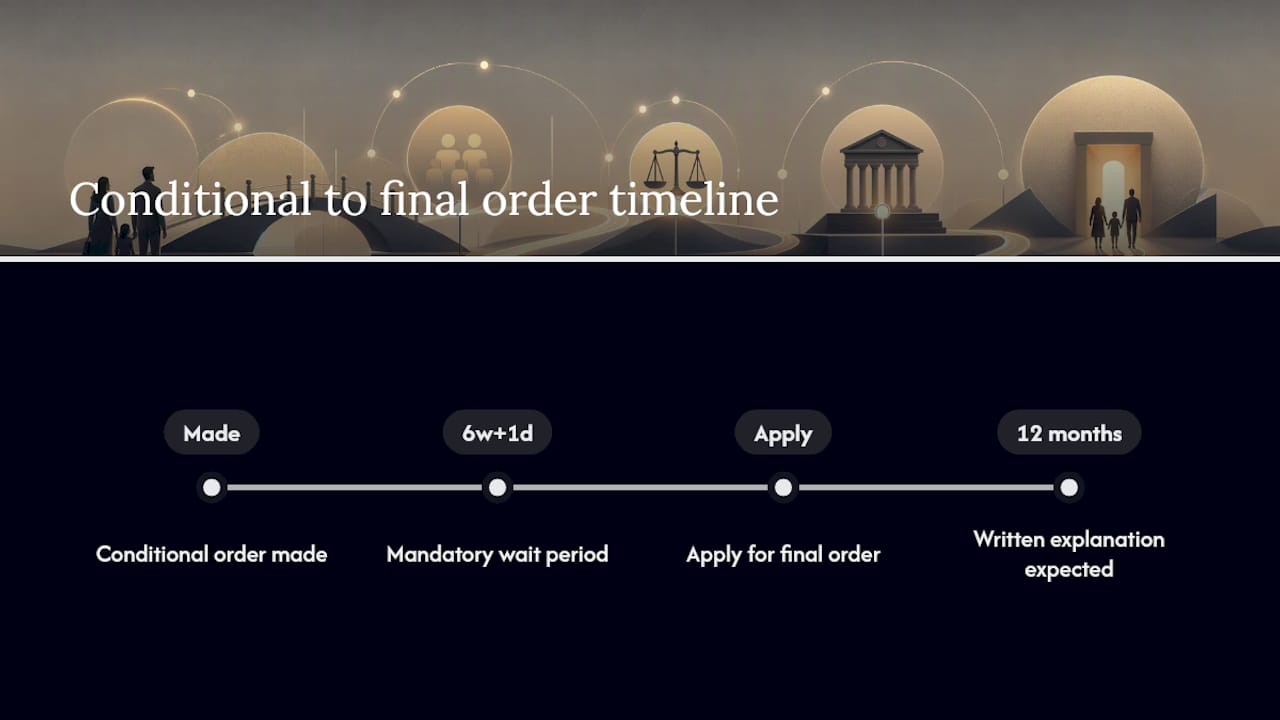
There is no fixed deadline for applying, but if more than 12 months pass between the conditional order and your final order application, the court expects a written explanation for the delay. Leaving it too long can also complicate pension sharing or property matters tied to your financial settlement, so most solicitors recommend applying as soon as the 6-week window closes.
What a conditional order costs, and where to get help
The court fee covers the whole divorce application, not each stage separately, so applying for the conditional order itself carries no additional court charge beyond what you already paid to start proceedings. If money is tight, GOV.UK’s help with fees guidance explains how to apply for a full or partial reduction based on income and savings.
Solicitor fees sit separately from court fees, and many firms offer fixed-fee packages for reviewing and submitting conditional order paperwork rather than charging by the hour. Paying for a proper review upfront is usually cheaper than paying to fix an application the court has bounced back for errors.
When can a conditional order be refused, and what should you do?
Refusals are rare under the no-fault system, but they do happen. Common grounds include:
- Doubts over whether the court has jurisdiction over the marriage
- Questions about the validity of the marriage itself
- Procedural errors, particularly around how the other party was served
Because the no-fault rules removed most grounds for contesting a divorce on the reasons behind it, genuine challenges now tend to be procedural rather than personal. If your application is queried or challenged, preserve every document related to service and communication, and get legal advice quickly rather than waiting to see if the issue resolves itself.
Pro Tip: If you’re switching from joint to sole because your ex has stopped engaging, keep a written record of every attempt to reach them. That record often matters more than anything else if the court asks questions later.
How a solicitor supports you through the conditional order stage
A family solicitor’s most valuable job at this stage is quiet and unglamorous: checking your draft before it goes anywhere near the court. That means reviewing statements of truth, confirming your MyHMCTS submission matches your original application, and flagging financial issues before they become expensive later.
This is also where a financial consent order usually gets drafted, since finalising money matters around the conditional order protects both parties once the marriage legally ends. Fixed-fee consultations and assessments for Legal Aid eligibility may be available, so cost need not be a barrier to getting this stage right the first time.
— George
Get straightforward help with your conditional order application
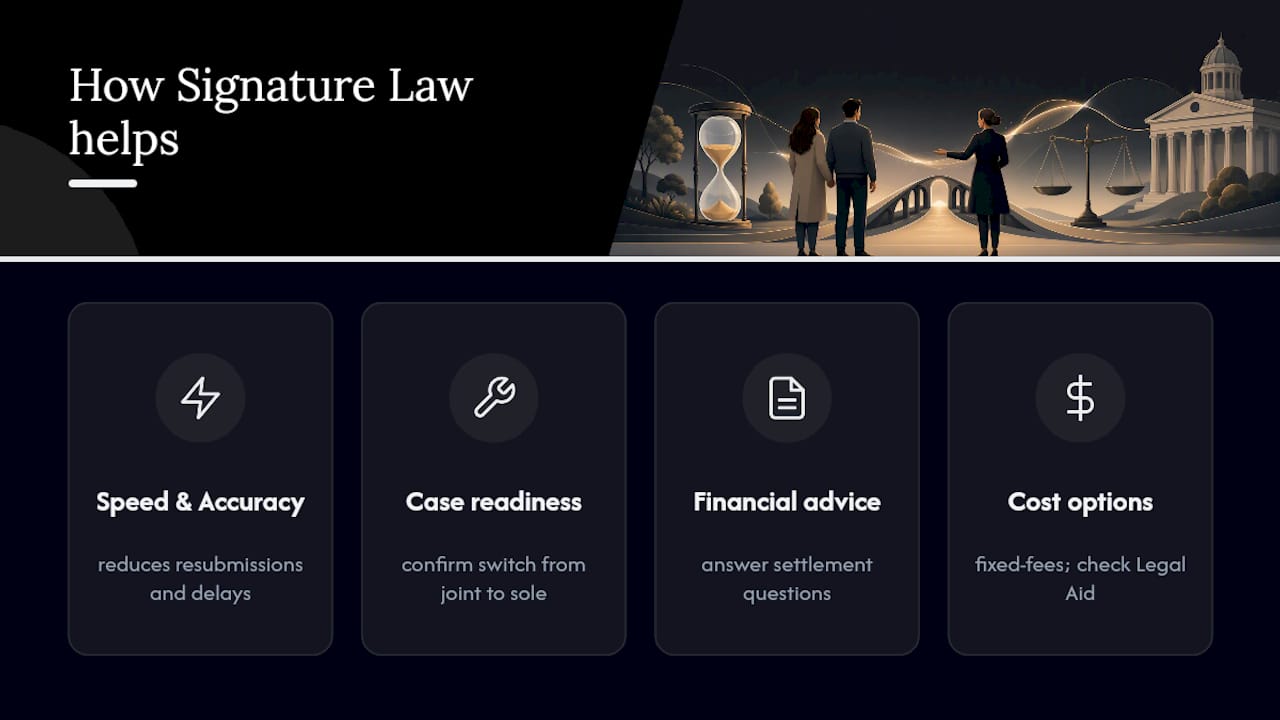
Legal support is an alternative to navigating MyHMCTS or D84 alone. For readers who want their conditional order application checked properly rather than resubmitted twice, that difference in accuracy and speed can be a real advantage over doing it alone.
Our family law team handles the parts that cause the most delay: reviewing your draft, confirming your case is ready to switch from joint to sole where needed, and advising on the financial settlement questions that so often surface at this stage. Fixed-fee consultations are available, and we assess Legal Aid eligibility for clients who qualify, so you know your costs before you commit to anything.
If you are approaching the 20-week mark, or you have already been refused or delayed, contact Signature Law today to book a consultation and get your application moving properly.
This article is general information, not a substitute for advice from a qualified lawyer. Consult a qualified legal professional about your own circumstances before acting on anything here.
Sources
- Get a divorce: Apply for a conditional order or decree nisi
- D84 application for a conditional order or (judicial) separation order (03.24)
Recommended
- Step by step divorce process in the UK: 2026 guide
- Precise C100 Wording That Speeds Specific Issue Orders for UK Parents
- Seal your UK divorce: consent order Form D81 checklist and red flags
- Divorce checklist for 2026: your step-by-step UK guide