





Family Law
Why use a conveyancing solicitor for divorce property

TL;DR:
- Conveyancing solicitors handle complex property transfers during divorce, providing legal and family law expertise.
- They protect interests by avoiding delays, disputes, and financial losses through thorough due diligence.
- Choosing a qualified solicitor with relevant experience ensures a smoother, less stressful property transfer process.
Many people going through divorce assume that transferring a property is simply a matter of paperwork. It is not. The legal, financial, and emotional stakes are significant, and the risks of getting it wrong are real. Professional conveyancing can reduce property transaction fall-through rates from around 33% to under 5%, which tells you everything about the difference specialist expertise makes. This article explores what a conveyancing solicitor actually does, how they protect your interests during divorce, and how to choose the right professional to guide you through one of the most consequential decisions of your life.
Table of Contents
- What does a conveyancing solicitor do?
- How a conveyancing solicitor safeguards your interests in divorce
- Comparing solicitors and conveyancers: Which is right for you?
- Choosing the right conveyancing solicitor: What to look for
- Why professional oversight in divorce property transfers matters more than ever
- Take the next step: Protect your property and peace of mind
- Frequently asked questions
Key Takeaways
| Point | Details |
|---|---|
| Solicitor vs. conveyancer | A conveyancing solicitor is essential for divorce-linked property cases, offering broader expertise than a conveyancer. |
| Risk reduction | Professional solicitors can cut property transaction fail rates from about 33% to under 5%, ensuring smoother outcomes. |
| Holistic support | Specialist solicitors safeguard both your legal rights and emotional wellbeing during complex property transfers. |
| Informed selection | Choose a solicitor with family law knowledge, clear communication, and a strong client support track record. |
What does a conveyancing solicitor do?
Conveyancing is the legal process of transferring ownership of property from one party to another. A conveyancing solicitor manages every stage of that process, from reviewing title deeds and conducting searches, to drafting transfer documents and registering the change of ownership with HM Land Registry. But during a divorce, the scope of work goes considerably further than a standard property transaction.
It is worth understanding the distinction between a conveyancing solicitor and a licensed conveyancer. Both are qualified to handle property transfers, but their training differs in important ways. A licensed conveyancer specialises solely in property law. A solicitor, by contrast, holds a broader legal qualification that may include family law, contract law, and financial proceedings. When a property transfer is linked to a divorce, that broader knowledge is not just useful — it can be essential.
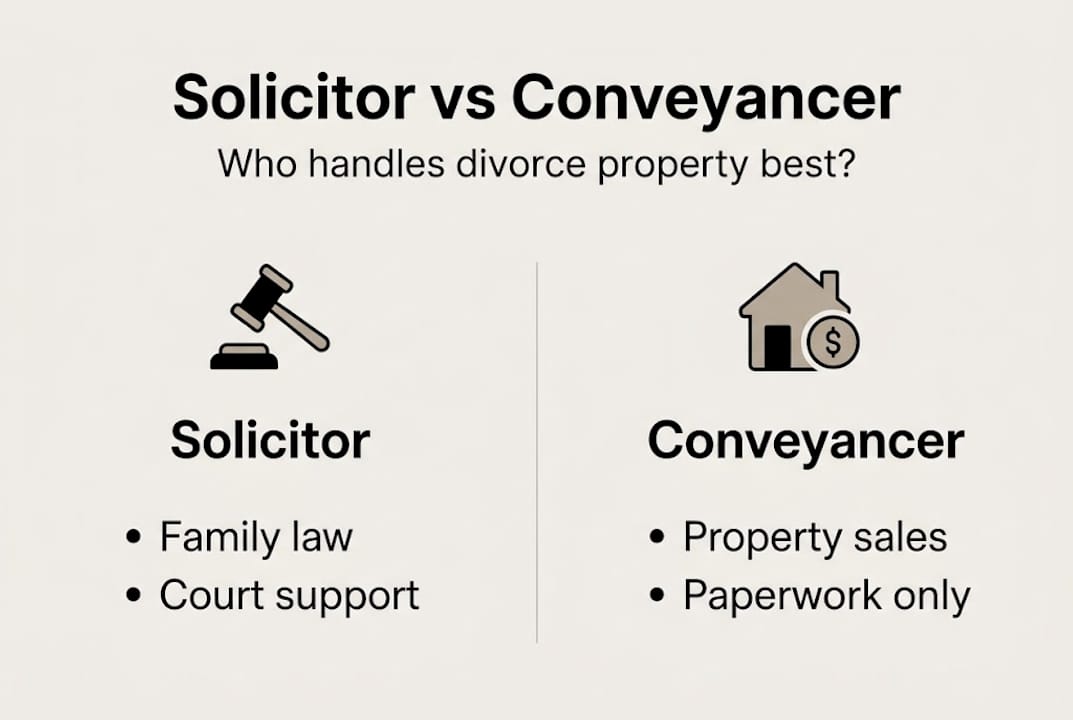
As noted in guidance from the Homeowners Alliance, solicitors are preferred over pure conveyancers for divorce-linked property transfers due to their broader family law expertise. This matters when issues such as financial settlements, children’s housing needs, or contested ownership arise alongside the property transfer itself.
Here is a summary of the key tasks a conveyancing solicitor performs in the context of divorce:
- Reviewing and interpreting title deeds and mortgage documentation
- Conducting local authority, environmental, and drainage searches
- Advising on the implications of any charges or restrictions on the property
- Drafting and reviewing the transfer deed
- Liaising with lenders regarding mortgage redemption or transfer
- Ensuring that the solicitor’s role in divorce property protects both parties’ legal interests
- Registering the new ownership or transfer with HM Land Registry
“The value of a conveyancing solicitor in a divorce is not just technical — it is strategic. They understand that a property transfer is rarely the whole picture, and they advise accordingly.”
In situations involving shared ownership, a mortgaged property, or children whose living arrangements are tied to the family home, the guidance of a solicitor who understands property transactions during divorce can make a measurable difference to your outcome.
| Feature | Conveyancing solicitor | Licensed conveyancer |
|---|---|---|
| Property law expertise | Yes | Yes |
| Family law knowledge | Yes | No |
| Financial proceedings advice | Yes | Limited |
| Can handle contested cases | Yes | Rarely |
| Suitable for divorce transfers | Yes | Not recommended |
How a conveyancing solicitor safeguards your interests in divorce
Understanding the solicitor’s broad role sets the stage for seeing how they actively shield your interests as you navigate divorce. When emotions are running high and financial futures are at stake, the consequences of errors in a property transfer can follow you for years.
Without proper legal handling, a number of serious problems can arise. Delays caused by incomplete documentation or unresolved mortgage obligations can unravel agreements reached between separating couples. Disputes over the valuation or division of a property can escalate into court proceedings. Perhaps most painfully, mistakes made in haste can expose you to financial liability or cause you to lose equity that is rightfully yours.

A conveyancing solicitor protects you by carrying out thorough due diligence at every stage. They check that the title is clean, that there are no outstanding charges or legal restrictions, and that any transfer reflects what was agreed as part of your financial settlement. Where children are involved, they can also ensure that any legal arrangements connected to housing and occupation rights are properly documented.
Research shows that efficient conveyancing firms reduce transaction fall-throughs from about 33% to under 5%, a reduction that represents not just fewer failed deals but fewer families left in legal and financial limbo.
Here are the key risks a conveyancing solicitor can help you avoid when dealing with property and divorce:
- Incomplete or incorrect transfer documents leading to registration delays
- Overlooked charges, restrictions, or rights of way on the title
- Mortgage lender complications that delay or block the transfer
- Failure to account for children’s occupation rights or tenancy in common arrangements
- Misunderstanding of financial court orders and how they apply to the property
- Loss of equity through poorly negotiated or inadequately reviewed settlements
This guide for separating couples provides further practical detail on how to approach property decisions during separation.
Pro Tip: When first speaking to a solicitor, ask specifically how many divorce-linked property transfers they have handled in the past year. Experience in this area is not universal, and you deserve someone who knows the terrain well.
Comparing solicitors and conveyancers: Which is right for you?
Clients often wonder whether a solicitor’s expense is justified compared to a licensed conveyancer. Here is how the roles compare, so you can decide what is right for your needs.
The honest answer is that for a straightforward property purchase with no complicating factors, a licensed conveyancer may be perfectly adequate. But divorce is almost never straightforward. Financial orders, disputed ownership, joint mortgages, and children’s needs all introduce layers of complexity that a property-only specialist is not trained to navigate.
As the Homeowners Alliance makes clear, solicitors should be chosen for cases involving overlapping family law elements, while pure conveyancers fit only the most basic cases. If your situation involves divorce, that guidance is unambiguous.
| Criteria | Conveyancing solicitor | Licensed conveyancer |
|---|---|---|
| Training scope | Law degree plus LPC | Specialist conveyancing qualification |
| Family law capability | Yes | No |
| Handles financial orders | Yes | No |
| Suitable for contested transfers | Yes | No |
| Cost | Moderate to higher | Often lower |
| Best suited to | Divorce, complexity, disputes | Simple purchases or sales |
To assess which professional is right for your situation, work through these steps:
- Identify whether your property transfer is connected to a divorce or separation.
- Establish whether there is a joint mortgage that needs to be addressed as part of the transfer.
- Confirm whether a court financial order or consent order is in place that references the property.
- Consider whether children’s living arrangements are tied to the outcome of the transfer.
- If any of the above apply, appoint a solicitor with both commercial conveyancing expertise and family law knowledge.
For clients seeking experienced conveyancing solicitors who understand the full picture, it is important to look beyond price and focus on breadth of expertise.
Choosing the right conveyancing solicitor: What to look for
Having weighed your options, the next step is ensuring you choose a conveyancing solicitor who is truly equipped to protect your interests. Not every solicitor who handles property matters will have meaningful experience of divorce-linked transfers, so your selection process matters.
Here is what to look for when making your choice:
- Dual expertise: Confirm they have experience in both conveyancing and family law matters, not just one or the other.
- Transparent fee structure: Ask for a full written breakdown of costs, including any disbursements such as search fees and Land Registry charges.
- Clear communication: You should feel informed at each stage. A good solicitor explains what is happening and why, without burying you in legal language.
- Client reviews: Look for feedback that specifically mentions divorce or separation cases, not just standard purchases.
- Regulatory registration: Check they are registered with the Solicitors Regulation Authority (SRA), which is the body that regulates solicitors in England and Wales.
- Responsiveness: During divorce, delays cause real distress. Ensure your solicitor has a reputation for timely action.
Data shows that firms with proven efficiency can deliver completions up to 9% faster, earning growing client trust. Speed matters when you are trying to move forward with your life.
When interviewing a potential solicitor, consider asking these questions directly: How do you handle situations where a mortgage lender is uncooperative? What happens if the other party disputes the terms of the transfer? How will you keep me updated throughout the process?
Pro Tip: Ensure your chosen solicitor is proactive about both legal and emotional support. Divorce is exhausting, and the best solicitors understand that their role is not just to process documents but to help you reach a resolution with as little additional strain as possible. Clear guidance for your property journey is your right, not a luxury.
A solicitor who listens, explains clearly, and acts promptly is worth considerably more than one who simply charges less. When it comes to ensuring smooth property transactions during one of the most difficult periods of your life, the quality of your legal support is everything.
Why professional oversight in divorce property transfers matters more than ever
After exploring practical advice, here is a deeper look at why using a conveyancing solicitor is about much more than legal paperwork.
In our experience, the clients who struggle most during divorce-related property transfers are those who underestimated the complexity and tried to cut costs at the wrong stage. A lower fee upfront can translate into thousands of pounds in losses, delays, or legal disputes later. The idea that a property transfer is a routine administrative task falls apart the moment a mortgage lender raises an objection, or a financial order is worded in a way that creates ambiguity.
Conveyancing solicitor instructions are up 32%, completion times are 9% faster, and fall-through rates are sharply reduced. That growth reflects something important: people are recognising the real value of professional legal oversight, particularly in complex personal circumstances.
The emotional dimension is also real and often underestimated. When a legal expert in divorce handles the property transfer cleanly and efficiently, it removes one major source of uncertainty from an already overwhelming situation. That matters. Getting the property resolved properly means you can focus on rebuilding your life rather than managing ongoing legal complications.
Take the next step: Protect your property and peace of mind
If you are facing a property transfer as part of your divorce, the right legal support will protect your financial interests and reduce the stress of an already difficult process. At Signature Law, our family law solicitors combine genuine compassion with rigorous legal expertise, ensuring that your property matters are handled with the care and precision they deserve. We offer fixed-fee consultations and multilingual support, so you can access clear, honest advice from the very first conversation. Our team has particular experience in conveyancing solicitors for divorce property matters, meaning we understand both the legal and human dimensions of what you are going through. Contact Signature Law today to speak with a solicitor who is ready to help.
Frequently asked questions
Do I need a conveyancing solicitor for a property transfer during divorce?
Yes, and the reason is straightforward. A solicitor’s family law expertise is crucial to protect your rights and avoid mistakes that could cause future disputes or financial loss. As guidance confirms, solicitors are preferred over pure conveyancers for divorce-linked transfers due to their wider expertise.
What are the risks of not using a specialist solicitor in a divorce property case?
You risk serious delays, legal errors, and possible disputes that can lead to financial loss and greater emotional strain. Efficient specialist firms can reduce transaction fall-throughs from 33% to less than 5%, which illustrates the scale of risk when specialist oversight is absent.
How does a conveyancing solicitor support emotional wellbeing during divorce?
A solicitor manages complex negotiations, reduces uncertainty, and ensures your interests and those of any children are fully protected throughout the process. Their broader training covers both property and family law elements, so nothing falls between the gaps.
Is a conveyancing solicitor more expensive than a conveyancer?
Solicitors can cost more, but their expertise is vital for complex situations and helps prevent far greater costs from legal mistakes. Where wider expertise is required for overlapping family law elements, the investment is well justified.
Recommended
- Conveyancing solicitor’s role in divorce property splits | Signature Law
- Solicitor’s role in divorce property transactions UK 2026 | Signature Law
- Property and Divorce | Signature Law
- Benefits of using a probate solicitor during divorce | Signature Law