





Family Law
Solicitor’s role in divorce property transactions UK 2026

Many people assume they can handle property matters during divorce without legal help, believing it will save money and simplify the process. This misconception often leads to costly errors, unfair settlements, and lingering financial disputes that resurface years later. The emotional strain of separation makes navigating complex property laws even harder, especially when children’s welfare depends on stable housing arrangements. Solicitors bring essential expertise to property transactions during divorce, ensuring legal compliance, fair division of assets, and protection of your long-term interests. This article explains how divorce solicitors guide you through property transfers, financial settlements, and child-related arrangements to secure your future.
Table of Contents
- Understanding The Solicitor’s Role In Divorce-Related Property Transactions
- Legal Framework Governing Property Division In Divorce
- Navigating Asset Valuation And Disclosure During Divorce
- Complex Property And Financial Arrangements: Solicitor Expertise In High-Value Divorces
- Secure Expert Legal Support For Property Matters In Divorce
Key takeaways
| Point | Details |
|---|---|
| Solicitors provide expert legal guidance | They navigate property division, asset valuation, and financial settlements to protect your rights and interests throughout divorce proceedings. |
| Matrimonial Causes Act 1973 governs settlements | This law grants courts discretionary powers to make fair financial orders based on contributions, needs, and children’s welfare. |
| Full financial disclosure is mandatory | Courts require complete asset disclosure within 35 days, with accurate valuations for assets exceeding £500 to ensure fair settlements. |
| Formal orders prevent future claims | Without court-approved financial orders, ex-spouses can make claims years after divorce, creating ongoing financial uncertainty. |
| High-net-worth cases need specialist expertise | Complex arrangements involving trusts, business interests, and pensions require solicitors experienced in high-value divorce settlements. |
Understanding the solicitor’s role in divorce-related property transactions
When your marriage ends, dividing property feels overwhelming. You face legal complexities whilst managing emotional turmoil, financial uncertainty, and possibly child custody concerns. Choosing a qualified divorce lawyer ensures guidance through legal processes, protection of rights, and informed decision-making that extends far beyond paperwork.
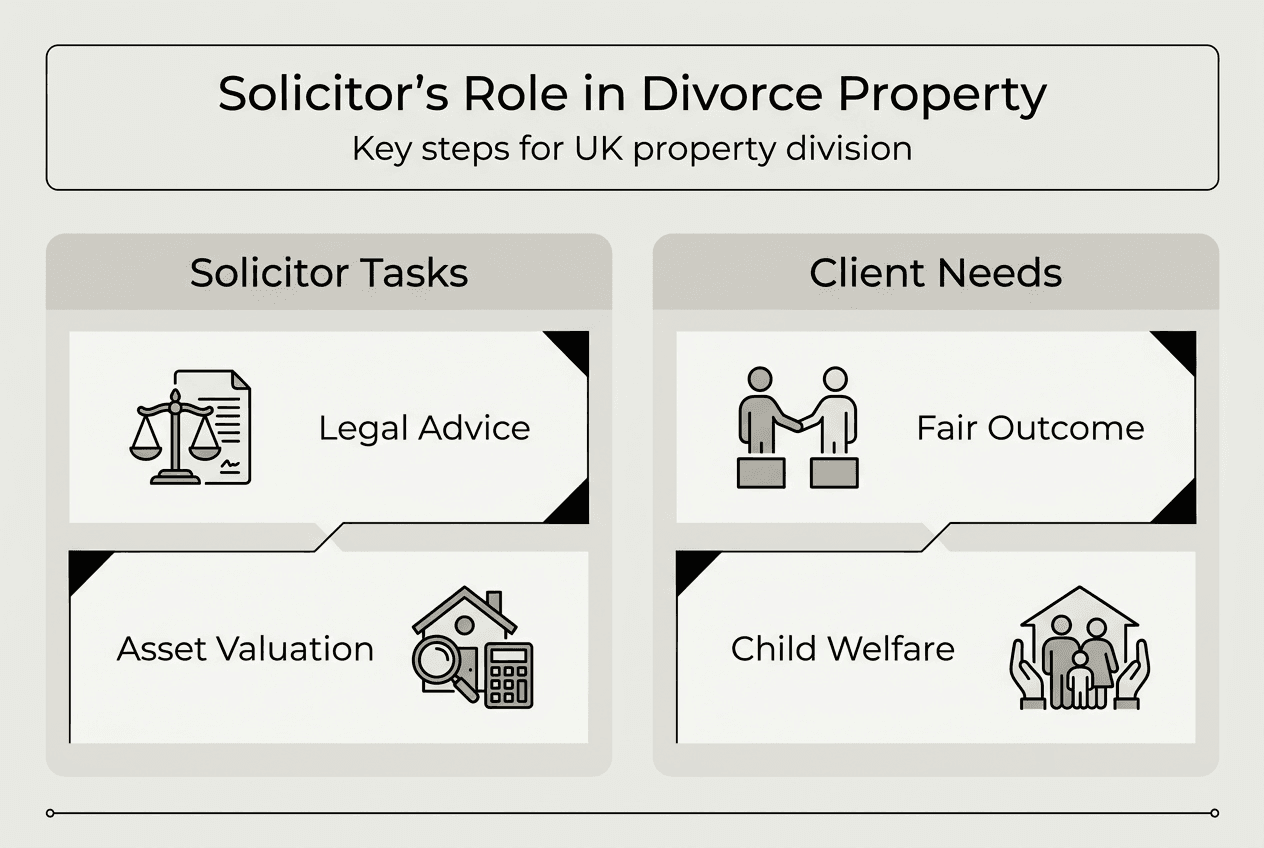
Solicitors specialising in family law offer vital guidance on property and asset division during divorce. They analyse your specific circumstances, explain your legal entitlements, and develop strategies to achieve fair outcomes. This expertise proves invaluable when emotions run high and rational decision-making becomes difficult.
The practical assistance solicitors provide includes:
- Preparing and reviewing legal documents related to property transfers and financial settlements
- Negotiating with your spouse’s legal team to reach mutually acceptable agreements
- Representing you in court proceedings if negotiations fail
- Coordinating with valuers, accountants, and other experts to assess assets accurately
- Ensuring compliance with Family Procedure Rules and court deadlines
Solicitors also address child custody and financial disputes linked to property matters. When children are involved, housing stability becomes paramount. Your solicitor ensures property arrangements support your children’s welfare whilst protecting your financial security.
Pro Tip: Engage a solicitor early in the divorce process, ideally before discussing property division with your spouse, to understand your rights and avoid inadvertently weakening your position through premature agreements.
Expertise prevents common costly mistakes in property transactions. Without legal guidance, you might accept unfair settlements, overlook hidden assets, or agree to arrangements that create tax liabilities. Solicitors identify these pitfalls before they damage your financial future.
Legal framework governing property division in divorce
The Matrimonial Causes Act 1973 provides the statutory foundation for property and financial settlements, granting courts wide discretionary powers to make financial orders between divorcing spouses. This legislation shapes how solicitors approach property division and what outcomes you can reasonably expect.
Section 25 of the Act outlines specific factors courts must consider when dividing property:
- Financial resources and needs of both parties now and in the foreseeable future
- Standard of living enjoyed during the marriage
- Age of each party and duration of the marriage
- Physical or mental disabilities affecting either party
- Contributions made by each party to the welfare of the family, including homemaking and childcare
- Conduct of each party, if it would be inequitable to disregard it
- Value of benefits either party will lose due to divorce, such as pension rights
Courts aim for fairness, not necessarily equal 50/50 splits. The law recognises that equal division may not be fair in all circumstances. For instance, if one spouse sacrificed career advancement to raise children, they might receive a larger share to compensate for reduced earning capacity.
The Supreme Court clarified family versus non-family assets for sharing in the landmark Standish v Standish [2025] case. This decision helps solicitors advise whether assets accumulated before marriage or through inheritance should be included in settlements. Generally, non-matrimonial assets receive different treatment than those built during the marriage.
The welfare of children under 18 remains paramount in all decisions. Courts prioritise housing arrangements that provide stability and continuity for children, often allowing the primary carer to remain in the family home until children reach adulthood. Your solicitor ensures property settlements reflect this principle whilst balancing both parties’ needs.
Understanding divorce settlements requires grasping these legal principles and how courts apply them to your specific situation. Solicitors translate complex statutory language into practical advice tailored to your circumstances.
Navigating asset valuation and disclosure during divorce
Accurate asset valuation forms the foundation of fair financial settlements. With around 82,000 divorces finalised annually in England and Wales, proper valuation ensures you receive your fair share of marital assets whilst avoiding disputes that prolong proceedings and increase costs.

The Family Procedure Rules 2010 mandate full and frank financial disclosure within 35 days of the first appointment, including valuations for assets exceeding £500. This legal requirement means both parties must reveal all financial information honestly and completely. Failure to comply can result in court sanctions and unfavourable financial orders.
The disclosure process follows these steps:
- Complete Form E detailing all assets, income, and liabilities
- Gather supporting documents including bank statements, pension valuations, and property deeds
- Obtain professional valuations for significant assets
- Exchange disclosure with your spouse simultaneously
- Respond to queries and provide additional documentation as requested
- Update disclosure if circumstances change materially before settlement
Valuation costs vary significantly depending on asset complexity:
| Asset Type | Typical Valuation Cost | Timeline |
|---|---|---|
| Residential property | £400–£1,500 | 1–2 weeks |
| Business interests | £2,000–£10,000+ | 4–8 weeks |
| Pension schemes | £500–£2,000 | 2–4 weeks |
| Investment portfolios | £300–£1,000 | 1–2 weeks |
Pro Tip: Instruct valuers jointly with your spouse when possible to reduce costs and minimise disputes over valuation methodology, but ensure the valuer has appropriate qualifications and experience in your specific asset type.
Non-disclosure or misleading information carries serious legal consequences. Courts can set aside financial orders if material non-disclosure is discovered later, leaving the dishonest party liable for both parties’ legal costs. In extreme cases, non-disclosure constitutes contempt of court, potentially resulting in fines or imprisonment.
Solicitors coordinate expert valuations to protect your interests. They identify which assets require professional assessment, recommend qualified valuers, and challenge questionable valuations from your spouse’s experts. This oversight ensures financial settlement agreements rest on solid factual foundations rather than guesswork or manipulation.
Complex property and financial arrangements: solicitor expertise in high-value divorces
High-net-worth UK divorces involve complex financial arrangements, business interests, and pensions that require specialist solicitor expertise. These cases present unique challenges beyond standard property division, including international assets, tax implications, and sophisticated wealth structures designed to protect family fortunes.
Solicitors experienced in high-value divorces address trusts, private equity holdings, and pension complications that ordinary practitioners may overlook. They work with forensic accountants to trace hidden assets, tax advisers to minimise liabilities, and pension actuaries to value complex retirement schemes accurately.
Consider the ED v AP case where a £6.95m family home and £3.4m settlement demonstrated how courts handle substantial assets. The wife received the family home and significant liquid assets to provide housing security and income, whilst the husband retained business interests and pension funds. This outcome reflected the court’s assessment of needs, contributions, and future earning capacity.
Solicitors negotiate various financial remedies to achieve fair outcomes:
- Lump sum payments to equalise asset division
- Property adjustment orders transferring ownership between spouses
- Pension sharing orders dividing retirement benefits
- Periodical payment orders for ongoing spousal maintenance
- Clean break orders severing all financial ties permanently
Court orders vary based on circumstances and negotiation outcomes:
| Order Type | Purpose | Duration |
|---|---|---|
| Lump sum | One-time capital payment | Immediate or staged |
| Property transfer | Change ownership of assets | Permanent |
| Pension sharing | Divide retirement benefits | Permanent |
| Periodical payments | Regular maintenance | Term or joint lives |
| Clean break | Sever financial ties | Permanent |
Expertise ensures protection in complex financial disputes. Solicitors experienced in navigating family law with complex assets understand how to structure settlements that minimise tax exposure, preserve business viability, and provide long-term financial security for both parties and any children.
They also recognise when litigation becomes necessary despite the costs involved. Some spouses hide assets, undervalue businesses, or refuse reasonable settlement offers, making court intervention unavoidable. Experienced solicitors prepare compelling cases that persuade judges to award fair settlements even when the other party acts obstructively.
Secure expert legal support for property matters in divorce
Navigating property transactions during divorce requires more than legal knowledge. You need solicitors who combine technical expertise with genuine understanding of the emotional challenges you face. Family law solicitors in London at Signature Law provide exactly this combination, offering clear guidance through complex property matters whilst supporting you through one of life’s most difficult transitions.
Our team handles every aspect of property and divorce with sensitivity and precision. We explain your options in straightforward language, develop strategies tailored to your circumstances, and negotiate firmly to protect your interests. Whether you need help with financial settlements, child custody-related property arrangements, or high-value asset division, we bring the expertise to secure favourable outcomes.
Signature Law offers fixed-fee initial consultations, Legal Aid for eligible clients, and multilingual advice to serve diverse communities across the UK. Our Romford office serves clients throughout East London and Essex, whilst our expertise extends nationwide. We are not a volume firm churning through cases. We provide personalised legal support that recognises your unique situation and goals.
Conveyancing solicitors in Harold Wood work alongside our family law team to ensure seamless property transfers following divorce settlements. This integrated approach prevents delays, reduces costs, and gives you confidence that all legal aspects of your property transaction are handled professionally.
Contact Signature Law today to discuss how we can help secure your financial future and protect what matters most during this challenging time.
FAQ
Do I need a solicitor for property transactions after divorce?
UK law does not mandate solicitors for property transfers after divorce, but legal representation is highly advisable due to complexities involved. Complex conditions, disputes over valuations, or disagreements about division usually require solicitor involvement to protect your interests and ensure legally binding agreements.
How does the Matrimonial Causes Act 1973 affect my property settlement?
The Matrimonial Causes Act 1973 grants courts wide powers to order fair financial settlements considering contributions, needs, and child welfare. Courts exercise discretion based on Section 25 factors including financial resources, standard of living, age, marriage duration, and contributions to family welfare. Child welfare remains paramount in all decisions affecting property division.
What happens if there is no financial order after divorce?
Without a financial order, claims can be made years after divorce, possibly complicating finances later on. Your ex-spouse retains the right to apply for financial remedies indefinitely unless a court approves a clean break order. Formal financial orders provide closure and certainty, preventing future claims against assets you acquire post-divorce.
How do solicitors help with child-related property arrangements?
Solicitors ensure property settlements protect child welfare as courts prioritise the welfare of children under 18 when making property and financial orders. They coordinate arrangements supporting custody needs and children’s housing stability, often negotiating for the primary carer to remain in the family home. This approach maintains continuity for children whilst balancing both parents’ financial needs and long-term security.
Recommended
- Signature Law Blog: Legal Insights & Updates (2026)
- Property and Divorce | Signature Law
- Family Law Solicitor for Property Disputes London: Expert Guidance on Divorce and Financial Settlements
- Role of Financial Settlements in UK Divorce: 70% Settled Out of Court | Signature Law