





Family Law
Will writing process explained: your UK guide for 2026

TL;DR:
- A will is a legal document that specifies how your estate should be distributed after death and must meet strict formal requirements to be valid in England and Wales. Most mistakes happen during signing or preparation, risking invalidity or disputes. Proper planning, accurate drafting, and timely updates ensure your wishes are legally protected and carried out effectively.
A will is a legally binding document that records your wishes for how your estate should be distributed after your death. The will writing process is the method by which you formally document those wishes, appoint executors, and protect the people you care about. Under the Wills Act 1837, a will must meet strict formal requirements to be valid in England and Wales. About 60% of UK adults have no will in place, which means their estates are distributed by intestacy rules rather than personal choice. Getting the process right from the start protects your family and gives you genuine peace of mind.
What legal requirements must your will meet to be valid in England and Wales?
A will is only legally binding if it satisfies the formal criteria set out in the Wills Act 1837. Missing even one requirement can render the entire document invalid, leaving your estate subject to intestacy rules that may not reflect your wishes at all.
The core validity criteria
Your will must meet all of the following conditions:
- Written format. The will must be in writing, either typed or handwritten. There is no prescribed form, but clarity is critical.
- Age and capacity. You must be at least 18 years old. You must also have testamentary capacity, meaning you understand the nature of the will, the extent of your estate, and the claims of those who might reasonably expect to benefit.
- Your signature. You must sign the will yourself, or direct someone to sign on your behalf in your presence, at the foot of the document.
- Two independent witnesses. Two adult witnesses must be physically present in the same room when you sign. They must then sign the will themselves in your presence.
- Witness eligibility. Witnesses cannot be beneficiaries under the will, nor the spouse or civil partner of a beneficiary. If a witness is also a beneficiary, the gift to that witness fails, though the rest of the will remains valid.
- Attestation clause. This clause confirms that the signing and witnessing took place correctly. Including it reduces the risk of the will being challenged later.
A will that appears complete but was signed without both witnesses physically present in the room at the same time is invalid under English law. The witnessing ceremony is not a formality. It is a legal requirement that courts take seriously.
Pro Tip: If you have concerns about your mental capacity at the time of signing, ask your GP to provide a brief written note confirming your capacity on that date. This is particularly relevant for older testators or those with early-stage health conditions.
One point that surprises many people: you cannot alter a signed will by crossing out words, adding notes in the margin, or making handwritten corrections. Any such amendment invalidates the affected part of the will. Changes must be made either through a formal codicil or by creating an entirely new will.
How do you prepare effectively to write your will?
Thorough preparation before you draft a single word saves time, reduces errors, and produces a clearer document. Rushing straight to the drafting stage is one of the most common reasons wills end up incomplete or ambiguous.
Step-by-step preparation
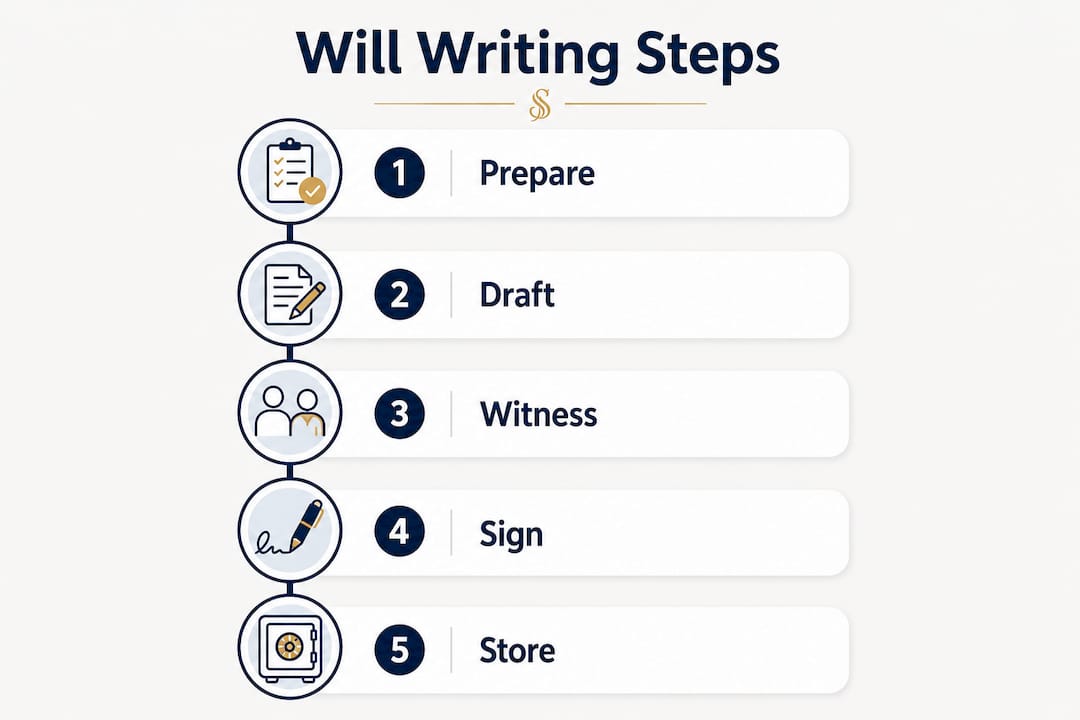
- List your assets. Write down everything of value: property, savings accounts, investments, pensions, vehicles, jewellery, and digital assets. Include estimated values and note how each asset is held, for example, whether a property is in sole or joint names.
- Identify your beneficiaries. Name each person clearly using their full legal name, date of birth, and address. Vague descriptions such as “my children” can cause disputes if your family circumstances are complex.
- Choose your executors. Executors manage your estate after your death, applying for probate and distributing assets. Choose people who are trustworthy, organised, and willing to take on the responsibility. Name at least one substitute executor in case your first choice cannot act.
- Consider guardians for minor children. If you have children under 18, appointing a guardian in your will is the clearest way to record your wishes. Without this, a court decides who cares for your children.
- Decide on specific gifts. Think about whether you want to leave particular items to particular people, such as jewellery to a daughter or a car to a sibling. Then consider how you want the remainder of your estate, known as the residuary estate, to be divided.
- Choose your approach. You can write a will yourself using a template, use an online will writing service, or instruct a solicitor. Complex estates, blended families, or significant assets make professional advice the safer choice.
Pro Tip: Use a well-structured will writing template as a starting point. Templates reduce the risk of missing essential clauses such as the residuary clause and the attestation clause, both of which are critical to a valid and complete document.
Reviewing the different types of wills available in the UK before you draft can also help you choose the right structure for your circumstances.
What are the step-by-step actions to create and sign your will correctly?
Once your preparation is complete, the drafting and signing process follows a clear sequence. Each step matters. Skipping or reordering any of them risks invalidity.
Drafting the will
- Open with a revocation clause. Your will should begin by revoking all previous wills and codicils. This clause prevents confusion if earlier documents are discovered after your death and confirms that this is your definitive final will.
- Appoint your executors. Name your primary executor and at least one substitute. State their full names and addresses.
- Record specific gifts. List any particular items or sums of money you wish to leave to named individuals.
- State the residuary gift. Explain how the remainder of your estate should be divided after debts, taxes, and specific gifts have been settled.
- Include a guardian clause if applicable. Name your chosen guardian for any children under 18.
- Add the attestation clause. This confirms the signing ceremony took place correctly and is witnessed by two independent adults.
The signing ceremony
The signing ceremony must follow a precise procedure:
- Both witnesses must be present in the same room at the same time when you sign.
- You sign first, in the presence of both witnesses simultaneously.
- Both witnesses then sign in your presence, adding their full names and addresses.
- Electronic signatures and video witnessing are not legally recognised in England and Wales as of 2026. The signing must be done in person.
Common signing errors to avoid
| Error | Consequence |
|---|---|
| Signing before witnesses arrive | Will is invalid |
| Only one witness present | Will is invalid |
| Witness is a beneficiary | Gift to that witness fails |
| Video or remote witnessing used | Will is invalid |
| Handwritten changes made after signing | Affected clause is invalid |
Storing your will safely
Once signed, store the original will in a secure location. Options include a solicitor’s strongroom, a bank, or a dedicated will storage service. Tell your executor where the original is kept. A will that cannot be found after your death is treated as though it does not exist.

What common mistakes and challenges should you avoid in the will writing process?
The most common reason a DIY will fails is improper witnessing under the Wills Act 1837. Understanding the full range of errors that can invalidate a will helps you avoid them.
Errors that put your will at risk
- Witnessing failures. Both witnesses must be physically present simultaneously. A witness who arrives after you have signed, or who signs in a different room, invalidates the will.
- Ineligible witnesses. Choosing a beneficiary or their spouse as a witness does not invalidate the whole will, but it does cancel the gift to that person. Choose witnesses who have no financial interest in your estate.
- Handwritten amendments. Writing on a signed will, even to correct a spelling mistake, can invalidate the affected section. Always use a formal codicil or a new will for any change.
- Failing to update after major life events. Marriage automatically revokes a will in England and Wales. Divorce does not revoke the will but removes your former spouse as a beneficiary and executor. The birth of a child does not automatically update your will.
- Not appointing guardians. Parents of young children who die without naming a guardian leave that decision entirely to the courts.
- Overlooking complex family situations. Blended families, estranged relatives, and unmarried partners all create complications that a standard template may not address adequately.
Avoiding inheritance disputes often comes down to the clarity and legal precision of the original will. Ambiguous wording, missing clauses, or procedural errors at the signing stage are the three most common triggers for contested estates.
For a deeper look at how to protect your estate from disputes, Signaturelaw’s guide on avoiding inheritance disputes covers the most frequent causes and how to prevent them.
How can you update or revoke your will over time?
A will is not a document you write once and forget. Life changes, and your will must keep pace with those changes to remain accurate and effective.
Your options for making changes
- Codicil. A codicil is a formal, signed, and witnessed amendment to an existing will. It must be executed with the same formality as the original will, meaning two independent witnesses present simultaneously. A codicil is suitable for minor changes, such as updating an executor’s address or adding a small specific gift.
- New will. For significant changes, writing a new will is almost always preferable. Multiple codicils attached to an older will can create confusion during estate administration. A new will with a clear revocation clause removes all ambiguity.
- Never use informal notes. Writing on the original will or attaching unsigned notes has no legal effect. Courts will not recognise informal amendments, regardless of how clearly your intentions are expressed.
When to review your will
- After marriage or entering a civil partnership (marriage revokes an existing will automatically)
- After separation or divorce
- After the birth or adoption of a child
- After a significant change in your financial position
- After the death of a named executor or beneficiary
- Every three to five years as a general review
Pro Tip: Keep a dated record of every review, even when you decide no changes are needed. This demonstrates that the will reflects your current wishes and can be useful if the will is ever challenged.
If you are unsure whether your existing will still reflects your circumstances, Signaturelaw’s will writing services include a review of existing documents as part of the initial consultation.
Key takeaways
A valid will requires strict compliance with the Wills Act 1837, including two independent witnesses physically present at the signing, and must be reviewed after every major life change to remain effective.
| Point | Details |
|---|---|
| Legal validity is non-negotiable | Your will must be signed by you and witnessed by two independent adults present simultaneously. |
| Witnesses must be independent | A witness who is also a beneficiary loses their gift, even though the rest of the will stands. |
| Never amend a signed will informally | Use a formal codicil or a new will for any change, however minor. |
| Marriage revokes your existing will | You must write a new will after getting married or entering a civil partnership. |
| Store the original safely | Tell your executor exactly where the original will is kept, or it may be treated as non-existent. |
Why I believe preparation is the part most people underestimate
People tend to focus on the signing ceremony as the critical moment in will writing. In my experience, the real risk lies much earlier, in the preparation stage. A will that is signed perfectly but contains vague beneficiary descriptions, a missing residuary clause, or an executor who was never told they were appointed creates serious problems for the people left behind.
The clients I see who have the smoothest estate administration are those who spent time before drafting, listing assets carefully, thinking through family dynamics honestly, and choosing executors who genuinely understood the role. The signing ceremony, when preparation is thorough, takes about ten minutes. The preparation can take a few hours spread over a couple of weeks, and every minute of it is worthwhile.
I also think the DIY route is underestimated in terms of its risks. A template will can work well for a straightforward estate with no blended family complications, no business interests, and no significant property abroad. The moment any of those factors appear, the template becomes a liability rather than a safeguard. Seeking professional advice at that point is not an admission of complexity. It is the sensible choice.
Finally, updating a will is something most people delay far longer than they should. Marriage, the birth of a child, a significant inheritance, the death of an executor: each of these events changes the picture materially. A will that was perfectly drafted five years ago may no longer reflect your wishes or your circumstances today. Review it regularly, and treat it as a living document rather than a one-time task.
— George
How Signaturelaw supports your estate planning
Signaturelaw provides professional will writing services that ensure full compliance with the Wills Act 1837, from the initial drafting of essential clauses through to the signing ceremony and secure storage guidance. The team supports clients in appointing suitable executors and guardians, and advises on more complex situations including blended families, significant assets, and estates that may be subject to inheritance tax. For clients who already have a will, Signaturelaw offers a review service to identify gaps or outdated provisions. You can find full details on Signaturelaw’s wills and probate services or contact the team directly to arrange a fixed-fee consultation. Start your estate planning enquiry today at signaturelaw.co.uk/contact-us.
FAQ
What makes a will legally valid in England and Wales?
A will is legally valid when it is in writing, signed by the testator, and witnessed simultaneously by two independent adults who also sign the document. Electronic or video witnessing is not recognised under English law as of 2026.
Can a beneficiary witness a will?
A beneficiary can witness a will, but doing so cancels any gift left to them in the document. The rest of the will remains valid. Witnesses should always be independent adults with no financial interest in the estate.
What happens if I die without a valid will?
Your estate is distributed according to intestacy rules, which follow a fixed legal order of priority. Unmarried partners and stepchildren receive nothing under intestacy rules, regardless of your relationship with them.
How do I update my will after a major life change?
Minor changes can be made through a formal codicil, signed and witnessed with the same formality as the original will. For significant changes, writing a new will with a revocation clause is the clearer and safer option.
Does marriage affect my existing will?
Marriage automatically revokes any existing will in England and Wales. You must write a new will after getting married or entering a civil partnership to ensure your wishes are legally recorded. Contact Signaturelaw for guidance on updating your will after a major life event.
Recommended
- Step-by-step UK divorce process: Essential guide for 2026 | Signature Law
- Estate planning guide UK: secure your family’s future in 2026 | Signature Law
- Step by step divorce process in the UK: 2026 guide | Signature Law
- Tips for buying property in the UK: 2026 guide | Signature Law