





Family Law
Urgent: when UK parents must get legal advice for Section 47 enquiries

A Section 47 enquiry is a statutory child protection investigation under section 47 of the Children Act 1989 that examines whether a child is suffering, or is likely to suffer, significant harm. It is a fact‑finding process, not a punishment. If children’s services have contacted you about one, getting independent legal advice early is one of the most sensible steps you can take.
TL;DR:
- An enquiry is triggered when there is reasonable cause to suspect a child is suffering or likely to suffer significant harm, which can include pattern concerns or a single serious incident.
- The process involves information gathering from multiple agencies, interviews, and possibly medical exams, often within a 45-day maximum time frame, but it can be faster.
- Most enquiries end without further action or with voluntary support plans, while some may lead to child protection conferences or legal orders if harm is confirmed.
- Early legal advice helps protect your rights, especially if police involvement or criminal investigations are part of the process.
- Keeping written records, requesting copies of reports, and asking for clear timescales are practical steps to manage and challenge decisions throughout the enquiry.
Table of Contents
- What a section 47 enquiry actually is
- What triggers an enquiry, and who usually raises concerns
- The strategy discussion: decisions made before you are contacted
- How the enquiry is conducted, and how long it should take
- Who gets involved, and what each agency actually does
- What happens at the end: the possible outcomes
- Your rights, how to cooperate, and when to call a solicitor
- How your case is recorded, and how to challenge a decision
- How Signature Law supports families through this process
- A reassuring word on where this process actually goes
- Get support from Signature Law during a section 47 enquiry
- Where to read more
- Sources
What a section 47 enquiry actually is
The legal basis sits in one short but powerful clause of the Children Act 1989. Section 47 places a duty on local authorities to make enquiries whenever they have “reasonable cause to suspect” that a child living or found in their area is suffering, or is likely to suffer, significant harm. That duty is not discretionary. Once the threshold is met, the local authority must investigate, and must decide what action, if any, is needed to safeguard and promote the child’s welfare.
That phrase, “safeguard and promote welfare,” runs through the entire Children Act. It links Section 47 to its quieter cousin, Section 17, which deals with children in need. The two are often confused, and it is worth being clear about the difference. A Section 17 assessment looks at whether a family needs support, such as help with housing, finances, or a disabled child’s care needs, and it is largely voluntary. A Section 47 enquiry is triggered by a specific concern about significant harm, and it carries a statutory duty to investigate rather than simply offer support. In practice, a case sometimes moves between the two: an assessment that starts under Section 17 can escalate to Section 47 if new information emerges, and a Section 47 enquiry that finds no evidence of significant harm can step back down to Section 17 support instead.
It helps to understand what “enquiry” means in this context. Social workers describe Section 47 as investigatory rather than accusatory. The goal is to gather information from the child, the family, and other professionals involved in the child’s life, then weigh that evidence against the legal threshold, according to Coram Family Lives. Many enquiries conclude that no further protective action is needed. Being the subject of one does not mean a decision has already been made against you, however alarming the process feels at the outset. Statutory guidance in Working Together to Safeguard Children sets out how agencies should conduct this process fairly and consistently across England, and it is the document underpinning almost every procedure described in this article.
If you are also facing questions about who has legal authority to make decisions for your child during this period, our guide to parental responsibility explains how that separate legal concept interacts with a child protection enquiry.
What triggers an enquiry, and who usually raises concerns
The trigger is that single legal phrase: “reasonable cause to suspect” significant harm. This is a lower bar than proof, and deliberately so. It exists so that professionals do not have to wait for certainty before checking a child is safe. Significant harm covers physical injury, sexual abuse, emotional abuse, neglect, and, increasingly, harm from witnessing domestic abuse in the home. A single serious incident can meet the threshold, but so can a pattern of smaller concerns building over time, such as repeated missed medical appointments alongside a child arriving at school hungry and poorly dressed.
Referrals reach children’s social care from a wide range of sources, and most parents are surprised by how ordinary many of them are:
- School staff noticing a change in a child’s behaviour, attendance, or appearance
- Health visitors or GPs flagging an injury inconsistent with the explanation given, or concerns raised at a routine check
- Police officers attending a domestic incident where children were present in the household
- Family members, neighbours, or members of the public who have witnessed something worrying
- The child themselves, disclosing something to a trusted adult
In an emergency, where a child appears to be at immediate risk, the police can use their powers of protection to remove a child to safety for up to 72 hours, or the local authority can apply to court for an emergency protection order. These are separate, more urgent legal powers than Section 47 itself, though they very often run alongside a Section 47 enquiry rather than instead of it.
The strategy discussion: decisions made before you are contacted
Before an enquiry visibly begins, there is usually a strategy discussion, sometimes called a strategy meeting, held between children’s social care and other agencies. According to guidance from West Berkshire Council, this meeting decides the scope of the enquiry, whether it should proceed as a single‑agency social care investigation or a joint enquiry with the police, and whether any immediate protective action is required before anyone speaks to the family.
Typical attendees include a social worker and their manager, a police officer where there is a suspected criminal element, and, where relevant, representatives from health services or the child’s school. The meeting is deliberately quick and focused. It is not a forum for weighing every piece of evidence; it is a triage exercise to decide the shape of what happens next.
Parents are not usually invited to the strategy discussion itself. This often feels unfair, particularly when major decisions about your family are being made in a room you are not part of, but the rationale is straightforward: professionals need to be able to speak candidly about risk without the immediate pressure of the parent’s presence, and in cases involving potential criminal offences, premature disclosure could compromise a police investigation. What you are entitled to is the outcome. Once the strategy discussion concludes, you should be told whether an enquiry is going ahead, whether it will involve the police, and who your allocated social worker will be. If nobody tells you this within a reasonable time, ask directly, and put the request in writing so there is a record of it.
How the enquiry is conducted, and how long it should take
Once a strategy discussion authorises a Section 47 enquiry, a lead social worker is allocated to your family. Their first task is usually to see the child, often at school or another familiar setting, and to begin what is commonly called a Child and Family Assessment. The Section 47 enquiry sits inside this wider assessment rather than as a separate, standalone document.
The process generally unfolds in a similar order for most families:
- Initial contact and safe‑and‑well check on the child, sometimes without prior warning to parents where there is a safeguarding reason for that.
- Information gathering from schools, GPs, health visitors, and any other professionals already involved with the family.
- Interviews with parents and carers, either separately or together depending on the nature of the concern.
- Medical examination, where physical harm is suspected, usually arranged through a paediatrician.
- Analysis and decision, where the social worker and their manager weigh the evidence against the significant harm threshold and agree the next step.
Where the strategy discussion decided on a joint enquiry, several of these steps change in practical terms. Police officers may conduct or attend interviews, particularly where a criminal offence is suspected, and evidence gathered can be shared between the police and children’s social care under the framework set out in Working Together to Safeguard Children. Interviews with children in these cases are usually conducted using specially trained officers, following protocols designed to protect the child while preserving any evidence for potential criminal proceedings, a distinction covered in more detail in partnership briefing guidance on Section 47 enquiries.
Pro Tip: Ask your social worker, in writing, for an estimated timeline at the very start of the process. You are entitled to know roughly when a decision will be made, and having it in writing gives you something concrete to refer back to if things drift.
On timescales, the NSPCC is clear that the wider assessment incorporating the Section 47 enquiry should ordinarily be completed within a maximum of 45 working days from the date of the initial referral. That is roughly nine working weeks, and it is a ceiling, not a target; many enquiries conclude considerably faster where concerns are quickly resolved. If you reach that point with no update, you have every right to ask the social worker’s manager for a written explanation of the delay and a revised date.
Who gets involved, and what each agency actually does
A Section 47 enquiry rarely involves just one professional. Children’s social care carries overall responsibility, and every significant decision, from opening the enquiry to closing it, requires manager sign‑off, a safeguard designed to prevent a single individual’s judgement from going unchecked.
The police become involved wherever a criminal offence may have occurred, most commonly in cases of physical or sexual abuse. Their investigation runs on a separate legal track from the local authority’s enquiry, governed by criminal law rather than the Children Act, though the two processes are meant to be coordinated closely rather than run in isolation, as set out in local partnership briefing guidance. This is precisely why it matters so much to seek legal advice quickly if a criminal investigation is running in parallel: anything you say to a social worker can, in certain circumstances, become relevant to a police investigation too.
Health services contribute through GPs, health visitors, and paediatricians, who may be asked to provide records or carry out a medical examination. Schools contribute attendance records, behavioural observations, and safeguarding logs already held on file. Every one of these agencies operates under a duty to cooperate with the local authority during a Section 47 enquiry, and you can ask, in writing, for a copy of any records that relate to your child, though release is subject to the usual data protection safeguards.
If social services involvement in your case touches on wider questions about care proceedings or your parental rights, our detailed explanation of the role of social services in family law sets out how these strands typically connect.
What happens at the end: the possible outcomes
There are, broadly, four ways a Section 47 enquiry can conclude, and knowing them in advance takes a lot of the fear out of waiting for the decision.
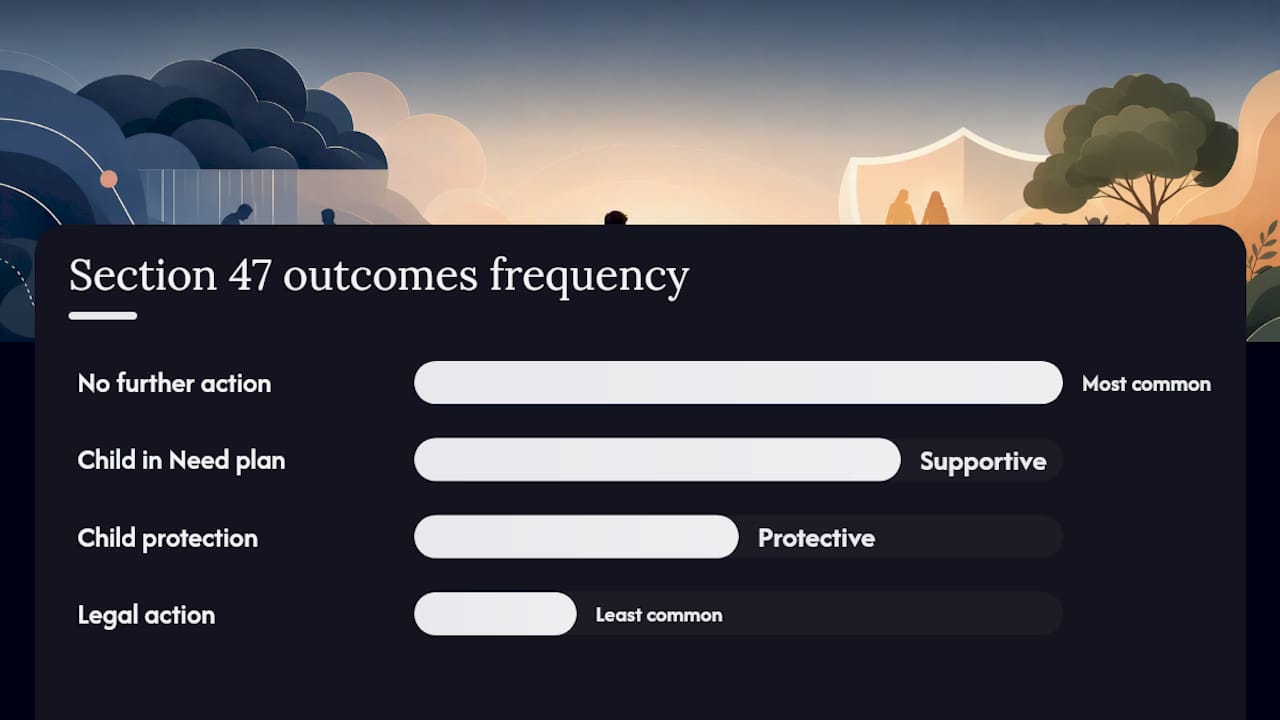
No further action is the most common outcome. The social worker concludes the significant harm threshold has not been met, or has been resolved, and the case is closed. You should receive a closure letter confirming this, and it is entirely reasonable to phone and confirm the case is genuinely closed if the letter is slow to arrive.
A Child in Need plan under Section 17 follows where the enquiry finds no evidence of significant harm, but does identify that the family would benefit from support, whether that is help accessing services, parenting support, or resources for a child with additional needs. This is a supportive, largely voluntary arrangement rather than a protective one.
A Child Protection Conference is convened where the enquiry concludes the threshold for significant harm is met. Local procedures such as those from Rhondda Cynon Taf Council often aim to convene this conference within around 15 working days of that decision. If the conference agrees the child should be subject to a Child Protection Plan, that plan sets out specific actions, a named lead social worker, and a review timetable, typically with the first review within a few months.
Legal action, including an application for a care order or, in urgent cases, an emergency protection order, is reserved for situations where the risk cannot be managed safely within the family home through a plan alone. This is the least common outcome by some distance, but it is the one that makes early legal advice most valuable, and it is the point at which our child arrangement solicitors and social services team are most frequently instructed.
Your rights, how to cooperate, and when to call a solicitor
You have more rights during this process than the anxiety of the situation often lets you feel. You are entitled to be told, in plain terms, why the enquiry is happening, to be kept informed of key decisions and timescales, and to be given reasons when a decision is made about your family. Where you disagree with a decision, you are entitled to ask how to challenge it.
Cooperation genuinely helps your case, and most families find that engaging openly, attending meetings, and providing information promptly leads to a faster and calmer resolution. That said, cooperative does not mean uncritical. A few practical habits protect your position without making you look difficult:
- Keep a written record of every call, visit, and meeting: date, time, who attended, and what was agreed.
- Ask for copies of any assessment, report, or minutes that mention your family.
- Request timescales in writing rather than relying on verbal assurances.
- Ask who your allocated social worker is and how to contact them directly, rather than going through a general duty line each time.
- Involve advocacy services where the child is old enough to want their own voice heard in the process, or where you feel you need support attending meetings.
The point at which you should get independent legal advice is earlier than most parents assume. If the police are involved, if you are asked to attend an interview alongside the child, or if the tone of contact from social care starts to feel adversarial rather than collaborative, speak to a solicitor before your next meeting rather than after it. Practical guidance from the Family Rights Group is consistent on this point: getting advice early, particularly where a criminal investigation is running alongside the enquiry, protects both your rights and your relationship with your child. Legal Aid is available for many family law matters involving social services, including Section 47 enquiries, and eligibility is worth checking even if you assume your income places you outside the criteria, because the rules around child protection cases are more generous than for many other areas of family law.
Pro Tip: If you are asked to attend a meeting or interview at short notice, it is entirely reasonable to ask for it to be moved by a day so you have time to seek advice first. A genuine safeguarding process will not be undermined by a short, sensible delay.
How your case is recorded, and how to challenge a decision
Every stage of a Section 47 enquiry is written up and, under local safeguarding procedures such as those used across Sussex, signed off by a manager before it becomes final. Ask for a written copy of the enquiry outcome and any conference minutes; these documents are the practical foundation for challenging a decision you believe is wrong.
Information gathered during the enquiry is shared between agencies under the lawful “public task” basis in data protection law, meaning schools, health services, and police can lawfully exchange relevant information without needing your separate consent each time. If you disagree with a finding or a plan, you can ask the local authority’s complaints team for a formal review, and independent advocacy services can support you through that process, particularly where the child themselves wants their views heard directly.
How Signature Law supports families through this process
Signature Law was founded by solicitor Sital Somaiya, who brings over 15 years of family law experience and has been featured on BBC and ITV discussing exactly these kinds of cases. We act for parents from the earliest stages of a Section 47 enquiry through to Child Protection Conferences, care proceedings, and beyond, and Legal Aid is available for eligible family law clients facing social services involvement.
Practically, that means help obtaining records and minutes, advice on what to say and what to avoid saying during interviews, representation at conferences, and calm, direct guidance on your realistic options at each stage. Our child law team offers fixed‑fee initial consultations, so you know the cost of that first conversation before you commit to it.
A reassuring word on where this process actually goes
Most Section 47 enquiries end quietly, with no further action, and the anxiety families feel while waiting rarely matches what actually happens next. I have seen enough of these cases to know the fear of the unknown does far more damage in the early days than the enquiry itself usually does. The process exists to find facts, not to find fault, and the professionals involved generally want the same outcome you do: a child who is safe and a family that stays together wherever that is possible.
Where things become genuinely difficult is when the process starts to feel adversarial, when communication dries up, or when a parallel police investigation raises the stakes. That is the moment to stop navigating it alone and get independent legal advice, not as a last resort, but as a sensible early precaution.
— George
Get support from Signature Law during a section 47 enquiry
Signature Law gives you a direct alternative to facing a Section 47 enquiry without independent advice: a fixed‑fee initial consultation with a solicitor who has specifically handled child protection cases, rather than a general practice guessing at the detail. Our family law team, led by a solicitor with over 15 years’ experience, can review your correspondence from children’s social care, tell you plainly where you stand, and help you prepare for a strategy outcome, a conference, or a court application before it happens rather than after. Legal Aid is available for eligible clients, so cost need not be the reason you delay getting advice.
An initial call typically covers what stage your enquiry has reached, what records you are entitled to request, and whether police involvement changes your next steps. If your case is likely to progress towards a Child Protection Conference or care proceedings, earlier advice tends to produce a stronger, calmer outcome for your family. Contact Signature Law today to arrange your consultation and find out exactly where you stand.
Where to read more
For the statutory text itself, read Section 47 of the Children Act 1989 directly on legislation.gov.uk, alongside the government’s Working Together to Safeguard Children statutory guidance. The NSPCC’s child protection system guide explains timescales in plain English, and the Family Rights Group offers independent, practical advice specifically written for parents. To report a concern about a child or find your local children’s services team, your council’s website will list the relevant contact number, which is worth saving before you need it.
Sources
- Legislation
- Working together to safeguard children (statutory guidance, 2023)
- Child protection system (NSPCC)
- What to expect: Child Protection Investigations (Section 47 enquiries) (West Berkshire Council)
Recommended
- Child arrangements guide for separating parents: practical steps
- Parental Responsibility Solicitors
- Child Care Solicitors & Legal Advice
- Steps in Family Law Proceedings UK: A Comprehensive Guide to the Family Court Process