





Family Law
Protect your share: 8 steps for a TOLATA claim in England and Wales

A TOLATA claim asks the court to decide who owns what share of a property and what should happen to it, using the Trusts of Land and Appointment of Trustees Act 1996. The court can declare each person’s beneficial interest, order one party to leave or stay, or force a sale and divide the proceeds. Most claims settle before trial, but litigation is expensive, so early advice and a genuine attempt at alternative dispute resolution matter more than almost anything else in the process.
TL;DR:
- Most TOLATA claims involve disputes over beneficial interests based on contributions or intentions, not automatic rights like those in divorce proceedings.
- Evidence of actual contribution, conduct, or written declarations is crucial, as the court infers ownership from actions rather than promises alone.
- The process typically takes nine months to two years, with high costs that can outweigh the property’s value if the case proceeds to trial.
- Mediation and early evidence gathering significantly reduce costs and increase the chances of resolving disputes outside court.
- Legal Aid is rarely available for property disputes but may cover connected family law issues, and proper documentation is critical before instructing a solicitor.
Table of Contents
- What is a TOLATA claim and what’s the legal basis?
- Who can bring a TOLATA claim?
- How does the court decide a TOLATA claim?
- What are the steps in a TOLATA claims process?
- How do you prove a beneficial interest in TOLATA?
- What does a TOLATA claim cost, and is Legal Aid available?
- Can mediation resolve a TOLATA dispute?
- What should you prepare before instructing a solicitor?
- Why instruct a specialist for a TOLATA claim?
- A note on the mistakes we see most often
- Getting practical support with a TOLATA claim
- Sources
What is a TOLATA claim and what’s the legal basis?
If you and your partner never married and you’re arguing about who owns the house, you can’t apply to the family court for a “fair” division the way divorcing couples can. Instead, you rely on trust law, and the relevant statute is the Trusts of Land and Appointment of Trustees Act 1996. Everyone in England and Wales who calls this a TOLATA claim is referring to court proceedings brought under this Act.
Section 14 is the operative power. It lets the court make orders relating to land held on trust, including declaring the extent of someone’s beneficial interest, deciding who can occupy the property, or ordering a sale. Section 15 sets out the factors the court weighs when deciding what to do, which we’ll come back to.
The crucial point to grasp early is that TOLATA is not divorce law wearing a different hat. Practitioner guidance is clear that TOLATA works backwards: the court establishes what the parties actually intended and contributed at the time, rather than deciding what would be fair looking forward, the way matrimonial proceedings do once a marriage or civil partnership ends. There’s no discretion to redistribute based on need or fairness in the way a divorce court has. You get what you can prove you already own.
Who can bring a TOLATA claim?
Standing to bring a claim isn’t limited to romantic partners. Anyone with a stake, financial or otherwise, in land held by someone else can potentially apply. In practice, four scenarios dominate:
- Cohabitants where only one partner is on the title. The non-owning partner argues they built up a beneficial interest through payments, renovations, or an agreement never put in writing.
- Joint legal owners disputing their shares. Both names are on the title, but they disagree about whether ownership is 50/50 or reflects unequal contributions.
- Family members who helped fund a purchase. A parent who contributed to a deposit, expecting some ongoing interest, is a recurring TOLATA fact pattern.
- Business partners or friends who bought property together outside any personal relationship, where the commercial arrangement has broken down.
As practitioner guidance notes, cohabitants simply don’t have the same statutory rights as spouses, so their disputes fall to be determined under ordinary trust law principles, which is precisely why proving intention and contribution becomes so central to these cases. If you find yourself in any of the four categories above and can’t agree who owns what, you almost certainly have standing to bring or defend a TOLATA claim.
How does the court decide a TOLATA claim?
Section 14 gives the judge three broad tools: a declaration of the beneficial shares each party holds, an order regulating occupation (who lives there, and on what terms), and an order for sale. Judges can combine these, for instance declaring shares and then ordering a sale so the proceeds can be split accordingly.
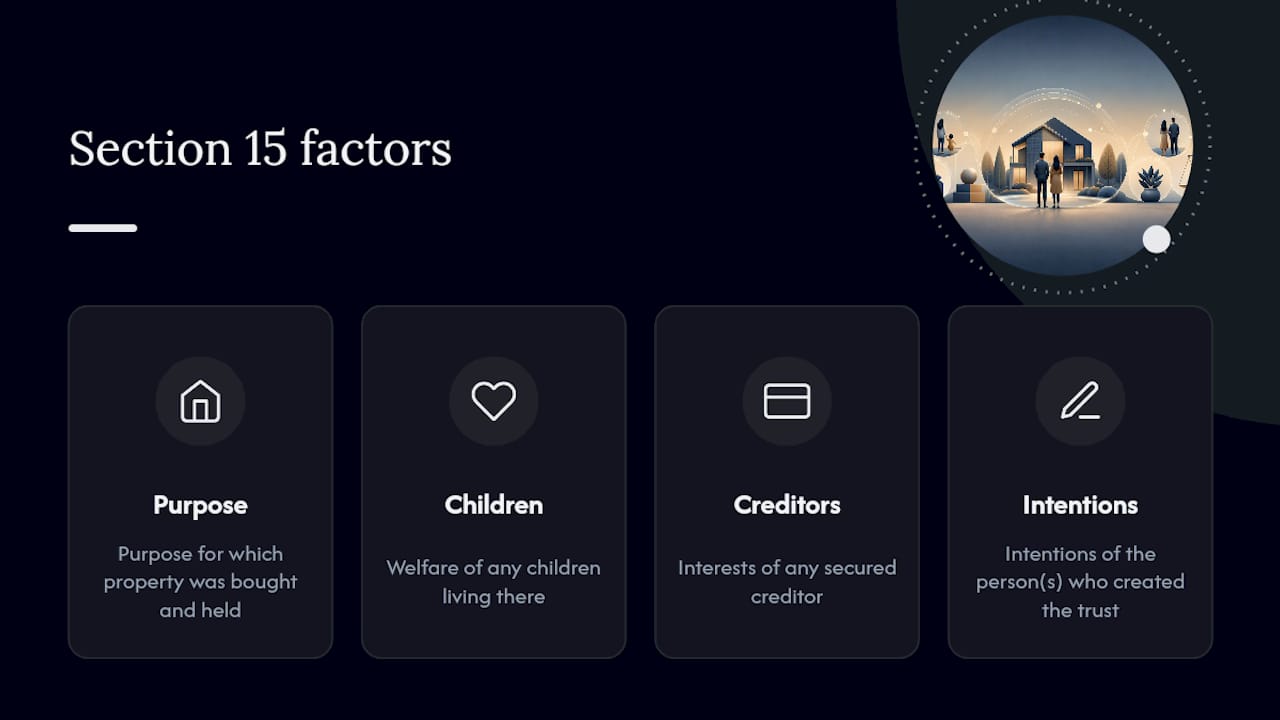
Section 15 lists the factors that guide how those powers are used: the purpose for which the property was bought and held, the welfare of any children living there, the interests of any secured creditor, and, where relevant, the intentions of the person or people who created the trust. Resolution’s guidance is careful to stress that children’s welfare is a factor to weigh, not the overriding consideration it would be in family proceedings, which surprises a lot of parents who assume the court will automatically protect their children’s home.
The two cases every family solicitor cites here are Stack v Dowden and Jones v Kernott. Stack v Dowden established that where property is held in joint names, the starting presumption is equal beneficial ownership, but that presumption can be displaced by evidence the parties intended something different. Jones v Kernott went further, confirming that where evidence of actual intention can’t be found, the court can impute an intention based on what’s fair given the whole course of dealing between the parties. In practice, this means judges look hard at bank statements, renovation spending, and how the parties actually behaved towards the property over the years, not just what was said at the time of purchase.
What are the steps in a TOLATA claims process?
TOLATA litigation runs on the same civil procedure rules as most other property disputes, and the Practice Direction on Pre-Action Conduct and Protocols expects real engagement before anyone issues a claim at court.
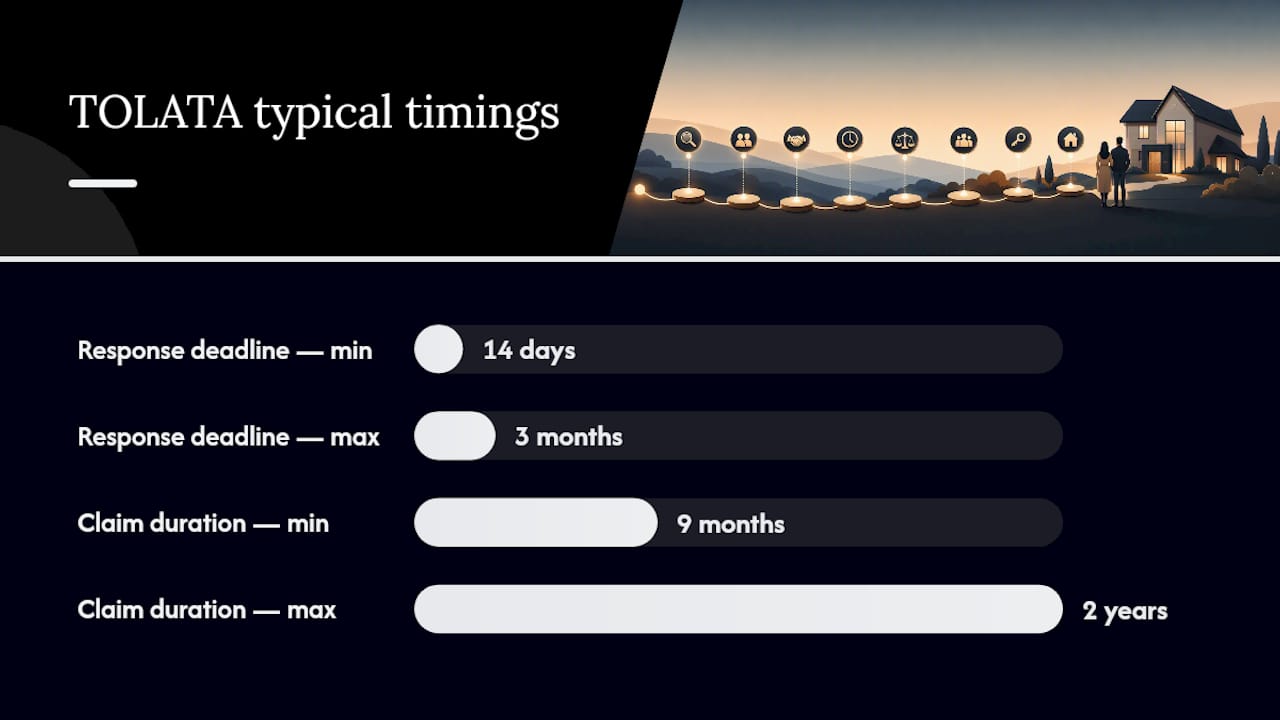
- Send a pre-action letter. This should set out the facts, the interest claimed, the documents relied on, and a reasonable deadline for a response, which Resolution’s guidance suggests should generally be at least 14 days and up to three months in more complex cases.
- Consider ADR before issuing. Courts expect to see that mediation or a similar process was at least considered; skipping this step can affect costs later.
- Issue the claim. Straightforward disputes about a single, clear-cut issue often proceed under CPR Part 8; anything involving contested facts, such as disputed contributions or conversations, usually needs Part 7, with full statements of case and particulars of claim.
- Acknowledgement and defence. The respondent has a set window to acknowledge the claim and file a defence, which may include a counterclaim.
- Allocation to track. The court allocates the case, typically to the multi-track given the value and complexity involved, and directions follow.
- Case management conference (CCMC). Directions are set for disclosure, witness statements, and expert evidence, often including cost budgeting on multi-track cases, as firm guidance on the TOLATA process confirms.
- Disclosure and evidence exchange. Both sides hand over relevant documents and finalise witness statements.
- Pre-trial review, then trial. A shorter hearing checks readiness before the substantive hearing where a judge decides the outcome.
Pro Tip: Keep a running file from day one, even before you’ve decided to instruct a solicitor. Screenshots of messages about “our house” or “your share” often carry more weight at trial than anyone expects at the time they were sent.
Realistically, expect a straightforward TOLATA claim to take somewhere between nine months and two years from pre-action letter to trial, with far quicker resolution if the parties settle at any stage along the way, which most do.
How do you prove a beneficial interest in TOLATA?
Proving your share usually rests on one of three legal routes: an express trust (a written declaration, however informal), a resulting trust (inferred from direct financial contribution to the purchase price), or a constructive trust (built from a common intention, evidenced by conduct, that both parties would share ownership). A fourth route, proprietary estoppel, applies where someone relied on a promise about the property to their detriment, even without a financial contribution to the purchase itself.
Gather these documents before you do anything else:
- The TR1 transfer deed and any accompanying transfer documents, which show how legal title was actually recorded.
- Mortgage application paperwork, which often states how the parties described their relationship and financial arrangement to the lender.
- Bank statements showing who paid the deposit, mortgage instalments, and major bills over time.
- Invoices for renovations or improvements, particularly where one partner funded significant work.
- Written communications, texts, emails, or letters, that touch on ownership, shares, or promises made about the property.
Courts infer common intention from conduct as much as from words. Refurbishing a kitchen at your own expense, or giving up a job to manage a joint renovation project, can count as an act of detriment supporting a constructive trust or estoppel claim, even where nothing was ever written down. Insight from practitioner sources is blunt on one point worth taking seriously: a small financial contribution can genuinely found a resulting trust in law, but the cost of litigating that claim can easily exceed the value you’d recover, which is exactly why a declaration of trust drawn up at the point of purchase is such cheap insurance compared with fighting the point years later.
What does a TOLATA claim cost, and is Legal Aid available?
Civil litigation, including TOLATA claims, generally follows the rule that costs follow the event, meaning the losing party is usually ordered to contribute towards the winner’s legal costs, often a substantial proportion rather than the full amount. Practitioner guidance is consistent in warning that this cost exposure can be severe enough to make litigation a poor financial decision even where the underlying legal claim has merit.
Court fees apply on top of your own solicitor’s costs, and multi-track cases with expert evidence and multiple hearings inevitably cost more than a claim that settles after one exchange of letters. Before committing to litigation, it’s worth doing a genuine cost-benefit assessment: what is the disputed share actually worth, and does that justify the legal spend if the case runs to trial?
Part 36 offers are a useful tool here. Making a formal settlement offer under Part 36 puts pressure on the other side, because if they reject it and later do worse at trial than the offer, they can face significant costs consequences.
Legal Aid for TOLATA property disputes themselves is very limited, but where a case runs alongside family law issues, such as domestic abuse protection, Legal Aid may still be available for those connected proceedings. It’s always worth getting a proper Legal Aid eligibility check rather than assuming you don’t qualify.
Can mediation resolve a TOLATA dispute?
Mediation and collaborative law resolve the majority of property disputes between cohabitants without ever reaching a courtroom, and courts increasingly expect to see that this route was genuinely tried. Resolution’s own good practice guidance recommends that solicitors build ADR clauses into cohabitation agreements from the outset and gather full evidence before any claim is issued, precisely because these cases turn so heavily on contemporaneous documentation rather than recollection.
Starting mediation is usually as simple as instructing an accredited family mediator, who will invite both parties to a joint session, or arranging collaborative law meetings where both sides attend with solicitors present but outside the court process entirely.
- Mediation is typically far cheaper and faster than litigation.
- It gives both parties more control over the outcome than a judge’s order would.
- A refusal to engage with ADR without good reason can count against you on costs later, even if you win the substantive claim.
Pro Tip: If your ex-partner won’t respond to a mediation invitation, keep a written record of that refusal. It becomes useful evidence at the costs stage, even months later.
What should you prepare before instructing a solicitor?
Walking into a first consultation with the right paperwork saves time and money, because your solicitor can assess the strength of your claim far more quickly with documents in hand than with a verbal account alone.
- Gather title deeds and Land Registry documents showing current legal ownership.
- Collect the full mortgage history, including who is named on the mortgage and who has made payments.
- Pull together bank statements and payment records covering the deposit, bills, and any renovation costs.
- Save messages, emails, or letters discussing ownership, shares, or promises about the property.
- Bring invoices or receipts for significant work or improvements you funded.
- Prepare a written timeline of the relationship and property history in your own words.
At the first meeting, ask what a fixed-fee consultation actually covers, what your realistic prospects look like on the evidence you have, and roughly what a contested claim would cost against what’s actually at stake. If children are involved, ask specifically whether a Schedule 1 Children Act claim should run alongside your TOLATA claim, since the two often overlap where a parent needs housing provision for a child rather than, or as well as, a declared beneficial share.
Why instruct a specialist for a TOLATA claim?
TOLATA cases reward early, careful evidence gathering, not last-minute scrambling before a hearing. The family law practice is led by an experienced solicitor, and the firm offers fixed-fee initial consultations alongside a Legal Aid eligibility check where family proceedings run alongside a property dispute.
Our approach starts with building a documentary timeline before anything is issued, testing whether mediation can resolve matters first, and giving clients honest, realistic advice about what a claim is likely to cost against what it’s likely to recover. That last point, frankly, is where too many cases go wrong elsewhere.
A note on the mistakes we see most often
The single biggest mistake is delay: clients wait months, sometimes years, to seek advice, by which point key messages have been deleted and memories of who paid for what have blurred. The second is assuming a TOLATA claim behaves like a divorce settlement; it doesn’t, and going in with the wrong expectations leads to disappointment even when the legal outcome is technically correct. Timing and cost rarely match what people hope for at the outset, so speak to a solicitor early, before the paper trail disappears and before positions harden.
— George
Getting practical support with a TOLATA claim
If you’re weighing up whether to bring or defend a TOLATA claim, the right first step is a conversation with someone who handles these disputes regularly, not a search engine. Fixed-fee initial consultations are offered for family law clients, so you know the cost of that first meeting before you walk in, and an assessment is made whether Legal Aid might cover any connected family proceedings before you spend a penny on litigation. We build your evidence timeline early, test whether mediation can resolve things without a courtroom, and give you a straight answer on whether your claim is worth the cost of pursuing it.
Bring your title deeds, bank statements, and any written communications about ownership to that first meeting, and we’ll tell you where you actually stand. Get in touch through our family law services page or contact us directly to arrange your consultation.
This article is general information, not a substitute for advice from a qualified lawyer. Consult a qualified legal professional about your own circumstances before acting on anything here.
Sources
- Trusts of Land and Appointment of Trustees Act 1996
- Good Practice Guide to cohabitation cases (Resolution)
- Cohabitants’ property claims under TOLATA 1996 (LexisNexis)
Recommended
- Property division checklist: your complete UK guide
- Matrimonial home rights: what they mean and how to protect yours
- Dividing rental property in divorce: a landlord’s guide