





Family Law
UK Mesher Order: When It Can Tie Up Your Equity for a Decade

A Mesher Order is a court order that postpones the sale of the family home until a defined future event, usually so a parent and children can stay put after divorce. It is made under the property adjustment powers of the Matrimonial Causes Act 1973 and holds the home on trust with fixed shares for each party. It carries real mortgage and tax consequences that both parties need to plan for.
TL;DR:
- Courts prefer Mesher Orders when child welfare requires housing stability and the parent cannot find alternative accommodation easily.
- Clear, objectively verifiable trigger events and a fixed longstop date reduce disputes and ensure enforcement.
- The occupying parent typically continues mortgage payments, while the non-occupier’s interest is protected by a charge on the property title.
- Costs include solicitor fees for drafting, court fees, and potentially Legal Aid, with fixed-fee options available for clarity.
- Orders can be refused or varied if triggers are vague, property equity is too low, or circumstances such as arrears or remarriage change significantly.
Table of Contents
- What is a Mesher Order? Legal basis, case origin and mechanics
- Common trigger events and drafting choices
- Weighing the advantages and disadvantages for each party
- How to get a Mesher Order: the procedure and evidence you need
- Who pays the mortgage, and what does it cost?
- How likely is a court to grant, refuse or vary the order?
- What are the alternatives to a Mesher Order?
- Tax consequences when the property is eventually sold
- How a solicitor helps you secure a robust order
- Priorities when negotiating a deferred sale order
- How Signature Law can support you through a Mesher Order
- Sources
- FAQ
What is a Mesher Order? Legal basis, case origin and mechanics
A Mesher Order takes its name from Mesher v Mesher & Hall [1980], a Court of Appeal case that established the template still used in family courts across England and Wales. Rather than forcing an immediate sale on divorce, the court defers it, allowing the primary carer and children to remain in the home for a set period.
Legally, it is a settlement order made under section 24(1)(b) of the Matrimonial Causes Act 1973, and it functions through a trust of land. Both parties usually retain fixed percentage shares of the eventual sale proceeds, agreed at the time of the order rather than left open to later argument.
This differs from a Martin order, which lets the occupying spouse stay for life or until remarriage or cohabitation, with no automatic sale trigger tied to children growing up. A Mesher Order is almost always child focused and time limited, whereas a Martin order tends to serve a spouse’s housing need rather than a child’s. Anyone weighing up property and divorce options should understand this distinction early, since it shapes everything that follows in negotiation.
Common trigger events and drafting choices
The sale trigger is the single most important clause in the order, and courts and solicitors have settled on a fairly standard set of options over the years.
Typical trigger events include the youngest child reaching maturity or finishing full-time education, the occupying party remarrying or cohabiting with a new partner, the occupying party’s death, or a fixed longstop date regardless of the children’s circumstances
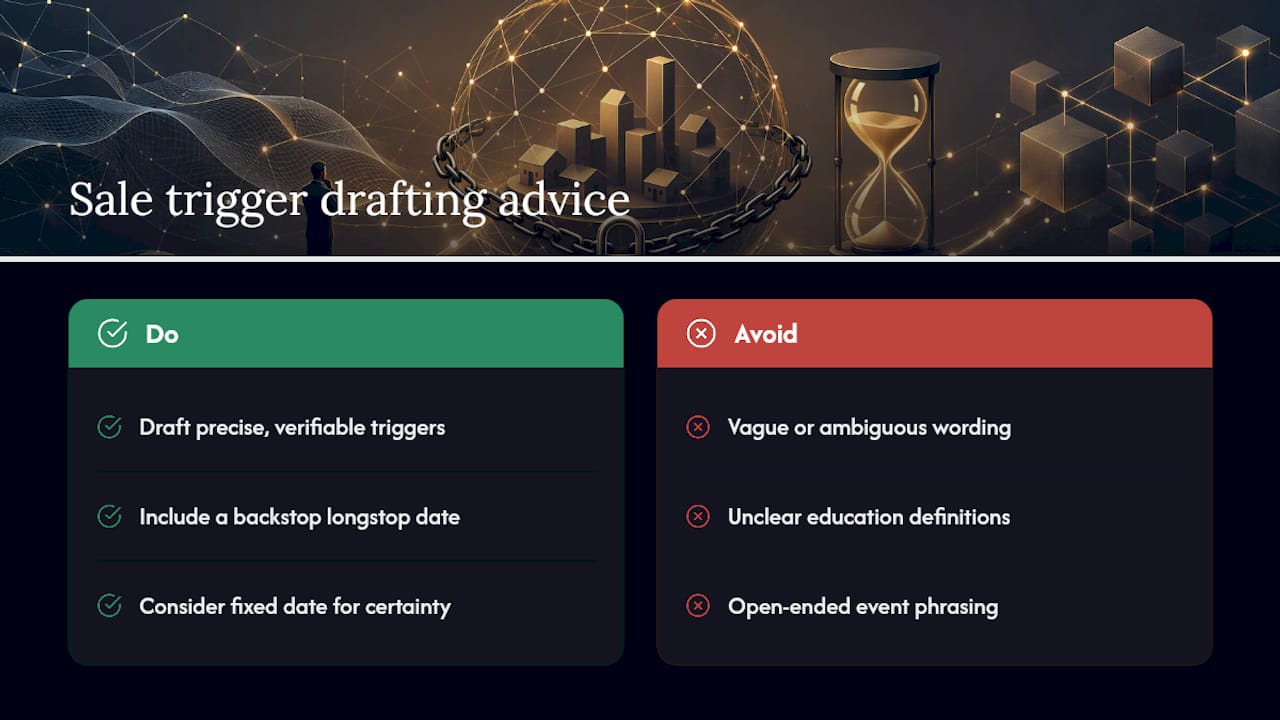
Fixed dates give certainty, while event-based triggers track the family’s actual needs but can generate disputes over interpretation, such as what counts as “full-time education” if a child goes to university. LexisNexis guidance recommends drafting triggers as precise, objectively verifiable events, paired with a backstop longstop date as a safety valve. Vague wording is the single most common cause of costly disputes years after the original order.
Weighing the advantages and disadvantages for each party
For the occupier, usually the parent with day-to-day care of the children, the order buys stability. It means no disruption to schooling and no rushed house move while the family is already adjusting to separation.
For the non-occupier, the order preserves a genuine financial stake in a property they no longer live in. The interest is protected by a charge on the title, so it cannot simply be sold or remortgaged away without their knowledge.
There are real downsides on both sides:
- The non-occupier’s capital stays locked up for a long period, while house prices and their own housing needs move on
- Mortgage arrears or a falling market during the deferral period can erode both parties’ shares
- Managing a jointly owned property from a distance creates ongoing friction over repairs, insurance and remortgaging
Pro Tip: Insist on a clause requiring both parties’ consent (or a court application) before either can remortgage, and set a longstop date even if you expect the trigger to arrive sooner. It protects the non-occupier from indefinite delay and gives both sides a clear end point to plan around.
How to get a Mesher Order: the procedure and evidence you need
A Mesher Order almost always arises during financial remedy proceedings on divorce, either by agreement or after a contested hearing.
- File the application. Mesher terms are proposed within Form A financial remedy proceedings, alongside full financial disclosure from both parties (Form E).
- Negotiate or mediate. Many couples agree the terms through solicitor negotiation or mediation, then submit them as a consent order for the court to approve, which is usually quicker and cheaper than a contested hearing.
- Prepare evidence if contested. Where agreement fails, the court expects up-to-date property valuations, mortgage account statements, and evidence of the children’s welfare needs and each party’s ability to secure alternative housing.
- Attend a hearing if needed. A District Judge will consider fairness to both parties under section 25 of the Matrimonial Causes Act 1973 before making a final order.
- Register the order. Once approved, the trust of land and any charge are registered against the property title, so the arrangement binds future dealings with the home.
Contested cases can take many months longer than an agreed consent order, so early legal advice on realistic terms tends to save both time and cost.
Who pays the mortgage, and what does it cost?
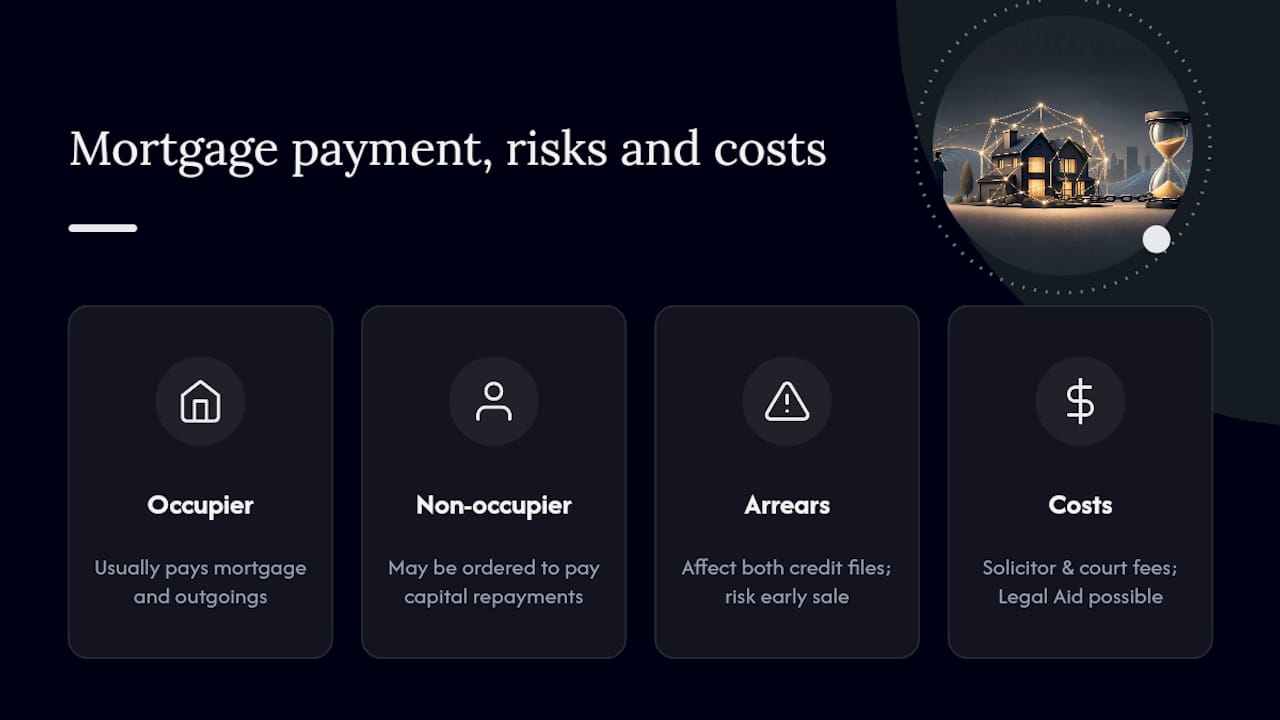
The occupying party usually continues paying the mortgage and day-to-day outgoings, though the order can direct the non-occupier to contribute towards capital repayments, particularly if their share of equity is otherwise being eroded by interest-only debt.
Missed payments matter more than in an ordinary co-ownership arrangement, because MoneyHelper notes that arrears affect both parties’ credit files and can ultimately force an early sale through lender enforcement. A well-drafted order usually gives the non-occupier the right to be notified of arrears and, in serious cases, to apply for an earlier sale.
Costs fall into three broad categories: solicitor fees for drafting and negotiation, court fees for a consent order or contested application, and, for eligible family law clients, Legal Aid may cover some or all of the process. Fixed-fee consultations let you understand your likely costs before committing to a full case.
How likely is a court to grant, refuse or vary the order?
Courts lean towards a Mesher Order where a child’s welfare genuinely requires housing continuity and the occupying parent cannot realistically secure alternative accommodation on the available capital.
Refusal is more common than many people expect. MoneyHelper makes clear that courts balance short-term child welfare against long-term fairness to the non-occupier, and a Mesher Order becomes less likely where it would tie up someone’s capital indefinitely, leave triggers ambiguous, or where the property has too little equity to make deferral worthwhile once mortgage debt is accounted for. Orders can later be varied or enforced through further court applications, usually where circumstances change materially, such as the occupier remarrying early or falling seriously into arrears.
What are the alternatives to a Mesher Order?
A Mesher Order is not the only route to protecting children’s housing while dividing assets fairly.
- Martin order: defers sale until the occupier’s death, remarriage or cohabitation, rather than a child related event
- Sale with a licence to occupy or tenancy: the property sells to a third party but the occupier and children stay on under a formal occupation arrangement for an agreed period
- Transfer of equity with a charge or deferred transfer: one party takes full ownership immediately, with the other’s share protected by a charge repayable later, avoiding the ongoing joint ownership entirely
A transfer of equity often suits couples who want a clean break sooner and can agree fair compensation for the departing party’s share.
Tax consequences when the property is eventually sold
When the Mesher Order finally triggers a sale, tax treatment depends heavily on timing and who has lived where. Private residence relief normally shelters a main home from capital gains tax, but a spouse who moved out years earlier may lose part of that relief on their share.
HMRC’s capital gains manual (CG65365) sets out how separation and divorce interact with private residence relief, and specifically addresses how a trust of land created by a Mesher Order can affect the timing of a disposal for tax purposes. Getting a current valuation and tax advice well before the trigger date, rather than after it, gives both parties room to plan the sale efficiently.
How a solicitor helps you secure a robust order
Specialist advice makes the difference between an order that works smoothly for a decade and one that ends up back in court. A solicitor’s role typically includes drafting precise, unambiguous triggers, negotiating charge and indemnity protections for the non-occupier, gathering valuation and welfare evidence, and representing you at any hearing.
Signature Law offers fixed-fee initial consultations so you can understand your options and costs from the outset, and assesses Legal Aid eligibility for family law clients who qualify. Multilingual advice is also available, reflecting the firm’s broader commitment to accessible, personal support rather than a volume caseload approach.
Bring these to a first appointment:
- Recent mortgage statements and a rough property valuation
- Details of household income and outgoings
- Any existing separation agreement or correspondence about the property
- Information about the children’s schooling and current living arrangements
Priorities when negotiating a deferred sale order
Children’s stability comes first, but only within triggers that are genuinely enforceable, not vague enough to argue over years later. Open-ended postponements without a longstop date store up conflict, not security. Getting advice before terms are agreed, not after a dispute erupts, is what actually protects both parties.
— George
How Signature Law can support you through a Mesher Order
Deferred sale arrangements sit at the intersection of family law and property law, and getting the drafting wrong is expensive to fix later. Signature Law handles Mesher Order negotiations, consent order drafting, and the wider financial settlement process as part of everyday family law practice, with fixed-fee initial consultations so you know your likely costs before you commit to anything further.
Legal Aid eligibility can be assessed for qualifying family law clients, and multilingual advice is available for families who need it. If you are weighing up whether a Mesher Order suits your situation, get in touch with Signature Law to book a fixed-fee consultation and find out where you stand.
Sources
- CG65365 – Private residence relief: separation, divorce or dissolution of civil partnership: Mesher Orders
- Mesher order | Practical Law
- Dividing the family home and mortgage during divorce or dissolution | MoneyHelper
This article is general information, not a substitute for advice from a qualified lawyer. Consult a qualified legal professional about your own circumstances before acting on anything here.
FAQ
Who pays the mortgage under a Mesher Order?
The occupying party usually keeps paying the mortgage, though the order can require the non-occupier to contribute towards capital repayments where their share is at risk of being eroded.
How likely am I to get a Mesher Order?
Courts favour the order where a child’s welfare genuinely requires housing continuity and the occupying parent cannot secure alternative housing, but they refuse it where triggers are unclear or it would unfairly delay the non-occupier’s access to their share.
How much does it cost to get a Mesher Order?
Costs cover solicitor fees for drafting and negotiation, court fees for a consent order or contested hearing, and Legal Aid may reduce or cover costs for eligible family law clients; a fixed-fee consultation clarifies likely costs upfront.
Can I refuse a Mesher Order?
Yes. Either party can argue against the terms proposed, and the court will only impose an order it considers fair to both sides under section 25 of the Matrimonial Causes Act 1973, taking independent legal advice into account.
Recommended
- Asset division in UK divorce settlements: what to expect
- Clean break order: what it does and how to get one
- Transfer of Equity: Signature Law’s Legal Guidance