





Family Law
Family Law Solicitor – Protecting Romford Families

Facing a relationship breakdown touches every corner of life, especially when children are involved and emotions run high. Many in Romford and Essex struggle to find clear, supportive legal help during these challenging times. A family law solicitor offers not just expert legal advice but also vital compassion and practical support to guide families through divorce, child arrangements, and complex decisions that shape the future.
Table of Contents
- What Is A Family Law Solicitor?
- Types Of Family Law Matters Handled
- Key Responsibilities And Processes
- Legal Framework Governing Family Solicitors
- Costs, Risks And Common Misconceptions
Key Takeaways
| Point | Details |
|---|---|
| Family Law Solicitor Expertise | Family law solicitors specialise in legal issues related to families, providing advice, negotiation, and representation in court. |
| Types of Cases Handled | They deal with a variety of matters including divorce, child custody, domestic abuse, and financial settlements. |
| Regulatory Framework | Solicitors operate under stringent regulations, ensuring accountability and professional standards through the Solicitors Regulation Authority. |
| Costs and Financial Clarity | Understanding the different charging methods and potential for legal aid is crucial to avoid unexpected expenses during legal proceedings. |
What Is a Family Law Solicitor?
A family law solicitor is a qualified legal professional who specialises in matters affecting families, relationships, and children. They provide expert advice, handle paperwork, negotiate settlements, and represent clients in court when needed.
Family law solicitors are trained through the Solicitors Qualifying Examination (SQE) or the Legal Practice Course (LPC), followed by practical work experience and registration with the Solicitors Regulation Authority. This qualification ensures they understand the complex legal landscape surrounding family disputes.
These solicitors help with a wide range of issues:
- Divorce and civil partnership dissolution
- Financial settlements and asset division
- Child arrangements and custody matters
- Parental responsibility disputes
- Domestic abuse and protection orders
- Adoption and surrogacy
- Guardianship and inheritance matters
A family law solicitor does more than handle paperwork—they guide you through one of life’s most challenging periods with both expertise and compassion.
Your solicitor acts as your advocate, negotiator, and legal advisor rolled into one. They meet with you to understand your situation, explain your rights and options, and work towards the best possible outcome. Whether your case involves complex financial arrangements or sensitive child protection issues, their role is to protect your interests and those of your children.
In Romford and across Essex, family law solicitors handle cases at various intensities. Some matters settle quickly through negotiation or mediation, whilst others require formal court proceedings. A skilled solicitor knows which approach suits your circumstances.
Many family law solicitors also understand how family law affects everyday life in the UK, including tax implications, pension divisions, and housing arrangements. This broad knowledge helps them spot issues that might otherwise be missed.
The emotional toll of family disputes is real. A good solicitor recognises this and balances professional distance with genuine empathy, helping you make clear-headed decisions during difficult times.
Pro tip: When choosing a family law solicitor, ask about their experience with cases similar to yours and whether they offer fixed-fee initial consultations—this removes financial uncertainty at a time when you need clarity most.
Types of Family Law Matters Handled
Family law solicitors work across a broad spectrum of legal issues. Each matter requires specialist knowledge, sensitive handling, and a clear understanding of how decisions affect your family’s future.

The most common issues solicitors deal with involve relationship breakdown. This includes divorce, civil partnership dissolution, and separation agreements. When relationships end, financial and emotional complexities multiply quickly.
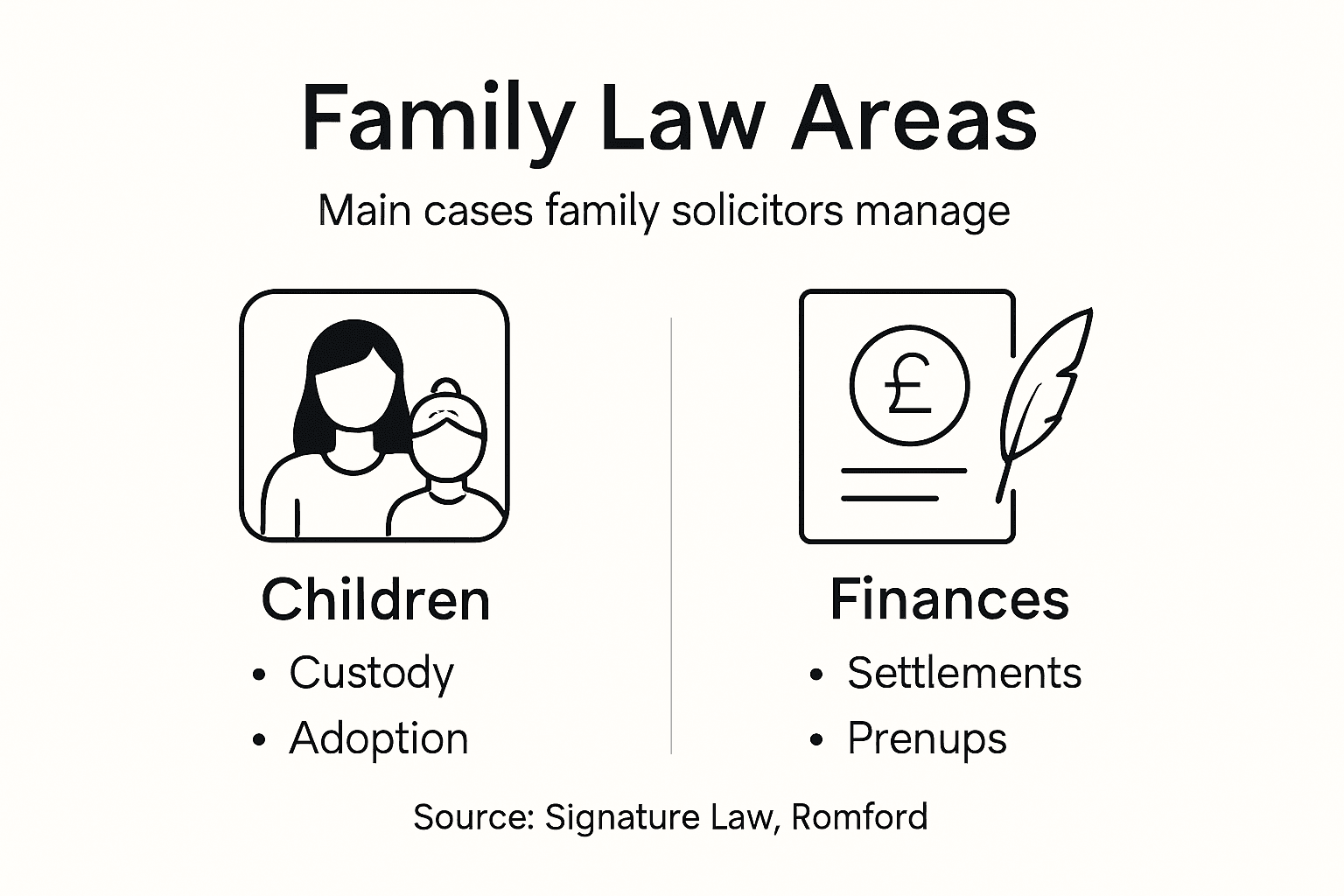
Child-related matters form the heart of family law practice:
- Child arrangements and custody decisions
- Contact schedules and parental access
- Parental responsibility disputes
- Child maintenance and financial support
- Safeguarding and welfare concerns
When parents cannot agree on child arrangements, solicitors help navigate court applications whilst prioritising the child’s welfare above all else.
Financial settlements represent another critical area. When couples separate, they must divide assets fairly—including property, pensions, savings, and business interests. Making child arrangements when couples divorce involves far more than deciding where children live; it requires legal clarity on financial responsibilities too.
Domestic abuse cases demand urgent, expert handling. Solicitors can help secure non-molestation orders and other protective measures. These matters often qualify for legal aid support, ensuring cost is not a barrier to safety.
Other matters family law solicitors handle include adoption proceedings, guardianship arrangements, and relationship breakdowns involving complex cross-border issues. Public law cases—where local authorities are involved in child protection—also fall within family law expertise.
Each case is unique. Your solicitor assesses your specific circumstances and recommends the best approach, whether that involves negotiation, mediation, or court representation. They ensure your interests and your children’s welfare remain the priority throughout.
Here’s a summary of how family law solicitors handle different types of cases:
| Case Type | Typical Approach | Key Outcome Sought |
|---|---|---|
| Divorce or Dissolution | Negotiation or court | Fair financial division |
| Child Arrangements | Mediation or application | Child’s welfare prioritised |
| Domestic Abuse | Urgent legal protection | Safety and protection orders |
| Complex Financial Matters | Expert and court input | Detailed asset distribution |
| Cross-Border Issues | Coordination with agencies | Legally compliant arrangement |
Pro tip: Bring all relevant documents to your first consultation—bank statements, property deeds, custody agreements, and communications with the other party—so your solicitor can give you the most accurate initial advice.
Key Responsibilities and Processes
A family law solicitor’s job extends far beyond sitting in an office. Their day involves constant communication, strategic planning, and detailed case management. Understanding what they actually do helps you appreciate the value they bring.
Evidence gathering and document preparation form the foundation of every case. Your solicitor collects bank statements, property valuations, correspondence, and other materials that support your position. They then prepare formal legal documents—petitions, affidavits, financial statements—that present your case clearly to the court or the other party.
Your solicitor provides clear advice on your legal rights and options. This means explaining what you can realistically achieve, what trade-offs exist, and what the court is likely to decide if your case goes to trial. They help you make informed decisions rather than emotionally driven ones.
Key responsibilities include:
- Advising on divorce, child contact, and protective injunctions
- Negotiating settlements on your behalf
- Gathering evidence and preparing legal documents
- Managing client correspondence and urgent matters
- Representing you in court hearings when necessary
- Instructing barristers for complex litigation
A solicitor’s real skill lies in knowing when to negotiate, when to fight, and when to compromise—protecting your interests whilst moving your case forward.
Negotiation and mediation are central to family law practice. Rather than every case going to court, solicitors work to settle matters between parties. This saves time, money, and emotional strain. When negotiation stalls, mediation—with a neutral third party—often helps both sides reach agreement.
Court representation requires detailed preparation and case management. Your solicitor prepares bundles of evidence, writes legal submissions, and presents your case persuasively to a judge. They balance urgent protective matters (like injunctions) with longer-term financial and child arrangement cases.
Throughout the entire process, your solicitor maintains confidentiality, manages sensitive information responsibly, and provides regular updates on your case’s progress.
Pro tip: Ask your solicitor what their communication policy is—how often you’ll hear updates, whether you can ring with urgent questions, and what documents you’ll receive—so expectations are clear from day one.
Legal Framework Governing Family Solicitors
Family law solicitors don’t work in a vacuum. They operate within a strict legal and regulatory framework designed to protect clients, uphold justice, and ensure professional standards. Understanding this framework gives you confidence in the service you receive.
The Solicitors Regulation Authority (SRA) is the independent regulator that oversees all solicitors in England and Wales. They set the rules, enforce standards, and investigate complaints. Every solicitor must comply with SRA standards and regulations covering conduct, competence, and client care.
Family solicitors must follow the SRA Code of Conduct. This code outlines core principles:
- Acting with integrity and honesty
- Maintaining absolute client confidentiality
- Delivering competent, diligent legal services
- Protecting client money and information
- Being transparent about costs and progress
- Upholding the rule of law
A regulated solicitor isn’t just qualified—they’re accountable to an independent authority that can investigate complaints and enforce standards if things go wrong.
Family law itself is governed by key statutes. The Children Act 1989 sets the legal framework for child protection, parental responsibility, and court orders affecting children. The Family Law Act 1996 covers divorce procedures, financial settlements, and domestic abuse protection.
Court decisions also establish important principles. Judges interpret and apply these laws, creating precedents that guide future cases. Your solicitor understands how courts typically approach different scenarios, helping you anticipate outcomes.
Family solicitors must also maintain continuous professional development (CPD). They stay current with law changes, case developments, and best practices. This ensures the advice they give you reflects the latest legal landscape.
When choosing a solicitor, verify they’re regulated by the SRA. You can check their registration online. This simple step confirms they’re properly qualified, insured, and subject to professional oversight.
Pro tip: Ask your solicitor about their professional indemnity insurance and how client complaints are handled—this shows they take professional accountability seriously and have systems to protect you if things go wrong.
Costs, Risks and Common Misconceptions
Family law is emotionally taxing and financially complex. Understanding costs upfront prevents nasty surprises later. Most misconceptions about solicitors stem from lack of clarity about how they charge and what they can actually achieve.
Costs vary dramatically depending on your case. A straightforward, uncontested divorce costs far less than a bitter financial dispute or custody battle. Complexity, length of negotiations, and whether court proceedings are needed all affect the final bill.
Solicitors charge in several ways:
- Hourly rates charged for time spent on your case
- Fixed fees for specific services (initial consultations, document preparation)
- Conditional fee agreements where the solicitor’s fee depends on outcome
- Disbursements (court fees, expert reports, process server costs)
- Success fees or insurance premiums in certain arrangements
Solicitors are legally required to explain costs clearly at the start and keep you updated throughout—if they don’t, that’s a red flag.
Clear information about likely legal costs must be provided before you instruct a solicitor. Ask for a written estimate or explanation of billing so there are no surprises.
Legal aid may be available if you meet financial eligibility criteria. This is particularly common for domestic abuse cases and some financial settlements. Don’t assume you can’t afford a solicitor without checking legal aid options first.
The table below clarifies how common solicitor charging methods differ:
| Charging Method | How it Works | When Used Most Often |
|---|---|---|
| Hourly Rate | Charged per hour of solicitor’s time | Complex, ongoing cases |
| Fixed Fee | Set amount for specific service | Initial consultations |
| Conditional Fee | Only paid if case is successful | Limited, certain case types |
| Legal Aid | State-funded for eligible individuals | Domestic abuse, low income |
Common misconceptions include:
- “A solicitor will guarantee I’ll win my case”—courts make decisions based on law and evidence, not solicitor skill alone
- “Going to court is always better”—many cases settle faster and cheaper through negotiation
- “I must get everything I want”—settlements involve compromise on both sides
- “A solicitor costs too much”—consider the cost of mistakes made without legal advice
Risks exist in every family law case. Courts may decide against you. Assets may be worth less than expected. The other party may refuse to cooperate. A good solicitor explains realistic risks upfront, not just best-case scenarios.
The real misconception is that family law is simple. It isn’t. Professional guidance costs money, but the wrong decisions cost far more.
Pro tip: During your initial consultation, ask for a fixed fee quote for specific services and always get cost estimates in writing—this creates a clear agreement and helps you budget properly for your case.
Secure Your Family’s Future with Expert Legal Support from Signature Law
Family disputes and relationship breakdowns are some of the most challenging moments life can bring. Whether navigating divorce, child arrangements, or urgent domestic abuse protection, the emotional strain and legal complexities can feel overwhelming. Signature Law understands these deep concerns and is committed to providing compassionate, tailored advice that protects you and your family’s interests throughout this difficult time. With over 15 years of local experience in Romford and Essex, our qualified family law solicitors offer clear guidance on complex matters such as financial settlements, parental responsibility, and legal aid eligibility.
If you want to take control of your situation with confidence, do not face it alone. Reach out now for a fixed-fee initial consultation with our family law team. Discover how expert legal support tailored to your unique needs can make all the difference. Whether you require advice on child arrangement orders or need help securing non-molestation orders, we are here to guide you step by step. Act today to protect what matters most — your family’s future.
Frequently Asked Questions
What does a family law solicitor do?
A family law solicitor is a legal professional who specialises in family-related issues such as divorce, child custody, financial settlements, and domestic abuse cases. They provide expert advice, handle legal paperwork, negotiate agreements, and represent clients in court if necessary.
How do I find the right family law solicitor for my case?
To find the right family law solicitor, consider their experience with cases similar to yours, their approach to handling sensitive matters, and whether they offer fixed-fee consultations. It’s also important to assess their communication style and ensure you feel comfortable discussing your situation with them.
What types of legal issues can family law solicitors help with?
Family law solicitors can assist with a range of legal issues, including divorce, civil partnership dissolution, child arrangements and custody, financial settlements, domestic abuse protection, adoption, and guardianship matters.
How are family law solicitors charged for their services?
Family law solicitors may charge in various ways, including hourly rates for their time, fixed fees for specific services, and conditional fee agreements based on the outcome of the case. It’s crucial to discuss costs upfront and obtain clear estimates to avoid surprises later.
Recommended
- Family Law – How It Affects Everyday Life in the UK | Signature Law
- Estate Planning in Divorce – Protecting Your Children | Signature Law
- Legal Aid in Family Law – Who Qualifies and How it Works | Signature Law
- Top 8 FamilyLawLondon.co.uk Alternatives in 2026 for Compassionate Legal Guidance in Divorce and Child Arrangements | Signature Law