





Family Law
Divorce Settlement Explained – Fair Outcomes in 2026 UK

When a marriage ends in Romford or East London, the stress of deciding who keeps the home, how savings are split, and what happens to pensions can feel overwhelming. Divorce settlements matter because they define your financial security and clarify child arrangements after separation. By understanding how a legally binding consent order protects your interests, you gain control, avoid uncertainty, and ensure future stability for yourself and your children.
Table of Contents
- What Is A Divorce Settlement In The UK
- Types Of Divorce Settlements Explained
- How Financial Settlements Are Decided
- Legal Requirements And Court Process
- Key Factors: Assets, Maintenance, Costs
Key Takeaways
| Point | Details |
|---|---|
| Divorce Settlement Definition | A divorce settlement is a legally binding agreement that outlines the division of financial assets, property, and maintenance, which must be court approved. |
| Types of Settlement | The four main types include informal agreements, mediated agreements, consent orders, and court-decided settlements, each varying in legal status and cost. |
| Legal Binding Process | An agreement becomes legally binding through a consent order, which requires court approval, ensuring enforceability and protection for both parties. |
| Financial Disclosure Importance | Full financial disclosure is essential before negotiations, ensuring transparency and equitable asset division. |
What Is a Divorce Settlement in the UK
A divorce settlement is a legally binding agreement between you and your spouse that outlines exactly how you’ll divide your money, property, pensions, and other assets when your marriage ends. It’s not something the court decides for you—it’s an arrangement you both reach together, though the court must approve it to make it legally binding.
Think of it as a comprehensive agreement that covers everything financial in your divorce. Once approved, both of you have clear legal obligations to follow what you’ve agreed.
What Does a Settlement Actually Cover?
Your divorce settlement will typically address these key areas:
- Financial assets: Cash, savings accounts, investments, and other liquid funds
- Property: Your home, buy-to-let properties, or any other real estate you own
- Pensions: Any pension pots accumulated during the marriage
- Maintenance payments: Child support or spousal maintenance (if applicable)
- Debts: Responsibility for mortgages, loans, credit cards, or other liabilities
- Personal belongings: Cars, jewellery, artwork, and household items of value
When couples reach agreement through mediation or legal advice, they can avoid a contested court hearing altogether.
How Does a Settlement Become Legally Binding?
Simply shaking hands on an agreement isn’t enough. Your settlement must be formalised through what’s called a consent order—a court document that both solicitors draft and both parties sign. Once a judge approves this consent order, it becomes legally enforceable.
Without this formal step, either party could change their mind and attempt to claim assets later. The consent order protects you both.
Why Does This Matter to You?
A properly structured settlement gives you certainty. You know exactly what you’re keeping and what you’re giving up. You avoid the stress, cost, and unpredictability of court proceedings. Most importantly, you have control over the outcome rather than leaving it to a judge who doesn’t know your circumstances.
A fair settlement isn’t about equal splits—it’s about arrangements that reflect each person’s needs, contributions, and future security.
In Romford and East London, many divorcing couples find that mediation or collaborative discussions produce settlements far faster than court battles. You maintain privacy, keep costs lower, and typically reach agreement within months rather than years.
Pro tip: Get independent legal advice before signing any settlement agreement, even if it feels amicable. A solicitor will ensure you’re not disadvantaging yourself and that your consent order is properly drafted.
Types of Divorce Settlements Explained
Not all divorce settlements look the same. The type that suits you depends on your circumstances, whether you have children, and how amicably you and your spouse can negotiate. Understanding the different settlement types helps you choose the right path for your situation.
The Four Main Types of Settlements
Divorce settlements in the UK typically fall into four categories:
- Informal agreements: You and your spouse agree terms together without legal formality. These are not legally binding unless formalised later.
- Mediated agreements: A neutral third party helps you both reach consensus on money, property, and arrangements. Much faster than court.
- Consent orders: Your agreement is drafted by solicitors and approved by a court, making it legally enforceable and final.
- Court-decided settlements: A judge decides how to divide your assets because you and your spouse cannot agree.
Most people in Romford and East London prefer mediated or consent order routes because they cost less and take months rather than years.
Here’s how the four types of divorce settlement differ at a glance:
| Settlement Type | Legal Status | Typical Cost Level | Likelihood of Court Involvement |
|---|---|---|---|
| Informal Agreement | Not legally binding | Very low | High if challenged |
| Mediated Agreement | Can become binding if formalised | Moderate | Low if successful |
| Consent Order | Legally binding after court approval | Moderate | Infrequent, unless disputed |
| Court-Decided Settlement | Legally binding by court decision | Very high | Always |
What Each Settlement Type Covers
Regardless of type, divorce settlements address distinct areas. Property distribution covers your home, investments, and possessions. Spousal support (sometimes called maintenance) can be temporary, rehabilitative to help you rebuild financially, or permanent in certain circumstances.

If you have children, the settlement includes child support calculated based on both parents’ income and the children’s needs. Custody and access arrangements are also documented, though these are sometimes handled separately from financial settlements.
Informal Agreements: Flexible but Risky
You and your spouse might discuss terms casually and reach agreement without solicitors. This feels quick and costs nothing upfront. The problem? It’s not legally binding, so either party can challenge it later.
If you have significant assets, property, or children involved, an informal agreement alone is dangerous. One person could claim more years down the line.
Mediated Agreements: Structured and Fair
Mediation brings you both together with a trained mediator who helps you negotiate fairly. You each retain your own solicitor for advice, but the mediator keeps discussions productive and on track.
Mediated settlements typically cost far less than court battles and reach completion within weeks or months. Both parties feel heard because you’re actively deciding, not having terms imposed by a judge.
Consent Orders: Legally Protected
Once you’ve agreed terms through mediation or negotiation, your solicitors draft a consent order. Both parties sign it, a judge reviews and approves it, and it becomes legally binding and final.
Consent orders protect you because neither party can change their mind later. Your agreement is enforceable by law.
Court-Decided Settlements: Last Resort
If you cannot agree, the court decides. A judge reviews evidence, listens to both sides, and makes binding decisions on asset division, maintenance, and child arrangements. This is expensive, takes years, and leaves the outcome entirely to someone who doesn’t know your family.
Court settlements should be your last option, not your first choice.
The best settlement is one both parties feel is fair—and that’s most likely when you’ve negotiated it yourselves rather than having it imposed by a court.
Which Type Is Right for You?
Consider these factors:
- Complexity: High-value assets or business interests? Consider mediation with specialist advice.
- Children involved: Child-focused mediation can address both arrangements and finances together.
- Relationship tone: Can you discuss terms calmly? Mediation works. Is the relationship too bitter? Court may be necessary.
- Timeline: Need resolution quickly? Mediation is faster than court by months or years.
- Cost: Mediation costs less than contested court proceedings.
Pro tip: Start with mediation even if you’re uncertain—it’s non-committal, costs significantly less than solicitor-led negotiation, and you can always escalate to court if agreement isn’t reached.
How Financial Settlements Are Decided
The process of dividing finances in a divorce isn’t arbitrary. Courts and mediators follow a structured approach that considers both parties’ circumstances, contributions, and future needs. Understanding how settlements are calculated helps you anticipate what might be fair.
The First Step: Full Financial Disclosure
Before anything is divided, both parties must declare all assets, debts, income, and liabilities. This full financial disclosure is essential and legally required. Hiding assets or undervaluing property is fraud and can result in court sanctions.
You’ll typically exchange Forms E (financial statements) that list everything from bank accounts to pensions, property to business interests. Transparency here sets the foundation for fair settlement.
Identifying and Valuing Marital Assets
Not everything you own gets divided. Courts distinguish between marital assets (acquired during the marriage) and separate property (owned before marriage or inherited).
Marital assets typically include:
- Your family home and any investment property
- Pensions accumulated during marriage
- Bank accounts and savings
- Investments and shares
- Business interests
- Vehicles and valuable items
Separate property usually stays with its owner. However, if separate property was significantly improved or enhanced during the marriage using marital funds, it may be considered partly marital.
The Principle of Equitable Distribution
The UK courts don’t simply split everything fifty-fifty. Instead, they apply equitable distribution—aiming for fairness rather than equal division.
Identifying and valuing all marital assets is the starting point. The court then considers multiple factors to reach a fair outcome.
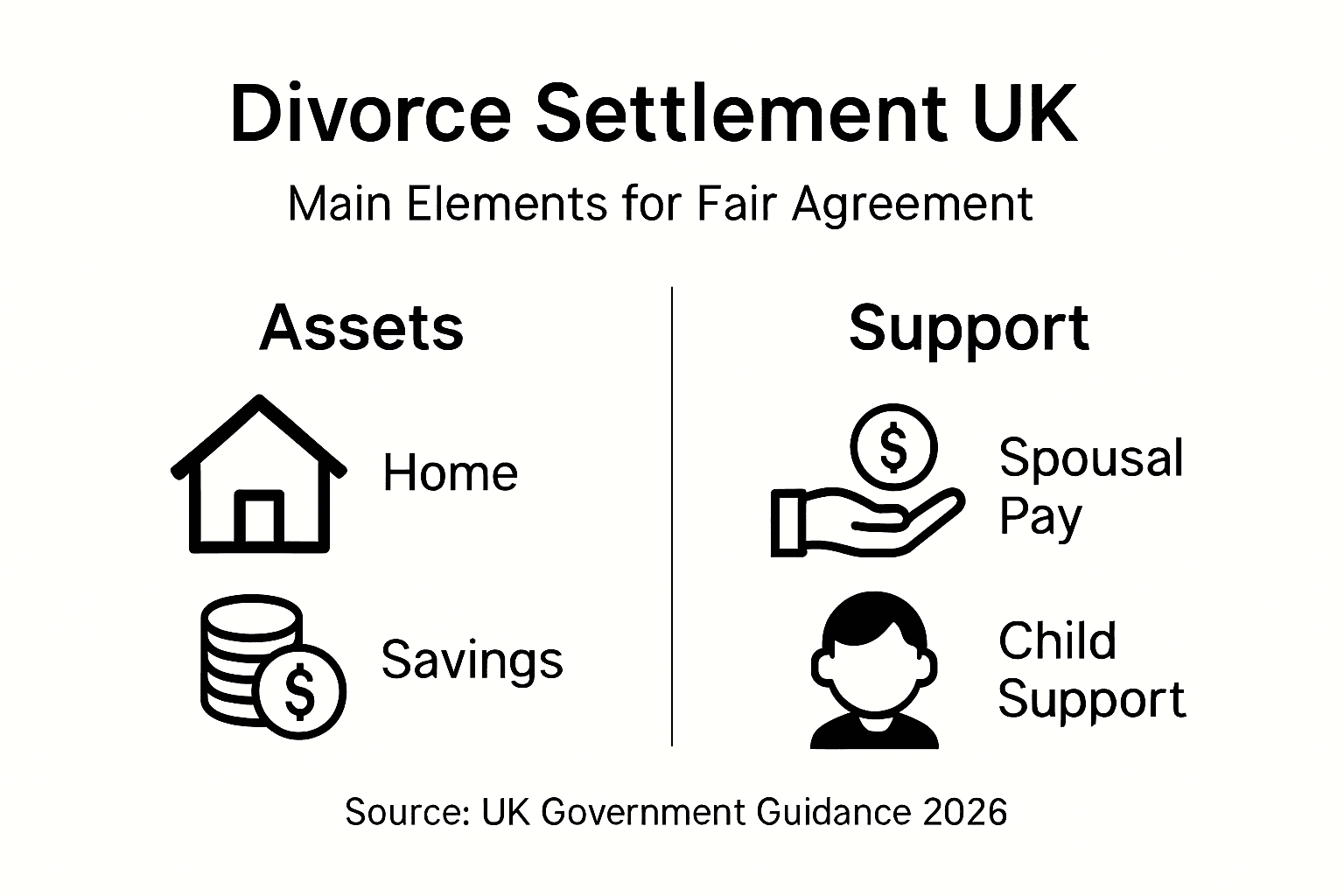
Key Factors Courts Consider
Judges weigh these circumstances when deciding financial settlements:
- Financial needs: What does each person need to house, feed, and support themselves and any children?
- Earning capacity: What can each person earn now and in future?
- Age and health: Younger people may retrain or earn more; older people face different challenges.
- Non-economic contributions: Did one spouse sacrifice career to raise children or manage the home?
- Length of marriage: Longer marriages typically result in more equal division.
- Welfare of children: Their housing, education, and financial security are prioritised.
- Standard of living: Courts try to maintain a reasonable standard for both parties post-divorce.
Child Support and Maintenance
If you have children, child support is calculated based on both parents’ income and the children’s needs. The Child Maintenance Service provides standard calculations, though courts can deviate in complex cases.
Spousal maintenance (support for your ex-spouse) may be temporary, rehabilitative to help them retrain, or permanent depending on circumstances. It’s separate from asset division.
When the Court Decides
If you cannot agree, the court reviews all financial evidence and makes binding decisions. A judge will:
- Analyse each party’s income, assets, and liabilities
- Consider the factors listed above
- Determine a division that achieves fairness
- Issue a court order binding both parties
This is expensive, lengthy, and removes your control. Most people reach agreement faster through mediation.
Fair doesn’t always mean equal—it means each party receives what they need and what’s proportionate to their contributions and circumstances.
Pro tip: Gather complete financial records before negotiating: mortgage statements, pension valuations, business accounts, and tax returns. The more thoroughly you document assets, the faster and fairer your settlement will be.
Legal Requirements and Court Process
Divorce in the UK follows a structured legal path. Understanding the statutory requirements and court process helps you know what to expect and when. This timeline applies whether you settle amicably or proceed to contested hearings.
The Divorce Application
The process begins when you (the applicant) submit a divorce application to the court. You must establish that your marriage has irretrievably broken down. The court reviews your application to ensure it meets legal requirements.
Once approved, you must wait a statutory period before progressing. This waiting period exists to allow reflection and negotiation time.
The Conditional Order (Decree Nisi)
After the waiting period, you can apply for a conditional order, formerly called a decree nisi. This is not yet final—it signals the court’s agreement that your marriage can end, but you’re not divorced yet.
Both parties receive notice at this stage. If your spouse disputes the divorce, the court may require hearings to resolve disagreements about grounds.
The Final Order (Decree Absolute)
The final order (decree absolute) is what legally ends your marriage. You apply for this after the conditional order has been issued. Once granted, you’re officially divorced and free to remarry.
Throughout this entire process, parties can negotiate financial settlements and make arrangements for children.
Mandatory Mediation Information Assessment
Before court proceedings on financial matters, you must attend a mediation information assessment meeting (MIAM). This isn’t mediation itself—it’s an appointment where a mediator explains how mediation works and whether it’s suitable for your situation.
The MIAM is compulsory unless specific exemptions apply (domestic abuse, urgency, or inability to contact the other party).
Financial Settlement Timelines
If you reach agreement through mediation or negotiation, your solicitors draft a consent order for court approval. This typically takes weeks.
If you cannot agree, the court process involves:
- Filing a financial order application
- Exchanging financial statements (Forms E)
- Attending directions hearings
- Possibly attending a final hearing where a judge decides
Contested cases take 12–24 months or longer.
Making Agreements Legally Binding
Simply reaching agreement isn’t enough. You must submit your consent order to court for approval. A judge reviews it and, if satisfied, stamps it as a court order.
Once approved, it’s legally binding and enforceable. Either party breaking the terms can face court sanctions.
Court Fees and Legal Aid
Court fees apply at various stages of the divorce process. Legal Aid may be available if you qualify based on income and the nature of your case (particularly if domestic abuse is involved).
Mediation often costs significantly less than court proceedings, making it financially sensible to explore settlement first.
The court process protects both parties by creating legally binding agreements neither can escape later—but it’s slower and more expensive than negotiated settlement.
What Happens if You Cannot Agree?
If settlement discussions fail, the court will decide your financial matters. A judge reviews all evidence, considers statutory factors, and issues a binding order. You lose control over the outcome.
This is why most people in Romford and East London settle through mediation when possible.
Pro tip: Attend your MIAM even if you think mediation won’t work—it’s a mandatory first step, and mediators often find common ground where you see none. It costs far less than discovering later that court was unavoidable.
Key Factors: Assets, Maintenance, Costs
Three elements dominate every divorce settlement: what you own, what you owe each other going forward, and what the process costs. Understanding these factors helps you anticipate realistic outcomes and budget appropriately.
Asset Division: The Foundation
Assets form the largest part of most settlements. Your matrimonial assets—property, pensions, savings, investments, and valuables acquired during marriage—are divided fairly between you.
Common assets in divorce include:
- The family home and any buy-to-let properties
- Pensions (yours and your spouse’s)
- Bank accounts and savings
- Investment portfolios and shares
- Vehicles and valuable items
- Business interests or professional practices
- Life insurance policies with cash value
Debts accumulated during marriage are also divided fairly. This includes mortgages, personal loans, credit cards, and other liabilities. The court doesn’t simply assign debt to whoever incurred it—it considers who benefited and what’s equitable.
Maintenance and Spousal Support
Maintenance (spousal support) is separate from asset division. The division of assets such as property, pensions, and debts considers longer-term financial security, but maintenance addresses ongoing income support.
Maintenance can take three forms:
- Temporary maintenance: Paid during divorce proceedings to cover living costs
- Rehabilitative maintenance: Time-limited support whilst your ex retrains or rebuilds earning capacity
- Permanent maintenance: Ongoing support, typically in long marriages or where one party cannot realistically work
Factors affecting maintenance include length of marriage, each party’s earning capacity, age, health, and any childcare responsibilities.
Child Maintenance
Child maintenance is calculated using the Child Maintenance Service guidelines based on the paying parent’s net income. If the non-resident parent earns over a certain threshold, the standard formula may be adjusted.
Child maintenance continues until your child turns 18 (or later if in full-time education up to age 20). It’s assessed separately from spousal maintenance and asset division.
The Real Cost of Divorce
Your settlement is also shaped by what you spend getting there. Costs include:
- Solicitor fees: Often £150–£350+ per hour
- Court fees: Application fees, hearing fees, consent order fees
- Mediation: Typically £150–£300 per person per session
- Expert valuations: Needed for property, pensions, or business interests
- Counsel (barristers): If contested hearings are required
Mediated settlements typically cost £2,000–£5,000. Contested court cases easily reach £10,000–£30,000+ per party. Legal Aid may cover costs if you qualify based on income.
This table summarises key cost components to budget for in a UK divorce:
| Cost Component | Typical Price Range | Impact on Settlement Size |
|---|---|---|
| Solicitor Fees | £150–£350+ per hour | Higher costs reduce settlement |
| Mediation Sessions | £150–£300 per session/person | Lowers overall legal expenditure |
| Court Proceedings | £10,000–£30,000+ per party | Significant reduction of assets |
| Expert Valuations | £500–£2,000+ | Essential for fair asset split |
How These Factors Interconnect
Assets, maintenance, and costs work together. A larger settlement of assets might reduce maintenance obligations. High dispute costs reduce what each party ultimately receives. Fair settlement considers all three.
Every pound spent on legal fees is a pound unavailable for your post-divorce life—which is why settlement often makes more financial sense than fighting.
Protecting Yourself Financially
You need clear valuations of all assets before negotiating. Pension valuations, property surveys, and business accountants’ reports cost money upfront but prevent unfair divisions later.
Understanding maintenance obligations helps you budget realistically. If you’re paying, you’ll need to factor support into your post-divorce income. If you’re receiving, don’t overestimate—courts rarely award generous ongoing support.
Pro tip: Request a “costs estimate” from your solicitor upfront: what will mediation cost versus court proceedings? Often seeing the financial difference shifts couples towards settlement quickly.
Secure a Fair and Binding Divorce Settlement with Expert Legal Support
Navigating the complexities of a divorce settlement can feel overwhelming, especially when you face challenges like dividing assets, agreeing on maintenance, or dealing with child arrangements. This article highlights the importance of formalising your agreement through a consent order to ensure your financial settlement is legally binding and protects your future well-being. At Signature Law, we understand the emotional strain and financial impact divorce can bring, which is why our experienced Family Law solicitors are dedicated to guiding you through every step with clarity and compassion.
If you want to avoid the stress and uncertainty of prolonged court battles and instead reach a fair outcome tailored to your circumstances, consider starting with expert advice on Financial Settlements and Child Arrangement Orders. Don’t wait until disputes escalate. Get the legal assurance you deserve by speaking with a Family Law specialist who can explain how mediation, consent orders, and the court process might apply to you.
Take control of your divorce settlement today. Contact Signature Law for a personalised consultation that puts your rights and future first.
Frequently Asked Questions
What is a divorce settlement?
A divorce settlement is a legally binding agreement between spouses that outlines the division of financial assets, property, pensions, debts, and other obligations upon the conclusion of a marriage.
How does a divorce settlement become legally binding?
To make a divorce settlement legally binding, it must be formalised through a consent order, which is a court document that both parties sign and that a judge approves. Without this, the agreement is not enforceable.
What types of issues are covered in a divorce settlement?
A divorce settlement typically covers financial assets, property divisions, pensions, maintenance payments, debts, and personal belongings such as cars and jewellery.
Why is mediation preferred in divorce settlements?
Mediation is often preferred because it allows couples to reach a mutual agreement more quickly and cost-effectively than contested court proceedings, while also maintaining privacy and reducing stress.
Recommended
- Estate Planning in Divorce – Protecting Your Children | Signature Law
- Family Law – How It Affects Everyday Life in the UK | Signature Law
- 7 Types of Family Law Agreements Every Parent Should Know | Signature Law
- Probate Costs UK 2026: What Families Must Know | Signature Law
- Why File Jointly: Real Tax Savings for Couples