





Family Law
What is conveyancing? Your complete UK guide for 2026

TL;DR:
- Conveyancing is the legal process that transfers property ownership in England and Wales. It involves detailed legal checks, searches, and registration handled by qualified professionals. Early instruction of a solicitor helps prevent delays and ensures a smooth property transaction.
Conveyancing is the formal legal procedure that transfers ownership of property from one party to another in England and Wales. Every residential property sale or purchase requires it, and without it, legal title cannot pass. The process is governed by the Law of Property Act 1925 and overseen by professionals regulated by the Solicitors Regulation Authority. Whether you are buying your first home or selling a family property, understanding how conveyancing works before you instruct a solicitor puts you in a far stronger position from the outset.
What is conveyancing and what does it actually involve?
Conveyancing is defined as the legal transfer of property ownership, covering every step from the acceptance of an offer to the registration of the new owner at HM Land Registry. It is not simply paperwork. It is a structured legal process that verifies the seller’s right to sell, checks the property’s legal status, and protects both parties from future disputes.
A qualified solicitor or licensed conveyancer carries out this work on your behalf. The Solicitors Regulation Authority regulates solicitors, while the Council for Licensed Conveyancers regulates licensed conveyancers. Both are legally qualified to handle residential property transactions, though solicitors can also advise on related legal matters such as family law or probate.
The conveyancing definition most people encounter online understates the complexity involved. Checking title, reviewing planning permissions, investigating restrictive covenants, and coordinating with mortgage lenders are all part of the work. Each of these steps carries legal weight, and an error at any stage can affect your ownership rights for years to come.
What are the main steps in the conveyancing process?
The conveyancing process follows a clear sequence, though the pace of each stage depends on the parties involved and the complexity of the transaction. Understanding the steps in conveyancing helps you know what to expect and where delays are most likely to arise.
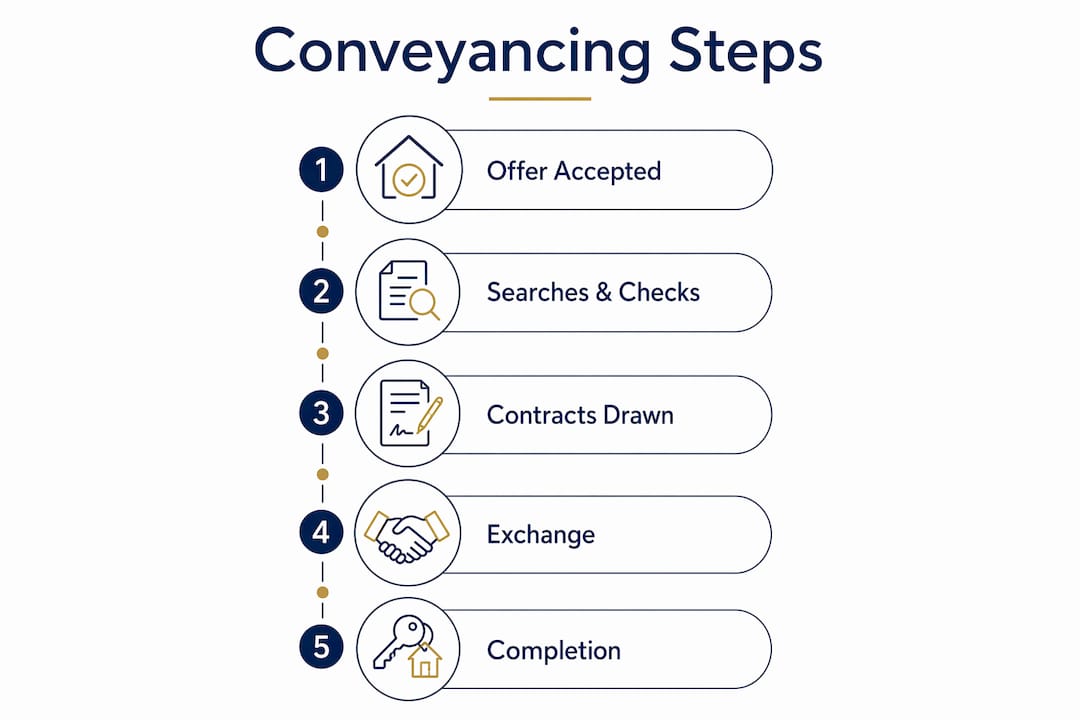
The typical conveyancing stages run as follows:
- Instruction. You appoint a solicitor or licensed conveyancer immediately after your offer is accepted. They open your file, carry out anti-money laundering checks, and request the contract pack from the seller’s solicitor.
- Property searches. Your solicitor submits searches to the local authority, water authority, and environmental agencies. These reveal planning restrictions, flood risk, drainage responsibilities, and any proposed developments nearby.
- Title investigation and enquiries. Your solicitor reviews the title deeds and raises formal enquiries with the seller’s solicitor. This stage uncovers issues such as missing planning consents, boundary disputes, or rights of way.
- Mortgage arrangements. If you are purchasing with a mortgage, your lender issues a formal mortgage offer. Your solicitor reviews the conditions and reports to you before exchange.
- Exchange of contracts. Both parties sign identical contracts and your solicitor exchanges them with the seller’s solicitor. At this point, the transaction becomes legally binding and you pay your deposit, typically 10% of the purchase price.
- Completion. Your solicitor transfers the remaining funds to the seller’s solicitor. Keys are released and you become the legal owner. Your solicitor then registers the transfer at HM Land Registry and pays any Stamp Duty Land Tax due.
Pro Tip: Ask your solicitor for a written timeline at the point of instruction. Knowing which stage you are at and what is outstanding reduces anxiety and helps you respond to requests promptly.
How long does conveyancing typically take?
The average conveyancing transaction takes approximately 123 days from offer acceptance to completion in 2026. That figure represents a 64% increase since 2007. The practical implication is clear: what once took around ten weeks now regularly takes seventeen or more.

Most buyers expect a much faster process. Research shows a significant “certainty gap” between consumer expectations of a 6–7 week completion and the reality of a process that routinely extends well beyond that. Understanding this gap from the start prevents frustration and helps you plan your moving arrangements more realistically.
The table below summarises the key timeline benchmarks and the factors that most commonly extend them.
| Stage or factor | Typical duration or impact |
|---|---|
| Offer to exchange | 8–14 weeks on average |
| Exchange to completion | 1–4 weeks, agreed by both parties |
| Replies to enquiries | Average 52 days to receive responses |
| Overall transaction (2026) | Approximately 123 days (17.5 weeks) |
| Missing documentation | Adds weeks to the process |
| Lender delays | Can extend mortgage offer processing significantly |
Delays most commonly arise from late replies to enquiries, incomplete documentation, and the coordination required between solicitors, lenders, local authorities, and estate agents. Instructing a solicitor early upon offer acceptance allows critical checks such as anti-money laundering verification and contract review to begin immediately, which reduces avoidable delays at later stages.
Pro Tip: If you are in a chain, ask your solicitor to confirm the status of all other parties in the chain at least once a fortnight. Chains stall when one party falls behind, and early awareness gives you time to act.
What are the typical costs involved in conveyancing?
Conveyancing costs in the UK fall into two categories: professional legal fees and disbursements. Disbursements are third-party charges your solicitor pays on your behalf, such as local authority search fees and Land Registry registration fees.
The key cost ranges to budget for are:
- Legal fees: £800 to £1,800 for a standard freehold purchase, depending on the property value and complexity of the transaction.
- Local authority searches: typically £250 to £450, varying by local council.
- HM Land Registry fees: calculated on a sliding scale based on the purchase price.
- Bank transfer charges: usually £20 to £50 per transfer.
- Stamp Duty Land Tax: payable on purchases above the relevant threshold, calculated separately from conveyancing fees.
Total conveyancing costs, including all disbursements, commonly fall between £1,200 and £2,500 for a freehold property. Leasehold properties carry additional complexity and typically incur a surcharge of £200 to £500 on top of standard fees. This reflects the extra work involved in reviewing the lease, service charge accounts, and ground rent arrangements. If you are purchasing a leasehold property, read more about leasehold enfranchisement to understand your long-term rights as an owner.
Always request a full written fee estimate before instructing a solicitor. A clear estimate should itemise legal fees and every anticipated disbursement separately. Avoid firms that quote only their professional fee without disclosing the full cost picture.
Why is professional legal support crucial in conveyancing?
Attempting to handle conveyancing without a qualified professional is legally possible for cash buyers in limited circumstances, but it carries serious risk. A professional conveyancer mitigates risks including invalid titles, restrictive covenants, missing planning permissions, and other legal issues that could generate costly disputes long after completion.
The legal risks a solicitor protects you from include:
- Title defects. A property may have an unregistered owner, a disputed boundary, or a gap in the chain of ownership. Your solicitor identifies and resolves these before exchange.
- Restrictive covenants. These are legally binding obligations attached to the land, such as restrictions on extending the property or running a business from it. Breaching a covenant after purchase can result in legal action.
- Missing planning permissions. If a previous owner built an extension without consent, you inherit that liability. Your solicitor checks planning history and advises on indemnity insurance where needed.
- Chancel repair liability. Certain properties in England carry an ancient obligation to contribute to church repairs. A solicitor checks for this and arranges insurance if required.
- Leasehold pitfalls. Short leases, high service charges, and onerous lease terms can affect your mortgage eligibility and future resale value.
Pro Tip: When choosing a conveyancing solicitor, ask specifically about their experience with your property type. A solicitor who regularly handles leasehold transactions will spot issues that a generalist might miss.
A solicitor also manages the legal negotiations between parties, advises you on the implications of contract terms, and ensures your mortgage lender’s requirements are met. The cost of professional legal support is modest relative to the value of the transaction it protects.
What practical steps can you take for a smooth conveyancing experience?
Preparation before and during the conveyancing process makes a measurable difference to how quickly your transaction completes. Most delays are not caused by legal complexity. They are caused by slow responses, missing documents, and poor communication between parties.
Follow these steps to give your transaction the best chance of completing on time:
- Instruct your solicitor immediately after offer acceptance. Do not wait until you have a formal mortgage offer. Early instruction allows anti-money laundering checks and initial searches to begin straight away.
- Gather your documents in advance. You will need proof of identity, proof of address, and evidence of your deposit funds. Sellers should locate title deeds, planning consents, building regulations certificates, and any guarantees for works carried out.
- Respond to enquiries promptly. Every day you delay in responding to your solicitor adds time to the process. Treat requests for information as urgent.
- Maintain clear communication with your estate agent. Your agent can chase the other side’s solicitor and keep the chain moving. Keep them informed of your progress.
- Understand your leasehold obligations before exchange. If you are buying a leasehold property, read the lease carefully with your solicitor before you commit. Surprises after exchange are far more costly than questions asked before it.
- Set realistic expectations for your moving date. Do not book removals or give notice on a rental property until exchange of contracts has taken place. Only at exchange does the completion date become legally binding.
For broader guidance on the property buying process, Signaturelaw’s tips for buying property in the UK covers the full picture from offer to completion.
Key takeaways
Conveyancing is the legal process that transfers property ownership, and getting it right requires professional guidance, realistic timelines, and thorough preparation from the outset.
| Point | Details |
|---|---|
| Conveyancing definition | The legal transfer of property ownership, governed by the Law of Property Act 1925 and regulated by the Solicitors Regulation Authority. |
| Average timeline in 2026 | Transactions take approximately 123 days from offer to completion, a 64% increase since 2007. |
| Typical total costs | Between £1,200 and £2,500 for freehold properties, with an additional £200 to £500 for leasehold transactions. |
| Biggest cause of delays | Late replies to enquiries average 52 days, adding nearly two months to the overall transaction. |
| Most effective action | Instruct a solicitor immediately after offer acceptance to begin critical checks without delay. |
Why I think most buyers underestimate conveyancing until it is too late
Having worked closely with property clients for many years, the pattern I see most often is this: buyers treat conveyancing as an administrative formality rather than a legal process with real consequences. They focus on the mortgage, the survey, and the moving date. The legal transfer of ownership feels like background noise until something goes wrong.
The 123-day average transaction time tells you something important. It is not that conveyancers are slow. It is that the process involves multiple parties, each with their own timelines and pressures, and the coordination required is genuinely complex. The buyers who complete fastest are almost always the ones who instructed their solicitor on the day their offer was accepted, responded to every request within 24 hours, and asked questions early rather than late.
I have also seen clients choose a conveyancer purely on price, only to find that the saving of a few hundred pounds cost them weeks of delay and, in one case, the loss of their purchase entirely when the chain collapsed. The right solicitor is not the cheapest one. It is the one who communicates clearly, moves quickly, and knows the issues to look for before they become problems.
Preparation and professional guidance are not optional extras in conveyancing. They are the difference between a transaction that completes on time and one that does not.
— George
How Signaturelaw supports your property transaction
Signaturelaw’s residential conveyancing solicitors handle property transactions across the UK, with particular strength in Romford, East London, and Essex. The firm offers transparent fee structures, clear communication at every stage, and the personal attention that volume-based firms cannot provide. Founded by solicitor Sital Somaiya, who has over 15 years of experience and has been featured on BBC and ITV, Signaturelaw brings both legal authority and genuine care to every transaction. If your property matter also involves a separation or divorce, the firm’s expertise across both conveyancing and family law means you receive joined-up advice under one roof. Contact Signaturelaw today at signaturelaw.co.uk/contact-us to discuss your property transaction.
FAQ
What is conveyancing in simple terms?
Conveyancing is the legal process of transferring property ownership from a seller to a buyer. It covers searches, contract review, exchange, and registration at HM Land Registry.
How long does the conveyancing process take in 2026?
The average transaction takes approximately 123 days from offer acceptance to completion in 2026, representing a 64% increase since 2007.
What are typical conveyancing costs in the UK?
Total conveyancing costs, including legal fees and disbursements, typically fall between £1,200 and £2,500 for a freehold property, with an additional £200 to £500 for leasehold transactions.
Do I need a solicitor for conveyancing?
Cash buyers can technically handle conveyancing themselves, but the legal risks involved, including title defects, restrictive covenants, and missing planning permissions, make professional legal representation strongly advisable for all buyers and sellers.
When should I instruct a conveyancing solicitor?
Instruct your solicitor immediately after your offer is accepted. Early instruction allows anti-money laundering checks and property searches to begin straight away, which reduces avoidable delays later in the transaction.
Recommended
- Why use conveyancing: your essential UK property guide | Signature Law
- Commercial conveyancing guide for separating couples 2026 | Signature Law
- Conveyancing Solicitors Harold Wood: Clear Guidance for a Smooth Property Journey | Signature Law
- Why use a conveyancing solicitor for divorce property | Signature Law