





Family Law
Protect rental property: a practical guide for UK landlords

TL;DR:
- Protecting rental properties in the UK involves thorough tenant checks, documentation, and specialist insurance to mitigate income loss, legal liabilities, and asset damage. Proper compliance with safety certificates, deposit protection, and clear records is essential for enforcing possession rights under new laws. Insurance, security measures, and legal support are critical to safeguarding income and minimizing costs during disputes or void periods.
Protecting a rental property preserves your income, limits your legal exposure, and guards the long-term value of your asset. Without the right safeguards in place, a single problem tenant, an uninsured repair, or a missing safety certificate can cost you months of rent and thousands in legal fees.
Three risks sit at the heart of every landlord’s exposure:
- Income loss — rent arrears, void periods, and tenants who simply stop paying
- Legal liability — injury claims, regulatory fines of up to £40,000 under the Renters’ Rights Act 2025, and rent repayment orders that can cover substantial amounts of rent over multiple years
- Asset damage — malicious damage, neglected maintenance, and unoccupancy risks that erode the property’s condition and value
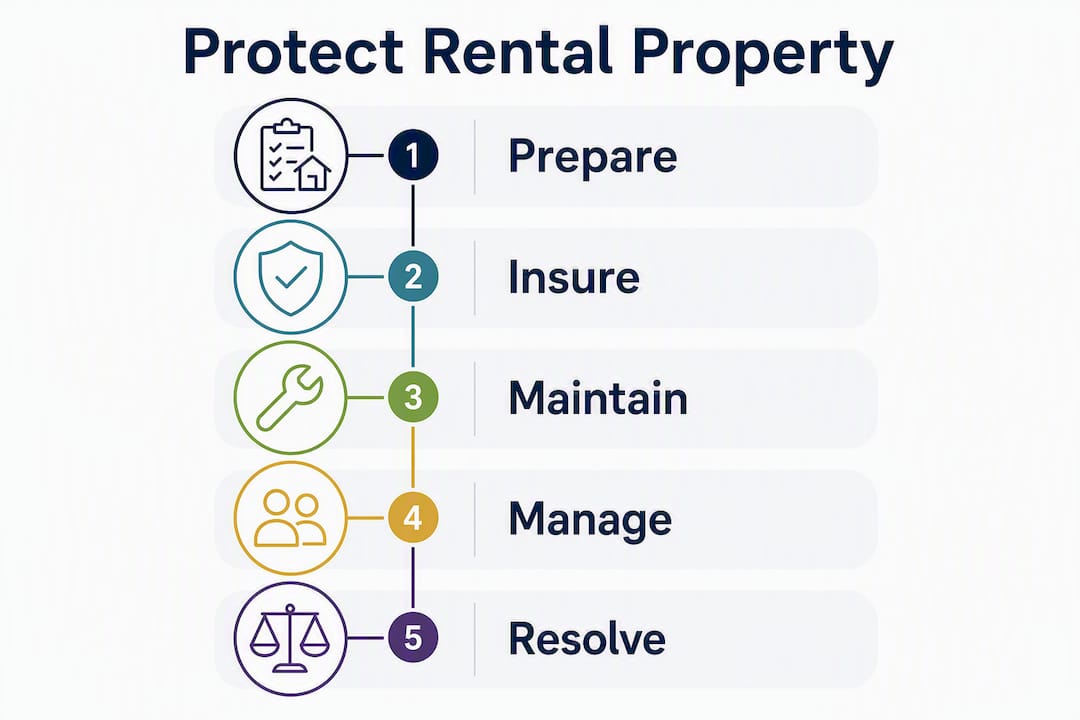
The protection pillars that address all three are straightforward:
- Thorough tenant checks and Right to Rent compliance
- A written tenancy agreement with a properly protected deposit
- Specialist landlord insurance covering buildings, liability, and rent guarantee
- Planned maintenance, safety certificates, and a clear evidence trail
Get these right before a tenancy begins and you are in a fundamentally stronger position if anything goes wrong.
Table of Contents
- Why protecting your rental property starts before a tenant moves in
- Which insurance products protect your rental income?
- Physical security and planned maintenance that reduce claims
- How to manage problem tenants and the legal protections available
- When should you contact a solicitor?
- Key takeaways
- A solicitor’s perspective on why compliance changes everything
- How Signaturelaw supports landlords facing disputes and compliance challenges
- Useful sources for UK landlords
Why protecting your rental property starts before a tenant moves in
The most cost-effective protection decisions happen before keys are handed over. Landlords who skip pre-tenancy controls tend to discover the gap only when they need to enforce their rights, at which point the options are narrower and the costs are higher.
1. Tenant referencing and Right to Rent checks
- Run a full credit and reference check through a recognised referencing agency. Verify employment income, previous landlord references, and any county court judgements.
- Carry out Right to Rent checks on every adult occupant before the tenancy starts. Keep a dated copy of the documents you checked. Failure to do so can result in a civil penalty of up to £3,000 per occupant.
- For higher-risk applicants, consider a guarantor and obtain the guarantee in writing before the tenancy agreement is signed.
2. Written tenancy agreement and permitted clauses
- Use a written assured shorthold tenancy agreement for every letting. The government publishes a model tenancy agreement as a starting point.
- Record permitted clauses clearly: pets policy, subletting restrictions, and the tenant’s repair obligations. Ambiguous terms are regularly used against landlords in deposit disputes.
3. Deposit protection within statutory timescales
- Protect the deposit in a government-approved scheme (Deposit Protection Service, MyDeposits, or Tenancy Deposit Scheme) within 30 days of receipt. Serve the prescribed information on the tenant within the same period.
- Failing to protect a deposit can result in penalties of 1–3 times the deposit amount and will independently block a Section 8 possession claim.
4. Photographic inventory and check-in procedure
- Produce a detailed, dated photographic inventory before the tenant moves in. Have it signed by the tenant at check-in.
- Repeat the process at check-out and note every discrepancy. Without a signed inventory, deposit deductions are almost impossible to defend at adjudication.
5. Rent collection and payment routes
- Set up a standing order rather than relying on bank transfers. A standing order creates a payment record that is harder to dispute.
- For tenants with limited credit history, consider a rent guarantor or a larger deposit where permitted.
6. Safety certificates and recordkeeping
- Obtain a gas safety certificate (CP12) annually and an Electrical Installation Condition Report (EICR) every five years. Keep dated copies of both.
- Store all certificates, service records, and correspondence in a single organised file. Courts and tribunals expect to see this evidence in possession proceedings.
Pro Tip: Set a calendar reminder 60 days before each CP12 and EICR renewal date. Letting a certificate lapse, even briefly, can block a possession claim under the post-Renters’ Rights Act 2025 regime.
Which insurance products protect your rental income?
Specialist landlord insurance is not a single product but a suite of protections, and it is fundamentally different from a standard home policy. Most buy-to-let mortgage lenders require it, and a standard home policy typically becomes void the moment a tenant moves in. Many landlords discover this only when they make a claim.
Core covers to consider
| Cover type | What it protects | Key point |
|---|---|---|
| Buildings insurance | Rebuild cost after fire, flood, subsidence | Required by most mortgage lenders |
| Contents (landlord’s fixtures) | Carpets, white goods, furniture you own | Excludes tenant’s belongings |
| Property owners’ liability | Injury or damage claims by tenants or visitors | Most specialist policies provide £2m–£5m as standard |
| Loss of rent | Income lost while property is uninhabitable after an insured event | Separate from rent guarantee |
| Rent guarantee | Covers arrears when a tenant stops paying | Typically covers a duration sufficient to support recovery efforts up to a monthly cap |
| Legal expenses | Funds Section 8 possession proceedings and rent recovery | Often bundled with rent guarantee |
When is rent guarantee insurance worth the premium?
Since Section 21 no-fault evictions were abolished on 1 May 2026 under the Renters’ Rights Act 2025, recovering possession through Section 8 takes considerably longer. Proceedings can run for many months, and the associated court and solicitor costs are significant. A rent guarantee policy that covers 8–12 months of arrears, combined with legal expenses cover, shifts much of that financial risk to the insurer. For landlords with a single property and no substantial cash reserve, the premium is almost always justified.
Typical premiums for a standard single-let property start from roughly £15–£22 per month, though the actual figure depends on rebuild cost, location, property type, and claims history.
Policy pitfalls to check before you buy
- Unoccupancy clauses: many policies restrict or void cover if the property is vacant for 30–60 consecutive days. Notify your broker before a planned void period.
- HMO disclosure: failing to declare that a property is a house in multiple occupation can void the policy entirely.
- Malicious damage exclusions: some policies exclude damage caused by tenants. Confirm this is covered before you rely on it.
- Maintenance-related exclusions: gradual deterioration and damp caused by neglected repairs are routinely excluded. Planned maintenance is your first line of defence here.
Physical security and planned maintenance that reduce claims
Good security and a regular maintenance routine do more than protect the building. They reduce the frequency and severity of insurance claims, strengthen your position in any dispute, and keep void periods short by maintaining the property’s condition and appeal.

Security essentials
| Area | Minimum standard | Why it matters |
|---|---|---|
| Entry doors | Five-lever mortice lock or BS3621-rated lock | Reduces forced-entry claims and may be required by insurers |
| Windows | Key-operated locks on all ground-floor windows | Common insurer requirement; deters opportunistic entry |
| External lighting | PIR-activated lighting at front and rear | Deters malicious damage and theft |
| Alarm | Audible alarm with signage | Reduces risk of break-in during void periods |
Planned maintenance calendar
- Annual: gas safety inspection (CP12), boiler service, smoke alarm and carbon monoxide alarm testing
- Every five years: EICR, full roof and gutter inspection
- At each tenancy change: full photographic inventory, lock change or re-key, and a visual check of all appliances
For HMOs, inspection cadences are more frequent and licensing conditions may impose additional requirements. Single-family homes and flats have different vulnerability profiles; a flat in a managed block may have communal maintenance obligations that sit with the freeholder rather than you.
Managing unoccupancy risk
A property left empty for more than 30–60 days can trigger unoccupancy clauses in your policy, restricting or removing cover. If you are refurbishing between tenancies or struggling to let, arrange a specialist unoccupied property policy before the standard threshold is reached. Ask a local contractor to carry out a visual check every two weeks and keep a written record of each visit. That record can be decisive if you need to make a claim during a void period.
Pro Tip: Add a home emergency add-on to your landlord policy. It covers call-out costs for boiler failures, burst pipes, and electrical faults, and gives tenants a direct number to call, which reduces the risk of a repair being ignored and escalating into a larger claim.
How to manage problem tenants and the legal protections available
The Renters’ Rights Act 2025, which came into force on 1 May 2026, abolished Section 21. Section 8 is now the principal route to possession in England, and compliance gaps can independently block a claim. Understanding the process, and the evidence it requires, is no longer optional.
Early steps when problems arise
- Send a written notice of arrears as soon as rent is one day late. Keep a copy.
- Maintain a dated log of all contact with the tenant: calls, texts, emails, and letters.
- Offer a repayment plan in writing if the tenant is in genuine short-term difficulty. A documented offer shows good faith and can be relevant if the matter reaches court.
- For antisocial behaviour, gather evidence from neighbours and local authorities before serving any notice.
Red flags that require immediate action
- Deposit not protected or prescribed information not served: this blocks possession and exposes you to a penalty of 1–3 times the deposit amount.
- Missing or expired CP12 or EICR: a court will not grant a possession order if required certificates were not served on the tenant.
- Repeated refusal to allow access for repairs: document every request and refusal in writing.
- Malicious damage or serious antisocial behaviour: photograph the damage immediately and report to the police to obtain a crime reference number.
The Section 8 possession route: what to expect
- Identify the relevant ground for possession (for example, Ground 8 for rent arrears of three months or more, or Ground 14 for antisocial behaviour).
- Serve a valid Section 8 notice with the correct notice period. For most rent arrears grounds, the notice period is four months; for antisocial behaviour, it can be shorter and you may apply to court immediately.
- If the tenant does not vacate, apply to the county court for a possession order.
- Attend the hearing with your evidence bundle: tenancy agreement, deposit protection certificate, CP12, EICR, rent account, and all correspondence.
- If the order is granted and the tenant still does not leave, apply for a warrant of possession.
The full process can take many months from the first notice to physical possession. Legal costs and court fees accumulate throughout. Rent guarantee and legal expenses insurance materially reduces that financial exposure.
What courts expect to see
Post-Renters’ Rights Act 2025, courts commonly require: a valid gas safety certificate served on the tenant, a current EICR, a valid EPC, proof of deposit protection with prescribed information served, and the Renters’ Rights Act information sheet. A gap in any of these can result in the claim being struck out or adjourned, adding further delay and cost. You can find a detailed breakdown of the compliance requirements in Signaturelaw’s landlord compliance guide.

Practical cost exposure
Unpaid rent during a contested Section 8 process, combined with court fees, solicitor costs, and potential repair bills, can run to several thousand pounds before a possession order is granted. A rent repayment order, if the tribunal finds you have committed a relevant offence, can now be up to two years’ rent. The cost of getting protection right at the outset is a fraction of that exposure.
When should you contact a solicitor?
Not every landlord problem requires immediate legal representation, but some situations genuinely do. Acting too late, or attempting to handle complex proceedings without specialist advice, tends to increase both cost and delay.
Situations that warrant specialist legal advice
- Contested possession claims: if a tenant disputes the grounds, raises a counterclaim, or alleges a disrepair defence, you need a solicitor before the first hearing.
- Deposit disputes involving large sums or allegations of improper deduction: adjudication decisions can be appealed, and the process benefits from legal preparation.
- Personal injury claims: a tenant or visitor injured at the property may bring a claim against you. Your insurer will usually appoint solicitors, but you should understand your obligations.
- Rent repayment order threats: if a tenant or local authority applies for an RRO, the financial exposure is significant. Early legal advice can limit the award or defeat the claim.
- Awaab’s Law and damp/mould obligations: the Renters’ Rights Act 2025 introduced stricter repair timescales. Allegations of non-compliance can carry both financial penalties and possession consequences.
What a landlord solicitor does in practice
A specialist solicitor will review your evidence, identify any compliance gaps before they become fatal to your claim, draft compliant notices, and represent you at court or tribunal. They can also negotiate settlements that avoid the cost and delay of a full hearing. The role of a landlord solicitor is as much about preparation and risk assessment as it is about courtroom advocacy.
What to prepare before your first appointment
- Signed tenancy agreement and any addenda
- Deposit protection certificate and prescribed information
- CP12, EICR, and EPC certificates
- Dated photographic inventory (check-in and check-out where available)
- Full rent account showing all payments and arrears
- Chronological log of all communications with the tenant
Fixed-fee advice versus full representation
For straightforward cases, a fixed-fee initial consultation gives you a clear picture of your position and the likely cost of proceeding. Where the matter is complex or contested, full representation is usually more cost-effective than attempting to manage proceedings yourself and correcting errors later. Signaturelaw offers fixed-fee initial consultations, so you can understand your options before committing to a course of action.
Key takeaways
Protecting a rental property in England requires compliance, insurance, and documented evidence working together: a gap in any one of them can block possession and expose you to significant financial loss.
| Point | Details |
|---|---|
| Protect the deposit immediately | Register in an approved scheme within 30 days and serve prescribed information; failure blocks Section 8 and triggers penalties of 1–3x the deposit. |
| Book your CP12 and EICR | Annual gas safety and five-yearly electrical checks are mandatory; missing certificates independently block possession claims post-Renters’ Rights Act 2025. |
| Take a photographic inventory | A signed, dated inventory at check-in and check-out is your primary evidence in deposit disputes and damage claims. |
| Review your landlord insurance | Standard home policies are void once a property is let; specialist cover including rent guarantee and legal expenses is the practical response to longer Section 8 timelines. |
| Signaturelaw for legal support | Signaturelaw provides fixed-fee landlord and tenant advice, possession proceedings support, and deposit dispute guidance across the UK. |
A solicitor’s perspective on why compliance changes everything
The landlords who come to us in the strongest position are almost never the ones with the most straightforward tenants. They are the ones who kept good records. A gas safety certificate renewed on time, a deposit protected on the correct date, an inventory signed by the tenant at check-in: these are not bureaucratic formalities. They are the difference between a possession claim that proceeds and one that is struck out at the first hearing.
Since Section 21 was abolished, I have seen cases where a landlord had a genuinely strong factual position, months of documented arrears, clear evidence of damage, and a tenant who had simply stopped engaging. The claim still failed at the first stage because the prescribed deposit information had not been served correctly. That is not a technicality the court will overlook. It is a statutory bar, and it means starting again.
The practical lesson is this: compliance is not a backstop you reach for when things go wrong. It is the foundation that makes every other protection work. If you have any doubt about whether your paperwork is in order, the time to check is now, not when you are three months into arrears and preparing a court bundle. Signaturelaw’s landlord tenant dispute guidance sets out exactly what courts expect to see and how to prepare it.
How Signaturelaw supports landlords facing disputes and compliance challenges
Signaturelaw gives landlords in England direct access to specialist legal advice on possession proceedings, deposit disputes, and tenancy compliance, without the uncertainty of open-ended billing. Whether you are dealing with a tenant in arrears, facing a rent repayment order application, or simply unsure whether your paperwork is court-ready, the firm’s landlord and tenant dispute service provides clear, fixed-fee guidance from solicitors who understand the post-Renters’ Rights Act 2025 environment.
Founded by solicitor Sital Somaiya, who has over 15 years’ experience and has been featured on BBC and ITV, Signaturelaw takes a practical, evidence-focused approach: reviewing your compliance position, identifying gaps before they become fatal to a claim, and representing you at court or tribunal where needed. Fixed-fee initial consultations mean you understand your options and likely costs before committing to a course of action.
To speak to a landlord solicitor, contact Signaturelaw today.
Useful sources for UK landlords
- GOV.UK: Renters’ Rights Act 2025 enforcement measures — official guidance on financial penalties, offences, and the enforcement process under the 2025 Act.
- GOV.UK: Renters’ Rights Act overview for landlords — plain-language summary of the main changes to possession, rent, and tenancy rules from 1 May 2026.
- GOV.UK: Right to Rent checks — step-by-step guidance on conducting and recording Right to Rent checks for all adult occupants.
- GOV.UK: Model assured shorthold tenancy agreement — a government-published template tenancy agreement suitable as a starting point for most residential lettings.
- Deposit Protection Service (DPS) — one of the three government-approved custodial deposit protection schemes; free to use for landlords.
- Tenancy Deposit Scheme (TDS) — government-approved scheme offering both custodial and insured deposit protection options.
- MyDeposits — third government-approved deposit protection scheme, widely used by private landlords and letting agents.
- Health and Safety Executive: Gas safety for landlords — official guidance on annual CP12 requirements, engineer qualifications, and record-keeping obligations.
This article provides general information for UK landlords and does not constitute legal advice. Landlord and tenant law is subject to change; confirm current requirements with a qualified solicitor or the relevant primary source before acting.
Recommended
- Landlord legal tips 2026: your compliance guide | Signature Law
- Landlord tenant law in the UK: your 2026 guide | Signature Law
- Step-by-step divorce guide for landlords in the UK | Signature Law
- Understanding the role of landlord solicitors in UK housing | Signature Law