





Family Law
Commercial conveyancing guide for separating couples 2026

TL;DR:
- Commercial conveyancing is a complex legal process involving transfer of ownership in business properties, especially during separations.
- Early specialist advice can help navigate lengthy timelines, legal risks, and unique issues like tenancy rights and VAT.
- Proper legal support ensures fair resolution and protection of financial interests in the challenging context of divorce.
When a relationship breaks down and business or mixed-use property is involved, the legal process becomes far more complex than most people expect. Commercial conveyancing is not simply a faster or slower version of buying a family home. It is an entirely different discipline, with its own rules, risks, and timelines. If you and your former partner share a commercial property, whether that is a shop, office, or a flat above a business premises, understanding this process early could protect your financial future and reduce unnecessary stress during an already difficult time.
Table of Contents
- What is commercial conveyancing?
- How does commercial conveyancing work in the UK?
- Common challenges in commercial conveyancing for divorcing couples
- Protecting your interests: Legal and practical support during commercial conveyancing
- A compassionate approach: Why specialist conveyancing advice really matters
- How Signature Law can support your commercial conveyancing journey
- Frequently asked questions
Key Takeaways
| Point | Details |
|---|---|
| Longer process | Commercial conveyancing usually takes longer than residential, often lasting 3-6 months due to added complexity. |
| Unique challenges | Divorcing couples may face obstacles like covenants, tenancies, and negotiation delays not seen in simple house sales. |
| Specialist support needed | Early advice from a specialist solicitor noticeably reduces risk and ensures fair outcomes in commercial family property transfers. |
| Legal frameworks matter | Law Society forms and standards help protect both parties and ensure correct procedures are followed. |
What is commercial conveyancing?
Commercial conveyancing is the legal process of transferring ownership or rights in commercial property. This includes outright sales and purchases, lease assignments, and commercial remortgages. It applies to offices, retail units, warehouses, development land, and mixed-use buildings. For separating couples, it becomes relevant whenever a shared business asset forms part of the matrimonial estate.
Understanding the commercial conveyancing process is essential because it differs significantly from what most people experience when buying or selling a home. The role of conveyancing solicitors in commercial matters is broader, more technical, and involves a wider range of third parties including lenders, tenants, planning authorities, and environmental consultants.
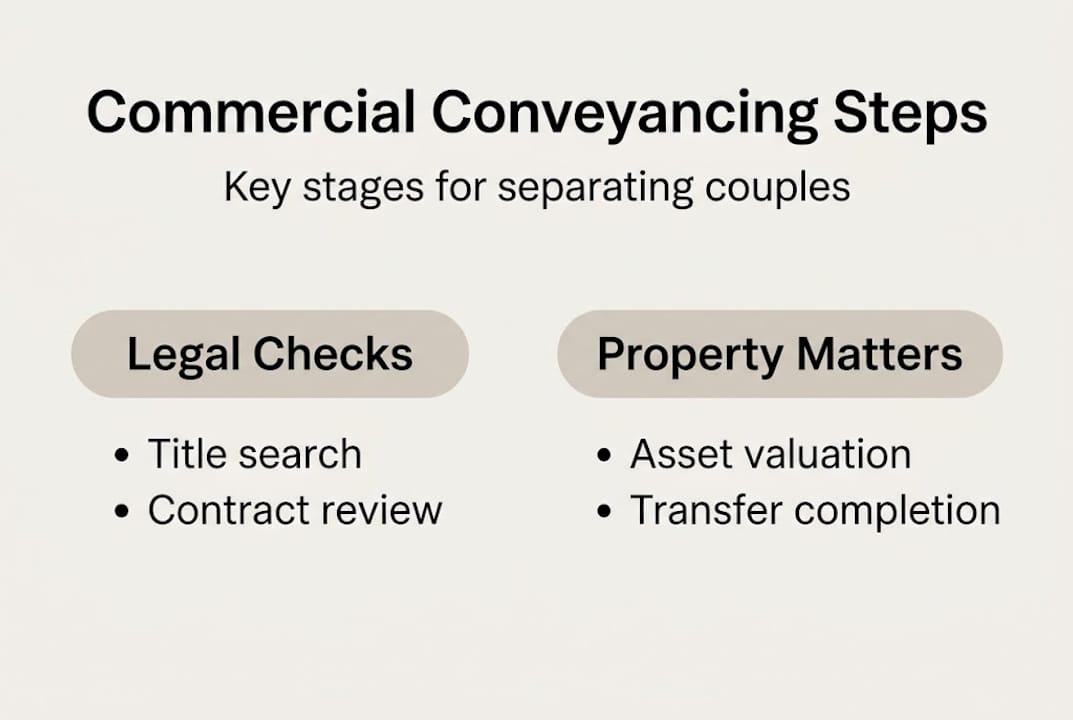
The table below illustrates the key differences between commercial and residential conveyancing:
| Feature | Commercial conveyancing | Residential conveyancing |
|---|---|---|
| Typical timeline | 3 to 6 months (8 to 16 weeks) | 8 to 12 weeks |
| Due diligence scope | Extensive: planning, tenancies, environmental | Standard searches |
| Parties involved | Solicitors, lenders, tenants, surveyors | Solicitors, lenders, estate agents |
| VAT considerations | Often applicable | Rarely applicable |
| Complexity of title | Frequently complex | Usually straightforward |
| Law Society standards | Property standards apply | CQS scheme applies |
For divorcing or separating couples, commercial conveyancing matters for several specific reasons:
- A family business premises may need to be sold or transferred as part of a financial settlement
- Mixed-use properties require specialist handling that standard residential solicitors are not equipped for
- Joint ownership structures must be formally unwound, often requiring court orders
- Tenancy agreements attached to the property add layers of legal obligation
- VAT elections and tax implications can significantly affect the net value received by each party
Approaching this process without specialist guidance is one of the most common and costly mistakes separating couples make.
How does commercial conveyancing work in the UK?
Once you understand what commercial conveyancing is, the next step is knowing how it actually unfolds. The process is methodical, but it can be disrupted at any stage, particularly when the parties involved are also navigating a divorce or separation.
Here is a step-by-step outline of how a typical commercial conveyancing transaction progresses:
- Instruction of solicitors. Both parties instruct their own solicitors. In a divorce context, independent legal advice is not just advisable, it is often essential to protect your interests.
- Heads of terms agreed. The key commercial terms, price, lease length, deposit, and conditions, are agreed in principle before legal work begins.
- Due diligence. Your solicitor investigates title, planning permissions, environmental matters, tenancy agreements, and any outstanding disputes. This stage is far more detailed than in residential transactions.
- Drafting and negotiation of contracts. Commercial contracts are bespoke documents. They take time to negotiate, particularly when co-owners disagree.
- Dealing with joint ownership. Where the property is held jointly, both parties must consent to the transaction. If consent is withheld, a court order may be required under family law proceedings.
- Exchange of contracts. Once both parties are satisfied, contracts are exchanged and a completion date is set.
- Completion and registration. The transaction completes, funds are transferred, and the new ownership is registered at HM Land Registry.
Timelines for this process are typically 8 to 16 weeks, considerably longer than residential transactions, due to the complexity of due diligence and the need for detailed negotiations. Delays are common when parties are also involved in contested family proceedings.

The solicitor’s role in property transfer during divorce goes beyond the transaction itself. Your solicitor must ensure that any consent order from the family court is properly reflected in the commercial conveyancing documents, so that the transfer is legally sound from both a property and family law perspective.
Pro Tip: Instruct a specialist commercial conveyancing solicitor at the earliest possible stage. The Law Society confirms that early specialist instruction significantly reduces the risk of costly delays and legal disputes later in the process.
Common challenges in commercial conveyancing for divorcing couples
Knowing the steps is one thing. Anticipating where things can go wrong is another matter entirely. Commercial property transactions during divorce or separation are particularly vulnerable to a range of complications that would not arise in a straightforward residential sale.
Some of the lesser-known commercial conveyancing obstacles that regularly affect separating couples include:
| Challenge | Why it matters | Practical solution |
|---|---|---|
| Late restrictive covenants | Limit future use of the property | Obtain indemnity insurance early |
| Title discrepancies | Can delay or invalidate the transaction | Commission a full title investigation |
| Access rights disputes | Affect the property’s value and usability | Resolve via negotiation or court order |
| Unregistered land | Requires first registration, adding time | Instruct solicitors immediately |
| VAT election issues | Can create unexpected tax liabilities | Take specialist tax advice in parallel |
| EPC ratings below D | May require costly upgrades before sale | Commission an energy assessment early |
| Building Safety Act obligations | Applies to high-risk buildings | Check compliance with your solicitor |
| Unresolved tenancy agreements | Tenants have legal rights that bind any buyer | Review all leases before marketing |
Before you sign anything, make sure you have checked the following:
- Whether the property is registered at HM Land Registry
- Whether any tenants have security of tenure under the Landlord and Tenant Act 1954
- Whether a VAT election has been made on the property
- Whether there are any outstanding planning conditions or enforcement notices
- Whether service charge accounts are up to date and reconciled
Pro Tip: Ask your solicitor directly whether the property has any unresolved planning permissions, service charge disputes, or access issues before you agree to any heads of terms. Choosing the right solicitor with specific commercial expertise is not optional in these circumstances. The Law Society’s TA forms and CQS accreditation provide a standardised framework that helps protect both parties and ensures professional accountability throughout.
Protecting your interests: Legal and practical support during commercial conveyancing
With the challenges clearly in view, the focus must shift to what you can actively do to protect yourself. Being prepared, informed, and properly represented makes an enormous difference to both the outcome and the experience.
Here is how to approach commercial conveyancing during a divorce or separation in a way that safeguards your position:
- Seek independent legal advice immediately. Do not share a solicitor with your former partner. Independent representation ensures your interests are prioritised without compromise.
- Gather all relevant documents early. This includes title deeds, lease agreements, planning permissions, energy performance certificates, and any existing mortgage or loan documentation.
- Understand your ownership structure. Whether you hold the property as joint tenants or tenants in common affects how it can be transferred and what share you are entitled to.
- Obtain a current valuation. An independent commercial property valuation is essential before any settlement discussions. Values can differ significantly from residential estimates.
- Align your family law and conveyancing proceedings. Ensure your family law solicitor and your conveyancing solicitor are communicating. Any consent order must be drafted to reflect the commercial transaction accurately.
- Plan for delays. Build contingency time into any financial settlement. Commercial transactions regularly take longer than anticipated, and a rushed process increases the risk of errors.
“The importance of instructing a specialist at the earliest stage cannot be overstated. Commercial property transactions carry risks that are simply not present in residential conveyancing, and those risks are amplified when the parties are also navigating the emotional and legal complexities of a relationship breakdown. Early, expert advice is the single most effective protection available.”
The importance of solicitor advice in these situations extends beyond paperwork. A good solicitor will help you understand your rights, manage your expectations, and guide you towards a resolution that is fair and legally secure.
A compassionate approach: Why specialist conveyancing advice really matters
There is a widely held assumption that any competent solicitor can handle a commercial property transaction. In our experience, that assumption causes real harm to people who are already vulnerable.
When a relationship ends and a business asset is involved, the emotional and financial stakes are at their highest. Generic legal advice, however well-intentioned, is rarely sufficient. The nuances of commercial title, lease obligations, and tax elections require a level of specialism that goes beyond general practice. We have seen separating couples lose significant sums, and years of goodwill, because they underestimated the complexity of the process or tried to manage it without proper support.
The regret is almost always the same. People wish they had sought specialist advice sooner. Not because the outcome would necessarily have been different, but because the process would have been clearer, less frightening, and more manageable.
If you are facing a situation involving commercial property and a relationship breakdown, please do not assume that cutting corners will save you money. It rarely does. You can find further legal insights on our website, but the most important step is speaking to someone who understands both sides of your situation.
How Signature Law can support your commercial conveyancing journey
At Signature Law, we understand that dealing with specialist commercial conveyancing during a separation is one of the most stressful experiences a person can face. Our team combines genuine legal expertise with a compassionate, personalised approach that treats you as an individual, not a case number. Whether you need family law support alongside your conveyancing advice, or simply need someone to explain your options clearly, we are here to help. Founded by BBC and ITV-featured solicitor Sital Somaiya, with over 15 years of experience, Signature Law offers fixed-fee consultations and multilingual support across the UK. Speak to our team today and take the first step towards clarity.
Frequently asked questions
How long does commercial conveyancing take in the UK?
Commercial conveyancing typically takes 3 to 6 months (8 to 16 weeks), which is considerably longer than most residential transactions due to the added complexity of due diligence, lease reviews, and negotiations.
What special challenges do divorcing couples face in commercial conveyancing?
Separating couples frequently encounter issues such as restrictive covenants, title discrepancies, unresolved tenancy agreements, VAT complications, and EPC rating obligations, all of which can significantly delay or complicate the transaction.
Why should I choose a specialist commercial conveyancing solicitor for my divorce?
A specialist solicitor helps you navigate complex legal risks, protects your financial interests, and ensures compliance with Law Society standards including TA forms and CQS accreditation, which are specifically designed to safeguard both parties in commercial transactions.
Can commercial conveyancing be completed without both parties’ signature in a divorce?
In most cases, both co-owners must agree and sign for the transaction to proceed. However, if one party withholds consent unreasonably, the family court can make an order requiring the transaction to go ahead under family law provisions.
Recommended
- Conveyancing solicitor’s role in divorce property splits | Signature Law
- Solicitor’s role in divorce property transactions UK 2026 | Signature Law
- Step-by-step UK divorce process: Essential guide for 2026 | Signature Law
- Your essential divorce checklist for the UK: Step-by-step guide | Signature Law