





Family Law
Why structured legal advice matters for UK SMEs

Structured legal advice is one of the most underused tools available to UK small and medium-sized enterprises. Research shows that formal advice raises productivity by around 10% within a year, with legal, regulatory, and tax topics delivering the greatest gains. Yet only 25% of small businesses use professional legal help when a legal issue arises. The gap between those two facts is where real business risk lives.
For SME owners navigating family law, property transactions, or estate planning, the stakes are personal as well as commercial. A divorce that touches a business, a property deal that goes wrong, or an estate left without a proper will can each unravel years of work. Structured legal guidance, delivered by qualified professionals, prevents those outcomes.
Key benefits at a glance:
- Productivity gains: Codified legal advice on regulatory, legal, and tax matters raises SME productivity by about 10%.
- Legal confidence: SMEs with high legal confidence are more likely to use professional help and achieve fairer outcomes.
- Risk reduction: Early legal intervention prevents costly disputes in contracts, employment, and property.
- Estate and family protection: Structured advice in wills, probate, and family law secures personal and business assets.
- Compliance certainty: Qualified solicitors keep you aligned with evolving regulatory obligations.
Table of Contents
- How traditional and growth-oriented SMEs differ in their legal needs
- How structured legal advice drives SME competitiveness and security
- Why the quality of your legal adviser shapes the outcome
- How to access structured legal advice through Signaturelaw
- Key takeaways
How traditional and growth-oriented SMEs differ in their legal needs
Not every SME needs the same kind of legal support, and treating them as though they do is one of the most common mistakes in advisory services.
Research distinguishes clearly between two types of SME. Traditional firms focus on day-to-day operational stability: managing suppliers, maintaining cashflow, and resolving immediate problems as they arise. Growth-oriented firms, by contrast, are making longer-term decisions about structure, investment, and scale. Their legal exposure is fundamentally different, and so is the advice they need.
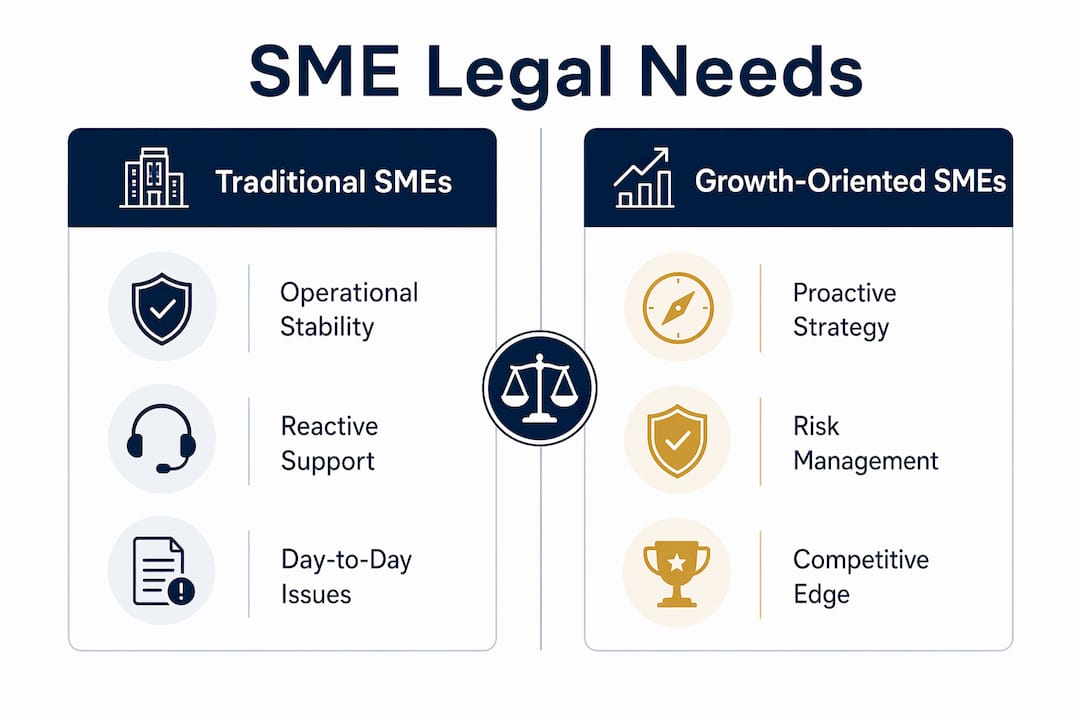
For a traditional SME, reactive legal help often feels sufficient. A dispute arises, a solicitor is called, the matter is resolved. The problem is that this approach leaves underlying vulnerabilities untouched. A sole trader running a property portfolio, for example, may have no will in place, no shareholder agreement, and no plan for what happens to the business if they become incapacitated. Those are not operational problems. They are structural ones.
Growth-oriented firms face a different set of pressures. Bringing in co-founders, raising capital, or expanding into commercial premises all create legal commitments that compound over time. Strategic advice plays a central role in unlocking the innovative potential of firms, leading to productivity-enhancing behaviours beyond reactive problem-solving.
Where family law, property, and estate planning intersect with SME ownership, the distinction matters most:
- A traditional SME owner going through divorce may not realise that business assets and divorce are treated as matrimonial assets unless properly structured.
- A growth-oriented firm acquiring commercial premises needs conveyancing advice that accounts for lease terms, liability caps, and future development plans.
- Both types of SME benefit from a clear will and inheritance plan, but the complexity of that plan scales with the business.
How structured legal advice drives SME competitiveness and security

The evidence on this point is clear. Strategic legal advice is a powerful driver of SME competitiveness, yet it remains consistently underused by firms focused on immediate operational pressures. The firms that do engage with it gain a measurable advantage.
Structured advice works because it is codified and specific. A solicitor reviewing a commercial lease does not offer generic reassurance; they identify the clauses that create risk, explain what those risks mean in practice, and advise on what to negotiate. That kind of precise, professional input is what separates firms that grow with confidence from those that discover problems only after they have become expensive.
The practical benefits across key legal areas include:
- Contracts: Clear terms around payment, liability, and intellectual property prevent disputes before they start. Without legal review, vague clauses can cost tens of thousands to resolve.
- Employment: Compliant contracts and policies reduce tribunal exposure and protect workplace relationships.
- Regulatory compliance: Qualified solicitors track changes in law and update your arrangements accordingly.
- Family law: For SME owners, family law affects everyday life and business assets simultaneously. Divorce proceedings, child arrangements, and cohabitation agreements all carry financial consequences for the business.
- Property: Whether buying commercial premises or managing a rental portfolio, early legal support reduces risk and enables scaling with confidence.
- Estate planning: A properly drafted will and inheritance plan protects the business from disruption if the owner dies or loses capacity.
The cost of not acting is rarely visible until it is too late. A vague supplier contract leads to a dispute. A missing intellectual property clause means a departing employee walks away with your designs. An intestate estate creates family conflict at the worst possible moment. Structured advice closes those gaps before they open.
Why the quality of your legal adviser shapes the outcome
Advice is only as good as the professional delivering it. Research confirms that advice effectiveness depends on the firm’s readiness, willingness, and ability to act on it, as well as the quality, clarity, and relevance of what is provided. Generic or poorly communicated advice produces poor outcomes regardless of the underlying legal knowledge.
Qualified solicitors with direct experience in family law, property, and estate planning bring something that general advisers cannot: codified, specific knowledge that is trusted precisely because it comes from an accredited professional. That trust matters. SMEs with high legal confidence tend to use professional help more, describe outcomes as fairer, and report better results.
What distinguishes genuinely effective legal advisers:
- They explain your position in plain terms, without drowning you in jargon.
- They balance your legal risk against your commercial reality, cashflow, and relationships.
- They tell you what is urgent and what can wait.
- They confirm next steps in writing so nothing is missed.
- They understand your stage of growth and tailor their advice accordingly.
Pro Tip: When selecting a solicitor for your SME, ask them directly how they would handle a situation where the legally cautious answer conflicts with your commercial goal. A good adviser will walk you through the trade-off, not simply default to the most conservative position.
Signaturelaw was founded by solicitor Sital Somaiya, who brings over 15 years of experience in family law, conveyancing, and estate planning. Featured on BBC and ITV, Sital combines legal authority with a genuinely personal approach. The firm offers fixed-fee legal services and multilingual support, making structured advice accessible to SME owners who need clarity without unpredictable costs.
How to access structured legal advice through Signaturelaw
Getting structured legal support in place does not need to be complicated. The most important step is simply starting the conversation before a problem arises, not after.
Signaturelaw offers a focused range of services that directly address the legal needs of SME owners in family law, property, and estate planning:
- Family law: Divorce, financial settlements, child arrangements, pre-nuptial agreements, and domestic abuse protection. Legal Aid is available for eligible clients.
- Conveyancing: Residential and commercial property transactions, transfer of equity, leasehold matters, and landlord and tenant disputes.
- Wills and probate: Will writing, grant of probate, estate administration, and inheritance planning.
The process is straightforward. A fixed-fee initial consultation gives you a clear picture of your legal position without financial uncertainty. From there, Signaturelaw builds a plan tailored to your specific circumstances, whether you are a sole trader managing a property portfolio, a business owner going through separation, or a family planning for the future.
Pro Tip: Do not wait for a dispute or a deadline to seek legal advice. The most cost-effective time to engage a solicitor is before you sign a contract, before a relationship breaks down, or before an estate becomes complicated. Early advice is almost always cheaper than late remediation.
For SME owners where divorce negotiation intersects with business assets, or where property and family matters overlap, Signaturelaw’s cross-practice expertise means you receive joined-up advice rather than fragmented guidance from multiple sources.
To speak with a solicitor about your legal needs, contact Signaturelaw today.
Key takeaways
Structured legal advice delivers measurable productivity gains and legal confidence for UK SMEs, with the greatest impact coming from qualified professionals providing codified guidance on legal, regulatory, and estate matters.
| Point | Details |
|---|---|
| Productivity impact | Formal legal advice raises SME productivity by 10%, with legal and regulatory topics yielding the largest gains. |
| Legal confidence gap | Only 25% of small businesses use professional legal help; those who do achieve significantly fairer outcomes. |
| Strategic vs reactive advice | Growth-oriented SMEs need strategic legal planning, not just reactive problem-solving when issues arise. |
| Adviser quality matters | Effective advice depends on qualified professionals who communicate clearly and balance legal risk with commercial reality. |
| Early engagement pays | Engaging a solicitor before problems arise is consistently more cost-effective than resolving disputes after the fact. |
Recommended
- Essential divorce negotiation tips for UK business owners | Signature Law
- Why use fixed fee legal services in the UK | Signature Law
- Estate planning guide UK: secure your family’s future in 2026 | Signature Law
- Why consider property trusts for UK estate planning | Signature Law