





Family Law
Step-by-step divorce guide for landlords in the UK

TL;DR:
- Divorce involving rental properties adds legal and financial complexities that require careful legal advice.
- Landlords must disclose all rental income and understand how properties are valued, transferred, or sold during proceedings.
Divorce is complicated enough on its own. When you own rental property, the process carries an additional layer of financial and legal complexity that most general guides simply do not address. As a landlord, you face decisions about buy-to-let assets, tenant obligations, capital gains tax, and mortgage liability — all while navigating the formal divorce procedure itself. This step-by-step divorce guide for landlords sets out the key stages clearly, so you know what to expect and where the critical decisions lie.
The core procedural stages are: filing your divorce application, obtaining a conditional order, reaching a financial settlement, and receiving the final order. Alongside each stage, landlord-specific concerns arise — particularly around full financial disclosure, which must include all rental income, mortgage statements, and tenancy agreements. Courts treat buy-to-let properties as matrimonial assets in most cases, meaning they sit firmly within the financial settlement process.
Key documents to gather from the outset:
- Mortgage statements for each rental property
- Current tenancy agreements and rent schedules
- Property valuations (vacant possession and tenanted)
- Rental income records and tax returns
- Details of any outstanding repairs or liabilities
Typical timelines run from six months for an uncontested divorce to well over a year where financial proceedings are disputed. Costs vary considerably depending on whether matters are resolved by agreement or through contested court hearings.
Table of Contents
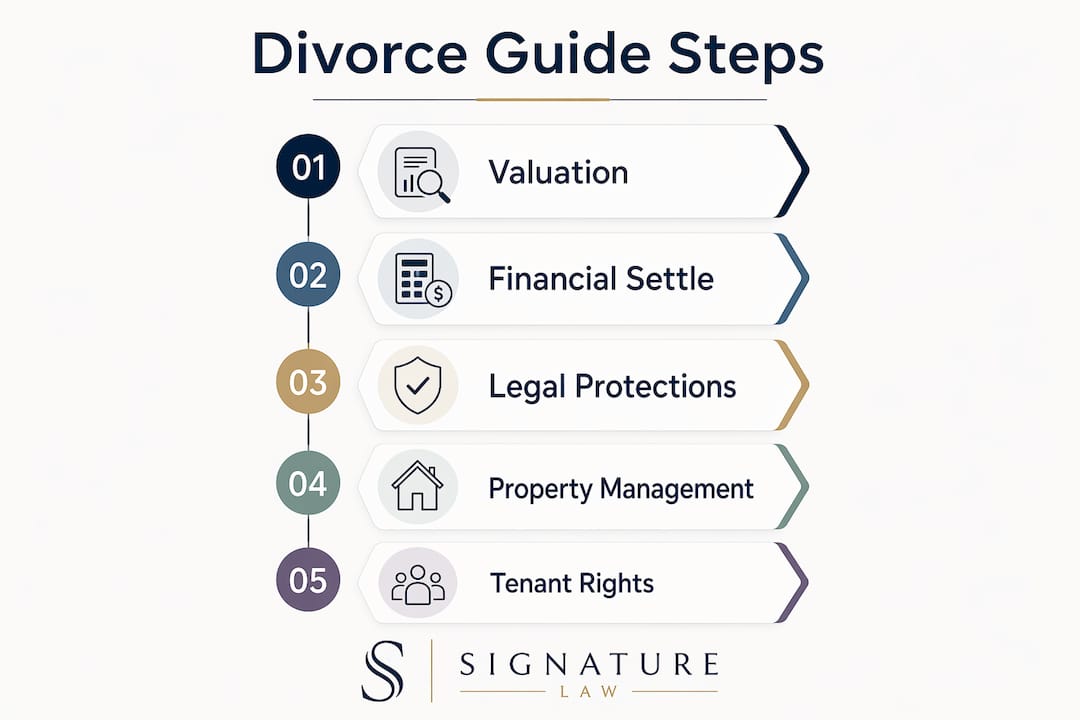
- How financial settlements work when rental properties are involved
- How to manage your rental properties during divorce proceedings
- Legal protections that safeguard your rights as a landlord after divorce
- What are your options for rental property ownership after divorce?
- How does divorce affect your existing tenants and your obligations to them?
- Strategies for negotiating property division when rental income is involved
- How Signaturelaw supports landlords through divorce and property matters
- Key takeaways
How financial settlements work when rental properties are involved
Property division in divorce involving buy-to-let assets requires careful analysis of each property’s net equity, rental yield, and outstanding mortgage. Courts in England and Wales operate under the Matrimonial Causes Act 1973, which gives judges broad discretion rather than a fixed formula. Court decisions on property division consider marriage length, children’s housing needs, financial circumstances, and comprehensive property valuations when determining fair settlements.
Three main options exist for handling rental properties:
- Transfer to one spouse, with the other receiving offsetting assets such as a larger share of the family home or pension
- Sale of the property, with proceeds divided between both parties
- Continued joint ownership under a formal co-ownership agreement, often used where an immediate sale would be financially disadvantageous
One factor that catches many landlords off guard is the impact of tenanted status on sale value. A rental property sold with a tenant in situ typically has a 10–25% lower sale value compared to vacant possession, which directly affects how equity is calculated and negotiated.
Tax implications are equally significant. Transfers made under formal divorce agreements can occur on a no-gain/no-loss basis for capital gains tax purposes. Outside that structure, CGT at 18% or 24% may apply on a market-value disposal. Stamp Duty Land Tax exemptions are also available on court-ordered transfers, but only where the correct legal framework is in place.
Many financial disputes involving rental properties are resolved without a court hearing through mediation or negotiated settlement, with a consent order then confirmed by the court. A consent order is legally binding and prevents either party from making future financial claims once the divorce is finalised.

Pro Tip: Always obtain a specialist valuation that distinguishes between vacant possession value and tenanted value before entering financial negotiations. The difference can be substantial and will shape the entire settlement discussion.
How to manage your rental properties during divorce proceedings
Without a clear strategy for who manages rent collection, maintenance, and tenant communication, portfolios risk mismanagement during divorce settlements. This is not a theoretical concern. Missed repairs, uncollected rent, and unresponsive communication can erode both property value and tenant goodwill at precisely the moment you need stability.
Where a property is jointly owned, both landlords are jointly and severally liable and must agree on granting tenancies, serving possession notices, or accepting surrenders. Disagreements between co-owners can leave tenants in limbo and expose both parties to legal risk.
Practical steps to protect your portfolio during proceedings:
- Agree in writing who is responsible for day-to-day management, including maintenance calls and rent collection
- Consider appointing a letting agent to act as a neutral intermediary
- Where agreement proves impossible, courts can appoint a receiver to manage the property
- Keep all rental income in a clearly designated account and document every transaction
- Maintain regular communication with tenants to preserve occupancy and avoid void periods
Existing tenancies continue unaffected by divorce. You cannot end a tenancy, serve a Section 21 notice, or remove a tenant simply because ownership is in dispute. Your landlord responsibilities during divorce remain fully intact throughout proceedings.
Legal protections that safeguard your rights as a landlord after divorce
Securing your position legally is not something to address after the financial settlement is agreed. It requires attention throughout the process. A consent order, approved by the court, makes any financial agreement legally binding and prevents an ex-spouse from making future claims once the divorce is finalised. Without one, financial claims can be brought years later.
For property transfers specifically, formal court orders unlock SDLT exemptions and allow transfers on a no-gain/no-loss CGT basis. Proceeding informally, outside a court order, removes those protections entirely and can trigger an immediate tax liability.
Key legal steps to protect your position:
- Obtain a formal property valuation before any settlement discussions begin
- Ensure all rental income is fully declared in financial disclosure
- Register your interest in jointly owned property with HM Land Registry if there is any risk of unilateral action
- If one spouse is to be removed from a mortgage, confirm with the lender that a sole remortgage is viable before agreeing to the transfer
- Instruct a solicitor with specific experience in buy-to-let divorce cases, not just general family law
The solicitor’s role in divorce property transactions extends well beyond drafting paperwork. A specialist will identify CGT exposure, advise on the timing of transfers relative to tax year-end, and ensure the consent order reflects the full complexity of a rental portfolio.
What are your options for rental property ownership after divorce?
Once the financial settlement is agreed, you need a clear structure for how each property will be held going forward. The three principal outcomes are sole ownership by one party, a clean sale, or a continuing joint arrangement.
Sole ownership is often the cleanest resolution. One party retains the property, the other receives equivalent value elsewhere in the settlement. This requires a transfer of equity, a new mortgage in the sole owner’s name, and updated Land Registry entries.
Sale and division of proceeds suits situations where neither party wishes to retain the property, or where the equity is needed to fund separate housing. Bear in mind the tenanted discount discussed above when calculating net proceeds.
Continued joint ownership is less common post-divorce but sometimes used where an immediate sale would crystallise a loss or where rental income is needed by both parties in the short term. A formal co-ownership agreement setting out management responsibilities, income division, and an exit mechanism is non-negotiable in this scenario.
How does divorce affect your existing tenants and your obligations to them?
Your tenants’ rights are entirely separate from your matrimonial proceedings. Existing assured shorthold tenancies continue on their current terms regardless of any change in ownership. Neither party can unilaterally end a tenancy, and attempting to do so without proper legal grounds exposes you to significant liability.
Where ownership transfers to one spouse, the incoming sole owner steps into the existing landlord’s shoes. The tenancy agreement remains valid, deposit protection obligations transfer, and all statutory repair and safety duties continue without interruption. Tenants must be notified of any change in landlord in writing, and their deposit must remain protected throughout.
If the property is to be sold, the buyer takes on the tenancy unless vacant possession is agreed. That agreement requires proper notice under the tenancy terms and cannot be accelerated simply because a divorce is in progress. For detailed guidance on landlord and tenant disputes that can arise during ownership transitions, specialist legal advice is worth taking early.
Strategies for negotiating property division when rental income is involved
Rental income properties require a different negotiating approach to the family home. The asset’s value is not just its capital worth but its ongoing yield, its mortgage terms, and its management demands. Treating it purely as a capital figure in a spreadsheet often produces an unfair outcome for one party.
Effective negotiation strategies include:
- Income capitalisation: present the property’s value as a combination of net equity and projected rental yield, not just market value
- Portfolio-level assessment: where multiple properties exist, courts assess the portfolio as a whole rather than property by property, which creates room for creative offsetting
- Pension offsetting: a rental portfolio generating income can be offset against a larger pension share for the other party, allowing both to retain assets suited to their circumstances
- Deferred sale orders: where children’s housing needs are a factor, courts can order that a property is retained and sold at a future date, with income managed in the interim
The role of financial settlements in UK divorce is to achieve fairness across all assets, not simply to divide each one equally. A solicitor experienced in buy-to-let matters will identify which approach best protects your long-term financial position.
How Signaturelaw supports landlords through divorce and property matters
Divorce involving rental property demands legal advice that spans both family law and property law. Signaturelaw, founded by solicitor Sital Somaiya with over 15 years’ experience and recognised by both BBC and ITV, provides exactly that combination. The firm’s family law solicitors advise landlords on financial settlements, consent orders, property transfers, and tenant obligations throughout the divorce process.
Fixed-fee initial consultations mean you understand the cost before you commit. Legal Aid is available for eligible clients. Multilingual advice is offered where needed. Every client receives personal, bespoke support rather than a volume-driven service. To discuss your situation with a solicitor who understands both the legal and practical realities of owning rental property through divorce, contact Signaturelaw today at signaturelaw.co.uk/contact-us.
Key takeaways
Divorce involving buy-to-let property requires a consent order, specialist valuations, and clear management arrangements to protect both your assets and your tenants throughout proceedings.
| Point | Details |
|---|---|
| Consent orders are non-negotiable | Without a court-approved consent order, an ex-spouse can make financial claims long after divorce is finalised. |
| Tenanted properties sell at a discount | A rental property with a tenant in situ typically achieves 10–25% less than vacant possession value, affecting settlement calculations. |
| CGT exposure is real | Transfers outside formal divorce agreements may trigger CGT at 18% or 24% on market-value disposal. |
| Tenancies continue unaffected | Existing tenancies remain valid through ownership changes; landlord obligations transfer to the new sole owner automatically. |
| Signaturelaw offers specialist support | Signaturelaw advises landlords on financial settlements, consent orders, and property transfers with fixed-fee consultations and Legal Aid availability. |
Recommended
- Step-by-step UK divorce process: Essential guide for 2026 | Signature Law
- Landlord’s role in divorce: Rights for UK tenants | Signature Law
- Your essential divorce checklist for the UK: Step-by-step guide | Signature Law
- Step by step divorce process in the UK: 2026 guide | Signature Law