





Family Law
What is a child arrangement order: essential guide for parents

A Child Arrangements Order is a court order that legally decides who a child lives with, who they spend time with, and when contact happens. It replaces what used to be called “custody” and “access” orders, and it is made under Section 8 of the Children Act 1989.
If you and the other parent cannot agree on arrangements between yourselves, your first step is usually a Mediation Information and Assessment Meeting, known as a MIAM. If mediation does not resolve things, you can apply to court using form C100. If your child is at immediate risk, do not wait for mediation. Speak to a solicitor about an urgent application straight away.
- Legal basis: Section 8, Children Act 1989
- First step (most cases): attend a MIAM
- Court application: form C100
- Urgent safety concerns: seek legal advice immediately, not mediation
Key Takeaways
A Child Arrangements Order legally decides where a child lives and how contact happens, and reaching one usually starts with a MIAM before any court application.
| Point | Details |
|---|---|
| Legal definition | A CAO sets who a child lives with, who they spend time with, and when, under Section 8 of the Children Act 1989. |
| MIAM comes first | Most applicants must attend a Mediation Information and Assessment Meeting before filing form C100. |
| Welfare is paramount | Courts decide using a statutory welfare checklist, with the child’s welfare as the overriding consideration. |
| Orders can be varied | Circumstances change, so orders can be adjusted through mediation or a fresh application to court. |
| Breach has consequences | Form C79 allows enforcement, with remedies ranging from variation to contempt proceedings. |
| Get advice early | Signature Law’s family law solicitors support MIAM attendance, C100 applications, and enforcement. |
Table of Contents
- What is a child arrangement order actually for?
- Who can apply for a child arrangements order?
- How to apply for a child arrangements order
- What the family court considers before deciding
- Parental responsibility and other Section 8 orders
- How long does a child arrangements order last?
- Breach and enforcement: what happens if an order is ignored
- What does it cost and how long does it take?
- When to get legal advice instead of going it alone
- Why getting this right matters from the outset
- How Signature Law supports parents through this process
- Frequently asked questions
- Sources
What is a child arrangement order actually for?
A Child Arrangements Order sets out three practical things: where a child lives, who they spend time with, and the shape that contact takes, including phone calls or video calls with a parent who lives elsewhere. GOV.UK describes it as legally binding once made, which means both parents must follow it or risk enforcement action.
What it does not do is fix a precise address for the child, and it does not assume time should be split down the middle. Courts tailor arrangements to the child, not to a formula.
- Weekday nights with one parent, weekends with the other
- Living primarily with mum, with regular contact including school holidays with dad
- Indirect contact, such as scheduled calls, for a parent working abroad
Who can apply for a child arrangements order?
Not everyone needs the court’s permission to apply, but some people do. Parents and anyone with parental responsibility can apply as of right. So can a child’s legal guardian.
Others need permission first, usually via a form C2 application:
- Step-parents in certain circumstances
- Grandparents or other relatives without parental responsibility
- Someone who has cared for the child, for example living with them for at least three years out of the last five
- A local authority, in specific safeguarding contexts, following Gov
Permission is rarely refused where the applicant has a genuine, established connection to the child, but the court still weighs the child’s welfare before granting it.
How to apply for a child arrangements order
The process follows a fairly predictable path, though timings vary by court and by how contested the case is.
- Attend a MIAM. This is a legal requirement before most applications unless an exemption applies, such as domestic abuse or urgent child protection concerns.
- Complete and file form C100. This sets out what order you want, a summary of the facts, and any evidence you are relying on.
- Case allocation and first hearing. The court may list an interim hearing while CAFCASS or a family court adviser gathers information.
- Final hearing or consent order. Many cases settle before a judge decides, often through a Memorandum of Understanding from mediation becoming a consent order.
Two other forms matter here. Use C2 if you are joining or varying existing proceedings, and C79 later if you need to enforce an order that is not being followed.
- Keep a diary of missed contact or disputes, with dates and times
- Save texts, emails, and any messages relevant to arrangements
- Gather school or medical records if they are relevant to the dispute
Pro Tip: Contemporaneous notes carry far more weight than recollections written weeks later. A dated diary entry from the evening a contact visit was cancelled is far more persuasive to a judge than a summary written for the hearing bundle.
What the family court considers before deciding
The court’s overriding principle is straightforward: the child’s welfare is paramount. Every decision, whatever the parents want, gets tested against a statutory welfare checklist under Section 1(3) of the Children Act 1989.
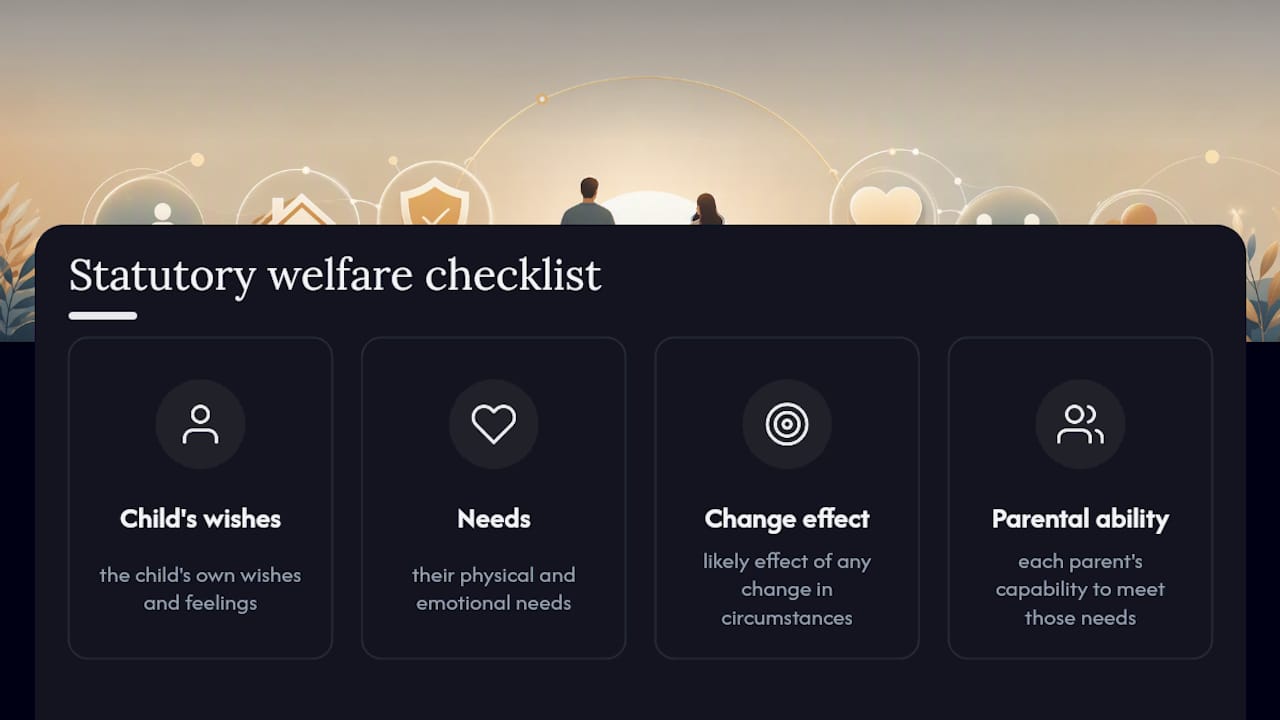
That checklist typically covers the child’s own wishes and feelings, their physical and emotional needs, the likely effect of any change in circumstances, and each parent’s capability to meet those needs.
CAFCASS or a family court adviser often gets involved to prepare a report for the judge, drawing on school reports, professional assessments, and sometimes conversations with the child directly.
The court will not make an order at all unless doing so is better for the child than making no order. This “no order” principle is why judges push hard for agreement before they impose one.
Parental responsibility and other Section 8 orders
Parental responsibility is not the same as a Child Arrangements Order. It is the legal authority to make decisions about a child’s upbringing, from schooling to medical treatment, and it exists separately from where the child lives day to day.
Two other Section 8 orders sit alongside CAOs for narrower problems:
- Specific issue orders settle a single disagreement, such as which school a child attends
- Prohibited steps orders stop a specific action, such as taking a child abroad without consent
A parent disputing one school choice does not need a full arrangements order. A specific issue order resolves that single question far more quickly.
How long does a child arrangements order last?
Most orders run until the child turns 18, though “lives with” arrangements often stop being enforced in practice once a child is old enough to decide for themselves, typically around 16.
Circumstances change, and the order can change with them. Parents can agree new terms through mediation, or apply back to court using form C100 to vary the order, or apply for discharge if it is no longer needed.
- Moving house or changing area
- A change of school
- New work patterns affecting care
- Emerging safety concerns
Breach and enforcement: what happens if an order is ignored
An order that is not followed is not toothless. If the other parent breaches the arrangement, you can apply to enforce it using form C79.
Remedies range widely depending on the facts: the court can vary the order, impose a fine, order unpaid work, or in more serious cases pursue committal for contempt of court. Police involvement is rare but possible where a child’s welfare is genuinely at risk.
- Keep dated records of every missed or altered contact
- Preserve messages, calendar entries, and witness accounts
- Seek legal advice on enforcing family court orders early rather than waiting for a pattern to worsen
Pro Tip: A single missed handover rarely persuades a court to act. Repeated missed handovers over time, backed by messages, build a stronger case.
What does it cost and how long does it take?
Costs vary by case complexity. Expect a court fee for filing C100, solicitor fees if you instruct one, and mediator fees if you go that route first. Legal aid may be available for eligible family law clients, particularly where domestic abuse is a factor, and fee remissions can reduce court costs for those on lower incomes.
Timelines depend heavily on local court listing practices. Mediation can conclude in weeks. Contested court proceedings, from first hearing to final order, often take several months. Check GOV.UK for current fees rather than relying on figures that go out of date.
When to get legal advice instead of going it alone
Mediation is usually cheaper, faster, and less adversarial than court, and it lets parents shape their own agreement rather than have one imposed. Its limitation is that it needs both parties willing to engage constructively.
Court, or at least legal advice, becomes the sensible route when:
- There is a history of breached agreements or enforcement problems
- One parent wants to relocate internationally
- Facts are heavily disputed
- There are safety concerns for the child or a parent
Pro Tip: If domestic abuse is present, do not attend mediation and do not delay. Contact a solicitor or the police immediately if a child’s safety is at risk.
Why getting this right matters from the outset
Families rarely come to us wanting a fight. They want certainty for their children and a process that does not drag on longer than it has to. The cases that resolve most smoothly are usually the ones where parents got clear advice early, understood what the court actually weighs, and tried mediation in good faith before matters became entrenched. That is the approach we take with every child arrangement case we handle.
How Signature Law supports parents through this process
Signature Law gives you direct access to a solicitor who has handled Child Arrangements Order cases from MIAM through to enforcement, not a call centre reading from a script. That matters. when a hearing is weeks away and you need someone who already knows the file.
Our family law team supports you with:
- MIAM attendance and exemption assessments
- Drafting and filing form C100 applications
- Representation at interim and final hearings
- Enforcement applications using form C79
- Legal Aid eligibility checks for qualifying clients
We offer fixed-fee initial consultations and multilingual advice, so cost and language are never the reason a parent goes without proper representation. If you need clarity on your situation, visit our family law services page or contact Signature Law directly to arrange a consultation.
Frequently asked questions
What is a child arrangement order in simple terms?
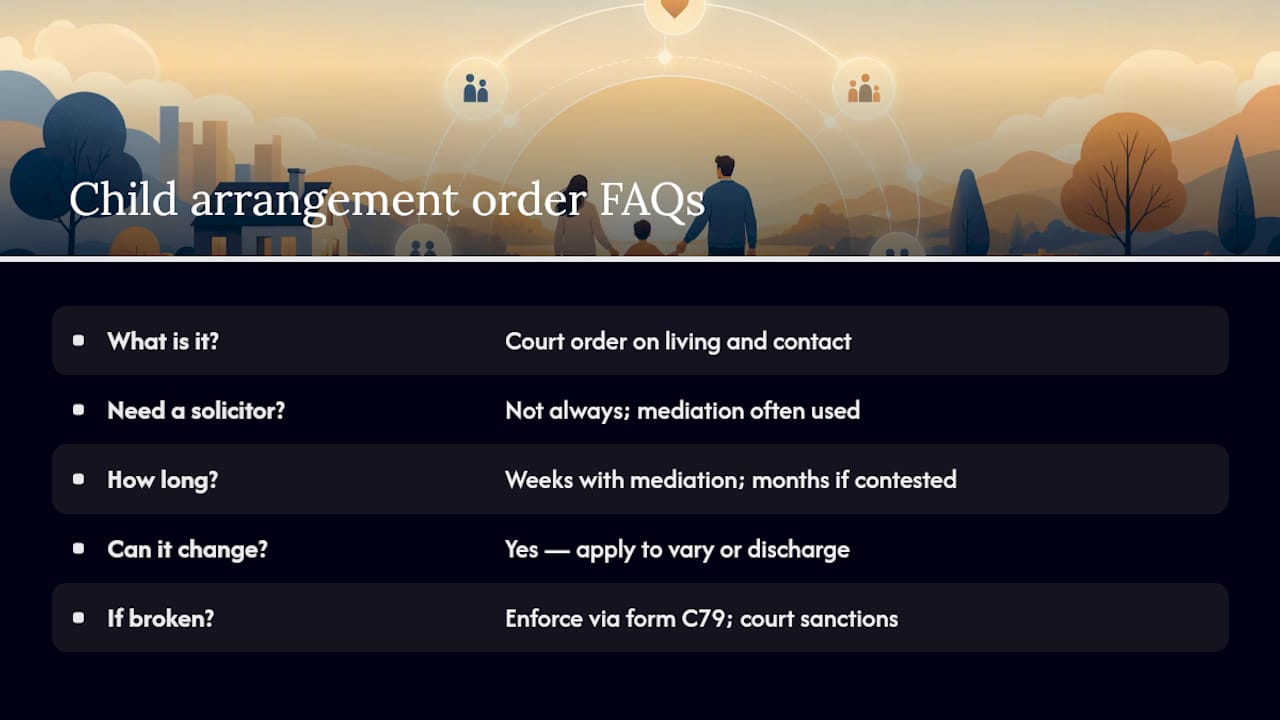
It is a court order deciding where a child lives, who they spend time with, and when. It is legally binding on both parents once made.
Do I need a solicitor to get a child arrangement order?
Not always. Many parents reach agreement through mediation, which the court can turn into a consent order. A solicitor becomes more important where facts are disputed or safety is a concern.
How long does a child arrangement order take to get?
Mediation can resolve matters in weeks. Contested court proceedings usually take several months from first hearing to final order, depending on the court’s listing practices.
Can a child arrangement order be changed later?
Yes. Either parent can apply to vary or discharge the order through mediation or by returning to court, typically when circumstances such as housing, schooling, or safety change.
What happens if the other parent breaks a child arrangement order?
You can apply to enforce it using form C79. The court can vary the order, impose fines, order unpaid work, or in serious cases pursue contempt proceedings.
This article is general information, not a substitute for advice from a qualified lawyer. Consult a qualified legal professional about your own circumstances before acting on anything here.
Sources
For forms and fee checks, rely on official pages rather than third-party summaries, since fees and procedures change.
- Legislation
- LexisNexis — Child arrangements orders (private children)
- CAFCASS — Children and Family Court Advisory and Support Service
Recommended
- Importance of child arrangement orders for UK parents | Signature Law
- Child arrangements guide for separating parents: practical steps | Signature Law
- Why child arrangements matter for your children’s future | Signature Law