





Family Law
How to draft a commercial lease: checklist for business owners

Start with detailed heads of terms, not the lease itself. Before a solicitor drafts anything, you need clear agreement on the parties, the premises, the term, rent, rent review, repairing obligations (whether full repairing and insuring, FRI, or internal repairing only, IRI), permitted use, alienation rights, and break clauses. A finished draft should never surprise either side on these points.
On first reading any draft, check for:
- A clear description of the premises, with a plan attached
- Rent, review mechanism, and payment dates stated without ambiguity
- The repairing standard, ideally tied to a schedule of condition
- Break rights with realistic, achievable conditions
Key Takeaways
Drafting a commercial lease works best when heads of terms are agreed in full detail before any solicitor starts the formal draft, and when schedules, repairing obligations, and break conditions are checked against the specific deal rather than copied from a template.
| Point | Details |
|---|---|
| Start with heads of terms | Agree parties, premises, term, rent, review, repairing basis, use, alienation and breaks first. |
| Use model forms for simple lets | Law Society LS1/LS2 forms suit short, straightforward office lettings. |
| Cap repairing risk with a schedule of condition | A dated, photographed schedule limits disputes over “fair wear and tear” at yield-up. |
| Watch the break clause conditions | Vacant possession and no-arrears conditions are common causes of failed breaks. |
| Meet post-signature deadlines | File an SDLT return within 14 days and register leases over a longer duration requiring registration at the Land Registry. |
| Get advice on complex or long leases | Signature Law offers fixed-fee reviews, bespoke drafting and dispute support for commercial leases. |
This article is general information, not a substitute for advice from a qualified lawyer. Consult a qualified legal professional about your own circumstances before acting on anything here.
Table of Contents
- What should a commercial lease include?
- How do you actually draft and negotiate a commercial lease?
- Which clauses carry the most risk in a commercial lease?
- What schedules and annexes does a commercial lease need?
- Which UK templates should you start with?
- Can you draft your own commercial lease?
- What happens after signing a commercial lease?
- A worked heads of terms checklist
- How Signature Law can help with your commercial lease
- Sources
What should a commercial lease include?
A commercial lease works from a template, but every clause earns its place. The Law Society’s short-form model commercial leases (known as LS1 and LS2, covering part and whole office lettings) show the standard shape: parties, premises, term, rent, and a run of operative clauses followed by schedules.
Your checklist for the first draft should cover:
- Full names and addresses of landlord and tenant (and any guarantor)
- A precise description of the demised premises, referenced to a plan
- The lease term, start date, and any option to renew
- Rent, payment frequency, and the review mechanism
- The security of tenure position under the Landlord and Tenant Act 1954
- The repairing covenant, linked to a schedule of condition where relevant
- The service charge basis and cap, if any
- Insurance responsibility and rent suspension provisions
- Permitted use and any restrictions on alienation
- Break rights, with clear trigger conditions
- Dilapidations and yield-up standards for the end of the term
Pro Tip: Commission a schedule of condition photographed and dated at the start of the term. It is the single cheapest way to cap a tenant’s repairing liability, and it removes most disputes about “fair wear and tear” before they start.
How do you actually draft and negotiate a commercial lease?
The process runs in a fairly predictable order, though timing varies with complexity.
- Agree heads of terms. The landlord’s surveyor typically prepares the first draft, recording parties, premises, term, rent, rent review, repairing obligations, permitted use, alienation and break rights.
- Instruct surveyors where needed, particularly for rent review mechanisms or service charge apportionment on multi-let buildings.
- Solicitor drafts the initial lease, working from the heads of terms and a template such as the Law Society’s LS1/LS2 forms or a bespoke draft for complex deals.
- Negotiate the commercial points, rent review, repairing standard, alienation, and break conditions, which is where most delay happens.
- Agree schedules and plans, including the schedule of condition and service charge apportionment.
- Complete execution formalities, signing and any statutory declarations.
- Handle post-signature steps, SDLT return and Land Registry application where applicable.
A straightforward single-let office or retail unit can complete in three to six weeks once heads of terms are agreed. Multi-let buildings, complex service charge structures, or contested break clauses commonly push that to two or three months. Solicitors add the most value at drafting and negotiation; surveyors earn their fee at heads of terms stage and again if a rent review dispute arises later.
Which clauses carry the most risk in a commercial lease?
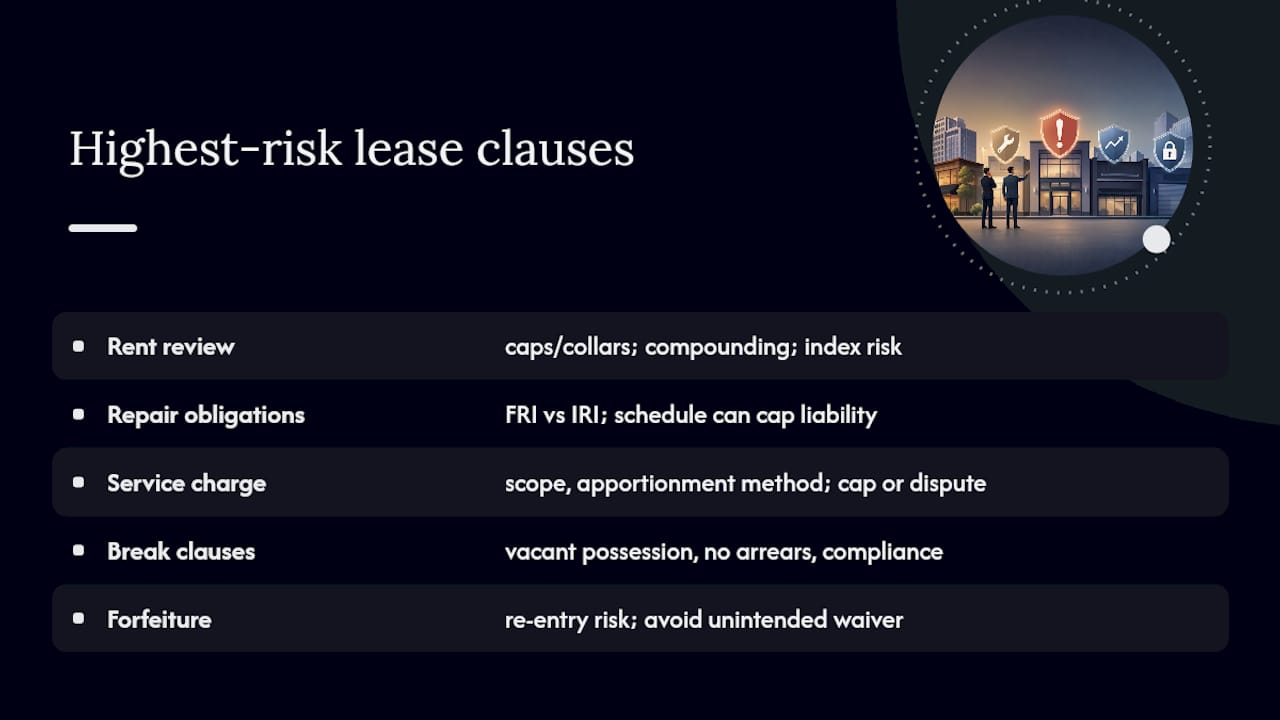
Some clauses decide who bears cost for the next five, ten, or fifteen years. Get these wrong and the mistake outlives the tenancy that caused it.
Rent and rent review. Open market reviews, index-linked increases, and fixed uplifts each shift risk differently. Watch for caps and collars that limit movement in either direction, and check whether increases compound or apply on a simple basis.
Repairing obligations. An FRI lease pushes full repair and insurance cost onto the tenant; an IRI lease limits that to internal fabric. A schedule of condition, referenced directly in the repairing covenant, can cap a tenant’s liability to the condition recorded at the start.
Service charge. Define the scope precisely, state the apportionment method (often floor area or rateable value), and include a cap or a dispute mechanism through an independent surveyor.
Insurance. Settle who insures, how the landlord recovers premiums, and what happens to rent if the building is damaged and unusable.
Alienation. Assignment and subletting terms, including whether an Authorised Guarantee Agreement is required, decide how easily a tenant can exit early.
Break clauses. Vacant possession, no arrears, and full covenant compliance are common conditions, and each has tripped up tenants who assumed “vacant possession” meant simply moving out.
Permitted use. Narrow use clauses protect landlord control; wide clauses tied to a planning use class give tenants flexibility.
Forfeiture and remedies. Draft carefully to preserve the landlord’s right of re-entry without triggering unintended waiver.
Pro Tip: Read the break clause backwards from the end date. Ask what “vacant possession” and “no arrears” will mean in practice on that exact day, not what they sound like on the page today.
What schedules and annexes does a commercial lease need?
Schedules do the detailed work the main clauses only summarise. A well-drafted lease should include detailed schedules for service charges, rent review process, rights to alter, and a schedule of condition.
Essential attachments:
- Plan of the demised premises
- Schedule of condition
- Service charge apportionment schedule
- List of excluded areas and retained landlord rights
- Rights granted and reserved (access, parking, signage)
- Inventory or fittings list where relevant
- Rent deposit deed, if a deposit is required
Registration and tax timing: an SDLT return is due within 14 days of completion where tax is chargeable, and leases granted for more than seven years generally require registration at the Land Registry.
Which UK templates should you start with?
Most commercial lettings do not need a lease built from scratch.
- Law Society short-form model commercial leases (LS1 for office part, LS2 for office whole) suit short, straightforward lettings
- Practical Law practice notes and toolkits give practitioners a full workflow covering drafting, due diligence, and registration
- Model Commercial Lease templates work well for standard institutional lettings
- The BPF short-term commercial lease suits limited-duration arrangements where bespoke drafting adds cost without adding protection
Reach for a short-form model on low-value or short-term lets. Move to bespoke drafting once rent reviews, service charges, or repairing obligations become genuinely complex.
Can you draft your own commercial lease?
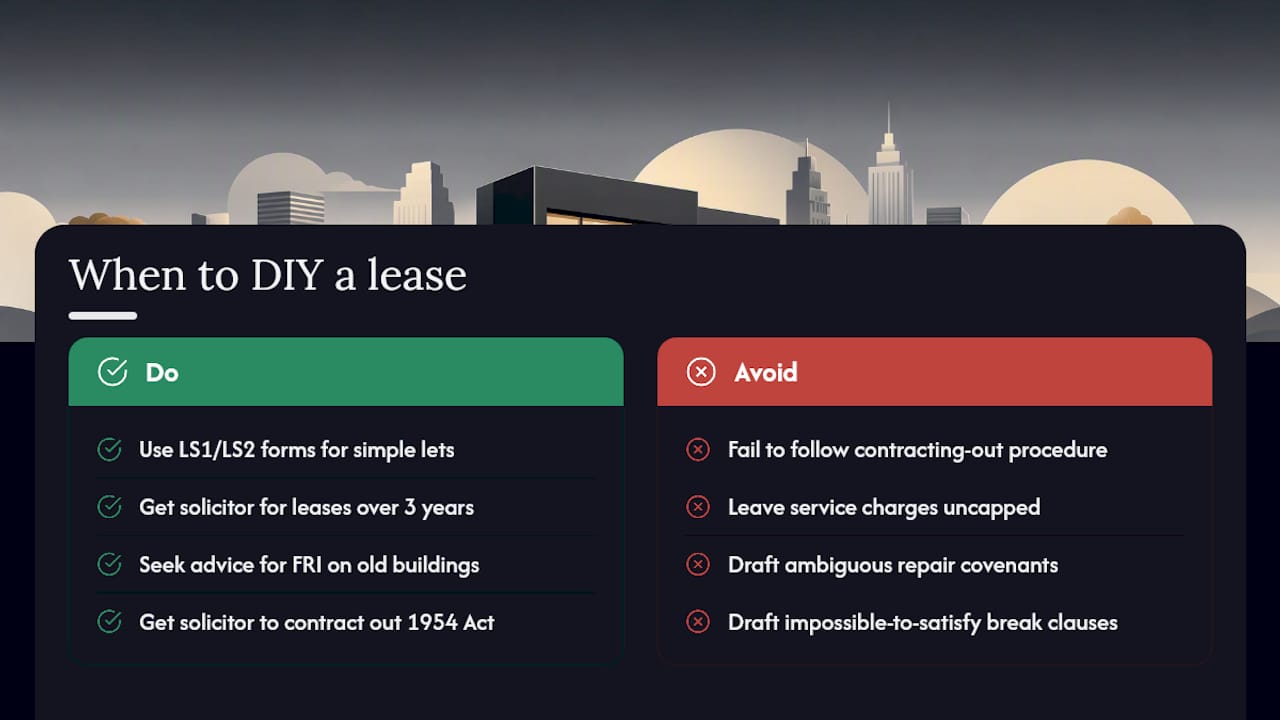
Self-drafting from a model form is reasonable for a simple, short-term letting at low rent, particularly where the Law Society’s LS1/LS2 forms already fit the deal. It stops being reasonable once you are dealing with a multi-year term, a significant repairing obligation, or any need to exclude security of tenure under the 1954 Act.
The costly mistakes are consistent: an incorrectly executed contracting-out procedure, which can be fatal to the exclusion, uncapped service charges, ambiguous repair covenants, and break clauses drafted with conditions that prove impossible to satisfy in practice.
When it’s worth paying for advice: any lease running more than three years, any FRI repairing obligation on an older building, or any attempt to contract out of security of tenure. Get these wrong and the fix usually costs more than the solicitor’s fee would have.
What happens after signing a commercial lease?
Execution needs care. Companies typically execute under seal or by two authorised signatories; individuals need proper witnessing. Where the parties are excluding security of tenure, the prescribed contracting-out notice and tenant declaration must be served and signed correctly before completion, not after.
Post-signature, act promptly on:
- SDLT return within 14 days where tax is chargeable
- Land Registry application for leases over a longer duration requiring registration at the Land Registry
- Updating insurance and service charge accounting records
Where the fiscal position or contracting-out procedure is uncertain, have a solicitor check the paperwork before you rely on it.
A worked heads of terms checklist
Drawing on the structure recommended by property practitioners, your heads of terms should fix: parties and guarantors, premises description with plan, term and any interim access, rent and incentives, rent review method, repairing covenant and schedule of condition, break and alienation terms, security of tenure position, and any occupier rights such as parking or signage.
Pro Tip: Settle security of tenure and the break clause conditions in heads of terms, not during drafting. Renegotiating these once solicitors are engaged costs both sides time and goodwill.
Author perspective: how we approach drafting commercial leases
We prioritise clarity over cleverness: fewer ambiguous repairing obligations, a defensible yield-up position, and strict compliance on tax and registration steps. Sloppy break clauses and skipped contracting-out notices cause more disputes than aggressive rent reviews ever do.
How Signature Law can help with your commercial lease
A model form gets you started, but every negotiated point, every schedule, and every contracting-out notice needs checking against your specific deal. Signature Law offers bespoke lease drafting, heads of terms preparation, contracting-out packs, and negotiation support, backed by post-signature handling of SDLT returns and Land Registry registration. If a dispute arises after signing over repairs, service charge, or a break clause, our landlord and tenant disputes team can step in directly. For a fixed-fee initial review of a draft lease or a tailored quote for full drafting support, get in touch with our team and tell us where you are in the process.
Sources
- Business leases forms | The Law Society
- Drafting and negotiating a commercial lease | Practical Law
- How to Draft Lease Heads of Terms | Free Template Guide (Myerson)
- BPF short-term commercial lease (document)
Recommended
- Asset protection tips for landlords: quick checklist | Signature Law
- Landlord legal tips 2026: your compliance guide | Signature Law
- Protect rental property: a practical guide for UK landlords | Signature Law
- Commercial property in UK divorce: Step-by-step guide | Signature Law