





Family Law
Clean break order: what it does and how to get one

A clean break order permanently ends one spouse’s ability to make future financial claims against the other, covering income, capital, property and pensions, once a court approves it as a consent or financial order. It does not touch child maintenance, which remains separately enforceable regardless of what the clean break settles. The order only binds once the court approves it and takes effect on the final order. If you’re weighing up whether this is the right route for your circumstances, Signature Law can talk you through what it would mean in practice.
TL;DR:
- A clean break order permanently ends future financial claims between spouses, including claims on income, assets, property, and pensions, once approved by the court.
- It does not affect child maintenance payments, which remain enforceable and separate from the financial order.
- Courts usually favor clean breaks when both parties are independently financially stable, the marriage was short, and there is enough capital to settle ongoing support.
- Achieving a clean break requires proper timing, full financial disclosure, and careful drafting to prevent future disputes or loopholes.
- Joint debts and liabilities remain the lender’s concern and must be explicitly addressed in the settlement to avoid lingering financial obligations.
Table of Contents
- What a clean break order covers, and what it leaves untouched
- When a clean break makes sense, and when a judge will resist one
- How to get a clean break order: the practical steps
- What a clean break costs, and whether you need a solicitor
- The contested route: what happens when you can’t agree
- Common drafting pitfalls we see, and how to avoid them
- Does a clean break order affect inheritance rights?
- Alternatives when a clean break isn’t right for you
- What happens to joint debts and liabilities?
- Clean break order: what it does, how to get one, and when to call a solicitor
- How Signature Law can help you secure a clean break
- Sources
What a clean break order covers, and what it leaves untouched
A clean break order is a mechanism used across England, Wales and Northern Ireland to draw a firm legal line under the financial side of a marriage. Once approved, neither of you can go back to court later demanding a share of the other’s future salary, a lottery win, an inheritance, or a business that takes off five years down the line. That finality is the entire point of it.
The order typically dismisses:
- Capital claims — lump sums, savings, and other one-off financial demands
- Income claims — ongoing spousal maintenance payments
- Property claims — rights to the former matrimonial home or other real estate
- Pension claims — entitlement to a share of the other party’s pension pot
What it does not touch is child maintenance, which sits outside the clean break entirely and can still be varied or enforced through the Child Maintenance Service regardless of what the financial order says. Courts in England and Wales operate under a statutory duty, set out in section 25A of the Matrimonial Causes Act 1973, to consider whether a clean break is appropriate in every case, though “appropriate” always bends to fairness rather than convenience.
When a clean break makes sense, and when a judge will resist one
Not every divorce suits a clean break, and pushing for one in the wrong circumstances usually backfires. Courts look for specific signals before agreeing that severing all future ties is fair to both parties.
A clean break tends to work well when:
- Both parties are already financially independent, with their own income and no reliance on the other
- The marriage was short, with limited entanglement of assets or lifestyle
- There’s enough capital to “buy out” any ongoing maintenance need in one settlement
- Both sides have broadly comparable earning capacity going forward
It becomes far harder to justify when one spouse has given up a career for childcare, when there’s a significant earning gap likely to persist, or when pension provision is so unequal that a clean break would leave one party exposed in later life. In these cases, courts sometimes order a deferred clean break (maintenance for a fixed term, then a break) rather than an immediate one, giving the lower earner time to rebuild financial independence without permanent dependency.
Pro Tip: Don’t underestimate Form E. Judges assess fairness based on full financial disclosure, and a clean break built on incomplete figures is far more vulnerable to challenge later, sometimes years after you thought the matter was closed.
How to get a clean break order: the practical steps
Getting from “we’ve agreed” to a legally binding clean break involves more paperwork than most people expect, and the timing matters as much as the drafting.
The consent order route generally runs like this:
- Negotiate the financial terms directly, through solicitors, or via mediation
- Draft a consent order recording those terms in the court’s required format
- Both parties sign it, along with a Statement of Information for the court
- Submit it to the court for approval alongside your divorce application
Timing is where people trip up. A consent order can’t be approved before the conditional order (decree nisi) stage, and critically, it only takes effect once the final order (decree absolute) is granted. Apply too early and the court simply won’t process it; leave it too late and you risk gaps in protection, particularly around pensions.
Expect the court to ask for:
- A completed consent order document
- A Statement of Information for a Consent Order
- Form E financial disclosure, where the case requires it
If you and your ex-partner can’t reach agreement, you’ll need to ask the court to decide instead. That contested route, sometimes called a financial remedy application, takes considerably longer and costs substantially more than agreeing terms by consent, largely because it involves hearings, formal disclosure exchanges, and often expert evidence on valuations.
What a clean break costs, and whether you need a solicitor
Court fees for financial order applications are set by the Ministry of Justice and change periodically, so always check current fee levels on GOV.UK before budgeting. Solicitor fees sit on top of that and vary widely depending on complexity, geography, and how much negotiation is involved before terms are agreed.
A solicitor typically handles:
- Negotiating terms with the other side or their representative
- Drafting the consent order in the format courts expect
- Preparing or reviewing Form E disclosure
- Advising on pension sharing and any tax consequences of the settlement
Applying without a lawyer is possible, and guidance exists for litigants in person covering forms and process. The risk isn’t the paperwork itself so much as what happens when wording is ambiguous, pension clauses are drafted loosely, or disclosure is incomplete. Enforcement, if your ex-partner later fails to comply with agreed terms, usually means an application to court (often using Form D11), and that process runs far more smoothly when the original order was drafted tightly in the first place.
The contested route: what happens when you can’t agree
When negotiation stalls, either party can ask the court to make a financial order rather than approve one by consent. This is the ancillary relief, or financial remedy, process, and it hands the decision to a judge rather than to the two of you.
Judges weigh a fixed set of factors: each party’s needs, their financial resources now and in the foreseeable future, contributions made during the marriage, and above all, the welfare of any children involved. The court doesn’t apportion blame for the marriage breaking down. It focuses squarely on producing a fair outcome given the resources actually available.
Priorities in practice usually run:
- Children’s housing and financial needs come first, ahead of either parent’s preference
- Fairness is assessed across the whole picture, not asset by asset
- Judges generally try to arrange a clean break where it’s just and reasonable to do so, even in contested cases
- Full disclosure remains mandatory. Concealing assets can unravel a settlement long after it’s finalised
Going down this route without solid evidence and complete disclosure is a common way for otherwise reasonable claims to fail on procedural grounds.
Common drafting pitfalls we see, and how to avoid them
Most clean break disputes we handle at Signature Law don’t stem from disagreement over the principle. They stem from drafting that didn’t anticipate a future scenario.
Frequent problems include:
- Pension sharing clauses that don’t specify the percentage or valuation date clearly enough
- Orders applied for before decree nisi, causing delay or rejection
- Incomplete disclosure that surfaces years later and reopens settled matters
- Vague wording around property that leaves room for reinterpretation
We generally recommend a clean break where both parties are genuinely self-sufficient, and something more staged where one party needs time to adjust. Eligible clients can have their case assessed for Legal Aid, and we offer fixed-fee initial consultations along with multilingual support for clients who’d rather discuss sensitive financial matters in their first language. Before any consultation, gather bank statements, pension valuations, and property documents. It saves time and sharpens the advice you get.
Does a clean break order affect inheritance rights?
A properly drafted clean break order is precisely what stops a former spouse making a claim against an inheritance received after the divorce, whether that’s a family estate, a business that grows in value, or any other windfall. Without one, the door to a later claim technically stays open, even years after the marriage ended.
This works both ways. If you’re the one who might inherit in future, a clean break protects that inheritance from your ex-partner’s reach. If your ex-partner stands to inherit, the clean break equally prevents you from later claiming against it. Legal commentary on clean break orders points to cases where sudden wealth, whether from inheritance, a lottery win, or business success, triggered claims from an ex-spouse specifically because no clean break had ever been finalised.
It’s worth noting that a clean break doesn’t override a will, and it doesn’t affect claims children might have against a parent’s estate. What it settles is the financial relationship between the two former spouses, nothing wider than that. If your financial settlement negotiations touch on future inheritance expectations, that’s a conversation worth having explicitly during drafting, not assumed as covered by default.
Alternatives when a clean break isn’t right for you
A clean break isn’t the only outcome available, and for a meaningful number of divorcing couples it isn’t the fairest one either.
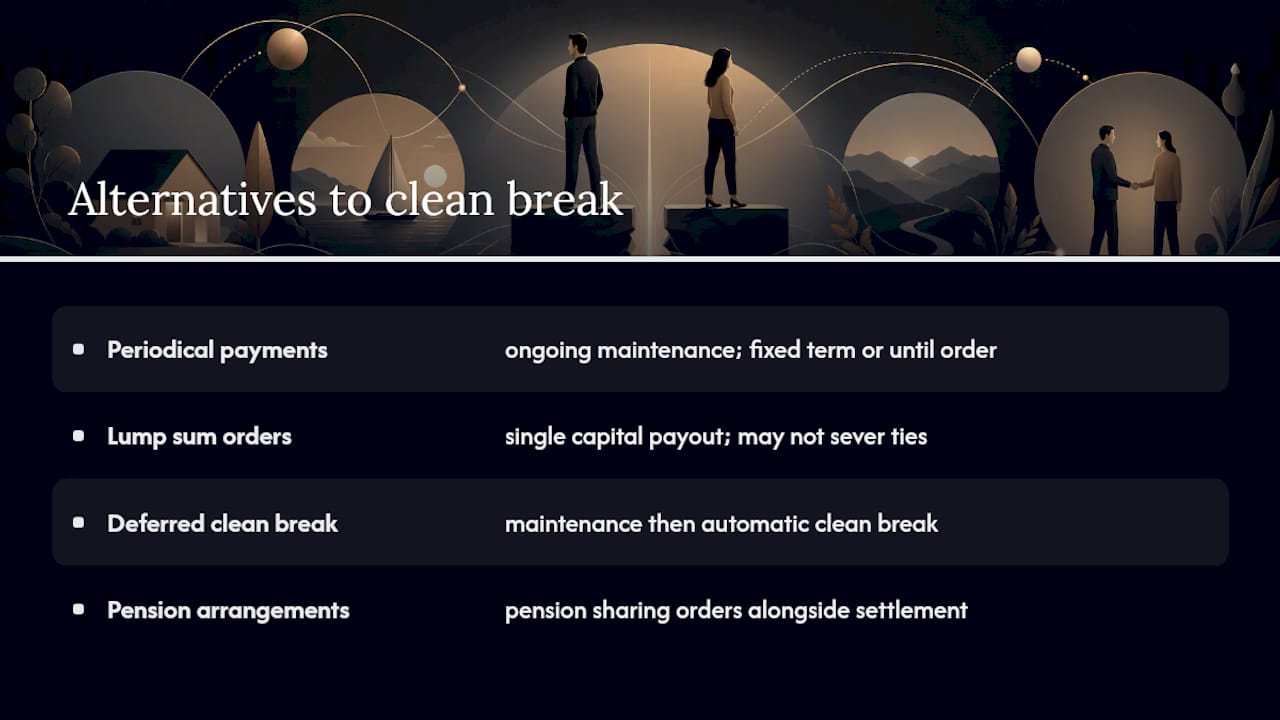
Periodical payments, ongoing spousal maintenance, suit situations where one party needs continuing income support, typically because they’ve stepped back from a career for childcare or health reasons. These can run for a fixed term or, less commonly now, until further order.
Lump sum orders transfer a single capital sum without necessarily severing every other financial tie, useful where one party needs a payout now but future circumstances remain uncertain enough that a full clean break feels premature.
Deferred clean breaks combine the two: maintenance for a set period, followed by an automatic clean break once that term ends. This gives a lower earner breathing room while still guaranteeing eventual finality, and courts increasingly favour this middle ground over either extreme.
Pension arrangements sometimes sit alongside any of these options through pension sharing orders, which can operate independently of whether the wider settlement is a clean break or not. Choosing between these routes usually comes down to earning capacity, health, age, and how much capital exists to work with. A financial settlement solicitor can model what each option would actually look like in pounds and pence before you commit to one.
What happens to joint debts and liabilities?
A clean break order deals with claims between spouses. It doesn’t automatically deal with what you owe to third parties, and that distinction catches people out more often than almost any other part of the process.
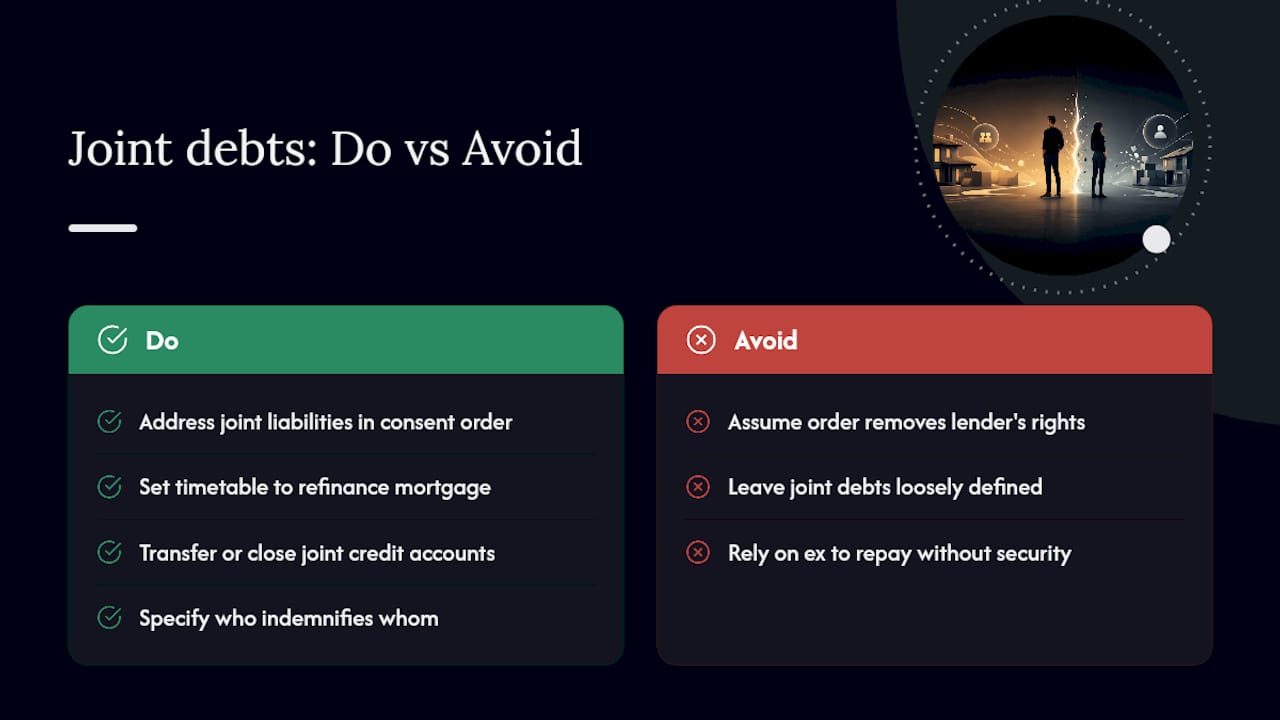
Joint mortgages, joint credit cards, and joint loans remain the lender’s business until the lender itself is satisfied, regardless of what your consent order says about who’s “responsible” for what. If your financial order states that your ex-partner will pay off a joint credit card and they simply don’t, the lender can still pursue you, because your name remains on the agreement. The clean break settles your position against each other; it doesn’t rewrite a contract with a bank.
The practical fix is to make sure any consent order explicitly addresses joint liabilities, including a timeline for refinancing a mortgage into one name, transferring or closing joint credit facilities, and confirming who indemnifies whom if a debt is chased. Property division discussed elsewhere in your settlement often hinges on this being sorted cleanly, since a lender won’t release one party from a mortgage until affordability checks are satisfied on the remaining party’s income alone. Leaving joint debts loosely defined is one of the most common reasons a settlement that looked clean on paper causes friction for years afterwards.
Clean break order: what it does, how to get one, and when to call a solicitor
The conventional advice on clean break orders treats them as a formality, something you tick off once you’ve agreed the numbers. That undersells what’s actually at stake. A clean break is the only mechanism that closes the door permanently on future claims, and once decree absolute is granted, timing can’t be undone.
Where I think most guidance falls short is in treating disclosure as a bureaucratic step rather than the foundation the entire order rests on. An order built on incomplete Form E disclosure isn’t just legally shaky, it’s a liability that can resurface a decade later when it’s far harder to unpick. The court’s fairness test isn’t window dressing either. Judges genuinely refuse or amend consent orders they consider unbalanced, which means “we both agreed” isn’t automatically enough.
If you take one thing from this: prioritise getting your financial disclosure right before you worry about the drafting language. Get the asset picture accurate and complete, and the rest of the process tends to fall into place far more smoothly than people expect.
— George
How Signature Law can help you secure a clean break
Signature Law negotiates and drafts consent orders, advises on pension sharing, and handles the financial disclosure that makes a clean break stand up to scrutiny, whether your situation is straightforward or involves business assets and complex pensions. Unlike firms that treat every case the same, we assess eligibility for Legal Aid where it applies and offer fixed-fee initial consultations, so you know the cost before you commit to anything. Multilingual support is available for clients who’d rather discuss finances in their first language.
Before your first appointment, gather bank statements, pension valuations, and property documents; it lets us give you a realistic view of your options from day one. Visit our family law services page to see how we approach financial settlements, or get in touch directly to book a consultation and find out where you stand.
Sources
For up-to-date forms and fees, consult GOV.UK’s consent order guidance, MoneyHelper’s overview of clean breaks, Advicenow’s guide for litigants in person, and LexisNexis’s legal commentary for statutory detail.
This article is general information, not a substitute for advice from a qualified lawyer. Consult a qualified legal professional about your own circumstances before acting on anything here.
- Money and property when you divorce or separate: apply for consent order
- How to apply for a financial order without a lawyer
Recommended
- Financial Settlement Solicitors | Signature Law
- What is a child arrangement order: essential guide for parents | Signature Law
- Importance of child arrangement orders for UK parents | Signature Law
- Non-Molestation Order | Signature Law