





Family Law
Matrimonial home rights: what they mean and how to protect yours

If you are married or in a civil partnership, you have matrimonial home rights: the right to stay in the family home and not be excluded from it except by court order. This is true whether or not your name is on the title deeds. Home rights give you occupation, not ownership, and they can be registered to warn any buyer or lender that you have an interest they cannot ignore.
The immediate legal effect matters more than most people realise. Your spouse or civil partner cannot change the locks, sell the property, or remortgage it without you finding out, provided you have registered your rights. That registration is the single most important thing to consider doing today.
- Check the title first. Contact HM Land Registry or ask a solicitor whether your home’s title is registered.
- Register a notice. If registered, a home rights notice can be entered against the title, usually free of charge.
- Get advice quickly if a sale, remortgage, or eviction feels imminent. Timing often decides the outcome.
Key Takeaways
Matrimonial home rights protect occupation, not ownership, and registering them promptly is the single most effective step you can take to secure your position during separation.
| Point | Details |
|---|---|
| Occupation, not ownership | Home rights stop you being excluded from the home but give no automatic share of sale proceeds. |
| Registration route depends on title | Registered land uses HR1 with HM Land Registry; unregistered land uses a Class F land charge via form K2. |
| Court orders can extend rights | A section 33 occupation order can extend protection beyond divorce, but you must register it via HR2/MH2. |
| Cohabitation offers no equivalent | Unmarried partners have no statutory home rights and must rely on separate property law claims. |
| Signature Law handles the full process | Signature Law registers notices, applies for occupation orders, and negotiates settlements under one fixed-fee consultation. |
Official forms and authoritative guidance to consult
For registering your rights, use form HR1 for registered land, and consult Practice Guide 20 for HR2, MH1, MH2, and HR4 procedures covering renewal and cancellation. The Family Law Act 1996 sets out the statutory scope in full. Shelter’s guidance explains the practical effect on sales and lending in plain terms, while LexisNexis commentary offers a solicitor’s-eye view of the limitations covered above.
Table of Contents
- What are matrimonial home rights under UK law?
- How do you protect your matrimonial home rights right now?
- What home rights actually cover, and where they fall short
- When do home rights end, and can a court change them?
- Your practical checklist for protecting your position
- Does living together without marrying give you the same rights?
- What if the family home is rented rather than owned?
- What can you do if your home rights are ignored?
- How do home rights affect what happens if a spouse dies?
- Are there exceptions, such as bankruptcy, that limit home rights?
- Frequently asked questions
- Sources
What are matrimonial home rights under UK law?
Matrimonial home rights are created by Part IV of the Family Law Act 1996, which gives a spouse or civil partner in occupation the right not to be evicted or excluded from the family home except with the court’s permission. The right exists regardless of whose name appears on the property register.
You qualify if you are:
- Married or in a civil partnership (not simply living together), and
- Living in the property, or you intended to live there as the matrimonial or civil partnership home.
The distinction between home rights and a beneficial interest matters enormously. Home rights give you a personal right to occupy; they say nothing about who owns the equity. Someone with a genuine beneficial interest, perhaps through contributing to the purchase price, holds a separate and stronger claim that survives divorce in a different way. Home rights are generally tied to the marriage or civil partnership itself, so they usually last only while that relationship legally continues, unless a court decides otherwise.
How do you protect your matrimonial home rights right now?
Protecting home rights is largely a registration exercise, and the correct route depends entirely on whether the property title is registered or unregistered.
- Establish the title status. Ask a solicitor to run an official search, or check yourself via HM Land Registry, to confirm whether the property is registered.
- Registered land: enter a notice. File form HR1 with HM Land Registry to register your home rights against the title. This registration is free of charge.
- Unregistered land: register a Class F land charge. Use form K2 through the Land Charges Department. This achieves broadly the same protective effect for property that has never been registered.
- Consider extra protection. If proceedings are underway, you can register the pending action itself, and you may apply for an occupation order or injunction if you fear imminent exclusion. Our guide to non-molestation orders covers the related protection available where safety is a concern.
- Notify the lender. Once home rights are registered, mortgage lenders will see the entry on any search, which affects their willingness to approve a remortgage or repossession without addressing your interest.
Practice Guide 20 sets out the full mechanics of registering, renewing, or cancelling home rights, including how mortgagees search the register. Registration itself usually takes only days once the application is correctly completed, though gathering the supporting paperwork often takes longer.
Pro Tip: Register your home rights before you raise the subject of separation with your spouse, where safety allows. Registration cannot be reversed unilaterally once entered, so it protects you during exactly the period when tensions run highest.
What home rights actually cover, and where they fall short
Home rights give you the right to live in the property and to resist eviction without a court order. They do not give you a share of the sale proceeds, a say in remortgaging beyond the protection registration provides, or any automatic entry on the title as an owner.
- Home rights are occupation rights only, not proprietary rights, as LexisNexis guidance on this area confirms.
- A genuine beneficial interest, arising from financial contribution or a trust arrangement, is a separate legal claim and needs its own route, often through a formal property or financial settlement.
- If you have been making mortgage payments while occupying under home rights, those payments can sometimes be treated as if made by the legal owner for certain purposes, but this does not hand you a share of title automatically.
Confusing occupation with ownership is one of the most common and costly misunderstandings people bring to their first meeting with a solicitor.
When do home rights end, and can a court change them?
Home rights end automatically on death, or on the final termination of the marriage or civil partnership, unless a court has ordered otherwise. That “unless” is doing a great deal of work, and it is where many people come unstuck.
- Under section 33 of the Family Law Act 1996, a court can make an occupation order that requires one party to leave the home, or that extends home rights beyond the point they would otherwise lapse, including after decree absolute.
- If a court extends your rights under section 33(5), you must register that order using form HR2 (or MH2 for civil partners) to keep your protection current. A previous registration does not automatically update itself.
- Failing to renew promptly after a court order leaves a gap in protection, during which a sale or remortgage could proceed before the new order is reflected on the register.
Treat any court order affecting occupation as a trigger to check your registration immediately, not as the end of the paperwork.
Your practical checklist for protecting your position
Getting organised now saves weeks of delay later, and it gives a solicitor everything needed to act fast at your first meeting.
- Order or request a title search to confirm registration status and check whether any notice already exists.
- Gather evidence of occupation, including tenancy agreements, utility bills, correspondence, and dates showing when you moved in or contributed financially.
- Collect payment records, such as bank statements showing mortgage or bill payments, which may become relevant to a wider financial settlement later.
- Decide which protection route fits your situation: registering a notice, registering pending proceedings, or applying for an occupation order, each with different urgency and cost implications.
- Check Legal Aid eligibility before assuming representation is unaffordable, and consider booking a fixed-fee initial consultation to get clarity without open-ended costs.
Pro Tip: Bring three things to your first solicitor’s appointment: proof of address, proof of the relationship (marriage or civil partnership certificate), and any correspondence about the property. It shortens the meeting by half and speeds up any registration significantly.
Does living together without marrying give you the same rights?
No. Cohabiting couples, however long they have lived together, do not acquire matrimonial home rights under the Family Law Act 1996. Those rights are reserved for spouses and civil partners specifically, which catches a lot of long-term partners by surprise.
If you are cohabiting and your name is not on the title, your position depends entirely on property law principles rather than family law protection. You would need to establish a beneficial interest, perhaps through a resulting or constructive trust, showing you contributed financially or relied on an agreement about ownership. That is a materially harder and more uncertain claim than registering a home rights notice.
Some unmarried couples address this in advance through a cohabitation agreement, setting out ownership shares and what happens if the relationship ends. Without one, a separating cohabitant can find themselves with no automatic right to remain in a home they have lived in for years, particularly where they are not named on the mortgage or the tenancy.
If you are currently cohabiting and unsure where you stand, get this checked before, not after, a dispute arises. Marriage and civil partnership create statutory protection that cohabitation, on its own, simply does not.
What if the family home is rented rather than owned?
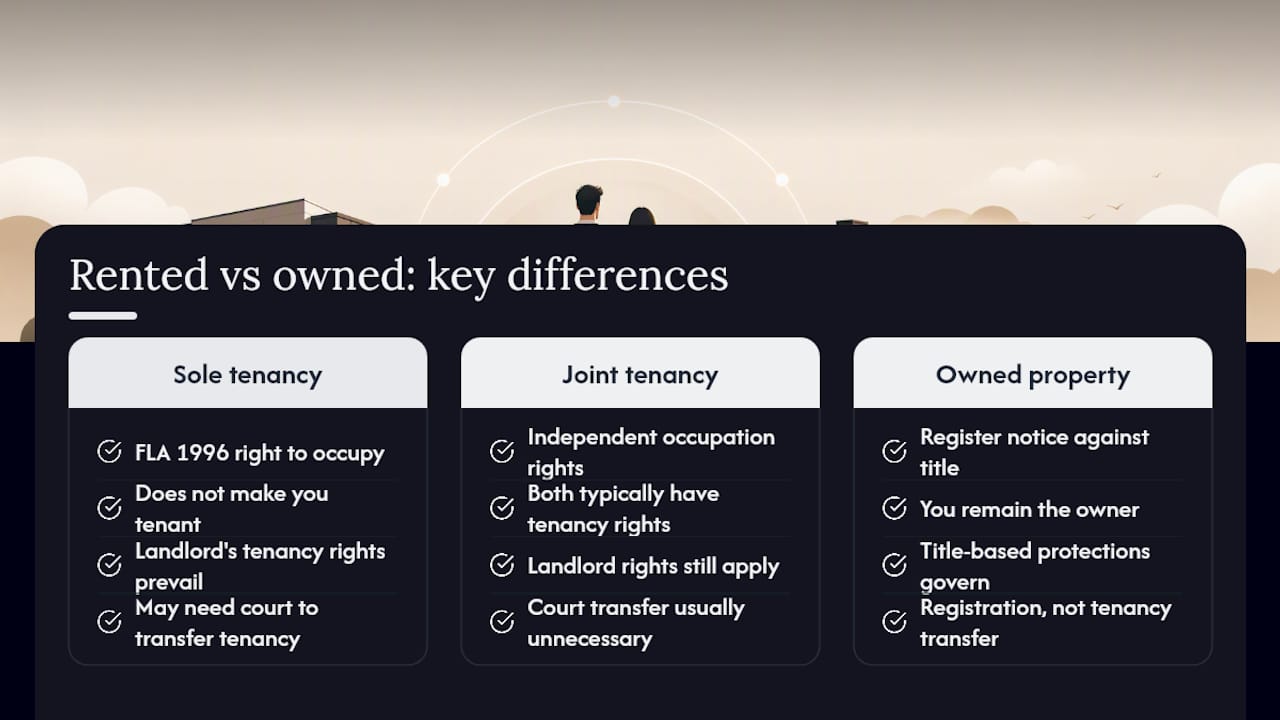
Home rights apply to rented properties as well as owned ones, though the mechanics differ from registering a notice against a title. If your spouse or civil partner holds the tenancy in their sole name, you generally still have the right to occupy under the Family Law Act 1996, and that right operates alongside, not instead of, the landlord’s own tenancy rights.
This creates a layered situation. Your home rights protect you from being excluded from the property by your spouse; they do not automatically make you a tenant, and they cannot override the landlord’s rights under the tenancy agreement or lease. A landlord seeking possession for arrears or breach of the tenancy can still pursue that claim, and your home rights do not, by themselves, provide a defence to that separate legal process.
Where the tenancy is jointly held, both parties typically have independent rights of occupation regardless of the Family Law Act, which can simplify matters. Where it is sole, you may need to apply to court for a transfer of tenancy as part of divorce proceedings, a step distinct from home rights registration itself. Landlords are entitled to be informed of relevant court orders affecting occupation, and our guidance on landlord and tenant disputes covers how these overlapping interests typically play out in practice. If a rented property is involved, flag this early. It changes which protections apply and how quickly they need to be actioned.
What can you do if your home rights are ignored?
If your spouse changes the locks, attempts to sell without your knowledge, or otherwise excludes you, you have real remedies, and speed matters more than almost anything else here.
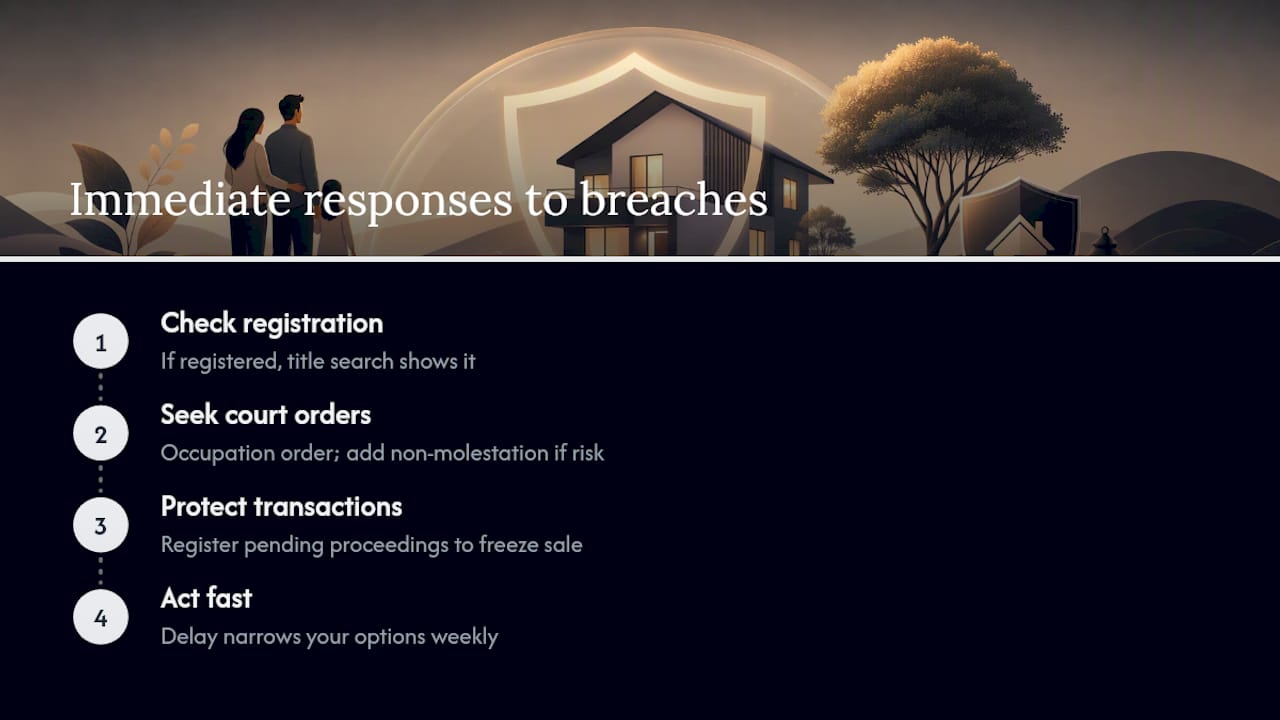
First, confirm whether your home rights were registered before the breach occurred. If they were, a buyer or lender searching the title should already have seen the entry, which strengthens your position considerably in any dispute over a sale that has proceeded regardless. If they were not registered, register them immediately, since even late registration puts future transactions on notice.
Second, consider applying to court for an occupation order under section 33, which can compel your spouse to allow you back into the property or restrain them from disposing of it further. Where there is any element of harassment, threats, or fear for your safety, a non-molestation order can run alongside an occupation order application.
Third, if a sale is already in motion, registering pending proceedings can effectively freeze the transaction until the court resolves the underlying dispute. Solicitors regularly see cases where a buyer’s conveyancer discovers the registered interest during searches and simply refuses to proceed until it is dealt with, which buys valuable time.
Do not wait to see whether the situation resolves itself. Breach of home rights tends to escalate rather than settle on its own, and every week of delay narrows your practical options.
How do home rights affect what happens if a spouse dies?
Matrimonial home rights are personal rights that do not, by themselves, transfer to your estate or create an inheritance for anyone else. If you die while home rights are registered in your favour, that registration typically lapses, since the right existed to protect your occupation specifically, not to pass wealth onward.
Death of the property owner raises a different and more pressing question. If your spouse dies and they were the sole legal owner of the home, your home rights as the surviving spouse generally continue only until the marriage effectively ends through death, which changes the legal picture considerably. What actually protects your ongoing occupation at that point is more likely to be your entitlement under their will, intestacy rules, or a beneficial interest you can independently prove.
This is precisely where home rights and inheritance planning intersect awkwardly. A surviving spouse who relied purely on home rights, rather than joint ownership or a will naming them, can find their position far less secure than they assumed during the marriage. Reviewing wills alongside any property protection is worth doing together rather than treating them as separate exercises. If succession and property questions are colliding for you right now, it is worth having both addressed in the same conversation rather than two disconnected ones.
Are there exceptions, such as bankruptcy, that limit home rights?
Home rights are robust, but they are not absolute, and certain circumstances can limit or complicate them significantly. Bankruptcy of the owning spouse is the clearest example.
If your spouse is declared bankrupt, their interest in the family home typically vests in their trustee in bankruptcy, who can seek an order for sale to realise funds for creditors. Your home rights registration does not prevent this outright, but it does mean the trustee and court must take your occupation into account, and in practice, a sale is often delayed for a period, particularly where children are involved, before being permitted to proceed.
Trust arrangements create a separate limitation. Where the property is held on trust for third-party beneficiaries, your ability to register a home rights notice may be restricted, since the underlying legal position is more complex than a straightforward matrimonial home. This is an area where checking title and trust status with a solicitor before assuming registration will proceed smoothly saves considerable frustration.
Court discretion is the final variable. Judges balance competing interests, including children’s welfare, financial hardship, and the practical realities facing both parties, when deciding whether to uphold, extend, or curtail home rights in unusual situations. No registration is entirely immune from a court deciding the wider circumstances justify a different outcome.
A solicitor’s brief perspective: common pitfalls and reassurance
The clients who struggle most are rarely those with complicated cases. They are the ones who waited, assuming occupation meant ownership, or that registering later would be just as effective as registering now. It rarely is. If cost is holding you back, ask about Legal Aid eligibility or a fixed-fee consultation before ruling out advice altogether. Getting this checked early is almost always the cheaper path.
How Signature Law can help protect your position
Registering home rights correctly, applying for an occupation order, or negotiating a fair property settlement all demand precision under time pressure, and getting the paperwork wrong can cost you the protection you were relying on. Unlike piecing this together yourself from GOV.UK guidance, Signature Law handles the registration, court applications, and financial negotiation together, so nothing falls between the gaps of separate processes.
We offer fixed-fee initial consultations, screen every family law enquiry for Legal Aid eligibility, and provide multilingual support for clients who need it. Our team, led by a solicitor with more than fifteen years’ experience in family law, has supported clients across Romford, East London, and Essex through exactly these situations.
If you need to register a notice, respond to a breach, or simply understand where you stand, contact Signature Law today for a fixed-fee consultation.
Frequently asked questions
Do I lose my home rights if I move out during a separation?
Not automatically. Home rights are tied to your marriage or civil partnership status, not your physical presence, though moving out can affect other aspects of a later financial settlement.
Can my spouse sell the house without telling me if my name is not on the title?
Not easily, provided you have registered your home rights. Once registered, any buyer’s search reveals the entry, and most conveyancers will refuse to proceed until it is resolved.
How much does it cost to register home rights?
Registering a notice of home rights at HM Land Registry using form HR1 is currently free of charge.
Do civil partners have the same home rights as married couples?
Yes. The Family Law Act 1996 extends identical home rights protection to civil partners as to spouses.
What happens to home rights if we get divorced?
Home rights generally end when the marriage legally ends, unless a court has made an order under section 33(5) extending them, in which case you must re-register using HR2 or MH2.
This article is general information, not a substitute for advice from a qualified lawyer. Consult a qualified legal professional about your own circumstances before acting on anything here.
Sources
Recommended
- What is a matrimonial home? Your UK rights explained | Signature Law
- Property and Divorce | Signature Law
- Divorce Property Division Guide: Secure Your Fair Share | Signature Law
- Commercial property in UK divorce: Step-by-step guide | Signature Law