





Family Law
Seal your UK divorce: consent order Form D81 checklist and red flags

A consent order makes your financial agreement legally binding and enforceable in court, giving both of you a clean break and protection from future claims on each other’s assets or income. You can only ask a judge to approve one once you have the conditional order (formerly decree nisi), and it does not take effect until sealed. Most separating couples should get one.
TL;DR:
- A consent order becomes enforceable only after a judge approves and seals the financial settlement, which must be done after the conditional order.
- Applying too early or delaying the consent order risks future claims and complicates pensions or property transfers, especially before finalizing divorce.
- Drafting a consent order without legal expertise can lead to issues such as unclear clauses, inadequate disclosures, or pension transfer errors that cause rejection.
- Judges evaluate the fairness and clarity of the settlement based on detailed disclosures; incomplete or biased terms often result in rejection or requests for amendments.
- Finalized consent orders are difficult to modify, with enforcement possible for breaches, so precision in drafting is essential for lasting legal protection.
Table of Contents
- What is a consent order in a UK divorce?
- When should you apply for a consent order?
- How do you apply for a consent order?
- What does a consent order cost, and do you need a solicitor?
- Why might a judge refuse to approve your consent order?
- What happens after your consent order is approved?
- The drafting details that catch people out
- Getting your consent order right the first time
- Sources
What is a consent order in a UK divorce?
A consent order is a sealed court order recording the financial settlement you and your ex-partner have agreed. Once a judge approves it, the terms become enforceable in the same way as any other court order. It is the legal mechanism that converts a private agreement, reached between you or through solicitors, into something the court will uphold and enforce if either of you fails to comply.
Consent orders typically cover:
- The family home and any other property, including who keeps it or how sale proceeds are split
- Savings, investments and other capital
- Pension sharing or pension offsetting arrangements
- Lump sum payments
- Spousal maintenance, or a “clean break” clause dismissing future maintenance claims
- Division of debts and liabilities
This differs sharply from a separation agreement, which the two of you sign privately without court involvement. A separation agreement is not a substitute for a consent order: it carries no binding force and leaves financial claims open indefinitely, no matter how detailed or fair it looks on paper. Only a sealed court order closes that door.
When should you apply for a consent order?
Timing matters more than most people realise. You cannot apply for a consent order until you have the conditional order in your divorce proceedings. Submitting before that stage simply results in the court rejecting the application.
The stronger practical point is that getting your consent order approved before the final order is usually the safer route. This matters most where pensions are involved: some pension schemes need both parties to still be legally married for a pension sharing transfer to complete smoothly, so sealing the order before the final order avoids unnecessary complications with the scheme administrator.
Skipping the consent order altogether, or leaving it too long, carries a real risk. Even years after a divorce is finalised, an ex-spouse can bring a financial claim if no order was ever sealed. Courts have seen claims resurface long after separation, sometimes triggered by a lottery win, inheritance, or new business success. Getting the order in place while you are still in the process is the only way to draw a firm line under it.
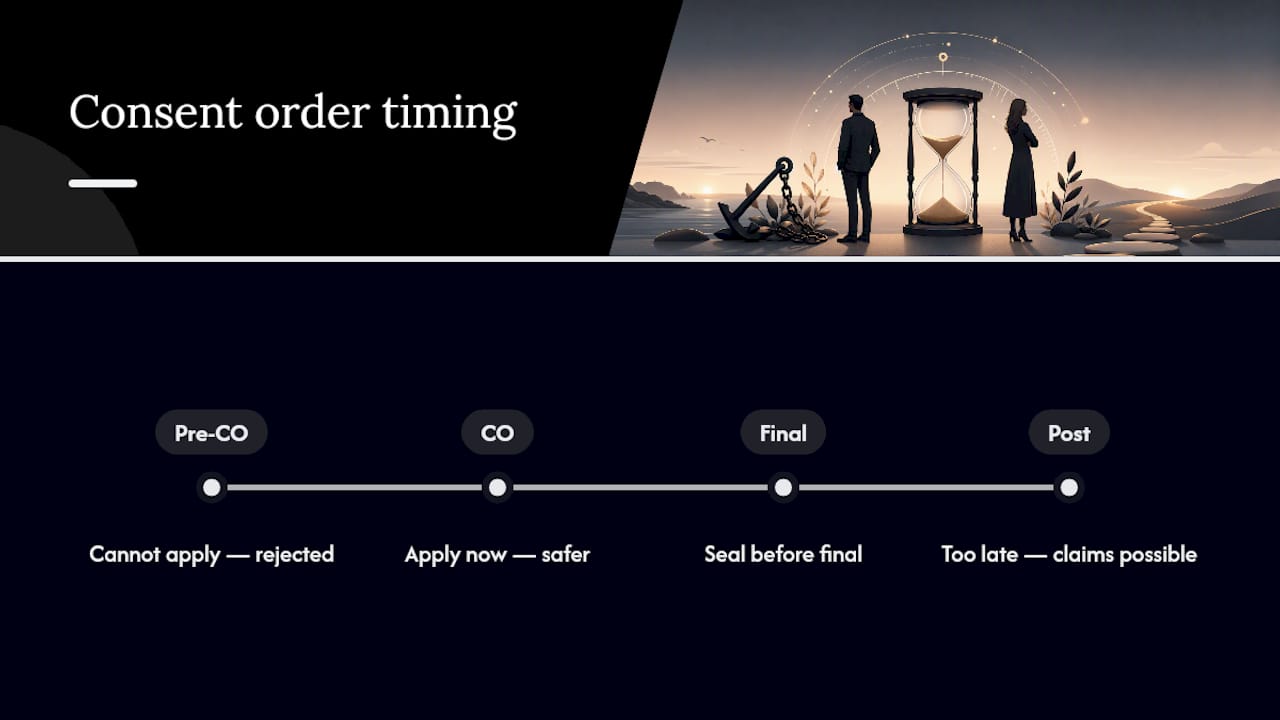
Understanding where the consent order sits within the broader divorce process helps you plan the sequence properly, rather than treating the financial settlement as an afterthought once the marriage itself is legally over.
How do you apply for a consent order?
The application follows a fairly consistent structure, whether you use a solicitor or handle it yourselves.
- Agree the terms and draft the order. Both of you need to reach agreement on every financial point, then have it drafted in the legal format the court expects, with recitals, clear operative clauses, and signatures from both parties.
- Complete Form D81. This statement of information summarises each person’s income, assets, liabilities, and pension provisions so the judge can assess whether the settlement looks fair.
- Complete Form A (the notice of application), gather the signed consent order in duplicate, and pay the court fee.
- Submit everything through the HMCTS online portal. Check your email regularly afterwards. Court queries usually arrive this way rather than by post.
Pro Tip: Keep Form D81 concise but complete. It is a short financial statement, not a full disclosure document, but vague or inconsistent figures are one of the most common reasons courts come back with questions.
Most applications never reach a hearing. A judge reviews the paperwork on the papers alone, checking that the terms look fair and properly drafted, and either approves it, asks questions by email, or in rarer cases requests both parties attend court. Processing typically takes four to ten weeks from submission to a decision, though busier courts or incomplete paperwork can push that further out.
What does a consent order cost, and do you need a solicitor?
You are not legally required to use a solicitor to apply for a consent order without a solicitor, but the risks of drafting it yourself are worth weighing carefully.

Typical private solicitor fees for drafting a straightforward consent order run from around £400 to £1,500, with complex cases involving businesses, multiple properties or overseas assets costing more. Compared with the financial exposure of a rejected or unenforceable order, that fee is often modest.
DIY drafting carries specific pitfalls:
- Poorly worded dismissal clauses that fail to actually close off future claims
- Missing or unclear financial disclosure that prompts judge queries or outright refusal
- Ambiguous undertakings that create disputes months or years later
- Pension sharing annexes drafted incorrectly, which pension providers then reject
If money is tight, Legal Aid for eligible family law clients remains available for certain cases, particularly where domestic abuse is a factor. Checking your eligibility through gov.uk before ruling out professional help is worth the ten minutes it takes.
Why might a judge refuse to approve your consent order?
Judges do not simply rubber-stamp whatever a couple agrees. Under section 25 of the Matrimonial Causes Act 1973, the court has an independent duty to consider whether a proposed settlement is fair, regardless of what both parties want.
Common reasons for refusal include:
- Inadequate or inconsistent financial disclosure on Form D81
- Terms that appear to unjustly favour one party over the other
- Insufficient provision for children’s housing or maintenance needs
- Drafting so unclear or unenforceable that the court cannot be confident of its effect
If a judge has concerns, the usual outcome is an email requesting clarification or amendment rather than an outright refusal. Attending a hearing is uncommon, reserved mostly for cases where the disclosure gaps or fairness concerns are significant.
What happens after your consent order is approved?
Once sealed, your consent order carries full legal weight. If either of you breaches its terms, the other can apply to enforce it, and in serious cases, non-compliance can amount to contempt of court.
A few practical points worth knowing:
- Variation is possible in limited circumstances, most commonly around spousal maintenance, but capital settlements and clean-break clauses are generally intended to be final.
- Pension sharing orders need to be sent to the pension provider promptly, and providers can take weeks to implement the transfer.
- Property transfers tied to the order should be actioned soon after sealing to avoid administrative delays.
Because finality is usually the entire point of a clean-break consent order, courts are reluctant to reopen settled terms except where genuinely justified. Understanding the difference between what can and cannot be revisited later saves considerable frustration.
The drafting details that catch people out
Having reviewed enough consent order applications, the pattern in refused or queried cases is consistent: it is almost never the big financial figures that cause problems. It is the small drafting choices. A poorly worded dismissal clause that leaves a maintenance claim technically alive, an undertaking that creates an ongoing obligation nobody intended, or a recital that contradicts the operative clause further down the same document.
Sital Somaiya, who founded Signature Law after more than 15 years in family law and has spoken on BBC and ITV about the realities facing separating families, built the firm around the idea that legal precision and compassion are not in tension. Fixed-fee consultations, Legal Aid assessment, and multilingual advice all matter here because separating couples are often dealing with financial complexity and emotional strain at the same time. If your case involves pensions, a business, or terms you are not confident will survive judicial scrutiny, get in touch with our family law consent order specialists before you submit anything to the court.
— George
Getting your consent order right the first time
Signaturelaw drafts consent orders for a living, and that specialism shows up in the details that trip up DIY applications: dismissal wording, pension annexes, and disclosure that satisfies a judge rather than just satisfying you and your ex-partner. Where solicitor fees for a straightforward order typically sit between £400 and £1,500, that cost buys you a document built to be approved first time rather than queried, amended, or rejected.
Fixed-fee consultations mean you know the cost before you commit, Legal Aid assessment is available for those who qualify, and multilingual advice is on hand for clients who need it. If you are ready to turn your financial agreement into something the court will actually enforce, speak to our family law team about drafting or reviewing your consent order today.
Sources
Recommended
- Divorce checklist for 2026: your step-by-step UK guide
- Your essential divorce checklist for the UK: Step-by-step guide
- Property division checklist: your complete UK guide
- Step-by-step UK divorce process: Essential guide for 2026