





Family Law
Clear guidance on the legal eviction process in the UK

TL;DR:
- Eviction laws in England changed in May 2026, abolishing no-fault Section 21 notices.
- Landlords now must use Section 8 with specific grounds and follow a strict court process.
- Proper evidence and legal advice are crucial for both landlords and tenants in eviction cases.
From May 2026, the rules governing eviction in England changed fundamentally. The abolition of Section 21 under the Renters’ Rights Act means landlords can no longer end a tenancy without providing a legally recognised reason. Every private tenancy is now a periodic assured tenancy, and every eviction must proceed through Section 8 using specific statutory grounds. If you are a tenant facing eviction, or a landlord trying to regain possession, the rules you may have relied upon previously no longer apply. This article explains exactly what the law requires, what the process looks like in practice, and how you can protect your position.
Table of Contents
- Key legal changes to eviction in 2026
- Step-by-step guide to the legal eviction process
- Understanding Section 8 grounds and notice periods
- Recent statistics and trends: what is changing in 2026?
- A solicitor’s perspective: what most guides miss about eviction law
- How Signature Law can help with landlord and tenant disputes
- Frequently asked questions
Key Takeaways
| Point | Details |
|---|---|
| Section 21 repealed | Evictions after May 2026 require legal grounds under Section 8, with no more no-fault removals. |
| Court order essential | Landlords cannot legally evict tenants without going through the correct court process. |
| Grounds and notice vary | Notice periods depend on the eviction ground; some require four weeks, others four months. |
| Trends favour due process | Recent data show fewer claims but higher success with proper evidence and legal support. |
| Legal advice available | Tenants and landlords should seek expert advice to navigate the post-2026 eviction system. |
Key legal changes to eviction in 2026
The shift that occurred on 1 May 2026 is not a minor procedural adjustment. It represents the most significant reform to residential eviction law in a generation. For years, landlords could serve a Section 21 notice to end a tenancy without giving any reason at all. That route is now gone. Entirely.
Under the Renters’ Rights Act, Section 21 no-fault evictions have been abolished for all private tenancies in England. Every tenancy has automatically converted to a periodic assured tenancy, which means there is no fixed end date after which a landlord can simply ask a tenant to leave. From this point forward, possession can only be sought through Section 8, and only where a specific statutory ground applies.
For tenants, this is a significant shift in protection. For landlords, it demands a very different approach to property management. The days of serving a quick notice to end a troublesome tenancy without explanation are over. Now, the role of landlord solicitors in navigating this process has become considerably more important.
Here is a clear comparison of how the law looked before and after May 2026:
| Area | Before May 2026 | After May 2026 |
|---|---|---|
| No-fault eviction | Permitted via Section 21 | Abolished entirely |
| Tenancy type | Fixed-term or periodic | All tenancies now periodic |
| Grounds required | Not needed for Section 21 | Always required under Section 8 |
| Notice period (no-fault) | 2 months minimum | No longer available |
| Court involvement | Often avoidable | Required for all contested cases |
The key consequences for both parties are worth summarising clearly:
- Tenants now have far greater security of tenure and cannot be removed without a proven legal ground.
- Landlords must demonstrate a valid reason for eviction, supported by appropriate evidence.
- All evictions require either voluntary departure or a court-issued possession order.
- Court scrutiny of eviction cases has increased significantly as a result.
This context is essential before you consider any step in the process. Whether you are seeking possession or resisting it, understanding that Section 8 is now the only available route shapes everything that follows.
Step-by-step guide to the legal eviction process
Now that you know the foundation, here is how to navigate each part of the process from notice to repossession.
The legal eviction process in England follows a structured sequence that neither landlords nor tenants can bypass. Skipping a step, serving an invalid notice, or attempting to evict someone without a court order is not simply a procedural error. It is a criminal offence. Here is how the process works in full:
-
Identify the correct Section 8 ground. Before serving any notice, a landlord must confirm which legal ground applies to the situation, whether that is rent arrears, antisocial behaviour, or another recognised reason. Using the wrong ground will invalidate the notice.
-
Serve a valid Section 8 notice. The notice must be in the correct prescribed form, specify the ground being relied upon, and include the date on which the tenancy is to end. It must be served correctly, ideally with proof of delivery.
-
Observe the required notice period. Different grounds carry different notice periods. Some require only four weeks; others require up to four months. The landlord cannot apply to court before this period has expired.
-
Apply to the court for a possession order. If the tenant does not vacate after the notice period, the landlord must apply to the county court. This involves completing the correct application form and paying the court fee.
-
Attend the hearing. The court will list the matter for a hearing, at which both parties may present their case. For mandatory grounds, the judge must grant possession if the ground is proved. For discretionary grounds, the judge decides whether it is reasonable to do so.
-
Obtain a warrant for possession. If the tenant still does not leave after the court order, the landlord must apply for a warrant. A court-appointed bailiff will then attend the property on a set date to enforce the order.
-
Bailiff enforcement. The bailiff attends, verifies identity, and the tenant must vacate. The landlord cannot take possession before this stage without risking criminal liability.
Pro Tip: Keep a detailed written record of every communication with your tenant throughout a tenancy, including text messages, emails, and any formal letters. Courts look closely at this evidence and it can significantly strengthen or weaken a possession claim.
You should also be aware of landlord and tenant disputes that arise around notice validity. A notice that is poorly drafted, served incorrectly, or based on an unproven ground will be challenged at court, causing delay and additional cost for both parties.

| Stage | Timeframe (approximate) |
|---|---|
| Section 8 notice period | 4 weeks to 4 months (ground dependent) |
| Court processing time | 8 to 16 weeks |
| Hearing listed | 4 to 8 weeks post-application |
| Warrant enforcement | 3 to 6 weeks post-order |
Total time from notice to repossession can easily exceed six months in contested cases, making early legal advice essential.
Understanding Section 8 grounds and notice periods
The process is only as strong as the grounds on which it is built. Let us examine how Section 8 works and what tenants and landlords must watch out for.
Section 8 grounds divide into two distinct categories, and understanding the difference between them is critical. The category a ground falls into determines how the court approaches the case and what outcome is likely. Guidance from the government is clear that Section 8 grounds operate differently depending on whether they are mandatory or discretionary.
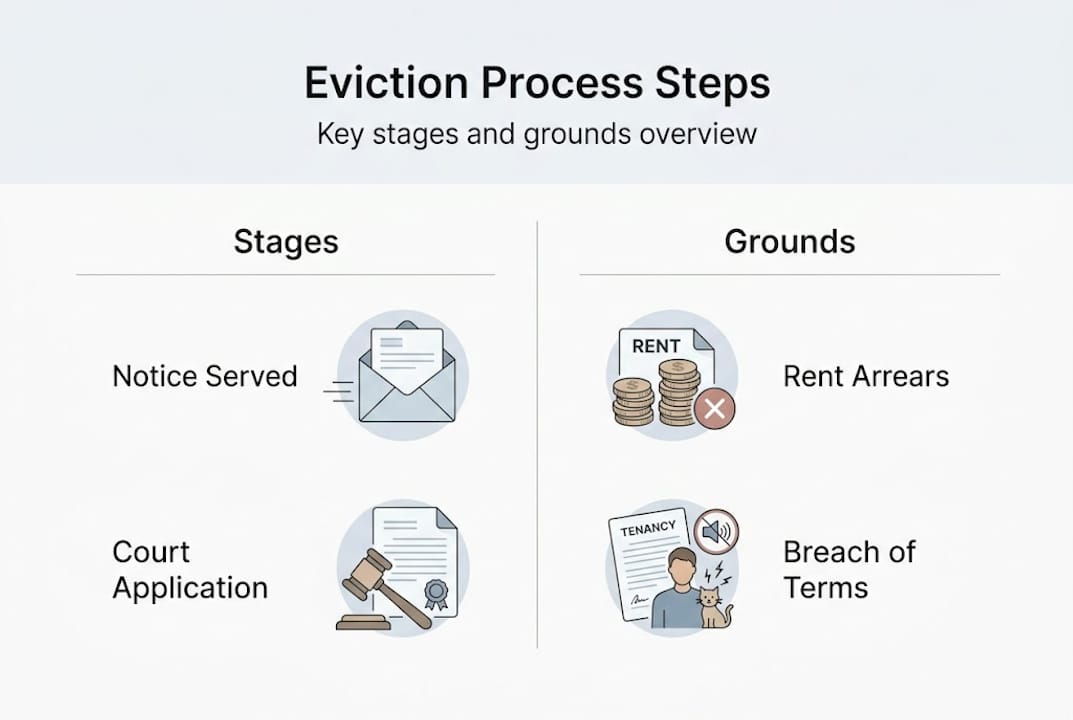
Mandatory grounds mean the court must grant possession if the ground is proved. There is no judicial discretion. Ground 8, for example, applies where a tenant has at least three months of rent arrears both at the time of serving the notice and at the date of the hearing. The notice period for Ground 8 is four weeks. If the landlord proves the arrears at the hearing, the court has no choice but to order possession.
Discretionary grounds give the court latitude. Even if the ground is technically proven, the court can decide whether making a possession order is reasonable in all the circumstances. Ground 10 covers any rent arrears, but because it is discretionary, the court may take into account the tenant’s personal circumstances, the landlord’s behaviour, or any steps taken to address the situation before ordering possession.
“The key distinction between mandatory and discretionary grounds is this: with mandatory grounds, proof is enough. With discretionary grounds, proof is just the beginning.”
New grounds introduced in 2026 are particularly significant. Ground 1A, for instance, allows a landlord to seek possession where they intend to sell the property. However, the notice period is four months, and crucially, this ground cannot be used during the first twelve months of a tenancy. The intention behind this provision is to protect tenants from being moved on shortly after they have settled.
Key points to understand about Section 8 grounds include:
- Notice periods vary widely from as little as two weeks to as much as four months depending on the ground.
- Evidence is everything. Rent account statements, correspondence records, and witness statements are all potentially decisive.
- Tenants can raise defences to both mandatory and discretionary grounds, including counterclaims for disrepair or unlawful deductions.
- Courts expect proportionality, particularly when vulnerable tenants are involved.
- Seeking advice from landlord solicitors in UK housing before serving any notice significantly reduces the risk of procedural errors that invalidate the claim.
Pro Tip: If you are a landlord relying on rent arrears as a ground, consider applying for both Ground 8 and Ground 10 simultaneously. If arrears reduce below the three-month threshold before the hearing, Ground 10 may still allow the court to consider possession.
Getting this right from the outset avoids the frustration and cost of a dismissed case and a fresh start of the entire process.
Recent statistics and trends: what is changing in 2026?
Understanding the legal steps is vital, but the wider context tells us what real outcomes look like for people today.
The statistics surrounding landlord evictions paint a revealing picture of a market in transition. According to government possession data for Q4 2025, there were 21,458 landlord possession claims, a fall of 11% compared to Q4 2024. Orders made totalled 16,913, down 8%. Warrants issued fell by 12% to 9,606. Yet repossessions by bailiffs rose by 3% to 7,254.
That final figure is the most telling. Fewer claims are being issued, but the cases that do proceed to enforcement are more likely to succeed. This suggests that landlords are becoming more selective, only pursuing claims where their evidence is solid and their grounds are clear.
Claims peaked in Q3 2024 at 25,402, most likely as landlords rushed to use Section 21 before reform took effect. Now that route is closed, that spike is gone. The decline in claims reflects a period of adjustment as landlords, tenants, and solicitors alike adapt to the new framework.
What this means in practice:
- Fewer but stronger claims are making their way through the courts.
- Court scrutiny is higher because every claim must now justify a legal ground.
- Landlords with poor record-keeping are finding their cases dismissed or adjourned for lack of evidence.
- Tenants are more likely to contest because they now have clearer statutory grounds to challenge possession.
- London accounts for approximately 34% of all landlord possession claims nationally, reflecting the density and complexity of the private rented sector in the capital.
- Delays remain a real challenge, with many cases taking six months or more from notice to repossession.
2026 is genuinely a benchmark year for the private rented sector. The systems, assumptions, and shortcuts that landlords and tenants relied upon for decades no longer apply. Both sides need to approach any eviction matter with more preparation, more documentation, and ideally, proper legal support. The courts will not look kindly on cases that have been handled carelessly under the old assumptions.
A solicitor’s perspective: what most guides miss about eviction law
Most guides focus on procedure. They walk you through the steps, list the grounds, and explain the timelines. That is all necessary and useful. But what they rarely address is the single biggest reason eviction cases fail: the evidence is simply not there.
In our experience, the post-2026 landscape has shifted real power to whichever party is better prepared. Under Section 21, a landlord needed very little. A correctly served notice and a bit of patience was usually sufficient. Under Section 8, you must prove your case. That is a materially different legal exercise, and many landlords are underestimating it. As government guidance makes clear, landlords must prioritise evidence gathering well before a notice is ever served.
Rent records must be accurate and complete. Service of all documents must be provable. Any communication relevant to the ground being relied upon needs to be preserved. Courts are scrutinising these cases with fresh eyes, and a disorganised file can collapse a claim that otherwise had genuine merit.
For tenants, the same principle applies in reverse. If you have a defence, particularly around disrepair, unlawful charges, or landlord breach, document it carefully. Courts are receptive, but only when the evidence is clear and presented properly. Seeking specialist landlord and tenant advice early in the process, before positions become entrenched, consistently produces better outcomes for both sides.
How Signature Law can help with landlord and tenant disputes
If you or someone you know is facing a dispute or complex eviction, here is how expert legal support can make a difference.
At Signature Law, we work with both landlords and tenants across Romford, East London, Essex, and beyond. Our landlord and tenant dispute support covers every stage of the eviction process, from reviewing the validity of a notice through to representing clients at possession hearings. We understand that these situations are stressful, often urgent, and frequently misunderstood. Our specialist landlord solicitors provide clear, tailored advice on the correct grounds, evidence requirements, and procedural steps under the current law. If you need guidance on where you stand, the most important step you can take right now is to speak to a solicitor before making any decisions.
Frequently asked questions
What is the difference between Section 8 and Section 21 notices?
Section 8 requires the landlord to prove a legal ground for possession, and the tenant can defend the claim in court. Section 21 no-fault evictions allowed a landlord to end a tenancy without giving any reason, but this has been abolished from May 2026.
What notice period does a landlord need to give under Section 8?
The notice period depends on the ground being relied upon. Ground 8 rent arrears requires a minimum of four weeks, whereas newer grounds such as Ground 1A for sale of the property require four months following the first twelve months of the tenancy.
Can a tenant be evicted without a court order in the UK?
No. The legal eviction process requires a court-issued possession order before a landlord can lawfully recover a property, and bailiff enforcement is required if a tenant does not leave voluntarily. Attempting to evict someone without this process is a criminal offence.
Where can tenants get legal support if they are facing eviction?
Tenants can access free legal aid for possession hearings and defences through organisations such as Shelter and Citizens Advice. Speaking with a qualified housing solicitor as early as possible in the process gives you the best chance of understanding and protecting your rights.
Recommended
- Understanding the role of landlord solicitors in UK housing | Signature Law
- Landlord’s role in divorce: Rights for UK tenants | Signature Law
- Step-by-step UK divorce process: Essential guide for 2026 | Signature Law
- Signature Law Blog: Legal Insights & Updates (2026)