





Family Law
How to manage a high net worth divorce effectively

TL;DR:
- High net worth divorce involves complex assets requiring careful, simultaneous financial disclosure and legal steps.
- Full transparency and early expert valuation are essential to avoid costly court sanctions and asset dissipation.
- Cross-border tax advice is crucial to prevent unexpected liabilities when transferring international assets.
Facing divorce when significant wealth is involved is a fundamentally different experience to a standard separation. The complexity multiplies quickly: businesses, offshore accounts, investment portfolios, trusts, pension funds, foreign property, and shareholdings all require careful handling. A single misstep — an incomplete financial disclosure, a poorly timed asset transfer, or a missed deadline — can trigger court sanctions, adverse inferences, or a settlement that leaves you significantly worse off. This guide sets out a clear, practical workflow that high net worth individuals in England and Wales can follow to protect their financial position, maintain privacy, and move through the process with confidence.
Table of Contents
- Key workflow stages in high net worth divorce
- Financial disclosure and preparation: Setting the foundation
- Mapping, valuing and securing complex assets
- Legal, tax and cross-border considerations
- Why the right advice and preparation outperform shortcuts in high net worth divorce
- How expert family law support streamlines your divorce workflow
- Frequently asked questions
Key Takeaways
| Point | Details |
|---|---|
| Follow a parallel workflow | Handle divorce procedure, asset preparation, and risk management together for efficient progress. |
| Prioritise full disclosure | Comprehensive, constantly updated financial disclosure is non-negotiable in high-value cases. |
| Seek cross-border advice early | International assets and tax issues require specialist input to avoid future complications. |
| Preparation secures outcomes | Advance planning with experts reduces the risk of costly errors and court intervention. |
Key workflow stages in high net worth divorce
With the stakes set, let’s clarify the process from start to finish.
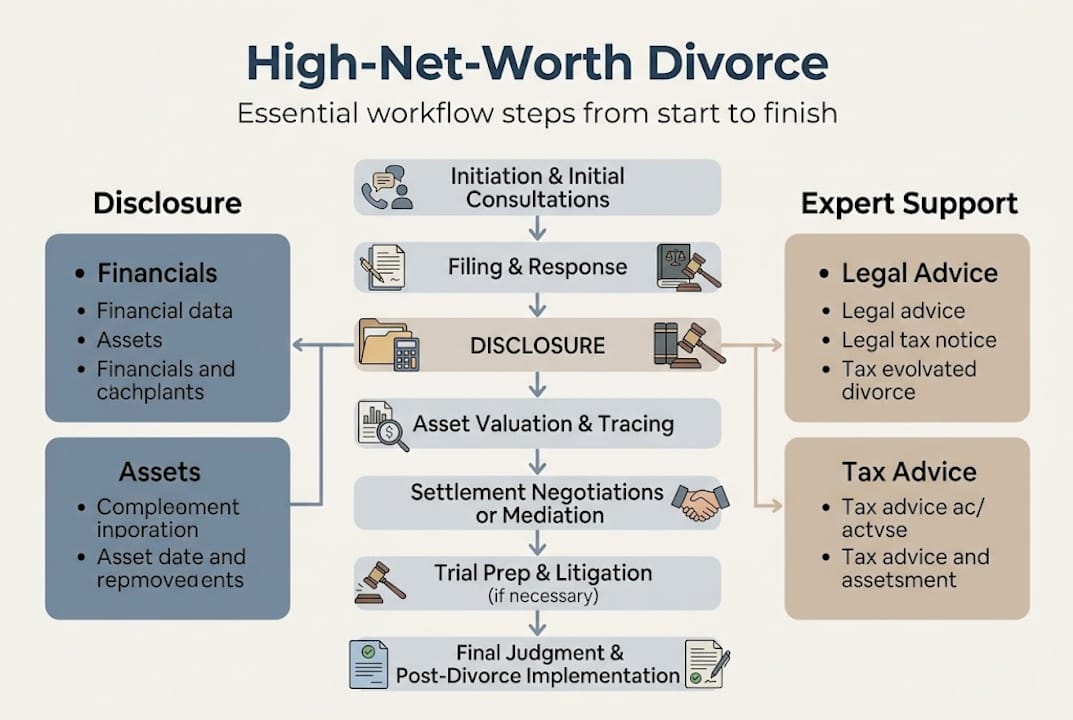
Understanding the statutory framework is your first task. In England and Wales, divorce follows a no-fault framework that requires filing the divorce application, waiting a statutory reflection period of 20 weeks, then applying for a conditional order, and finally applying for the final order at least 6 weeks and one day after the conditional order. The minimum total timeline is approximately 26 weeks, though in practice, high net worth cases often run considerably longer due to the complexity of financial remedy proceedings.
It is important to understand that the divorce petition itself and the financial remedy proceedings run on parallel tracks. One does not wait for the other. You can and should begin preparing your financial disclosure at the same time as the divorce application is filed. Waiting until the divorce paperwork is processed before thinking about finances is a common and costly error.
The key stages in a high net worth divorce workflow are:
- File the divorce application — formally commence proceedings with the court.
- Begin financial disclosure preparation — gather all relevant evidence, including business valuations and offshore assets.
- Apply for the conditional order — 20 weeks after the application date.
- Attend the First Appointment (FDA) — a court hearing to narrow issues and establish what evidence is needed.
- Financial Dispute Resolution (FDR) hearing — a without-prejudice settlement meeting before a judge.
- Final hearing (if no settlement is reached) — the court decides the financial outcome.
- Apply for the final order — at least 6 weeks and one day after the conditional order.
| Stage | Typical timing | Key requirement |
|---|---|---|
| Divorce application | Day one | Court fee, supporting information |
| Reflection period | 20 weeks | Statutory wait |
| Conditional order | After 20 weeks | Application to court |
| Financial First Appointment | Typically 12 to 16 weeks after filing Form E | Full financial disclosure |
| FDR hearing | After FDA | Settlement proposals |
| Final order | 6 weeks and one day after conditional order | Formal application |
Pro Tip: Begin gathering financial evidence — bank statements, business accounts, tax returns, pension valuations — before you file the divorce application. This puts you significantly ahead of the disclosure timetable and prevents rushed, incomplete submissions later.
For a clearer overview of each stage, the UK divorce process steps resource offers further guidance, and you may also benefit from reviewing a thorough divorce checklist UK before you begin.
Financial disclosure and preparation: Setting the foundation
Once you know the workflow, your next priority is financial transparency and proper groundwork.
Financial disclosure is not optional. It is not something you can approach selectively. In financial remedy proceedings in England and Wales, both parties have an absolute duty to give full and frank disclosure via Form E, and non-disclosure can lead to adverse inferences and court-ordered disclosure from third parties. This duty continues throughout proceedings — if your financial circumstances change, or if you acquire or dispose of assets after separation, you must update your disclosure.
“The obligation to provide full and frank disclosure is one of the most fundamental requirements in financial remedy proceedings. Courts take a very dim view of any party who attempts to conceal or minimise their assets.”
This is the reality many high net worth clients underestimate. The court has extensive powers to investigate, including ordering banks, accountants, and offshore trustees to produce records directly. Attempting to conceal assets rarely succeeds and almost always results in a worse outcome.
Common disclosure errors in high net worth cases:
- Incomplete bank records, particularly where multiple accounts or international banking is involved
- Failure to disclose interests in offshore trusts or nominee shareholdings
- Omitting company assets, director’s loans, or deferred income
- Not updating Form E after separation when asset values fluctuate
- Treating assets held in a family member’s name as outside the matrimonial pot without proper justification
The comparison below shows how disclosure requirements differ between standard and high net worth cases:
| Disclosure element | Standard divorce | High net worth divorce |
|---|---|---|
| Bank statements | 12 months | 24 to 36 months, all accounts |
| Business interests | Basic valuation | Full independent business valuation |
| Pension assets | CETV (cash equivalent transfer value) | Forensic actuarial report |
| Offshore assets | Often overlooked | Mandatory, with supporting documentation |
| Privacy measures | Standard court filing | Possible anonymisation in certain proceedings |
| Expert involvement | Occasional | Routine — accountants, valuers, actuaries |
For detailed guidance on how solicitors approach situations involving complex asset guidance, and why engaging specialist divorce solicitors from the outset makes a material difference, it is worth understanding the depth of preparation required before a single document reaches the court.
Mapping, valuing and securing complex assets
Accurate and proactive disclosure is the start; now, you need to apply this to your asset base.

Asset mapping is the process of creating a complete, structured inventory of everything owned, jointly or separately, in the UK and abroad. This is not simply listing what you remember owning. It is a methodical exercise that requires professional input and, often, access to documentation you may not have reviewed in years.
A practical high net worth divorce workflow is best understood as parallel workstreams: the divorce process timing, financial remedy preparation, and risk management for disclosure failures and asset dissipation through various legal tools. Each must be managed concurrently, not sequentially.
The steps to mapping, valuing, and securing your assets are:
- Create a master asset inventory. List every property, bank account, investment account, pension, business interest, trust, shareholding, vehicle, artwork, jewellery, and digital asset. Include assets held abroad and any beneficial interests in family trusts.
- Obtain independent expert valuations. Business interests require a qualified forensic accountant or business valuer. Pension assets should be assessed by an actuary, not simply taken from a pension statement. Artwork, antiques, and collectibles need specialist valuers with verifiable credentials.
- Document the matrimonial and non-matrimonial distinction. Assets brought into the marriage, received as inheritance, or gifted by third parties may be treated differently by the court. Evidence of origin matters enormously.
- Identify dissipation risks. If you have reason to believe your spouse is moving or hiding assets, act quickly. Your solicitor can apply for a freezing order (a court order preventing disposal of assets) or seek urgent third-party disclosure.
- Instruct multi-jurisdictional advisers where needed. If assets are held in the United States, Europe, or elsewhere, local legal and tax advice may be required in addition to your UK team.
When it comes to asset division settlements, the court will consider the nature, origin, and value of all assets identified. Understanding the range of asset types in divorce that courts regularly encounter helps you anticipate how your specific circumstances may be assessed.
Pro Tip: Do not rely solely on your existing accountant for business valuations in divorce proceedings. Courts expect independence. An accountant who has worked with your business for years may not be seen as sufficiently impartial. Appoint a separately instructed forensic accountant whose sole role is to produce an objective valuation for the court.
Legal, tax and cross-border considerations
Divorces involving substantial or international assets come with added complexity beyond UK law alone.
Tax and cross-border considerations are a workflow component for high net worth divorces involving international assets or US-UK connections, and it is strongly recommended to seek cross-border tax specialists before taking any steps that could trigger tax events, such as asset transfers or sales. This advice is not optional. It is often the difference between a clean financial settlement and an unexpected six-figure tax liability.
UK tax law and the tax laws of other jurisdictions do not always align. What appears to be a straightforward transfer of a foreign property or shareholding to achieve an equal division of assets can, in certain circumstances, be treated as a disposal for capital gains tax purposes. If the asset is located in a country with different tax treatment, you may also face a liability in that jurisdiction.
Key moments in a high net worth divorce when specialist tax advice is essential:
- Before agreeing to sell a jointly held property, particularly one that is not your primary residence
- Before transferring shares in a private company as part of a settlement
- Before disposing of or transferring foreign assets, including property, bank accounts, and investment portfolios
- Before drawing down pension assets as part of a settlement arrangement
- When considering whether to accept a lump sum versus ongoing maintenance, as tax treatment differs
The table below illustrates how tax consequences can vary depending on the type of asset and the action taken:
| Asset type | Action | Potential tax consequence |
|---|---|---|
| UK investment property | Sold as part of settlement | Capital gains tax may apply |
| US shareholding | Transferred to spouse | US capital gains tax event possible |
| UK pension | Pension sharing order | Generally tax neutral if done correctly |
| Foreign bank account | Funds transferred | Foreign exchange and local tax rules apply |
| Private company shares | Transferred to spouse | Stamp duty, CGT, and valuation issues arise |
When seeking fair outcomes for assets, it is vital that any proposed settlement is reviewed by both your family law solicitor and a qualified tax adviser before any order is agreed. Courts can and do approve consent orders that inadvertently create tax problems that could have been avoided entirely with earlier advice.
Why the right advice and preparation outperform shortcuts in high net worth divorce
From our experience working with clients across complex and high-value divorce cases, one observation stands out above all others: the cases that go most wrong are rarely those involving the most complicated assets. They are the cases where one or both parties tried to cut corners at the start.
There is a tempting logic in trying to manage disclosure quietly or move assets before proceedings begin. The thinking goes: if the court does not know about it, it cannot divide it. In practice, this approach fails far more often than it succeeds. Courts are experienced in identifying financial inconsistencies. Forensic accountants are adept at tracing funds through complex corporate structures. And when concealment is discovered, the court’s response is rarely sympathetic.
Genuine asset protection in divorce does not come from hiding wealth. It comes from thorough preparation, accurate disclosure, timely expert engagement, and a clear legal strategy from day one. The clients who achieve the best outcomes are those who invest in proper professional support early and who approach the process with a clear understanding of expectations on asset division rather than assumptions based on what they think they deserve.
Most of the protracted, expensive litigation we see stems from a failure to prepare properly at the start. Families pay far more in legal costs trying to unravel poor early decisions than they would have paid for the right advice from the outset. The reputation damage, the stress, and the uncertainty of contested court proceedings are avoidable with the right foundation. That is the principle that should guide every step of the workflow outlined in this article.
How expert family law support streamlines your divorce workflow
If you are ready to take the next steps, professional help ensures the entire workflow is managed strategically with your priorities front and centre.
At Signature Law, we work with clients navigating complex, high-value divorces where the financial and personal stakes are significant. Our approach is structured around your specific asset profile, timeline, and objectives, so that every stage of the process is handled with precision. From initial financial disclosure through to final settlement, our team co-ordinates with forensic accountants, tax advisers, and valuers to ensure nothing is overlooked. Understanding family law’s impact on long-term financial outcomes is central to how we advise. Whether your case requires court proceedings or can be resolved through negotiation, our London divorce solicitors are here to guide you. Contact us today for a confidential consultation.
Frequently asked questions
What is the minimum time required for a high net worth divorce in England and Wales?
The statutory minimum is 26 weeks, including the 20-week reflection period and at least 6 weeks and one day after the conditional order, though complex financial cases often take considerably longer.
What happens if one party fails to disclose all assets?
Non-disclosure leads to court sanctions, adverse inferences drawn against the non-disclosing party, and disclosure orders requiring banks and third parties to produce financial records directly.
How important is cross-border tax advice in high net worth divorces?
It is essential. Cross-border tax specialists should be engaged before any international assets are transferred or sold, as unexpected tax liabilities can fundamentally alter what a settlement is worth in practice.
Can asset transfers during divorce create extra tax liabilities?
Yes. Selling or transferring assets without prior specialist advice can trigger capital gains tax, stamp duty, or overseas tax obligations that significantly reduce the net value of what you receive.
Recommended
- High Net Worth Divorce Solicitors | Signature Law
- Navigating Family Law with Complex Assets: Expert Guidance for Fair Asset Division and Protection
- Essential divorce negotiation tips for UK business owners | Signature Law
- How estate planning supports you through divorce in 2026 | Signature Law