





Family Law
Probate Costs UK 2026: What Families Must Know

Losing someone close leaves families in Romford with overwhelming decisions and unfamiliar expenses. Dealing with probate means handling more than paperwork or shifting assets—it brings legal responsibilities, time pressures, and financial uncertainty all at once. Knowing that the court application fee is now a flat £273 offers some predictability, but fully understanding the steps, who pays what, and where money is spent helps bring peace of mind when every penny and moment matters most.
Table of Contents
- Understanding Probate Costs And Process
- Key Types Of Probate Fees In 2026
- How Probate Solicitor Charges Work
- Inheritance Tax And Other Extra Expenses
- Reducing Risks And Avoiding Hidden Costs
Key Takeaways
| Point | Details |
|---|---|
| Understanding Probate Costs | Families should be aware of both fixed and variable costs associated with probate to avoid unexpected expenses. |
| Inheritance Tax Implications | Estates exceeding £325,000 incur a 40% Inheritance Tax, necessitating financial planning to manage potential liabilities. |
| Choosing a Solicitor | Opt for solicitors offering fixed fees for straightforward cases to ensure budget certainty and minimise costs. |
| Staying Informed | Regular updates on costs and clear documentation will help maintain financial control throughout the probate process. |
Understanding Probate Costs and Process
Probate is the legal process of managing and distributing someone’s estate after they pass away. It involves far more than simply handing over assets to beneficiaries—executors must settle debts, manage tax obligations, and ensure everything complies with UK law.
The costs can surprise families who haven’t prepared. Understanding what you’ll face helps you plan better and avoid unnecessary expenses down the line.
What Probate Actually Covers
Managing an estate involves settling debts, paying taxes like Income Tax and Capital Gains Tax, and reporting the estate’s value to HMRC. Executors become legally responsible for all assets from the moment of death until distribution completes.
Not every estate needs formal probate. Smaller estates or those with straightforward assets may bypass this step entirely. However, access to certain assets—particularly property and investments—often requires a probate grant.
Breaking Down the Costs
Probate fees have increased significantly in recent years. The cost structure depends on the estate’s total value, and there’s no single flat rate across the UK.
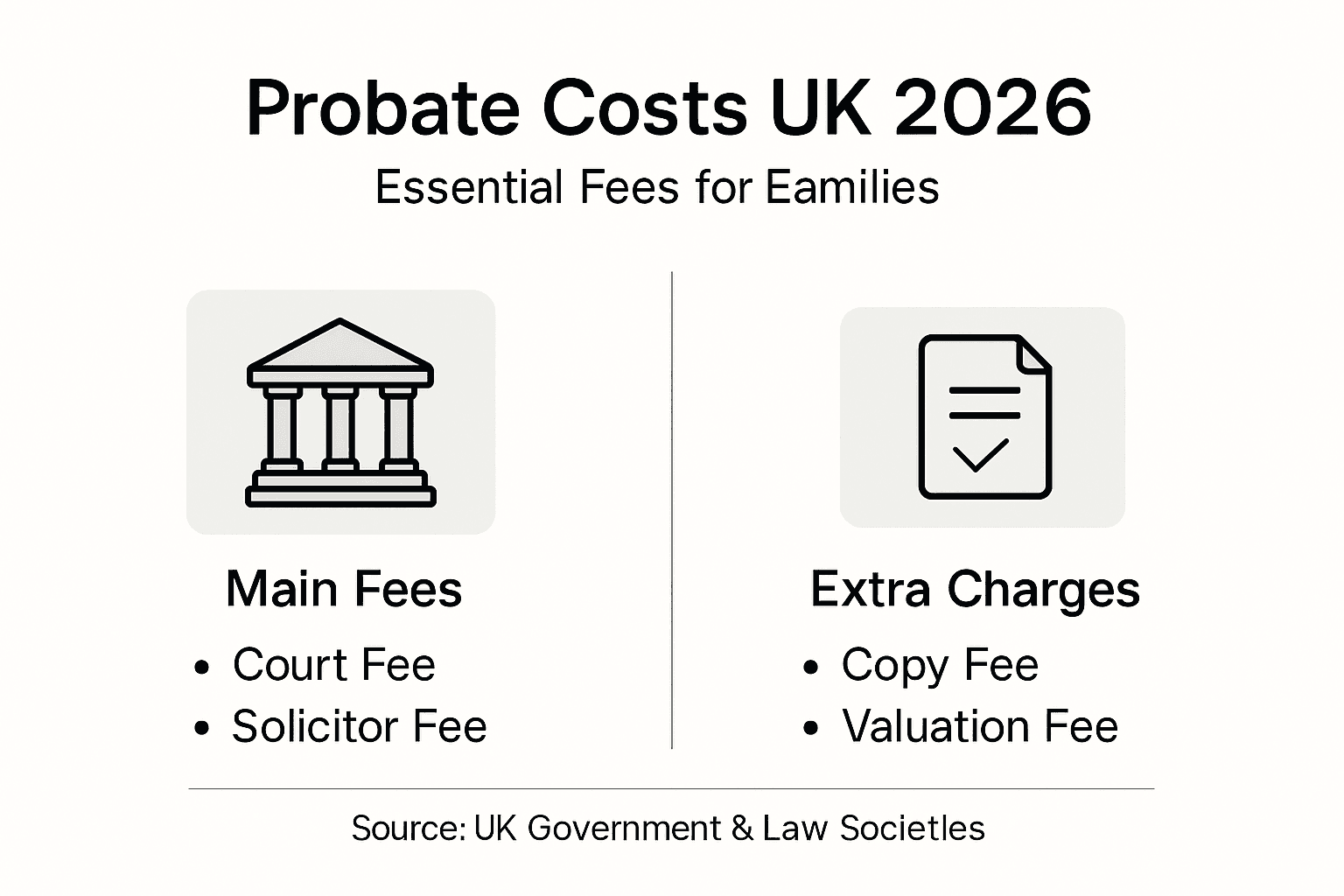
Key cost areas include:
- Probate application fees – required when submitting your application to the court
- Solicitor’s legal fees – typically charged hourly or as a fixed fee for straightforward cases
- Inheritance Tax – payable on estates exceeding £325,000 (the current nil-rate band)
- Asset valuation costs – required for property surveys and specialist valuations
- Bond fees – insurance against executor misconduct (sometimes required)
- Copies of probate grants – recent fee increases reflect service costs and can accumulate if multiple copies are needed
Timeline and Its Impact on Costs
The probate process typically takes 4–8 months in straightforward cases. Complex estates—those with property disputes, multiple assets across different countries, or contested wills—take considerably longer.
Delays extend costs. Solicitors continue charging for their time, bank accounts accrue interest charges, and property requires ongoing maintenance or management fees. Planning ahead reduces these hidden expenses.
Recent Changes (2026 Update)
The UK probate system has undergone reform. New online application services have streamlined the process for simpler estates. Additionally, more estates are now exempt from detailed reporting requirements if they fall below the inheritance tax threshold.
These changes aimed to improve efficiency, though some delays occurred during implementation. Understanding these reforms helps you navigate current processes more effectively.
Who Bears the Costs?
Generally, probate costs come from the estate itself—paid before beneficiaries receive their inheritance. If the estate lacks liquid funds, executors may need to sell assets or request personal contributions.
In Romford and across the UK, many families benefit from professional guidance to minimise unnecessary spending. The cost of hiring a solicitor often pays for itself by preventing costly mistakes.
Complex estates typically require professional legal support to navigate tax obligations and asset distribution correctly.
Pro tip: Request fixed-fee quotes from solicitors rather than hourly rates for probate work—this gives you budget certainty and prevents unexpected cost overruns.
Key Types of Probate Fees in 2026
Probate fees in 2026 are simpler than they were previously, but families still need to understand what they’re paying for. The UK government reformed the fee structure to reflect actual service costs rather than generate excess revenue.
Knowing each fee type helps you budget accurately and avoid surprises when the bills arrive.
The Court Application Fee
The primary cost is the flat-rate grant application fee of £273. This single charge covers your court application for a grant of probate, regardless of your estate’s value.

This represents a significant shift. Previously, fees scaled with estate value, meaning larger estates paid substantially more. The new flat rate applies equally to £100,000 estates and £1 million estates alike.
Copies of the Grant
You’ll often need multiple copies of your probate grant. Banks, building societies, and other institutions typically request certified copies before releasing funds or assets.
Each additional copy costs £16. Most estates require between two and five copies, depending on how many institutions hold assets. If you’re uncertain how many you’ll need, it’s better to order extra now rather than request them later—each order incurs processing delays.
Solicitor and Professional Fees
Whilst court fees are fixed, solicitor charges vary significantly. Many firms now offer fixed-fee probate services, particularly for straightforward estates without complications.
Typical solicitor costs include:
- Fixed-fee packages for simple estates (usually £1,500–£3,000)
- Hourly rates for complex cases (£150–£400 per hour depending on seniority)
- Additional charges for specialist work like property valuations or tax advice
In Romford and across the UK, fixed fees give you budget certainty and remove the stress of open-ended hourly billing.
Here’s a summary of typical probate-related fees and their impact on estate planning:
| Fee Type | Typical Cost Range | Budgeting Impact | When Payable |
|---|---|---|---|
| Court Application Fee | £273 (flat rate) | Predictable, fixed expense | On application |
| Probate Grant Copies | £16 per copy | Multiply by number required | Ordering grant copies |
| Solicitor’s Fixed Fee | £1,500–£3,500 | Certainty for simple estates | On completion/intervals |
| Solicitor’s Hourly Fee | £150–£400 per hour | Can escalate with complexity | Periodically invoiced |
| Property Valuation | £300–£500 per property | Essential, often overlooked | Before distribution |
| Inheritance Tax | 40% above £325,000 | Largest single expense | Before inheritance |
Asset-Related Fees
Beyond the court and legal costs, managing the estate itself can generate additional expenses. These aren’t “probate fees” technically, but they affect your total costs.
These include:
- Property valuations – surveyor fees for determining asset worth
- Estate agent fees – if selling property (typically 1–2% of sale price)
- Inheritance Tax payments – due if the estate exceeds £325,000
- Bank fees – for transferring funds or closing accounts
What You Might Avoid
Smaller estates with minor assets may not require probate at all. If assets are held jointly or in trust, they pass outside probate, saving time and money.
Checking whether probate is actually necessary can save thousands in unnecessary costs.
The new flat-fee structure means all estates now pay the same court application fee, removing the penalty previously imposed on larger estates.
Pro tip: Ask your solicitor upfront exactly how many copies of the probate grant you’ll need—ordering them all at once costs less than requesting extras later.
How Probate Solicitor Charges Work
Solicitor fees are often the largest cost families face when handling probate. Understanding how solicitors charge and what you’re actually paying for helps you make informed decisions and avoid overspending.
Not all solicitors charge the same way, and the differences matter significantly to your final bill.
Types of Charging Models
Solicitors use three main charging structures for probate work. Each has advantages and drawbacks depending on your estate’s complexity.
- Fixed fees – a set price for straightforward estates (typically £1,500–£3,500)
- Hourly rates – charged at £150–£400 per hour depending on the solicitor’s experience
- Percentage-based fees – a percentage of the estate value (less common now, typically 0.5–2%)
Fixed fees offer budget certainty. Hourly rates work better for complex cases where time spent varies unpredictably. Percentage fees are increasingly rare because they can become disproportionately expensive for larger estates.
The following table compares solicitor charging models for probate work:
| Charging Model | Best Use Case | Potential Benefits | Possible Drawbacks |
|---|---|---|---|
| Fixed Fee | Simple estates | Budget certainty | Not suited to complex cases |
| Hourly Rate | Complicated matters | Flexible for uncertainty | Total cost unpredictable |
| Percentage-Based | Large/high-value estate | Aligns fee to estate size | Expensive for bigger estates |
What’s Included in Solicitor Fees?
Solicitor charges typically cover several services. Understanding what’s included prevents surprises when you receive your bill.
Standard inclusions usually are:
- Providing legal advice on probate matters
- Preparing and submitting probate documentation
- Corresponding with HMRC and other organisations
- Managing estate assets and distributions
- Handling inheritance tax calculations and payments
Things often excluded—and charged separately—include property valuations, estate agent fees, and specialist tax advice. Ask your solicitor explicitly what’s covered before committing.
Regulated Standards and Transparency
Probate is a reserved legal activity requiring regulated professionals such as solicitors, barristers, or legal executives. This regulation protects you from unfair or hidden charges.
Solicitors must provide clear, transparent fee information upfront. They cannot charge hidden extras or unexpected amounts. If a solicitor won’t give you a written fee agreement before work begins, that’s a red flag.
Comparing Solicitor Quotes
Obtaining multiple quotes reveals significant price variation. Two solicitors handling the same estate might charge £1,500 and £3,000—both perfectly legitimate depending on their service levels.
When comparing quotes, ensure you’re comparing like with like. Ask specifically about:
- Whether copies of the probate grant are included
- How many hours of correspondence they expect
- What happens if complications arise
- Whether tax advice is included or separate
Don’t automatically choose the cheapest option. Cheap solicitors sometimes cut corners or work inefficiently, costing you time and stress.
Additional Costs Beyond Solicitor Fees
Remember that solicitor fees are just one part of the total cost. Court fees, property valuations, and inheritance tax remain separate expenses regardless of which solicitor you hire.
Regulated probate professionals must provide transparent fee agreements in writing before beginning work, protecting you from hidden charges.
Pro tip: Request a detailed fee breakdown in writing before engaging a solicitor, and ask explicitly whether costs like Inheritance Tax payments or property valuations are included or charged separately.
Inheritance Tax and Other Extra Expenses
Inheritance Tax can be the largest single cost your family faces during probate. Many families are caught off guard by the bill because they didn’t realise their estate exceeded the threshold.
Understanding these extra expenses upfront gives you time to plan and avoid financial stress later.
Inheritance Tax Explained
Inheritance Tax applies to estates exceeding the £325,000 threshold. This is the nil-rate band—anything below it is tax-free, but amounts above it are taxed at 40%.
However, the rules become more generous if you’re leaving your main residence to children or grandchildren. The residence nil-rate band adds an extra £175,000 per person, potentially raising your threshold to £500,000.
Calculating your liability requires knowing your total estate value, including property, savings, investments, and life insurance payouts.
How Much Will You Pay?
Inheritance Tax is straightforward to calculate once you know your estate’s value. Every pound above the threshold is taxed at 40%.
Example scenarios:
- Estate worth £400,000 (no residence allowance): £30,000 tax due (40% of £75,000 above threshold)
- Estate worth £550,000 with main residence to children: £20,000 tax due (40% of £50,000 above combined threshold)
- Estate worth £300,000: £0 tax due (below threshold)
These bills must be paid before beneficiaries receive their inheritance. If the estate lacks ready cash, executors must sell assets to cover the bill.
Other Taxes on the Estate
Inheritance Tax isn’t the only tax concern. Capital Gains Tax applies when selling assets like investment properties or shares held in the estate.
Additional costs include professional valuations for assets valued over £500 and income tax on any income the estate generates whilst in administration.
Estate income—rental payments, interest on savings, or dividends—must be reported to HMRC and may be taxed depending on rates.
Professional Valuation Costs
Determining what your assets are actually worth costs money. Bank statements are straightforward, but property valuations require surveyors, and specialist items need expert appraisal.
Typical valuation costs include:
- Property surveys: £300–£500 per property
- Specialist asset appraisals (jewellery, art, collectibles): £100–£300 each
- Investment portfolio valuations: usually provided free by financial institutions
These fees are legitimate estate administration expenses, paid before beneficiaries receive anything.
Planning Ahead Reduces Bills
Many people could reduce their Inheritance Tax bill through proper estate planning. Gifts, trusts, and spousal arrangements all offer ways to minimise tax exposure.
Planning whilst alive is far easier than trying to reduce bills after death. Families in Romford and across the UK who take this step often save tens of thousands of pounds.
Inheritance Tax of 40% applies above the £325,000 threshold, but additional allowances can increase this limit significantly for family homes.
Pro tip: Obtain professional valuations for all significant assets early in the probate process—delaying this step creates bottlenecks and prevents timely tax calculations and payments.
Reducing Risks and Avoiding Hidden Costs
Hidden costs and poor service can turn an already difficult process into a financial nightmare. Protecting yourself requires knowing what to look for and asking the right questions before you commit to any professional.
Taking time upfront saves money, stress, and time later.
Verify Professional Credentials
Not everyone offering probate services is properly qualified. Using an unregulated provider puts your estate at serious risk of mismanagement, theft, or legal errors.
Before hiring anyone, check that they are:
- Regulated by the Solicitors Regulation Authority (SRA) for solicitors
- Authorised by the Financial Conduct Authority (FCA) for some services
- Listed on the official register of their regulatory body
- Properly insured against professional negligence
Regulated probate service providers must offer transparent pricing and fair terms, protecting you from exploitation. Unregulated firms have no such obligation.
Request Detailed Fee Agreements in Writing
A written fee agreement is your best protection against unexpected charges. It should clearly state what’s included, what’s excluded, and how you’ll be charged.
Your agreement must specify:
- Total cost or hourly rate with estimated hours
- What services are covered by the base fee
- Which costs (valuations, court fees, taxes) are separate
- When payments are due
- What happens if complications arise
If a firm won’t provide this in writing, walk away. Legitimate professionals always document their terms clearly.
Get Multiple Quotes
Obtaining quotes from at least three solicitors reveals normal pricing in your area. Comparing quotes shows you which firms are overcharging and which offer genuine value.
When requesting quotes, provide identical information to each firm. Ask them all the same questions about what’s included so you’re comparing apples with apples, not apples with oranges.
Demand Regular Cost Updates
As probate progresses, costs can change. Your solicitor should provide regular updates on spending, particularly for itemised expenses like valuations or court fees.
Request written updates at least monthly. This prevents bills from mounting unexpectedly and allows you to query charges whilst the work is fresh.
Watch for Red Flags
Certain warning signs indicate a firm may not be trustworthy. If you notice any of these, seek alternative representation immediately.
Red flags include:
- Pressure to pay upfront before work begins
- Reluctance to provide a written fee agreement
- Vague answers about what costs you’ll face
- No transparency about timescales or progress
- Refusal to provide references or credentials
Documentation and Record-Keeping
Keep detailed records of everything. Save all correspondence, fee invoices, and cost statements.
This documentation protects you if disputes arise later. It also helps you verify that charges are legitimate and within the agreed terms.
Regulated professionals are legally required to provide transparent fee agreements and fair pricing, protecting clients from hidden charges and poor service.
Pro tip: Request itemised invoices breaking down exactly what you’re being charged for—solicitors should happily provide this, and if they resist, it’s a warning sign to find alternative representation.
Simplify Your Probate Journey with Expert Legal Support
Navigating probate costs and processes in the UK can be overwhelming, especially with recent 2026 reforms and complex fees like inheritance tax and solicitor charges. Families often face unexpected expenses and delays that cause stress and uncertainty during an already difficult time. Understanding the breakdown of fees and planning carefully becomes essential to protect your inheritance and settle the estate smoothly.
At Signature Law, we specialise in helping families across Romford, East London, and beyond to manage probate efficiently and cost-effectively. Our expert solicitors provide clear advice on grant of probate applications, estate administration, and inheritance planning to minimise costly mistakes and hidden charges. We believe in transparent fees, personalised service, and empowering you with knowledge throughout the process.
If you want peace of mind knowing your probate matters are handled professionally and compassionately, start your enquiry with our Wills, Probate & Estate Planning team today. Take control of the probate process and secure your family’s future by contacting us at Signature Law for trusted guidance tailored to your unique situation.
You can also learn more about how we support you with Estate Administration and Grant of Probate. Don’t wait until probate costs and complexities grow—reach out now and get the expert help you need.
Frequently Asked Questions
What are the main costs associated with probate in the UK?
The key costs include the court application fee, solicitor’s legal fees, inheritance tax, asset valuation costs, and copies of the probate grant.
How long does the probate process typically take?
The probate process usually takes 4 to 8 months in straightforward cases, but can take longer for complex estates or those with disputes.
Can I avoid probate costs for a small estate?
Yes, smaller estates with minor assets may not require formal probate, potentially saving costs and time. It’s important to assess if probate is necessary in such cases.
How are solicitor fees structured for probate cases?
Solicitor fees can be structured as fixed fees for simple estates, hourly rates for more complex cases, or less commonly, as a percentage of the estate’s value. Fixed fees are often preferred for budgeting certainty.
Recommended
- How to Handle Probate UK: Complete Step-by-Step Guide | Signature Law
- Estate Administration Explained – Managing Loss in Romford | Signature Law
- Estate Planning in Divorce – Protecting Your Children | Signature Law
- Family Law – How It Affects Everyday Life in the UK | Signature Law