





Family Law
Family Law Terminology – Clarity for Divorce in the UK

Sorting through family law in the United Kingdom can feel like decoding a new language when your future is on the line. If you’re in Romford and facing divorce, every phrase used by solicitors or courts shapes your rights, assets, and relationship with your children. Understanding key legal terms like affidavit, parental responsibility, and ancillary relief is the difference between feeling lost and confidently protecting what matters most. You’ll discover straightforward definitions that clear up confusion and help you make informed choices.
Table of Contents
- What Family Law Terminology Means
- Key Terms in Divorce Proceedings
- Understanding Child Arrangements Vocabulary
- Financial Orders and Settlement Language
- Rights, Obligations, and Common Pitfalls
Key Takeaways
| Point | Details |
|---|---|
| Understand Family Law Terminology | Familiarise yourself with key terms like ‘Affidavit’, ‘Ancillary Relief’, and ‘Parental Responsibility’ to protect your rights during divorce proceedings. |
| Clarify Any Confusion | Always ask your solicitor for clarification on unfamiliar terms to avoid misunderstandings about your case and agreements. |
| Financial Terminology Matters | Recognise precise financial terms such as ‘Lump Sum’ and ‘Clean Break’ to understand your entitlements and obligations post-divorce. |
| Know Your Rights and Obligations | Be aware of your legal rights, such as parental responsibilities and financial entitlements, to ensure you are protected throughout the divorce process. |
What Family Law Terminology Means
Family law has its own language. If you’re going through divorce in the UK, you’ll encounter terms that sound unfamiliar or confusing. Understanding these words isn’t optional—it’s the foundation of protecting your rights and making informed decisions about your future.
When solicitors, judges, and court documents reference affidavits, ancillary relief, or parental responsibility, they’re using precise legal language with specific meanings. Get the terminology wrong, and you might misunderstand what’s happening to your case. Get it right, and you’re empowered.
Core Terminology You’ll Encounter
The UK courts maintain official glossaries of family law terms to ensure consistency and clarity. Here are the terms you’re most likely to hear:
Affidavit – A written statement made under oath. You swear it’s truthful, and it can be used as evidence in court proceedings.
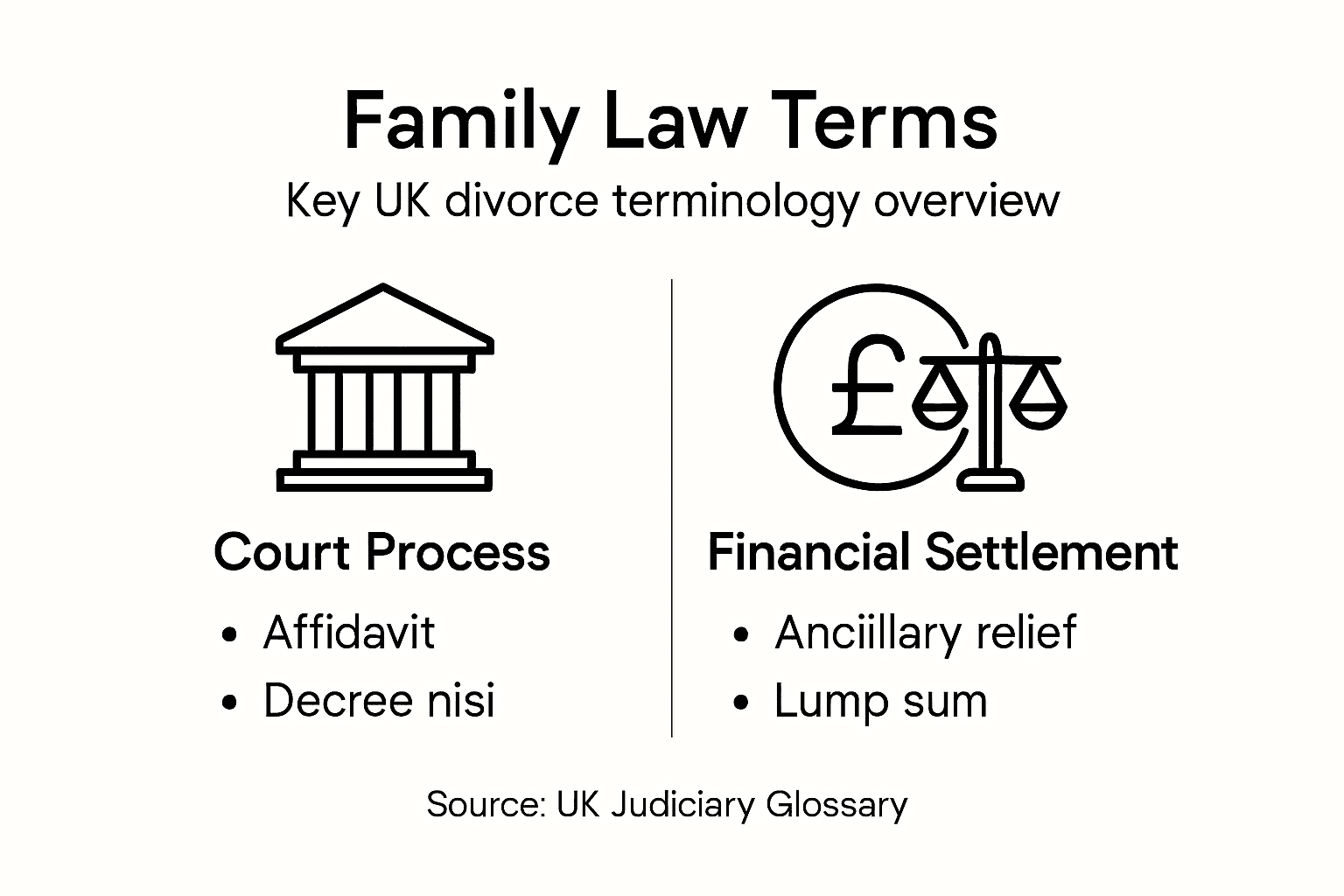
Ancillary relief – The formal term for financial settlements after divorce. This includes dividing assets, pension arrangements, and maintenance payments.
Parental responsibility – The legal right and duty to make decisions about your child’s upbringing, education, healthcare, and welfare.
Decree nisi – The first stage of divorce. It confirms the court accepts your grounds for divorce but doesn’t finalise the marriage dissolution yet.
Decree absolute – The final divorce order. Once granted, you’re legally no longer married.
Child arrangement order – A court order specifying where children live and how much time they spend with each parent.
Non-molestation order – A court order protecting you from harassment, abuse, or threats from another person.
Why Precision Matters
Legal terminology isn’t just formal language—it defines your rights. When a solicitor mentions maintenance, they mean ongoing financial support after separation. When they reference matrimonial assets, they’re discussing property, savings, and valuables acquired during the marriage.
Misunderstanding these terms can cost you. You might accept a settlement thinking you understand it, only to realise later you’ve missed crucial protections or financial entitlements.
Breaking Down Common Confusion Points
Many clients confuse similar-sounding terms. Here’s what distinguishes them:
-
Divorce vs. dissolution – Divorce ends a marriage; dissolution ends a civil partnership.
-
Custody vs. parental responsibility – “Custody” is outdated language. Modern law uses “parental responsibility” and “child arrangement orders” instead.
-
Maintenance vs. child support – Maintenance is financial support to a spouse or ex-partner; child support specifically supports children.
-
Settlement vs. order – A settlement is an agreement you both reach; an order is imposed by the court.
Understanding these distinctions prevents costly misunderstandings and ensures you know exactly what agreements you’re signing.
Where to Find Authoritative Definitions
The judiciary publishes comprehensive glossaries of family law terminology used in proceedings. These official definitions give you confidence that you’re interpreting terminology correctly.
When your solicitor uses an unfamiliar term, ask for clarification immediately. There’s no such thing as a silly question—clarity now prevents confusion later.
Pro tip: Keep a notebook of unfamiliar legal terms as they arise during your case, writing down both the term and your solicitor’s explanation in your own words. This personal glossary becomes a valuable reference throughout your proceedings.
Key Terms in Divorce Proceedings
Divorce proceedings involve specific terminology that appears in court documents, solicitor correspondence, and formal orders. These terms define what happens to your assets, your children, and your legal status. Misunderstanding them during proceedings can lead to costly mistakes or missed opportunities.
The language used in court isn’t designed to confuse you—it’s designed for precision. Once you understand the key terms, you’ll follow your case with confidence and know exactly what agreements you’re entering into.
Essential Procedural Terms
When your case moves through the courts, you’ll encounter terms that describe stages and actions:
Petition – Your formal written request to the court asking for a divorce. It states your grounds (reason) for divorcing and any orders you’re seeking.
Statement of arrangements – A document describing where children will live and how you’ll share childcare responsibilities.
Financial statement – A detailed disclosure of your income, assets, debts, and liabilities. Both parties must complete this honestly.
Directions hearing – An early court meeting to establish a timeline, identify issues, and plan how the case will progress.
First appointment – The initial settlement discussion in financial cases, often held with a judge or mediator present.
Trial – If you can’t agree on financial or child matters, the court decides for you after hearing evidence from both sides.
Financial Settlement Language
Divorce settlements involve dividing assets and arranging ongoing support. Understanding divorce settlement terminology prevents confusion about what you’re entitled to receive or expected to pay.

Lump sum – A one-time payment from one spouse to another, often used to divide assets fairly.
Periodical payments – Regular monthly or annual payments for spousal maintenance or child support.
Clean break – A court order ending all financial ties between you and your ex-partner after settlement.
Matrimonial assets – Property and savings acquired during the marriage that the court can divide, including homes, pensions, and investments.
Needs – The court assesses what each person actually requires to maintain a reasonable standard of living after divorce.
Orders and Agreements
Divorce outcomes are documented through court orders or agreements:
To help clarify how court orders and settlements differ, here’s a quick comparison table:
| Aspect | Court Order | Settlement Agreement |
|---|---|---|
| Decision Maker | Judge or magistrate | Both parties (negotiated) |
| Legal Binding | Always enforceable by law | Becomes enforceable when approved |
| Modification | Needs formal application | Needs new agreement, court approval |
| Typical Outcome | Set terms for assets/child arrangements | Agreed terms, often more flexible |
-
Consent order – An agreement you both reached that the court has approved and made official.
-
Financial order – A court decision dividing assets and arranging maintenance payments.
-
Sealed order – A court order marked as final and binding, impossible to change without exceptional circumstances.
-
Interim order – A temporary court decision made while proceedings continue, later replaced by a final order.
Every order you receive changes your legal position permanently, so understanding exactly what each one requires is critical to protecting yourself.
Common Procedural Actions
During proceedings, solicitors use specific language to describe what’s happening:
Disclosure – Providing complete, honest information about your finances to the other party and the court.
Affidavit evidence – Written statements sworn under oath, used instead of giving evidence in person.
Application – A formal request to the court for a specific order or decision before trial.
Injunction – A court order prohibiting someone from taking a specific action, such as contacting you or selling property.
Stay of proceedings – A temporary halt to court actions, usually while you attempt settlement negotiations.
Pro tip: Request your solicitor to explain any unfamiliar term the moment you encounter it in documents or correspondence—don’t wait until you’re confused later.
Understanding Child Arrangements Vocabulary
When children are involved in divorce, the terminology shifts. Instead of talking about “custody” or “access”, modern UK family law uses precise language around child arrangements, contact, and parental responsibility. These terms aren’t just different words—they reflect a fundamental change in how the law views children’s relationships with both parents.
Understanding this vocabulary matters because it directly affects your rights as a parent and protects your child’s wellbeing. Courts use these terms in orders that become legally binding, so getting them right is essential.
Core Child Arrangements Terms
Child arrangement order – A court decision specifying where your child lives and how much time they spend with each parent. This replaces the outdated terms “custody” and “access”.
Contact – The legal term for time your child spends with a parent or other family member. It can be direct (in person) or indirect (phone calls, letters, video calls).
Parental responsibility – The legal right and duty to make decisions about your child’s welfare, education, healthcare, and upbringing. Both parents can have this, even if they don’t live together.
Residence – Where your child lives as their main home. Most children have one primary residence, though some split time equally between parents.
Indirect contact – Non-face-to-face communication with your child, such as telephone calls, emails, or birthday gifts. Used when direct contact isn’t appropriate or safe.
Understanding CAFCASS and Children’s Guardians
CAFCASS glossary terms help clarify what happens when children’s welfare is at risk. CAFCASS (Children and Family Court Advisory and Support Service) is an independent organisation that investigates child welfare cases and advises courts.
Children’s guardian – An independent person appointed by the court to represent your child’s best interests, separate from both parents’ interests.
Child contact centre – A safe, neutral space where parents and children can meet when direct contact at home isn’t appropriate.
Care order – A court decision placing a child under local authority care when parents cannot provide adequate safety or welfare.
Key Distinctions Parents Miss
Many parents confuse similar-sounding terms that actually mean very different things:
-
Contact vs. residency – Contact is time spent together; residency is where the child lives.
-
Parental responsibility vs. contact – Responsibility covers all major decisions; contact is just about spending time together.
-
Direct contact vs. indirect contact – Direct means face-to-face; indirect means phone calls or gifts.
-
Child abduction vs. wrongful removal – Both involve taking a child without consent, but have different legal consequences.
Getting these distinctions wrong could affect how you interpret a court order or what you’re legally permitted to do with your child.
Important Welfare-Related Terms
If your case involves safeguarding concerns, you’ll encounter additional terminology:
-
Child maintenance – Regular financial payments from one parent to support the child’s living costs.
-
Parenting plan – An agreed arrangement between parents about how they’ll share childcare and make decisions together.
-
Supervised contact – Time spent with your child under observation by a professional, used when unsupervised contact presents risks.
-
Welfare checklist – The factors courts consider when deciding what’s in your child’s best interests.
Pro tip: Ask your solicitor for a written copy of any child arrangement order and request they explain each term in plain language before you sign—this prevents misunderstandings later.
Financial Orders and Settlement Language
Financial terminology in divorce can feel overwhelming. Words like ancillary relief, lump sum, and periodical payments appear in court documents, solicitor letters, and settlement proposals. Understanding exactly what these terms mean protects your financial interests and ensures you’re not agreeing to something you don’t fully grasp.
Financial language in divorce isn’t designed to confuse—it’s designed for precision. Once you understand the vocabulary, you’ll know exactly what you’re entitled to and what obligations you’re accepting.
Core Financial Order Terms
Ancillary relief – The formal legal term for financial orders made in divorce. This includes dividing assets, arranging maintenance payments, and sorting pension arrangements.
Financial order – A court-made decision about money and property division. It becomes legally binding once sealed by the court.
Consent order – An agreement you and your ex-partner both reached about finances. The court approves it, making it legally enforceable.
Lump sum – A one-time cash payment from one spouse to another. Often used to balance out asset division fairly.
Periodical payments – Regular monthly or yearly payments for maintenance. Usually continues until remarriage or a set end date.
Clean break order – A court decision that ends all future financial claims between you and your ex-partner. Once granted, neither can claim against the other’s future earnings or assets.
Understanding Asset-Related Language
Financial settlement terminology includes specific terms about property and valuables. Matrimonial assets are possessions acquired during the marriage that courts can divide. This covers your home, savings, investments, vehicles, and jewellery.
Charge on property – A legal claim against your home or other property. If your ex-partner receives it as part of settlement, they have a secured right against that asset.
Declaration of trust – A formal document stating who owns what when property is held in joint names. Prevents disputes about actual ownership.
Pension sharing order – Divides pension benefits accumulated during the marriage between you and your ex-partner.
Cash equivalent transfer value – The cash value of a pension at a specific point in time, used when dividing pensions.
Payment and Support Terms
Once settlement is decided, specific language describes how payments work:
Here’s a reference table summarising types of financial support in divorce:
| Type | Who Pays | Main Purpose |
|---|---|---|
| Spousal Maintenance | One ex-partner to the other | Support partner post-divorce |
| Child Support | Non-resident parent | Cover child living costs |
| Periodical Payments | Either party (court-ordered) | Regular ongoing financial provision |
| Lump Sum | Either party (one-off) | Fair asset distribution |
-
Maintenance – Ongoing financial support paid to a spouse or ex-partner.
-
Child support – Payments specifically for supporting children’s living costs.
-
Spousal maintenance – Support paid to an ex-spouse, separate from child support.
-
Arrears – Money owed when maintenance payments fall behind.
A clean break order provides finality, but only if both parties genuinely can afford to separate financially—courts won’t impose impossible settlements.
Settlement Language That Matters
When discussing settlement, these terms define your options:
-
Open offer – A settlement proposal you make, with costs consequences if refused.
-
Without prejudice – Settlement discussions that can’t be used as evidence in court if negotiations fail.
-
Sealed – A final order recorded as complete and binding.
-
Variation – Changing an existing court order due to changed circumstances.
Pro tip: Before accepting any financial settlement, ask your solicitor to write a summary explaining exactly what you’re receiving, what you’re paying, and when payments end—this clarity prevents future disputes.
Rights, Obligations, and Common Pitfalls
Divorce creates both rights and obligations. Understanding what you’re legally entitled to and what you’re legally bound to do prevents costly mistakes. Many people misinterpret their obligations or fail to exercise their rights simply because the terminology wasn’t clear.
Terminology matters here because it defines enforceability. A right you don’t understand is a right you can’t protect. An obligation you underestimate becomes a liability.
Understanding Your Rights
Parental responsibility gives you the right to make major decisions about your child’s upbringing, education, healthcare, and religion. This is separate from where your child lives or how much time you spend together.
Residency rights mean your child lives with you as their primary home. You control day-to-day decisions about their welfare and have legal authority to represent them.
Contact rights entitle you to spend time with your child. This can be direct (face-to-face) or indirect (phone calls, emails, video calls).
Financial rights protect your entitlement to a fair share of matrimonial assets and maintenance payments if you need support.
Right to appeal allows you to challenge court decisions you believe were made unfairly or based on incorrect information.
Key Obligations You Must Know
Child maintenance obligation – If you earn above a threshold, you must pay towards your child’s living costs. Parental responsibilities and child maintenance obligations are enforced through the Child Maintenance Service.
Spousal maintenance – Courts can order you to pay financial support to your ex-partner, either temporarily or indefinitely, depending on circumstances.
Disclosure obligations – You must honestly declare all your financial information. Hiding assets or income is fraud and can result in criminal charges.
Court order compliance – You’re legally bound to follow any order the court makes. Breaching it can lead to contempt of court proceedings.
Parenting obligations – Even without residency, you must support your child’s welfare and maintain contact unless the court orders otherwise.
Common Pitfalls to Avoid
Many clients stumble because they misunderstand what rights and obligations actually mean:
-
Assuming contact automatically equals parental responsibility – You can have one without the other.
-
Ignoring maintenance orders – The Child Maintenance Service actively pursues arrears with enforcement action.
-
Hiding assets during disclosure – Courts discover hidden information, and lying under oath has serious legal consequences.
-
Breaking court orders – Even if you disagree with an order, you must follow it until it’s formally changed by the court.
-
Assuming your ex will comply voluntarily – Many parents need enforcement action to honour orders.
Misunderstanding your obligations often costs more in enforcement action than simply complying from the start.
Non-Resident Parent Status
If you don’t live with your child, non-resident parent status defines your legal position. You still have parental responsibility and child maintenance obligations, but your practical involvement in day-to-day childcare differs.
Being a non-resident parent doesn’t reduce your legal rights or responsibilities—it simply describes your living arrangement.
Pro tip: Keep written records of all financial payments and contact with your child—if disputes arise later, documentation proves you’ve met your obligations and exercised your rights.
Gain Confidence Navigating Family Law Terminology with Expert Support
Understanding the precise language of family law is essential to protect your rights and make informed decisions during any divorce or child arrangement process in the UK. Terms like affidavit, ancillary relief, and parental responsibility carry critical legal meaning that directly impacts your case outcome. Without clear guidance, the complex vocabulary can feel overwhelming and lead to costly misunderstandings.
At Signature Law, we specialise in delivering clear, compassionate, and expert Family Law advice tailored to your unique situation. Whether you need help with Divorce, Financial Settlements, or Child Arrangement Orders, our experienced solicitors break down legal jargon into plain English so you feel empowered every step of the way. Do not let confusing terminology hold you back. Get the clarity and personalised legal support you deserve today.
If you want to confidently navigate your family law journey with trusted experts by your side, reach out now. Contact Signature Law and take control of your future with clarity and compassion.
👉 Start your personalised Family Law support here: Contact Us
Frequently Asked Questions
What does an affidavit mean in family law?
An affidavit is a written statement made under oath, confirming that its contents are truthful. It is often used as evidence in court proceedings.
What is the difference between a decree nisi and a decree absolute?
A decree nisi is the first stage in divorce proceedings, indicating that the court accepts the grounds for divorce but does not yet finalise the dissolution. A decree absolute is the final order that legally ends the marriage.
What is a child arrangement order?
A child arrangement order is a court order that specifies where a child will live and how much time they spend with each parent, replacing the older terms of custody and access.
Why is understanding financial terminology important during divorce?
Understanding financial terminology is crucial as it defines rights and obligations regarding the division of assets and maintenance payments, preventing costly misunderstandings and ensuring fair settlements.
Recommended
- Family Law – How It Affects Everyday Life in the UK | Signature Law
- Divorce Settlement Explained – Fair Outcomes in 2026 UK | Signature Law
- Estate Planning in Divorce – Protecting Your Children | Signature Law
- Top 8 FamilyLawLondon.co.uk Alternatives in 2026 for Compassionate Legal Guidance in Divorce and Child Arrangements | Signature Law