





Family Law
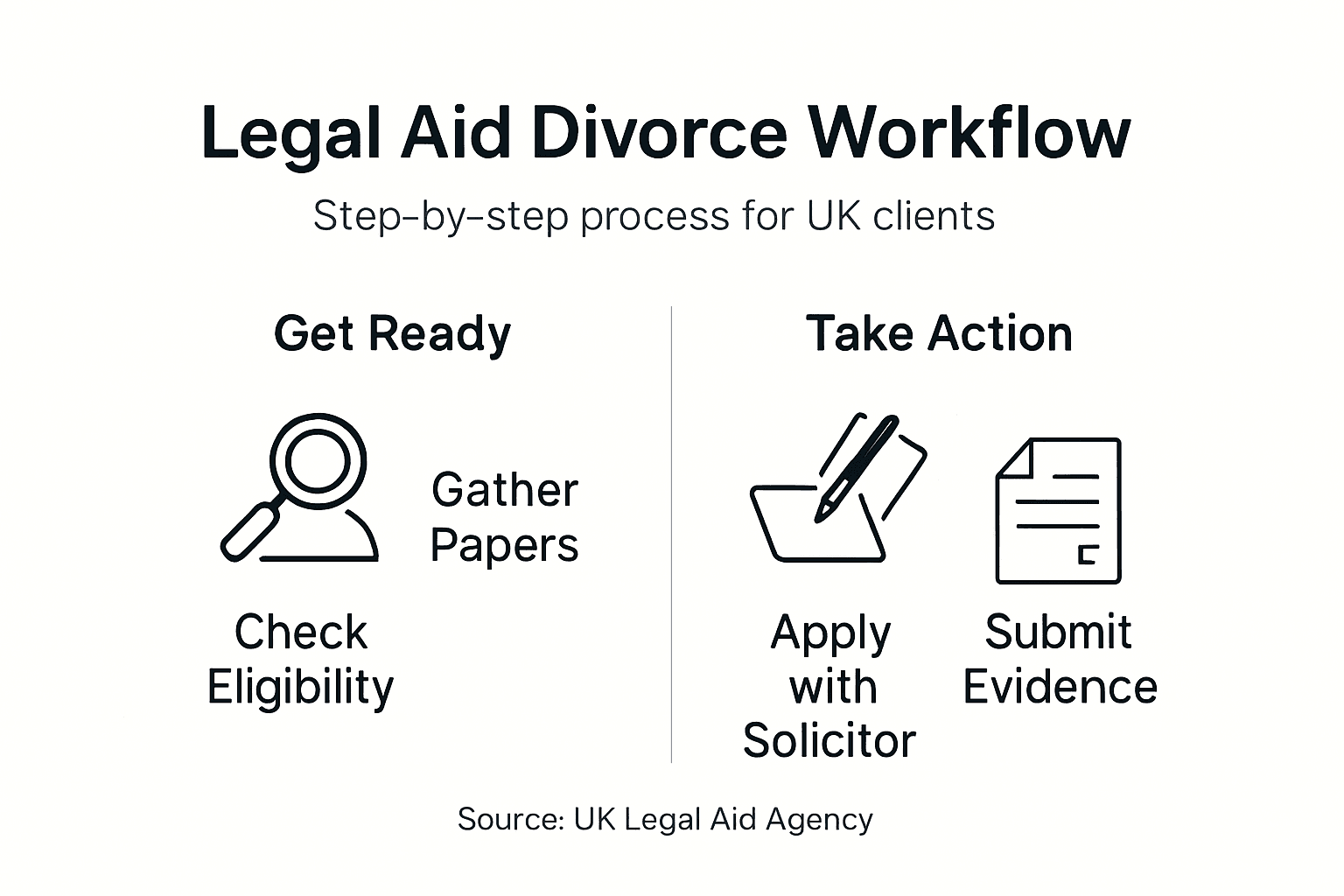
Legal Aid Divorce Workflow: Step-by-Step Guide for UK Clients

Facing divorce in Romford when money is tight can feel overwhelming, especially if you are unsure where to turn for support. The stress of ending a marriage is hard enough without worrying about legal bills or confusing requirements. This guide breaks down each step of the UK legal aid process, helping you understand if you qualify, what documents you need, and how to work with your solicitor for the support you deserve.
Table of Contents
- Step 1: Assess Legal Aid Eligibility and Gather Documents
- Step 2: Initiate Your Legal Aid Application for Divorce
- Step 3: Engage with Your Solicitor and Submit Evidence
- Step 4: Advance Divorce Proceedings Under Legal Aid
- Step 5: Confirm Completion and Secure Final Decree
Quick Summary
| Key Point | Explanation |
|---|---|
| 1. Check Legal Aid Eligibility | Assess your financial situation against government thresholds before starting your divorce process to determine if you qualify for support. |
| 2. Gather Required Documents | Collect essential financial and personal documents, including payslips and evidence of any domestic abuse, to support your application for legal aid. |
| 3. Work with a Solicitor | Partner with a solicitor who can submit your legal aid application, ensuring it meets all necessary requirements for approval. |
| 4. Follow Up Promptly | Respond immediately to requests from your solicitor or the Legal Aid Agency to avoid delays in your application process. |
| 5. Secure Your Decree Absolute | After your divorce is finalised, ensure you receive your Decree Absolute, which officially ends your marriage and is necessary for future legal matters. |
Step 1: Assess Legal Aid Eligibility and Gather Documents
Before you proceed with your divorce, you need to understand whether you qualify for legal aid and what documents you’ll need to prove your case. This step determines whether the state can help fund your legal representation, which is crucial if finances are tight.
Legal aid eligibility in the UK depends primarily on your financial circumstances. The government sets strict thresholds: your joint monthly income should be £2,657 or less and your savings and assets below approximately £8,000. However, if you are experiencing domestic abuse, you may qualify for legal aid even if your income slightly exceeds these limits.
Here’s a quick reference to the key financial thresholds for legal aid in divorce cases:
| Criteria | Standard Limit | Special Consideration |
|---|---|---|
| Monthly income | £2,657 or below | May be higher if domestic abuse |
| Savings and assets | Below £8,000 | Flexible for domestic abuse victims |
| Ownership of property | Assessed case by case | Main home may be disregarded partly |
| Benefits (e.g. Universal Credit) | Counted towards limit | Proof may fast-track eligibility |
Start by gathering evidence of your current financial position. You will need to collect the following documents:
- Recent payslips (last 3 months)
- Bank statements (typically 3 months)
- Proof of any benefits you receive
- Details of savings accounts and investments
- Mortgage or rental agreements
- Council tax bills or similar proof of residence
- Details of any debts or loans
If you’re self-employed, gather your last two years of accounts or tax returns. This shows a clear picture of your income and spending.
You should also gather documents related to your marriage and separation. These include your marriage certificate, any separation agreements, and evidence of your children’s needs if child arrangements are in dispute. If you’ve experienced domestic abuse, collect any evidence such as police reports, medical records, or communications documenting the abuse.
Organise everything into a folder or document before you meet with a solicitor. Having materials ready speeds up the process and reduces initial consultation time.
Domestic abuse cases qualify for legal aid support even when income exceeds standard thresholds, which can provide critical protection when you need it most.
Once you’ve gathered your documents, you’ll be ready to discuss your circumstances with a solicitor who can formally assess your eligibility and advise on next steps.

Pro tip: Create a simple spreadsheet listing your income sources and monthly outgoings before your consultation—solicitors can quickly verify your eligibility when you have clear numbers ready.
Step 2: Initiate Your Legal Aid Application for Divorce
Now that you’ve gathered your documents and confirmed you meet the financial thresholds, it’s time to formally apply for legal aid. This step involves submitting your application through the proper channels so the Legal Aid Agency can assess your eligibility.
You cannot apply for legal aid directly yourself. Instead, you’ll need to work with a solicitor or family mediator who can submit the application on your behalf. This is actually beneficial because legal representatives know exactly what the Legal Aid Agency requires and can ensure your application is complete from the start.
Before formally applying, use the government’s eligibility checker service to verify you’re likely to qualify. You input your financial information and receive an indication of whether you’ll meet the means test. This takes only a few minutes and gives you confidence before proceeding.
Once you’ve selected a solicitor, they will guide you through the next steps:
- Complete the means test form with your financial details
- Complete the merits test to show your case has reasonable prospects of success
- Provide evidence supporting your circumstances
- Allow your solicitor to submit everything to the Legal Aid Agency
The application process itself is handled online or through your legal representative’s system. You won’t need to visit an office repeatedly; most communication happens electronically. Your solicitor will keep you updated on progress.
Your solicitor must apply on your behalf, as this ensures your application meets all agency requirements and maximises your chances of approval.
Typically, you’ll receive a decision within two to four weeks, though this can vary. If approved, the Legal Aid Agency will issue you a certificate confirming financial support for your case.
Practical tip: Respond immediately to any requests from the Legal Aid Agency or your solicitor—delays in providing documents can slow your approval, so check your emails regularly during this period.
Step 3: Engage with Your Solicitor and Submit Evidence
Your solicitor is now your partner in the legal aid process. This step involves close collaboration to gather and submit all evidence needed to support your application and demonstrate your case’s merit.
Your solicitor will conduct detailed means testing using specific government forms and guidelines. They’ll review your financial documents thoroughly to ensure everything complies with the Legal Aid Agency’s rules. This process determines whether you genuinely qualify based on income and assets.
You’ll need to provide comprehensive evidence across several areas. Financial documentation includes payslips, bank statements, mortgage agreements, and proof of benefits. If you’re claiming hardship or have dependents, gather supporting letters or proof of their needs. For domestic abuse cases, collect police reports, medical records, or any communications documenting the abuse.
Your solicitor will help you understand what counts as evidence:
- Proof of income and expenditure
- Details of all savings and investments
- Tenancy agreements or mortgage documentation
- Evidence of dependents or caring responsibilities
- Records of domestic abuse or threats
- Court orders or agreements already in place
Once gathered, your solicitor submits this evidence alongside forms showing your case meets the means and merits tests required by the Legal Aid Agency. The merits test examines whether your divorce has reasonable prospects of success and whether it’s appropriate to use public funds.
Communication with your solicitor must be prompt and honest—any gaps or delays in providing evidence can slow your application significantly.
Your solicitor will also help you gather necessary supporting documentation such as proof of domestic abuse or financial hardship. They handle all submissions to the Legal Aid Agency electronically, so you won’t need to post documents yourself.
Practical tip: Keep copies of everything you submit and ask your solicitor for a checklist of what they need—this prevents back-and-forth delays and shows you’re organised and serious about your case.
Step 4: Advance Divorce Proceedings Under Legal Aid
Once your legal aid certificate is approved, your solicitor can now guide you through the actual divorce process. This step involves progressing your case through mediation, negotiation, and potentially court proceedings, all funded by legal aid.
Your solicitor will explain what happens next. Legal aid covers representation and advice throughout the divorce process, including settlement negotiations and court hearings if needed. Your solicitor ensures every step complies with both legal standards and the terms of your legal aid funding.
Many divorces begin with mediation or negotiation before any court involvement. Your solicitor will encourage settlement discussions with your ex-partner’s solicitor to resolve matters like financial arrangements and child custody. This is faster, less costly, and often less adversarial than court proceedings.
The process typically unfolds in these stages:
- Submit your divorce petition with required documentation
- Serve papers on your ex-partner
- Attend mediation or negotiation meetings
- Exchange financial information if needed
- Attempt to reach settlement agreement
- Attend court hearings only if settlement fails
Your solicitor handles paperwork submission and manages communication with your ex-partner’s legal team. They keep you informed of progress and explain what each stage means. Legal aid covers representation in family law cases involving domestic violence, child protection, or forced marriage, ensuring you have proper support throughout.
Settlement outside court saves time, reduces stress, and preserves funds for your post-divorce life.
If court becomes necessary, your solicitor will prepare evidence, attend hearings, and present your case to the judge. They advocate for your interests whilst respecting the court’s authority to make final decisions.
Practical tip: Be honest with your solicitor about what matters most to you—whether that’s child arrangements, financial security, or a quick resolution—so they can prioritise negotiations accordingly.
The following table summarises the main roles of solicitors during the legal aid divorce process:
| Stage | Solicitor’s Role | Your Role |
|---|---|---|
| Eligibility assessment | Analyse finances, advise next steps | Provide documents, answer questions |
| Legal aid application | Complete and submit forms | Supply accurate details |
| Evidence gathering | Review, organise, present case | Locate and share records |
| Divorce proceedings | Advise, represent in negotiations/court | Make decisions and instruct solicitor |
| Completion and closure | Finalise decree, explain outcomes | Keep paperwork, act on advice |
Step 5: Confirm Completion and Secure Final Decree
You’re nearly at the finish line. This final step involves obtaining your Decree Absolute, the official court document that legally ends your marriage. Your solicitor will guide you through the application process to ensure everything is completed correctly.
After your case has been settled or decided in court, the next phase begins. Your solicitor will prepare the final application for the Decree Absolute and submit it to the court. This document is essential because without it, you remain legally married even though your divorce is otherwise finished.
The process involves several key actions. Your solicitor will confirm all previous orders are satisfied, prepare the final paperwork, submit the application to court, and await the judge’s signature. Once approved, the court issues your Decree Absolute, which you’ll receive in the post.
Here’s what typically happens:
- Your solicitor reviews settlement or court judgment
- They prepare the final application documents
- The court receives and processes your application
- The judge signs off on the Decree Absolute
- You receive the official sealed document by post
Obtaining the final decree (Decree Absolute) legally ends your marriage and completes the divorce process. This is the document you’ll need for any future legal matters, such as remarriage, updating your will, or changing your name officially.
The Decree Absolute is your proof that you’re no longer married—keep it safe in a secure location.
Once you have your Decree Absolute, your legal aid certificate will close. Your solicitor will explain any remaining financial matters and what happens with your case file. You’re now free to move forward with your new chapter.
Practical tip: Request multiple certified copies of your Decree Absolute from the court—you may need them for bank accounts, pension transfers, or future legal proceedings, so having spares prevents delays.
Navigate Your Legal Aid Divorce with Expert Family Law Support
Facing a divorce while managing financial constraints can feel overwhelming, especially when legal aid eligibility requirements add complexity to your journey. This detailed step-by-step guide to the Legal Aid Divorce Workflow highlights critical stages such as assessing eligibility, compiling essential documents, and effectively collaborating with your solicitor to ensure a smooth process. Key challenges include understanding the means and merits tests, submitting comprehensive evidence, and advancing proceedings with confidence despite emotional and financial stress.
At Signature Law, we understand how important it is to have compassionate, knowledgeable solicitors by your side during these difficult times. Our Family Law team specialises in supporting clients through every stage of legally aided divorces, including cases involving domestic abuse protection and child arrangements. We offer personalised advice, fixed-fee consultations, and guidance tailored to your unique circumstances to help you move forward with clarity and control.
Are you ready to take control of your legal aid divorce process with trusted expert help? Discover our full range of Family Law services, including Financial Settlements and Child Arrangements, designed to protect your rights and those of your family. Contact Signature Law today for a confidential consultation and start your journey toward resolution with support you can trust.
Frequently Asked Questions
How do I know if I qualify for legal aid in my divorce case?
To determine if you qualify for legal aid, assess your financial circumstances against the government’s thresholds. Gather information about your income and savings, and then consult your solicitor to complete the means test and evaluate your eligibility.
What documents do I need to gather for my legal aid application?
You will need various financial documents, including payslips, bank statements, proofs of benefits, and details about your savings and assets. Organise these documents into a folder to streamline the application process when you meet with your solicitor.
What is the process for applying for legal aid for my divorce?
You cannot apply directly for legal aid; instead, you must work with a solicitor who will complete your application. This involves filling out a means test form, providing evidence of your situation, and allowing your solicitor to submit everything to the Legal Aid Agency.
How long does it take to get a decision on my legal aid application?
Typically, you can expect a decision on your legal aid application within two to four weeks. Respond quickly to any requests for additional documentation to avoid delays in the approval process.
What should I do after my legal aid is approved?
Once your legal aid is approved, collaborate closely with your solicitor to advance your divorce proceedings. This may involve mediation or court processes, which your solicitor will guide you through while ensuring that they comply with the legal aid arrangements.
What is the final step in the legal aid divorce process?
The final step is obtaining your Decree Absolute, which legally ends your marriage. Your solicitor will prepare and submit the necessary application to the court, and ensure you receive the official document once it has been approved.
Recommended
- Legal Aid in Family Law – Who Qualifies and How it Works | Signature Law
- Divorce Settlement Explained – Fair Outcomes in 2026 UK | Signature Law
- Top 8 FamilyLawLondon.co.uk Alternatives in 2026 for Compassionate Legal Guidance in Divorce and Child Arrangements | Signature Law
- Family Law – How It Affects Everyday Life in the UK | Signature Law