





Family Law
Legal aid for domestic abuse: protection and support UK

Civil representation applications with domestic violence evidence up 43%, and the grant rate sitting at 81%, the demand for legal aid in domestic abuse cases has never been higher. If you are living with abuse right now, the law provides urgent tools to protect you, and legal aid can make those tools accessible regardless of your financial situation. This article explains what legal aid covers, who qualifies, how to apply for emergency protection, and what to do if you face barriers along the way.
Table of Contents
- Understanding legal aid and protection from domestic abuse
- Eligibility rules: evidence and means testing explained
- Emergency applications for non-molestation orders: step-by-step guide
- System barriers: evidence hurdles, legal aid deserts and unrepresented victims
- Finding support and preparing for your legal aid application
- Get professional support for legal aid and domestic abuse cases
- Frequently asked questions
Key Takeaways
| Point | Details |
|---|---|
| Legal aid empowers victims | Legal aid provides urgent legal protection for domestic abuse survivors, including non-molestation and occupation orders. |
| Eligibility criteria are strict | To qualify, you must show both evidence of abuse and pass a financial means test, though emergencies waive evidence requirements. |
| Systemic barriers remain | Many victims face hurdles due to evidence requirements and shortages of solicitors, but support is available for those who persist. |
| Practical help is available | Sample letters, local agencies and specialised solicitors can help gather evidence and strengthen your application. |
| Breaches carry serious penalties | Violating a non-molestation order is a criminal offence with penalties up to 5 years’ imprisonment. |
Understanding legal aid and protection from domestic abuse
Legal aid is government funding that covers your legal costs when you cannot afford a solicitor. In domestic abuse cases, it is not just about saving money. It is about giving you a real chance to access the courts and stop the harm.
Legal aid is available for victims seeking non-molestation orders, occupation orders, and child arrangement orders. These are the three most urgent tools the family courts can grant. Each one carries legal weight, and breaching any of them is a serious matter.
Here is what legal aid can help you obtain:
- Non-molestation order: Prohibits your abuser from contacting or harassing you
- Occupation order: Determines who can live in the family home
- Child arrangement order: Protects where your children live and who they spend time with
- Emergency injunctions: Granted without notice to your abuser in urgent situations
Our guide to non-molestation orders explains each type of order in plain terms. You can also read more about family lawyer support for domestic abuse to understand how a solicitor works alongside you throughout the process.
“Protection from domestic abuse is not just a civil matter. The law treats breaches of non-molestation orders as criminal offences, meaning your abuser can face arrest and prosecution for ignoring a court order.” — Protection from Domestic Abuse: The Law and Practice
This criminal enforcement element is significant. It means the order has real teeth, not just a piece of paper.
Eligibility rules: evidence and means testing explained
Qualifying for legal aid in domestic abuse cases involves two separate tests. You must pass both to receive funded representation.
1. The gateway evidence test
You need to show that domestic abuse has occurred. The Civil Legal Aid Procedure Regulations 2013 set out the accepted forms of evidence. There are 21 recognised types, including police reports, medical letters, court orders, and refuge referral letters.
2. The financial means test
You must demonstrate that your income and capital fall below set thresholds. If you receive certain benefits, you automatically pass this test.
| Benefit | Auto-qualifies for legal aid? |
|---|---|
| Income Support | Yes |
| Universal Credit | Yes |
| Income-based Jobseeker’s Allowance | Yes |
| Income-related Employment and Support Allowance | Yes |
| Guarantee Credit (Pension Credit) | Yes |
For those not on passport benefits, eligibility requires both gateway evidence and a means assessment based on your disposable income and capital. The disposable income limit in 2026 is £733 per month, and the capital limit is £8,000 (with some exceptions for property).
Accepted gateway evidence includes:
- A police caution, charge, or conviction relating to domestic abuse
- A domestic violence protection notice (DVPN) or order (DVPO)
- A letter from a health professional confirming injuries consistent with abuse
- A letter from a refuge confirming you were admitted as a domestic abuse victim
- A court order, injunction, or undertaking relating to domestic abuse
- A social services risk assessment
Pro Tip: If you are in immediate danger and need an emergency order, you do not need to gather evidence first. Emergency non-molestation and occupation orders can be granted without the usual evidence requirements, giving you protection while you build your case.
For a full breakdown of who qualifies for legal aid and the common legal aid eligibility barriers people face, our dedicated pages cover both in detail.
Emergency applications for non-molestation orders: step-by-step guide
If you are in danger right now, the courts can act fast. Here is how the process works in practice.
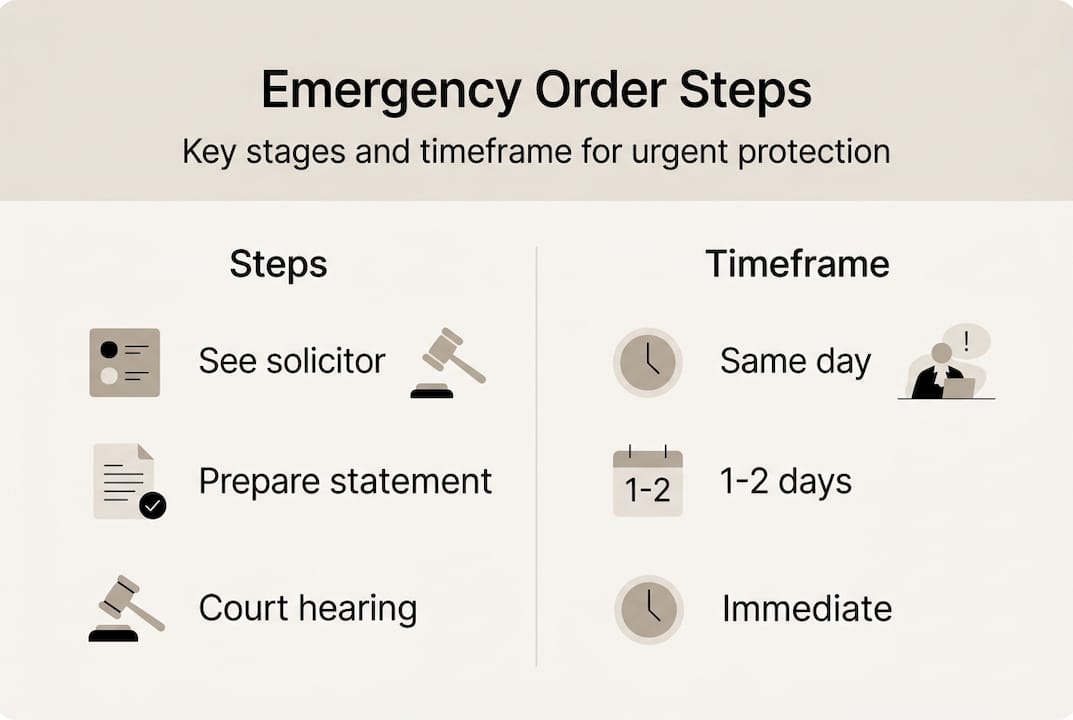
Step 1: Contact a legal aid solicitor
A solicitor with a legal aid contract can apply for emergency funding on the same day. Do not wait.
Step 2: Complete the FL401 form
This is the official application form for a non-molestation or occupation order. Your solicitor will help you complete it accurately. No court fee is payable when applying.
Step 3: Prepare a witness statement
You will need to describe the abuse in your own words. Your solicitor will guide you on what to include. Be specific about dates, incidents, and any injuries or threats.
Step 4: Apply without notice if necessary
In urgent cases, the court can hear your application without telling your abuser first. This is called a “without notice” application. The PFDs Guidance 2026 confirms that without notice orders are appropriate where giving notice would expose the applicant to further risk.
Step 5: Attend the hearing
For without notice applications, the hearing is usually short. The judge reads your statement and decides whether to grant the order. You may not need to speak at length.
Step 6: Serve the order
Once granted, the order must be personally served on your abuser. Your solicitor arranges this. The order takes effect once served.
| Stage | Typical timeframe |
|---|---|
| Emergency legal aid granted | Same day |
| Without notice hearing listed | Same day or next working day |
| Order served on respondent | Within 24 to 48 hours |
| Return hearing (respondent attends) | Usually 7 to 14 days later |
Breaching a non-molestation order is a criminal offence under the Family Law Act 1996. Your abuser can be arrested without a warrant if they breach it. This is one of the most powerful protections available to you.
If children are involved, our child care legal advice page explains how social services and the courts work together to keep children safe. You can also read our detailed non-molestation order guide for more on what the order covers and how long it lasts.
System barriers: evidence hurdles, legal aid deserts and unrepresented victims
The legal aid system exists to protect you. But the honest truth is that many victims still cannot access it. Understanding why helps you prepare.
The evidence problem
Post-LASPO (Legal Aid, Sentencing and Punishment of Offenders Act 2012) reforms introduced strict evidence requirements that many victims simply cannot meet. Economic abuse and coercive control, for example, rarely leave physical evidence. A victim whose partner controls every penny may have no police record, no medical letter, and no refuge referral.
Legal aid deserts
Post-LASPO strict evidence requirements have reduced access significantly, and a shortage of legal aid solicitors in many areas compounds the problem. Some regions have no legal aid family law provider at all. This forces victims to travel long distances or go without representation entirely.
The scale of the problem
Family legal aid cases fell from 204,000 in 2012/13 to just 29,000 in 2020/21. In a 2015 Rights of Women survey, 53% of respondents took no action after experiencing domestic abuse, largely due to cost and access barriers.
The key barriers victims face include:
- Evidence requirements that exclude coercive and economic abuse
- No legal aid solicitors available locally
- Confusion about eligibility leading to no application being made
- Fear of the court process without professional support
- Language barriers for non-English speakers
Pro Tip: If you cannot find a local legal aid solicitor, contact the Civil Legal Advice helpline on 0345 345 4 345. They can confirm your eligibility and refer you to a provider, including remote services.
“The legal aid system is in crisis. Victims of domestic abuse are navigating complex court proceedings alone, often facing their abuser in court without any legal support.” — Legal Aid System in Crisis Now
Advocacy groups including Rights of Women are pushing for reform, including broader evidence standards and automatic legal aid for all domestic abuse victims. Until those reforms arrive, knowing the systemic barriers to legal aid is the first step to working around them.
Finding support and preparing for your legal aid application
Despite the barriers, there are concrete steps you can take right now to strengthen your application and access support.
Gather your evidence early
The gateway evidence list includes 21 accepted types. You only need one. Start with what is most accessible to you. A GP letter, a referral from a domestic abuse charity, or a record from a social worker all count.
Useful evidence to collect includes:
- Medical records or a letter from your GP or A&E
- Text messages, emails, or voicemails showing threatening behaviour
- Photographs of injuries or property damage
- A diary of incidents with dates and descriptions
- Letters from schools, health visitors, or social workers
- A referral letter from a domestic abuse support organisation
The government provides sample evidence request letters you can use to ask professionals for supporting documentation. These are free to download and use.
Contact a domestic abuse charity
Organisations such as Refuge, Women’s Aid, and Galop (for LGBTQ+ victims) can provide support letters, safety planning, and referrals to legal aid solicitors. They understand the evidence requirements and can help you gather what you need.
Prepare your personal statement
Write down what has happened to you, in your own words, as soon as it is safe to do so. Include specific incidents, dates, and any witnesses. This becomes the foundation of your witness statement for court.
Pro Tip: Keep copies of all evidence in a safe place your abuser cannot access. A trusted friend, family member, or your solicitor can hold copies for you.
Our family lawyer domestic abuse support page explains how a solicitor works with you from the first call through to the final hearing. If you are already considering an order, our non-molestation order resources provide further practical guidance.
Get professional support for legal aid and domestic abuse cases
At Signature Law, we understand that reaching out for legal help when you are experiencing abuse takes real courage. Our founder, Sital Somaiya, has over 15 years of experience in family law and has been featured on BBC and ITV for her work in this area. We offer family law legal aid for eligible clients, fixed-fee initial consultations, and multilingual support so that language is never a barrier to protection. Whether you need an emergency non-molestation order today or want to understand your options before taking action, our team is here to guide you with genuine care and legal authority. We serve clients across the UK, with a strong presence in Romford, East London and Essex. To speak to a family law solicitor about your situation, contact us today. You do not have to face this alone.
Frequently asked questions
Can I apply for legal aid if I haven’t reported the abuse to the police?
Yes. Many other forms of accepted evidence are recognised, including medical reports, GP letters, refuge referral letters, and social worker assessments. A police report is not required.
Do I need to provide evidence when applying for an emergency non-molestation order?
No. For emergency orders, evidence is not required to access legal aid immediately. You can obtain protection first and gather supporting documentation afterwards.
What happens if I don’t pass the financial means test for legal aid?
If you receive passport benefits such as Universal Credit or Income Support, you automatically qualify financially. If you do not, you may need to self-represent or seek free advice from a charity, but a solicitor can still advise you on your options at a fixed-fee consultation.
Is there a fee to apply for a non-molestation order?
No. There is no court fee when applying for a non-molestation order in England and Wales. The FL401 application is free to submit.
How long does a non-molestation order last?
A non-molestation order usually lasts between 6 and 12 months. The court can extend it if the risk continues, and you can apply for a further order before the current one expires.
Recommended
- How Family Lawyers Provide Expert Domestic Violence Help and Legal Support in the UK
- Why choose legal aid for family law matters in the UK | Signature Law
- How legal aid supports family law cases in UK 2026 | Signature Law
- Role of legal aid in UK divorce: 32% qualify for support | Signature Law