





Family Law
Role of legal aid in UK divorce: 32% qualify for support

Facing divorce is difficult enough without worrying about legal costs. Surprisingly, only about 32% of those seeking legal aid in divorce cases actually qualify despite widespread financial hardship. Many UK families face emotional turmoil, financial uncertainty, and child custody battles without the legal support they desperately need. This article clarifies how legal aid works in divorce, who qualifies, what it covers, and how to secure the help you need during one of life’s most challenging transitions.
Table of Contents
- Introduction To Legal Aid In UK Divorce
- Legal Aid Eligibility In Divorce Cases
- Scope Of Legal Aid Coverage In Divorce Proceedings
- Benefits Of Legal Aid For Emotional And Financial Challenges
- Legal Aid Application Process And Challenges
- Common Misconceptions About Legal Aid In Divorce
- Role Of Legal Aid In Child Custody And Arrangements
- Challenges And Access To Legal Aid In The UK Family Law System
- Conclusion And Practical Steps To Secure Legal Aid For Your Divorce
- How Signature Law Can Support Your Divorce Legal Aid Needs
- Frequently Asked Questions
Key takeaways
| Point | Details |
|---|---|
| Eligibility is strict | You must pass both a financial means test and a merits test covering urgent family issues like child arrangements or domestic abuse. |
| Coverage is comprehensive | Legal aid covers legal advice, mediation, court representation, child arrangement orders, and financial settlements in qualifying divorce cases. |
| Benefits are substantial | Legal aid reduces financial stress, improves child custody outcomes, and provides professional emotional support during separation. |
| Application takes time | The process typically requires 3 to 6 weeks for approval after submitting complete documentation. |
| Misconceptions block access | Many believe legal aid only covers criminal cases or all divorces, when eligibility depends on specific financial and case criteria. |
Introduction to legal aid in UK divorce
Legal aid provides government funding to help people access legal advice and representation when they cannot afford it themselves. In family law, this support becomes critical during divorce proceedings, where legal aid is designed to ensure access to justice for those facing financial and emotional challenges.
The role of legal aid in family law extends across several key areas. It helps you understand your rights, negotiate fair settlements, and protect your children’s welfare. During emotionally and financially challenging separations, having professional legal guidance prevents costly mistakes and reduces stress.
Legal aid typically covers:
- Initial legal advice about your divorce options and rights
- Mediation services to reach agreements outside court
- Court representation when negotiations fail
- Child arrangement proceedings focusing on children’s best interests
- Protection from domestic abuse through court orders
Without this support, many individuals would face the legal system alone, potentially accepting unfair settlements or losing contact with their children. The system recognises that justice should not depend on wealth, especially when family welfare is at stake.
Legal aid eligibility in divorce cases
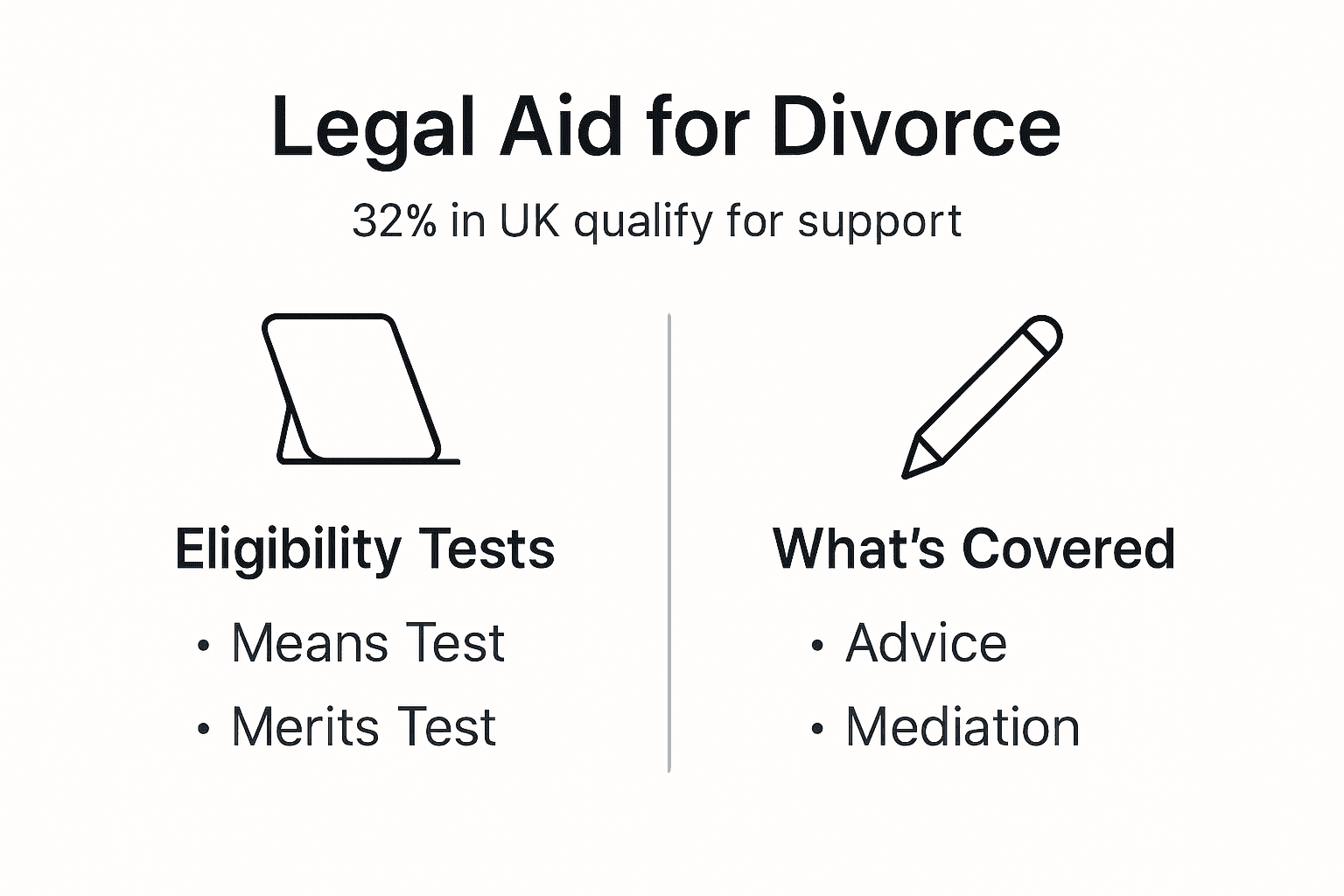
Qualifying for legal aid requires passing two distinct assessments. Understanding these tests helps you determine whether you can access support before starting your application.
The means test examines your financial situation. It considers your income, savings, and assets to determine whether you can afford legal representation yourself. For 2026, if your gross monthly income exceeds £2,657, you likely will not qualify. The test also considers capital and savings, with limits varying based on whether you receive certain benefits.

The merits test evaluates whether your case qualifies for legal aid coverage. Not every divorce issue receives funding. Eligibility depends on passing both a financial means test and a merits test covering urgent family issues such as child arrangements or domestic abuse. You must demonstrate that your case involves qualifying issues and has reasonable prospects of success.
Types of family law issues qualifying for legal aid include:
- Cases involving domestic abuse or violence
- Child abduction or forced marriage protection
- Child arrangement disputes when other methods have failed
- Protection from harm for you or your children
- Situations where you lack mental capacity to represent yourself
Financial disputes over property division or spousal maintenance typically do not qualify unless linked to domestic abuse or child welfare. This limitation causes frustration for many applicants who struggle financially but do not meet the strict criteria.
The legal aid divorce workflow requires gathering extensive documentation. You need proof of income, bank statements, evidence of qualifying issues, and details about your case. Missing documents delay approval or lead to rejection.
Scope of legal aid coverage in divorce proceedings
Understanding what legal aid actually pays for prevents disappointment and helps you plan additional funding if needed. Coverage is comprehensive for qualifying issues but has clear boundaries.
Legal aid covers legal advice, mediation, court representation, child arrangement orders, and financial settlements in divorce. This includes initial consultations where a solicitor assesses your situation, explains your options, and helps you understand the legal process ahead.
Mediation receives strong support under legal aid. This process brings you and your former partner together with a neutral third party to reach agreements about children, finances, and property. Mediation often resolves issues faster and less expensively than court proceedings. Legal aid covers mediation assessment meetings and subsequent sessions if appropriate.
Court representation becomes available when mediation fails or is unsuitable. Your solicitor can represent you in hearings about child arrangements, protective orders, or other qualifying matters. This representation includes preparing court documents, gathering evidence, instructing barristers if needed, and attending hearings on your behalf.
Family law legal aid coverage specifically includes:
- Advice on separation and divorce procedures
- Mediation for child and financial arrangements
- Court applications for child arrangement orders
- Non-molestation and occupation orders
- Representation in care proceedings
- Appeals against certain family court decisions
| Service Type | Legal Aid Coverage | Typical Exclusions |
|---|---|---|
| Legal advice | Initial consultations, ongoing guidance | General divorce without qualifying issues |
| Mediation | Assessment and sessions | Cases with domestic abuse (direct mediation unsafe) |
| Court representation | Child arrangements, protective orders | Property division disputes alone |
| Financial settlements | Only when linked to child welfare or abuse | Standard financial remedy applications |
Pro Tip: Even if legal aid does not cover your entire divorce, partial coverage for child arrangements significantly reduces your overall legal costs.
Benefits of legal aid for emotional and financial challenges
Legal aid provides more than just funding. It delivers tangible improvements to your wellbeing and case outcomes during an incredibly stressful period.
Financial stress decreases dramatically when you secure legal aid. Instead of choosing between legal representation and daily expenses, you gain access to professional support without depleting savings or taking on debt. This relief allows you to focus on your family’s needs rather than accumulating legal bills.
Child arrangement outcomes improve with proper legal representation. Solicitors experienced in family law understand how courts assess children’s best interests. They present your case effectively, gather appropriate evidence, and negotiate arrangements that protect your relationship with your children. Legal aid reduces financial distress and improves clarity on child custody arrangements for vulnerable families.
Emotional support through professional legal guidance cannot be overstated. Your solicitor becomes an advocate who understands the legal system and your rights. This support reduces anxiety about court proceedings, helps you make informed decisions, and provides stability when everything else feels uncertain.
Key benefits include:
- Reduced financial burden allowing focus on children and recovery
- Fair negotiation of child arrangements protecting your parental relationship
- Professional emotional reassurance during overwhelming proceedings
- Better understanding of legal rights and options
- Increased confidence when facing court hearings
Many clients report that knowing they have legal representation improves their mental health. The divorce process remains difficult, but you face it with professional support rather than alone. This support for legal aid benefits in divorce makes challenging situations more manageable.
Pro Tip: Apply for legal aid early in your divorce process to maximise the emotional and practical benefits throughout your case.
Legal aid application process and challenges
Navigating the legal aid application requires patience, organisation, and realistic expectations about timelines and potential obstacles.
The application process follows several distinct stages:
- Initial assessment with a legal aid solicitor who determines potential eligibility
- Completion of the means test application with detailed financial information
- Gathering evidence of qualifying issues (domestic abuse evidence, child welfare concerns)
- Submission of your application through your solicitor to the Legal Aid Agency
- Review period where the Agency assesses your means and merits
- Decision and notification, typically within several weeks
The application process involves an online means assessment and documentation submission, often taking 3 to 6 weeks for approval. However, complex cases or missing documentation can extend this period significantly.
Common challenges delay or prevent approval. Financial disclosure must be complete and accurate. The Legal Aid Agency requests bank statements, payslips, benefit letters, and proof of assets. Incomplete submissions return for additional information, restarting the clock. Evidence of qualifying issues requires specific documentation. For domestic abuse cases, you need police reports, court orders, medical records, or letters from support organisations. Gathering this evidence while managing separation stress proves difficult for many applicants.
Processing times vary based on application volume and case complexity. Straightforward applications with complete documentation process faster. Cases requiring additional evidence or clarification take longer. During busy periods, the Legal Aid Agency faces backlogs that extend waiting times beyond the typical range.
Pro Tip: Start gathering financial documents and evidence of qualifying issues before your initial solicitor meeting to speed up your application significantly.
The legal aid application process rewards preparation. Organised applicants with complete documentation receive decisions faster and face fewer rejections.
Common misconceptions about legal aid in divorce
Misunderstanding legal aid eligibility and coverage prevents many eligible individuals from applying. Clearing up these misconceptions helps you assess your situation accurately.
The belief that legal aid only covers criminal cases remains widespread. In reality, family law represents a significant portion of civil legal aid work. Divorce, child arrangements, and domestic abuse cases receive substantial funding for eligible applicants. This misconception causes people to avoid applying when they actually qualify.
Many assume legal aid covers all divorces regardless of circumstances. The strict means and merits tests ensure funding goes to those facing financial hardship and serious family law issues. Standard divorces without child welfare concerns or domestic abuse typically do not qualify. This targeted approach frustrates applicants who need help but do not meet the specific criteria.
Confusion about financial eligibility thresholds stops applications before they start. Some people believe any income or savings disqualifies them. The means test uses specific income limits and considers your household circumstances. If you receive certain benefits, you may automatically qualify regardless of the standard income threshold. Understanding these nuances helps you determine whether to apply.
Common myths about legal aid include:
- Legal aid only covers criminal defence work
- All family law issues receive automatic legal aid funding
- Any savings or property ownership disqualifies you completely
- The application process takes many months or years
- Legal aid solicitors provide lower quality representation
- You must repay legal aid like a loan
These misconceptions create barriers to accessing support. Legal aid solicitors offer the same professional standards as privately funded representation. Your case receives proper attention regardless of funding source. The application process, while thorough, typically concludes within weeks, not months. Legal aid is a grant, not a loan, though the Statutory Charge may recover costs from money or property you gain through the case.
Role of legal aid in child custody and arrangements
Child arrangement disputes receive priority in legal aid funding because courts recognise that children’s welfare depends on proper legal representation for parents.
Legal aid specifically supports child arrangement order applications. These orders determine where children live and how much time they spend with each parent. When you cannot reach agreement through mediation or informal discussion, court applications become necessary. Legal aid funds your solicitor to prepare your application, gather evidence about your children’s needs, and represent you in hearings.
The focus on children’s best interests drives all family court decisions. Legal aid ensures representation focusing on children’s welfare and fair custody decisions in family courts. Your solicitor presents evidence about your relationship with your children, your ability to meet their needs, and why your proposed arrangements serve their interests.
Legal representation for custody matters proves particularly important when:
- Your former partner makes unfounded allegations against you
- Child welfare concerns require investigation and response
- Complex living arrangements need careful legal structuring
- Your children express preferences that need proper presentation to the court
- Relocation or international custody issues arise
Without proper representation, parents struggle to present their case effectively. Court procedures, evidence rules, and legal arguments require professional knowledge. Judges make decisions based on the evidence presented. Poor presentation or missed legal points can result in arrangements that do not reflect your children’s true best interests or your capability as a parent.
Child custody legal aid support recognises that equal access to justice for parents protects children’s rights to relationships with both parents. When one parent cannot afford legal representation, power imbalances affect outcomes. Legal aid levels this playing field.
Challenges and access to legal aid in the UK family law system
Despite legal aid’s critical role, significant barriers limit access for many families who need support.
Funding cuts since 2013 dramatically reduced legal aid availability. The Legal Aid, Sentencing and Punishment of Offenders Act 2012 (LASPO) removed many family law matters from scope. Legal aid budget cuts since 2013 and stricter financial limits have reduced eligibility and access for financial disputes in family law. Financial remedy cases, unless involving domestic abuse, no longer qualify. This change left many people facing complex property and financial disputes without professional help.
Eligibility limits for financial disputes create particular hardship. Divorce often involves significant financial decisions about property, pensions, and ongoing support. Without legal aid, people accept unfair settlements because they cannot afford to negotiate properly or challenge unreasonable proposals. This situation particularly affects women, who statistically earn less and have fewer financial resources during separation.
Court procedure delays compound legal aid access challenges. Even with legal aid approval, court backlogs mean waiting months for hearings. This delay prolongs uncertainty and stress for families. Children remain in temporary arrangements longer than necessary. Protective orders take weeks to obtain when immediate action is needed.
| Challenge Area | Impact on Families | Current Status 2026 |
|---|---|---|
| Funding cuts | Reduced scope of coverage | Financial disputes largely excluded since 2013 |
| Means test thresholds | Many working families do not qualify | Income limit £2,657 gross monthly |
| Evidence requirements | Difficult to prove qualifying issues | Strict documentation needed for domestic abuse |
| Processing delays | Extended uncertainty and stress | 3 to 6 weeks typical, longer if complex |
| Legal aid provider shortage | Limited solicitor availability in some regions | Ongoing recruitment challenges |
The shortage of legal aid providers affects access in certain areas. Many solicitors stopped offering legal aid work after funding cuts reduced payment rates. Finding a legal aid family solicitor in rural areas or smaller towns proves difficult. This geographic inequality means your postcode affects your access to justice.
Advocacy groups continue pressing for legal aid reform. They argue that current restrictions violate access to justice principles and disproportionately harm women and children. Legal aid access challenges remain a contentious policy area with calls for scope expansion and better funding.
Conclusion and practical steps to secure legal aid for your divorce
Legal aid provides essential support for families facing divorce, but accessing it requires understanding, preparation, and prompt action.
The benefits of legal aid extend beyond funding. You gain professional representation, reduced financial stress, improved child arrangement outcomes, and emotional support during your most difficult period. Eligibility depends on meeting strict means and merits tests, but many more people qualify than actually apply due to misconceptions.
To secure legal aid effectively:
- Contact a legal aid family solicitor immediately when considering divorce
- Gather financial documents including bank statements, payslips, and benefit letters
- Collect evidence of qualifying issues such as domestic abuse documentation
- Complete your application thoroughly with all requested information
- Respond promptly to any requests for additional documentation
- Apply early in your divorce process to avoid delays affecting your case
Early application prevents complications. Waiting until your case becomes urgent reduces your options and increases stress. Speaking with a solicitor helps you understand whether you qualify and what documentation you need.
Pro Tip: Even if you think you might not qualify, consult a legal aid solicitor for an assessment. Eligibility rules are complex, and you may have options you have not considered.
Your family’s future depends on proper legal support during divorce. Do not let misconceptions or application complexity prevent you from seeking the help you need and deserve.
How Signature Law can support your divorce legal aid needs
Navigating legal aid eligibility and divorce proceedings requires experienced guidance. Signature Law specialises in family law across the UK, with particular expertise in legal aid cases. Our approach combines legal authority with genuine compassion during your most challenging times.
Founded by solicitor Sital Somaiya, who brings over 15 years’ experience and has been featured on BBC and ITV, our firm understands the emotional and financial pressures you face. We offer fixed-fee initial consultations to assess your legal aid eligibility and explain your options clearly. Our family law solicitors in London provide multilingual advice and personalised support throughout your case.
We help with legal aid applications, child arrangement proceedings, financial settlements, and domestic abuse protection. Our team guides you through documentation requirements and represents you effectively in negotiations and court. Contact Signature Law today to discuss your situation and start securing the legal support your family needs.
Frequently asked questions
What types of divorce cases qualify for legal aid in the UK?
Legal aid supports cases involving domestic abuse, child arrangement disputes, forced marriage protection, or child abduction. Standard divorces focusing solely on financial settlements typically do not qualify unless linked to child welfare or safety concerns. You must pass both means and merits tests demonstrating financial need and serious family law issues.
How long does it typically take to get approved for legal aid?
Legal aid applications usually take 3 to 6 weeks for approval after complete submission. Complex cases or incomplete documentation extend this period. Start gathering financial documents and evidence of qualifying issues early. Processing times vary based on the Legal Aid Agency’s workload and your case complexity.
Can legal aid cover child custody disputes during divorce?
Yes, legal aid covers child arrangement disputes. Funding includes legal advice, mediation assessment, and court representation for child arrangement orders. The focus remains on children’s best interests and ensuring fair custody outcomes. This coverage applies when mediation has failed or is inappropriate due to domestic abuse or safety concerns.
What are common reasons for legal aid application rejection?
Applications fail when applicants do not pass the means test due to income or assets exceeding thresholds, or when cases do not meet merits test criteria. Insufficient documentation proving qualifying issues like domestic abuse causes rejection. Applying too late in proceedings or for matters outside legal aid scope also leads to denial.
Recommended
- Legal Aid Divorce Workflow: Step-by-Step Guide for UK Clients | Signature Law
- Role of Financial Settlements in UK Divorce: 70% Settled Out of Court | Signature Law
- Legal Aid in Family Law – Who Qualifies and How it Works | Signature Law
- Signature Law Blog: Legal Insights & Updates (2026)