





Family Law
Role of Financial Settlements in UK Divorce: 70% Settled Out of Court

Many people entering divorce believe their assets will be split evenly. That’s rarely how it works. Courts use fairness rather than strict equality; divisions depend on individual circumstances. In fact, 70% of divorcing couples settle financial matters outside court, reflecting the process’s complexity. This guide will explain key legal principles, how assets are divided, and practical steps for fair settlements.
Table of Contents
- Introduction To Financial Settlements In Divorce
- Legal Framework Of Financial Settlements
- Factors Influencing Financial Settlements
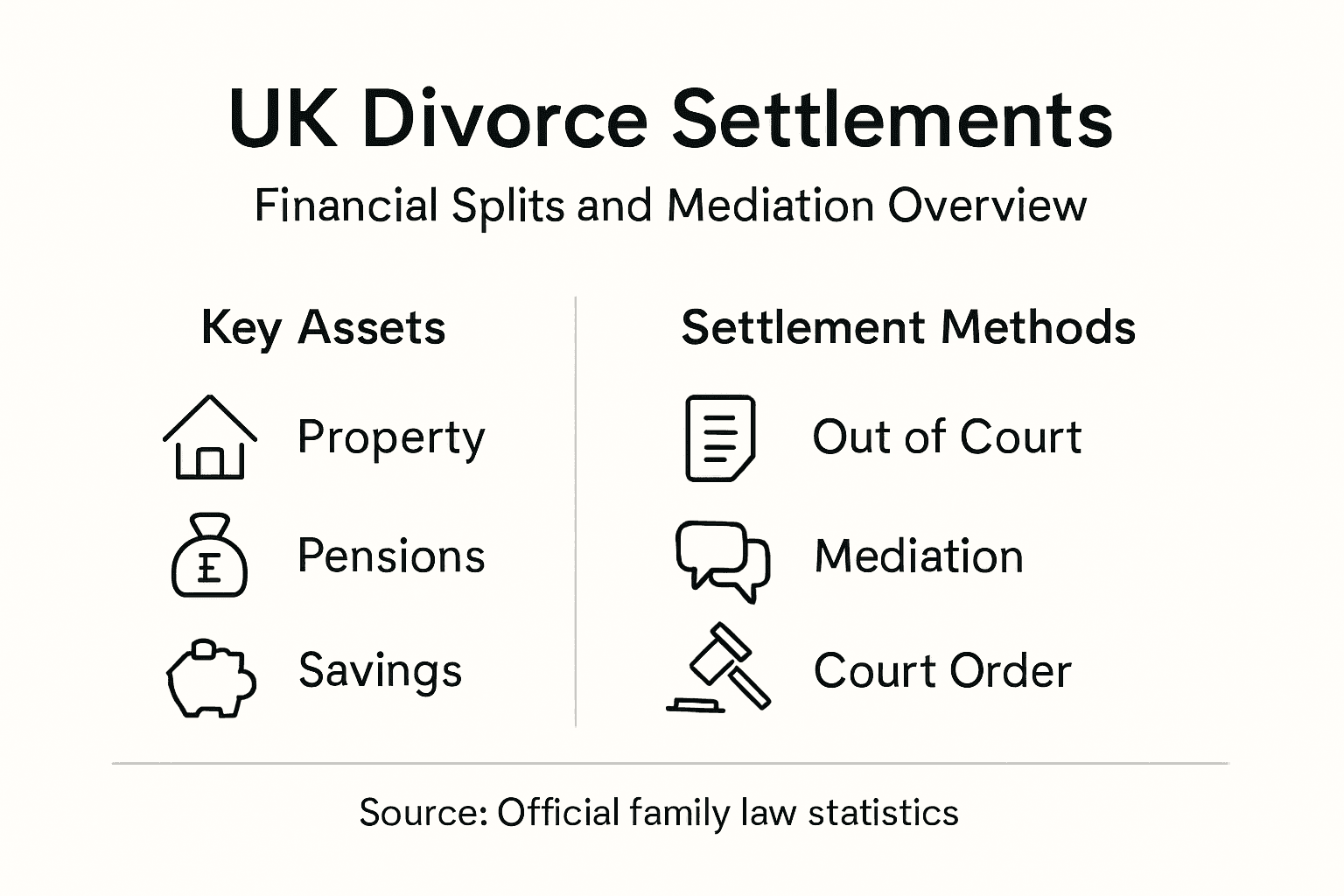
- Division Of Property, Pensions, And Assets
- Role Of Mediation And Negotiation In Financial Settlements
- Maintenance And Spousal Support Considerations
- Common Misconceptions About Financial Settlements
- Practical Steps And Legal Deadlines For Financial Settlements
- Get Expert Family Law Support For Divorce Financial Settlements
- FAQ: Role Of Financial Settlements In Divorce
Key Takeaways
| Point | Details |
|---|---|
| Legal foundation | Financial settlements are governed by the Matrimonial Causes Act 1973, which enables courts to divide assets fairly. |
| Court considerations | Courts assess needs, income, standard of living, contributions, and future earning capacity, prioritising fairness over equality. |
| Major assets | Property and pensions are typically the largest marital assets, divided equitably but not necessarily equally. |
| Mediation success | About 70% of UK financial settlements are resolved through mediation or negotiation, saving time and reducing conflict. |
| Maintenance | Spousal maintenance is discretionary, based on need and ability to pay, not automatically granted. |
Introduction to Financial Settlements in Divorce
A financial settlement is a legal arrangement that divides assets, liabilities, and income between divorcing spouses. It’s not about punishment or rewarding one party. It’s about fairness.
Financial settlements in divorce are governed by the Matrimonial Causes Act 1973, which enables courts to divide assets fairly. The purpose is to ensure both spouses can move forward financially without ongoing disputes.
Financial Remedy Orders give courts the power to impose various arrangements:
- Lump sum payments
- Property adjustment orders
- Pension sharing orders
- Maintenance payments
- Transfer of assets
Settlements cover everything from the family home and savings accounts to pensions, investments, businesses, and debts. The goal is to achieve a clean break where possible, allowing both parties to rebuild their lives independently.
Legal Framework of Financial Settlements
The Matrimonial Causes Act 1973 establishes court powers to make financial remedy orders covering property, maintenance, and pensions. This legislation provides the backbone for all divorce financial settlements in England and Wales.
Courts can issue several types of orders:
- Lump sum orders requiring one spouse to pay the other a specific amount
- Property adjustment orders transferring ownership of property or altering existing interests
- Pension sharing orders dividing pension benefits between spouses
- Periodical payments orders requiring ongoing maintenance payments
- Sale of property orders forcing the sale of assets to distribute proceeds
Understanding financial settlement agreements is essential before entering negotiations. The court won’t impose an order without good reason if both parties reach agreement through mediation or negotiation.
The legal process formalises settlements through a consent order, which makes the agreement legally binding and enforceable. Without this, either party could later make financial claims against the other, even years after divorce.
You should seek legal advice when assets are complex, significant disputes exist, or you’re unsure about fairness. A divorce settlement explained can clarify your rights and options.
Factors Influencing Financial Settlements
Courts don’t apply a fixed formula when determining financial settlements. Instead, they assess each case individually using Section 25 factors from the Matrimonial Causes Act 1973.
Key considerations include:
- Needs, obligations, and responsibilities of each party, including housing and income requirements
- Income, earning capacity, and financial resources both parties have or could reasonably acquire
- Standard of living enjoyed by the family before breakdown
- Age of parties and duration of marriage, recognising longer marriages typically result in more equal division
- Physical or mental disability affecting either party’s earning capacity
- Contributions made by each party, including financial and non-financial contributions like childcare and homemaking
- Conduct in exceptional circumstances where one party’s behaviour affected finances
- Value of benefits lost through divorce, such as pension rights
Children’s needs always come first. If you have dependent children, their housing, education, and care needs will significantly influence how assets are divided.
Courts weigh fairness over strict equality. A spouse who sacrificed career progression to raise children may receive a larger share to compensate for reduced earning capacity. Similarly, if one spouse brought substantial wealth into the marriage, this may be recognised.
Pro Tip: Prepare comprehensive financial disclosure before negotiations begin. Complete transparency about income, assets, pensions, and debts strengthens your position and speeds up the process.
Division of Property, Pensions, and Assets
Property is typically the largest asset in divorce. Over 80% of divorcing couples in the UK own property, making its division a central concern. The family home’s value must be established through professional valuation.
Options for property division in divorce include:
- Selling the property and splitting proceeds
- One spouse buying out the other’s share
- Offsetting property value against other assets like pensions
- Deferred sale until children reach adulthood
Pensions represent significant wealth but are often overlooked. Pensions division can be achieved through pension sharing orders, which split pension benefits between spouses at the time of divorce.
| Asset Type | Division Method | Key Considerations |
|---|---|---|
| Property | Sale, buyout, or offset | Valuation, mortgage capacity, housing needs |
| Pensions | Pension sharing order | Cash equivalent transfer value, retirement age |
| Savings | Direct transfer or offset | Accessibility, tax implications |
| Investments | Transfer or sale | Market value, capital gains tax |
Other assets include:
- Bank accounts and savings
- Investments and shares
- Business interests and partnerships
- Vehicles and personal possessions
- Debts and liabilities
Debts acquired during marriage are usually shared, but debts incurred after separation may be treated differently. Document everything to establish clear timelines.
Pro Tip: Obtain pension valuations early. Cash equivalent transfer values can take months to receive, and pension assets often represent substantial wealth requiring expert assessment.
Role of Mediation and Negotiation in Financial Settlements
Going to court is expensive, stressful, and time consuming. That’s why about 70% of UK financial settlements are reached through mediation or negotiation, avoiding court trials entirely.
Mediation offers several advantages:
- Lower costs compared to litigation, often saving thousands of pounds
- Faster resolution, typically concluded in 3 to 6 sessions over a few months
- Greater control over outcomes, as you decide rather than a judge
- Reduced conflict, preserving relationships especially important when children are involved
- Confidentiality, unlike court proceedings which become public record
The mediation process involves both parties meeting with a neutral mediator who facilitates discussion and helps identify fair solutions. You’ll each disclose financial information, discuss needs and priorities, and work toward mutually acceptable terms.

Understanding the difference between mediation and litigation helps you choose the right approach. Mediation isn’t suitable in cases involving domestic abuse or where one party refuses to engage honestly.
Negotiation through solicitors offers another route. Your solicitor communicates directly with your spouse’s solicitor to reach agreement without face to face meetings. This works well when direct contact is difficult.
Pro Tip: Engage in mediation as early as possible. The longer you wait, the more positions become entrenched and the harder compromise becomes. Early mediation protects relationships and reduces legal costs.
Maintenance and Spousal Support Considerations
Spousal maintenance isn’t automatically granted in divorce. Courts consider whether one party needs financial support and whether the other can afford to provide it.
Maintenance may be awarded when:
- Significant income disparity exists between spouses
- One spouse sacrificed career for childcare or homemaking
- A spouse cannot immediately become self sufficient due to age, health, or caring responsibilities
- The marriage was long, and the standard of living established can’t be maintained without support
Factors influencing maintenance decisions include:
- Income and earning capacity of both parties
- Duration of marriage, with longer marriages more likely to attract maintenance
- Age and health affecting ability to work
- Childcare responsibilities limiting working hours
- Standard of living during marriage
Maintenance can be structured as:
- Joint lives maintenance continuing until death or remarriage
- Term maintenance lasting a specific period to allow adjustment
- Nominal maintenance preserving future claims if circumstances change
Courts increasingly favour clean break settlements where possible, avoiding ongoing financial ties. If you’re younger, healthy, and capable of work, expect limited or no maintenance. The expectation is that you’ll achieve financial independence.
Common misconceptions include believing maintenance is always paid to wives, that it continues indefinitely, or that it can’t be varied. In reality, maintenance orders can be increased, decreased, or terminated if circumstances change significantly.
Common Misconceptions About Financial Settlements
Misunderstandings about financial settlements can derail negotiations and lead to unfair expectations. Let’s correct the most damaging myths.
| Myth | Reality |
|---|---|
| Assets are always split 50/50 | Courts prioritise fairness based on individual circumstances, not mathematical equality. |
| Maintenance is guaranteed | Maintenance is discretionary, awarded only when need and ability to pay exist. |
| Legal aid covers all financial disputes | Legal aid for financial settlements is extremely limited, available only in exceptional cases. |
| Inherited assets must be shared equally | Assets inherited before or during marriage may be ring fenced, especially in shorter marriages. |
| Financial claims end at divorce | Without a consent order, financial claims can continue indefinitely even after divorce. |
Other misconceptions:
- The person who left must pay more. Fault rarely affects financial settlements unless conduct was exceptionally bad.
- Women always get the house. Housing needs, especially for children, determine property allocation, not gender.
- Pensions don’t count. Pensions are often the second largest asset and must be included in settlements.
- Debts belong to whoever took them out. Joint debts or those benefiting the family are usually shared.
- You can hide assets. Non disclosure is a serious offence leading to settlements being set aside and potential criminal charges.
These misconceptions lead to poor decision making, unrealistic expectations, and prolonged disputes. Understanding the reality helps you negotiate effectively and accept fair outcomes.
Practical Steps and Legal Deadlines for Financial Settlements
Securing a fair financial settlement requires following proper procedures and meeting strict deadlines. Here’s your roadmap:
-
Gather complete financial disclosure including bank statements, property valuations, pension statements, business accounts, and debt records for at least 12 months.
-
Attempt negotiation or mediation before court proceedings. Most judges expect you to explore settlement outside court first.
-
Apply for financial remedy orders by submitting Form A to the court if agreement can’t be reached. Financial claims must be made within 12 months of the divorce decree absolute.
-
Attend Financial Dispute Resolution hearing where a judge reviews positions and encourages settlement. Around 30% of cases settle at this stage.
-
Proceed to final hearing if settlement remains elusive. The judge examines evidence, hears testimony, and imposes a binding financial order.
-
Obtain a consent order even if you reach agreement through negotiation. This makes your settlement legally enforceable and prevents future claims.
The 12 month deadline is critical. Miss it, and you may lose the right to claim against your ex spouse’s assets. This applies even if your divorce was years ago but you never formalised financial arrangements.
Full financial disclosure is mandatory. You must provide:
- Form E detailing all financial information
- Supporting documents proving income, assets, and liabilities
- Updated information if circumstances change
Failure to disclose assets fully can result in settlements being overturned, even years later. Courts take non disclosure extremely seriously.
Seek mediation if communication is possible and no abuse exists. Consider legal advice when assets exceed £100,000, pensions are substantial, business interests exist, or disputes seem intractable.
Variation of court orders is possible if circumstances change materially, such as job loss, serious illness, or remarriage. However, capital orders like property transfers can’t be varied, only maintenance orders.
Get Expert Family Law Support for Divorce Financial Settlements
Navigating divorce financial settlements without professional guidance risks costly mistakes and unfair outcomes. Signature Law’s experienced family law team provides clear, compassionate advice tailored to your circumstances. We help clients across London and Essex understand their rights, negotiate effectively, and secure settlements that protect their financial future. Whether you need mediation support, court representation, or advice on complex assets, our solicitors bring 15 years’ experience featured on BBC and ITV. Our approach combines legal authority with genuine care during emotionally challenging times. Explore our insights on family law impact in the UK and London family law solicitors. Confused by family law terminology? We explain everything in plain English.
FAQ: Role of Financial Settlements in Divorce
What assets are included in financial settlements?
All assets acquired during marriage are typically included: property, pensions, savings, investments, businesses, vehicles, and personal possessions. Assets owned before marriage may be ring fenced in shorter marriages but are often included in longer marriages. Inherited assets and gifts may receive special treatment depending on circumstances.
How is maintenance decided and is it guaranteed?
Maintenance isn’t guaranteed. Courts consider whether one spouse needs financial support and whether the other can afford to provide it. Factors include income disparity, duration of marriage, age, health, childcare responsibilities, and earning capacity. Courts increasingly favour clean break settlements where both parties can achieve financial independence.
Can I vary a financial settlement after it’s agreed?
Maintenance orders can be varied if circumstances change materially, such as job loss, illness, or remarriage. However, capital orders covering property transfers, lump sums, and pension sharing cannot be varied once finalised. This is why getting the settlement right initially is crucial.
What happens if my ex spouse hides assets?
Non disclosure is a serious offence. If discovered, courts can set aside financial settlements, order full disclosure under penalty, and in extreme cases pursue criminal charges. You can apply to reopen settlements if you later discover hidden assets. Forensic accountants can help trace concealed wealth.
When should I consider mediation?
Consider mediation if communication is possible, no domestic abuse exists, and both parties want to resolve matters amicably. Mediation works best when approached early before positions harden. It’s particularly suitable when you want to preserve relationships, reduce costs, and maintain control over outcomes rather than letting a judge decide.
Recommended
- Divorce Settlement Explained – Fair Outcomes in 2026 UK | Signature Law
- Understanding Financial Settlement Agreements: A Comprehensive Guide to Divorce Financial Settlements in the UK
- Understanding Financial Settlement Agreements: A Comprehensive Guide for UK Divorce | Signature Law
- Financial Consent Order Solicitor London: Expert Legal Guidance for Divorce Financial Settlements