





Family Law
Commercial property in UK divorce: Step-by-step guide

TL;DR:
- Commercial property in divorce is classified as a matrimonial asset, especially if value is enhanced during marriage.
- Proper preparation involves full financial disclosure, independent valuation, and professional legal advice to protect assets.
- Court often favors business preservation over equal split, encouraging negotiated solutions like buyouts or deferred sale.
Divorce is rarely straightforward, but when commercial property is involved, the financial and emotional stakes rise sharply. A business premises, investment property, or jointly owned commercial asset can represent years of hard work and significant wealth. Without the right guidance, you risk an unfair settlement, prolonged court proceedings, or lasting damage to the business itself. This guide walks you through the legal principles governing commercial property in UK divorce, how to prepare and execute the transaction safely, and how to protect your family’s future once the process is complete.
Table of Contents
- Understanding commercial property as a matrimonial asset
- Preparing for a commercial property transaction during divorce
- Executing the property transaction: Process, safeguards and common pitfalls
- Verifying outcomes and ensuring long-term protection
- Our perspective: The hard truths and hidden opportunities in commercial property divorce transactions
- How Signature Law can support you through commercial property transactions in divorce
- Frequently asked questions
Key Takeaways
| Point | Details |
|---|---|
| Legal framework clarity | UK law treats commercial property acquired or enhanced during marriage as matrimonial assets in divorce. |
| Preparation is critical | Thorough disclosure, documentation and professional advice are essential for a fair transaction. |
| Children’s welfare priority | Child arrangements are considered separately, and their welfare always comes first. |
| Non-court options available | Mediation and other non-court solutions often help resolve commercial asset disputes efficiently. |
| Long-term protection | Verifying fairness and safeguarding interests post-transaction ensures ongoing family and business stability. |
Understanding commercial property as a matrimonial asset
Before any transaction can proceed, you need to understand how the law classifies commercial property in the context of a divorce. The term matrimonial asset refers to any property or financial resource accumulated during the marriage. Commercial property acquired before the marriage may be treated differently, but if its value was enhanced during the marriage, courts will often bring it into scope.
Under the Matrimonial Causes Act 1973, specifically section 25, commercial property is treated as a financial resource when assessing a fair settlement. Courts do not simply divide everything equally. Instead, they weigh a range of factors including the needs of any children, each party’s financial contributions, and the overall welfare of the family. This means that a commercial property generating income may be viewed very differently from a vacant investment site.
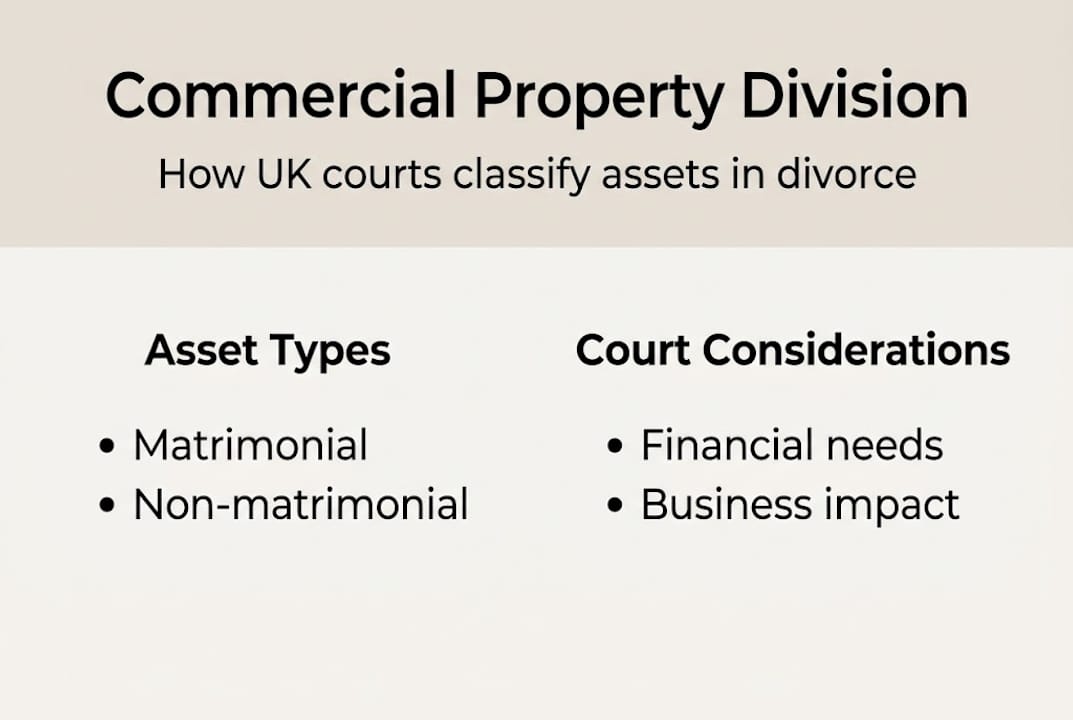
Understanding the distinction between matrimonial and non-matrimonial assets is essential before you enter negotiations. You can explore this further through Signature Law’s property and divorce guidance, which sets out how property interests are assessed in practice.
When business interests in divorce are at stake, courts must also consider the operational impact of any proposed split. Forcing a sale of business premises to achieve a 50/50 division may harm employees, tenants, or the viability of the business itself. Judges are acutely aware of this tension.
Here is a comparison of how courts typically approach commercial versus residential property in divorce proceedings:
| Factor | Commercial property | Residential property |
|---|---|---|
| Primary purpose | Income generation or business use | Family home or investment |
| Valuation complexity | High (business goodwill, leases) | Moderate (market value) |
| Court’s main concern | Business continuity and income | Housing needs of children |
| Typical outcome | Offset, buyout, or retained by operator | Sale or transfer |
| Legal framework | Matrimonial Causes Act 1973, s25 | Matrimonial Causes Act 1973, s25 |
Key factors courts consider when assessing commercial property include:
- Whether the property was acquired before or during the marriage
- The degree to which marital funds or joint effort enhanced its value
- The income it generates and its impact on each party’s financial needs
- The welfare and housing needs of any dependent children
- Each party’s non-financial contributions, such as supporting the business indirectly
For a broader picture of how courts approach the divorce property division guide, including how the solicitor’s role fits into the process, Signature Law’s resources provide clear, practical explanations.
Preparing for a commercial property transaction during divorce
Once you understand the legal framework, preparation becomes your most powerful tool. Courts expect full and frank financial disclosure from both parties. Concealing or undervaluing commercial assets is a serious legal risk and can result in the court setting aside any agreed settlement.

Your preparation should begin with a thorough documentation review. Courts and solicitors will require evidence of ownership, current valuations, lease agreements, and business accounts. Engaging a qualified commercial surveyor early ensures your valuation is robust and defensible. Courts have set aside settlements where valuations were found to be inadequate or biased.
As noted in guidance on business asset division rules, courts balance sharing versus needs, and business preservation often takes priority over an equal split to avoid commercial harm. This means your preparation must account for operational continuity, not just asset value.
Here is a summary of the key documentation and professional roles involved:
| Document or task | Responsible party | Purpose |
|---|---|---|
| Title deeds and ownership records | Property owner | Confirm legal ownership |
| Commercial valuation report | Qualified surveyor | Establish market value |
| Business accounts (3 years) | Business owner or accountant | Assess income and liabilities |
| Lease agreements | Solicitor | Identify tenants and obligations |
| Disclosure statement | Both parties via solicitor | Satisfy court requirements |
Pro Tip: Always instruct an independent surveyor rather than one recommended by your spouse’s legal team. Independence protects the integrity of the valuation and strengthens your position in negotiations.
Follow these steps to prepare effectively:
- Instruct a specialist family law solicitor with experience in complex asset guidance as early as possible.
- Gather all title deeds, lease agreements, and business accounts.
- Commission an independent commercial valuation.
- Assess the impact of any proposed transaction on business operations and staff.
- Consider the needs of your children and how the property’s income or sale proceeds will affect their welfare.
- Review whether a pre-nuptial or post-nuptial agreement exists that covers the property.
- Seek specialist advice on business and divorce to understand your options before entering negotiations.
Rushing this stage is one of the most common and costly mistakes. Taking time to prepare properly gives you and your solicitor the strongest possible foundation.
Executing the property transaction: Process, safeguards and common pitfalls
With your preparation complete, the transaction itself can proceed. The route you take will depend on whether you and your spouse can reach agreement or whether court intervention is required.
The typical process follows these steps:
- Both parties exchange full financial disclosure through their solicitors.
- Negotiations take place, either directly between solicitors or through mediation.
- If agreement is reached, a consent order is drafted and submitted to the court for approval.
- The court reviews the consent order to ensure it is fair and legally sound.
- Once approved, the property transfer, buyout, or sale proceeds under the terms agreed.
- The transaction is completed and registered with HM Land Registry where applicable.
Non-court options are strongly encouraged before litigation. Mediation solicitors can help both parties reach a workable agreement without the cost and stress of a contested hearing. Under current government guidance, parties are expected to attend a Mediation Information and Assessment Meeting, known as a MIAM, before applying to court in most circumstances. As confirmed by government guidance, non-court dispute resolution including mediation and MIAMs is actively encouraged before court proceedings begin.
“The welfare of children must remain the central consideration throughout any property transaction in divorce proceedings. Financial arrangements should support stability, not undermine it.”
Where domestic abuse is a concern, safeguards such as supervised contact arrangements and non-molestation orders must be in place before any joint meetings or negotiations proceed. Child arrangements are governed separately under the Children Act 1989, with the child’s welfare treated as the paramount consideration.
Pro Tip: Never sign a consent order without having it reviewed by your own solicitor. Even if the terms appear straightforward, an independent review through a conveyancing solicitor guide can identify risks you may have overlooked.
Common pitfalls to avoid during execution include:
- Incomplete or inaccurate financial disclosure, which can invalidate a settlement
- Accepting a valuation without independent verification
- Rushing to agree terms to reduce conflict, without considering long-term financial impact
- Failing to account for capital gains tax or stamp duty implications of the transfer
- Overlooking the impact on business partners or co-owners who are not party to the divorce
For detailed guidance on the conveyancing process in this context, Signature Law’s commercial conveyancing guide for separating couples sets out each stage clearly.
Verifying outcomes and ensuring long-term protection
Completing the transaction is a significant milestone, but it is not the end of your responsibilities. Verifying that the outcome is genuinely fair and legally secure is essential, particularly where children’s welfare and ongoing financial arrangements are involved.
Start by reviewing the final settlement documentation carefully with your solicitor. Confirm that all assets have been accounted for, that the property transfer has been registered correctly, and that any income arrangements from the commercial property reflect what was agreed. Retaining copies of all signed documents, court orders, and correspondence is vital. These records protect you if a dispute arises later.
Under the Matrimonial Causes Act 1973, courts retain the power to revisit financial orders in limited circumstances, particularly where there has been material non-disclosure or a significant change in circumstances. Knowing this gives you both reassurance and a legal remedy if something goes wrong.
Pro Tip: Review your financial settlement and child arrangements annually, particularly if the commercial property’s value or income changes significantly. Early legal advice is far less costly than contested proceedings.
Watch for these red flags after the transaction is complete:
- The other party fails to comply with the terms of the consent order
- The commercial property’s value was materially misrepresented during proceedings
- New financial information emerges that was not disclosed
- Child arrangement provisions are not being followed
- Income from the property is not being paid as agreed
If any of these arise, legal remedies are available. Courts can enforce consent orders, and in cases of serious non-disclosure, a settlement can be set aside entirely. Guidance on fair outcomes explained and negotiation tips for business owners can help you understand your options if you believe the outcome was not equitable.
Checking in on business interest handling practices periodically also helps you stay informed about how courts are evolving their approach to complex commercial assets.
Our perspective: The hard truths and hidden opportunities in commercial property divorce transactions
Most guides on this subject focus on process. What they rarely address is the deeper tension at the heart of these cases: mathematical fairness and practical fairness are not always the same thing.
We have seen situations where a rigid 50/50 split would have destroyed a viable business, made employees redundant, and left both parties worse off. Courts recognise this, which is why business preservation often trumps equal split to avoid wider commercial harm. The law gives judges significant discretion, and skilled advisors know how to use that discretion to your advantage.
The hidden opportunity in these cases is that flexibility often unlocks better outcomes. A structured buyout, a deferred sale, or a retained income arrangement can serve both parties far more effectively than a forced sale at an unfavourable time. These solutions require advisors who genuinely understand both family law and commercial property, not just one or the other.
“Preserving stability for children and the business often takes priority over mathematical fairness.”
If you are navigating complex asset guidance or trying to understand how property and divorce intersect in your specific circumstances, the quality of your legal team matters enormously. Choose advisors who ask the right questions, not just the standard ones.
How Signature Law can support you through commercial property transactions in divorce
At Signature Law, we understand that commercial property disputes within divorce proceedings carry both financial weight and deep personal significance. Our team, led by solicitor Sital Somaiya with over 15 years’ experience and recognition from BBC and ITV, brings together expertise in family law and commercial conveyancing to give you genuinely joined-up advice.
We offer fixed-fee initial consultations, Legal Aid for eligible clients, and multilingual support so that nothing gets lost in translation. Whether you need help understanding your rights, preparing for negotiations, or executing a commercial conveyancing guide for couples, we are here to guide you at every stage. Our leading family solicitors are ready to listen and act. Contact us today at https://signaturelaw.co.uk/contact-us/ to arrange your confidential consultation.
Frequently asked questions
How does UK law treat commercial property acquired before marriage in a divorce?
Commercial property acquired before marriage may not be considered a matrimonial asset unless its value was enhanced during the marriage. Under the Matrimonial Causes Act 1973, courts assess all financial resources in context, so pre-marital property is not automatically excluded.
Can my spouse force the sale of a business property during divorce?
Courts aim for fairness and will consider operational continuity before ordering a forced sale. As business preservation often trumps an equal split, a buyout or deferred arrangement may be ordered instead.
What happens to child arrangements if one parent controls the business assets?
Child arrangements are handled separately under the Children Act 1989, with the child’s welfare treated as the paramount consideration. Where abuse is alleged, safeguards including supervised contact are put in place regardless of the financial proceedings.
Are there alternatives to going to court for commercial property disputes in family law?
Yes. Mediation and MIAMs are actively encouraged before court proceedings begin and can resolve disputes with significantly less cost and emotional strain. A consent order can then formalise any agreement reached outside court.
Recommended
- Step-by-step UK divorce process: Essential guide for 2026 | Signature Law
- Your essential divorce checklist for the UK: Step-by-step guide | Signature Law
- Property division in UK divorce: fair outcomes explained | Signature Law
- Essential divorce negotiation tips for UK business owners | Signature Law