





Family Law
Property division in UK divorce: fair outcomes explained

Most people going through divorce assume the family home and shared assets will be split straight down the middle. It is a natural assumption, but it is rarely what actually happens. Only 28% of divorcing couples achieve an equal property split, which means the vast majority of separating couples face a far more complex process than they anticipated. Understanding how property division actually works in England and Wales, what the courts prioritise, and how you can protect your financial future and your children’s welfare is not just useful. It is essential.
Table of Contents
- Understanding property division in UK divorce
- How the courts decide property division
- Common outcomes in UK property division
- Alternatives to court: mediation, agreements and protecting children
- Find expert legal help for property division
- Frequently asked questions
Key Takeaways
| Point | Details |
|---|---|
| Equal split is rare | Courts usually decide based on needs and children’s welfare, not automatic equality. |
| Asset types matter | Homes, pensions, and savings are usually included, but each case is assessed individually. |
| Formal agreements protect | Court orders and mediated settlements are safest for ensuring fairness and enforceability. |
| Children come first | If children are involved, their housing and financial stability are the court’s top priorities. |
| Legal advice prevents loss | Expert guidance is key, especially for those at financial risk like childcarers and lower earners. |
Understanding property division in UK divorce
Property division in divorce is not simply about who gets the house. It covers the full picture of a couple’s financial life together. That includes the family home, savings accounts, investments, pensions, business interests, and even shared debts. Everything accumulated during the marriage is potentially subject to division, and the process can feel overwhelming if you do not know where to start.
One of the most important distinctions in family law is between matrimonial assets and non-matrimonial assets. Matrimonial assets are those acquired during the marriage, such as the family home, joint savings, and pensions built up while you were together. Non-matrimonial assets typically include inheritances, gifts received by one spouse, or property owned before the marriage. Courts generally focus on matrimonial assets, though non-matrimonial assets can still be considered if the needs of the family require it.
Our property and divorce guide explains these distinctions in detail, and it is worth reading before you make any decisions. You should also be aware that 63% of divorcing couples have less than £500,000 in total assets, which means the stakes are high and every decision matters. Understanding the different divorce settlement types available to you is a critical first step.
Here is what property division typically covers:
- The family home and any other property
- Pensions, including workplace and private schemes
- Savings, current accounts, and ISAs
- Investments and shares
- Business interests or self-employment assets
- Debts, including mortgages, loans, and credit cards
- Vehicles, jewellery, and other valuable possessions
Pro Tip: Document all assets as early as possible in the process. Missing a pension, an investment account, or a business interest can lead to a settlement that significantly undervalues what you are entitled to. A solicitor can help you obtain full financial disclosure from your spouse.
How the courts decide property division
When couples cannot agree on how to divide their assets, the family court steps in. The court does not simply apply a 50/50 rule. Instead, it works through a structured process guided by the Matrimonial Causes Act 1973, weighing up a range of factors to reach what it considers a fair outcome. Fairness, in legal terms, is not the same as equality.
As research consistently shows, courts prioritise needs, especially those of any children involved, over a strict equal division of assets. The welfare of children is the court’s first consideration, and this shapes every decision about housing, income, and financial support.
“The court’s role is not to punish or reward either party, but to ensure that the needs of the family, particularly the children, are met as fairly as possible given the available resources.”
Here is how the court typically approaches the process:
- Full financial disclosure — Both parties must provide a complete picture of their finances using Form E, a detailed financial statement.
- Identifying the assets — The court establishes the total value of all matrimonial and non-matrimonial assets.
- Assessing needs — The court considers each party’s housing needs, income, earning capacity, and financial obligations.
- Considering children’s welfare — The primary carer’s housing and financial stability are given significant weight.
- Reviewing contributions — Both financial and non-financial contributions, such as childcare and homemaking, are taken into account.
- Reaching a decision — The court makes an order that reflects what is fair given all the circumstances.
Factors such as the length of the marriage, the age and health of each party, future earning potential, and any special needs of the children all influence the final outcome. You can read more about what constitutes a fair divorce settlement and how the property division process unfolds in practice. For those with more complex asset division needs, specialist advice is particularly important.

Common outcomes in UK property division
Knowing what typically happens in practice helps you set realistic expectations and make informed decisions. The data paints a clear picture of how property division plays out for most couples in the UK.
UK divorce statistics reveal that only 28% of couples achieve an equal split, 46% of family homes are transferred to one party rather than sold, and women’s household income falls by an average of 50% in the year following divorce. These figures highlight just how significant the financial consequences of separation can be.
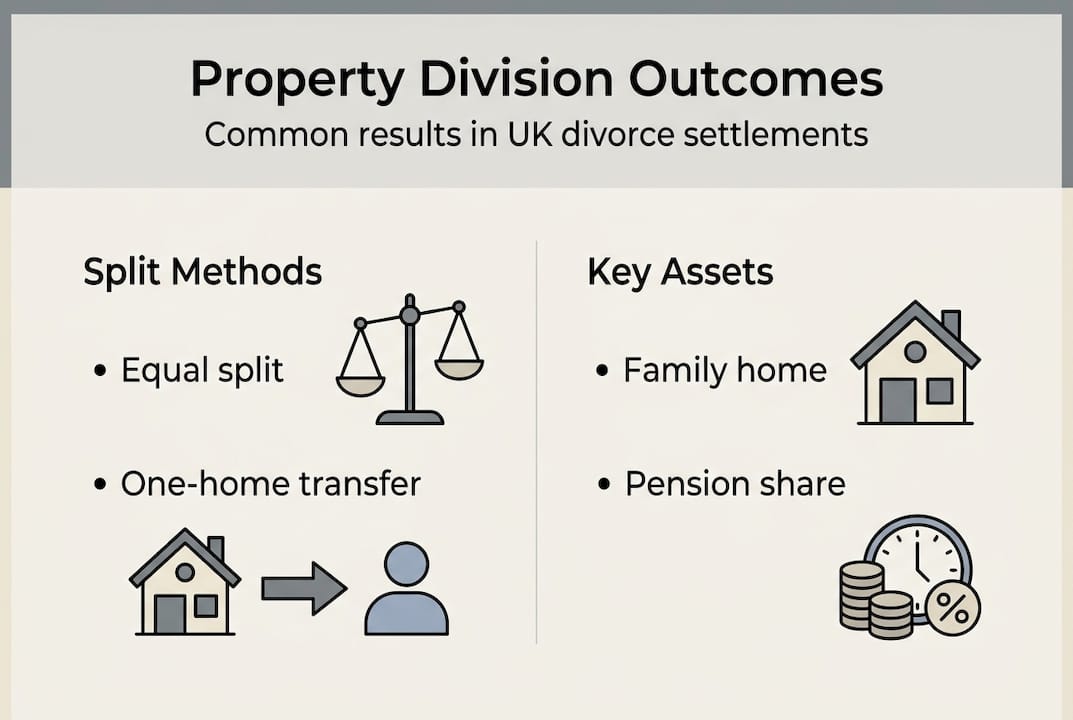
| Outcome | Percentage of cases | Key driver |
|---|---|---|
| Equal asset split | 28% | Broadly equal contributions and needs |
| Home transferred to one party | 46% | Children’s welfare and primary carer needs |
| Home sold and proceeds divided | 26% | Neither party can sustain mortgage alone |
| Court order obtained | Approx. 33% | Disputed or complex financial arrangements |
The impact of caring responsibilities on property division is significant and often underestimated. Consider the following:
- The primary carer of children is more likely to retain the family home, at least until the children reach adulthood
- Lower earners, who are disproportionately women, often receive a greater share of capital assets to offset reduced income
- Pensions are frequently the second largest asset in a marriage, yet many people overlook them during settlement negotiations
- Those who took career breaks for childcare may have reduced pension savings, which the court can address through pension sharing orders
Understanding financial settlement agreements in detail is essential before agreeing to anything. Pensions in particular deserve careful attention, and our guide to dividing pensions explains the options available to you.
Alternatives to court: mediation, agreements and protecting children
Going to court is not the only way to resolve property division, and for many couples it is not the best way either. Court proceedings are costly, time-consuming, and emotionally draining. There are several alternatives that can produce fair, legally binding outcomes while preserving a more constructive relationship between separating parents.
| Approach | Average cost | Typical duration | Legally binding? |
|---|---|---|---|
| Mediation | £1,000 to £3,000 | 2 to 4 months | Only if converted to court order |
| Solicitor-negotiated agreement | £3,000 to £10,000 | 3 to 6 months | Yes, via consent order |
| Court proceedings | £10,000 to £30,000+ | 12 to 24 months | Yes |
| Collaborative law | £5,000 to £15,000 | 4 to 9 months | Yes, via consent order |
Research shows that mediation and court orders both protect fairness, but women and primary childcarers are often significantly disadvantaged when they proceed without independent legal advice. Reaching an informal agreement without legal input can leave you with far less than you are entitled to.
If protecting your children’s welfare is your priority, here are the steps you should take:
- Seek independent legal advice early — Do not rely on your spouse’s solicitor or informal agreements made under pressure.
- Consider mediation — A trained mediator can help both parties reach a fair agreement without the adversarial nature of court.
- Prioritise housing stability — Ensure any agreement addresses where the children will live and for how long.
- Address school and community ties — Courts consider the disruption of moving children away from their school and support network.
- Formalise any agreement — A consent order, approved by the court, makes your agreement legally enforceable and protects both parties.
- Review the arrangement as circumstances change — Financial orders can sometimes be varied if there is a significant change in circumstances.
Our settlement agreement guide walks you through the process of formalising an agreement, and the property division guide covers the practical steps in detail. If you are also dealing with estate matters following a separation, our guidance on probate after divorce may also be relevant.
Pro Tip: If you are the primary carer or the lower earner in the relationship, independent legal advice is not optional. It is the single most effective step you can take to protect your financial future and your children’s stability.
Find expert legal help for property division
Property division is one of the most consequential financial decisions you will ever face. Getting it right matters enormously, not just for you, but for your children’s security and your long-term wellbeing. At Signature Law, we understand the emotional weight of this process, and we are here to guide you through it with clarity, compassion, and genuine legal expertise. Our founder, Sital Somaiya, has over 15 years of experience in family law and has been featured on both BBC and ITV. We offer fixed-fee initial consultations, Legal Aid for eligible clients, and multilingual support. Whether you need help understanding your options or are ready to begin formal proceedings, our leading family lawyers are ready to help. Explore the family law impact we have made for clients across the UK, and take the first step towards a fair outcome by contacting our team today.
Frequently asked questions
Does property division always mean a 50/50 split in the UK?
No. Only 28% of couples achieve an equal split, as courts focus primarily on the needs of each party and the welfare of any children rather than strict equality.
What assets are included in property division?
Property division covers homes, pensions, savings, investments, business interests, and debts accumulated during the marriage. Non-matrimonial assets such as inheritances may also be considered if the family’s needs require it.
Can property division be agreed outside of court?
Yes. Mediation and solicitor-negotiated agreements are both viable routes, but any agreement should be formalised as a consent order to make it legally enforceable and to protect both parties going forward.
How does property division impact children?
Children’s welfare is the court’s primary consideration. Courts prioritise children’s housing stability and financial security first, which often means the primary carer retains the family home.
Why do women often lose out financially in divorce?
Women’s income halves on average in the year after divorce, largely due to childcare responsibilities and reduced earning capacity. Without independent legal advice, primary carers and lower earners are at significant risk of accepting less than they are entitled to.
Recommended
- Divorce Settlement Explained – Fair Outcomes in 2026 UK | Signature Law
- Types of divorce settlements: UK guide to fair solutions | Signature Law
- Divorce Property Division Guide: Secure Your Fair Share | Signature Law
- Signature Law Blog: Legal Insights & Updates (2026)