





Family Law
Hidden Fees in Conveyancing

TL;DR:
- Conveyancing costs include professional legal fees and numerous disbursements, not just a single fee.
- Hidden fees often arise from incomplete quotes, additional searches, or costs incurred if the transaction falls through.
- To avoid surprises, obtain detailed, itemised quotes, confirm non-refundable costs, and understand scenarios that may increase fees.
Avoiding Unexpected Costs in Your Conveyancing Quote
Most people budgeting for a property purchase or sale focus on the headline solicitor fee. It looks manageable. It fits within the plan. Then the final bill arrives and it is noticeably higher than expected. For first-time buyers already stretched to their limits, and for individuals navigating a divorce-related property transfer, those extra charges can cause serious financial and emotional strain. The reality is that conveyancing costs are made up of far more than a single professional fee, and the less visible elements are often the ones that catch people off guard. This guide will show you exactly where those costs hide and what you can do about them.
Table of Contents
- What are the components of conveyancing fees?
- Where do ‘hidden fees’ in conveyancing appear?
- How to compare conveyancing quotes and spot missing costs
- How to reduce or avoid hidden conveyancing fees
- Our perspective: what most people get wrong about conveyancing fees
- Get clear, transparent conveyancing support
- Frequently asked questions
Key Takeaways
| Point | Details |
|---|---|
| Conveyancing fees add up | Legal fees plus disbursements typically total £1,200–£2,500, with extras possible for complex cases. |
| Disbursements often hidden | Many third-party costs—like searches and Land Registry fees—are not always clear in initial quotes. |
| Divorce property deals cost more | Extra fees in divorce cases may run well into the thousands due to remortgaging, pension sharing, and expert advice. |
| Transparency beats the cheapest quote | Low quotes often omit key fees; service quality and communication help prevent expensive surprises. |
| Know your refund rights | Legal fees may be refundable if a sale fails, but disbursements almost never are. |
What are the components of conveyancing fees?
Understanding your total conveyancing bill begins with knowing that the fee is not a single number. It is a combination of two distinct categories: professional legal fees and disbursements.
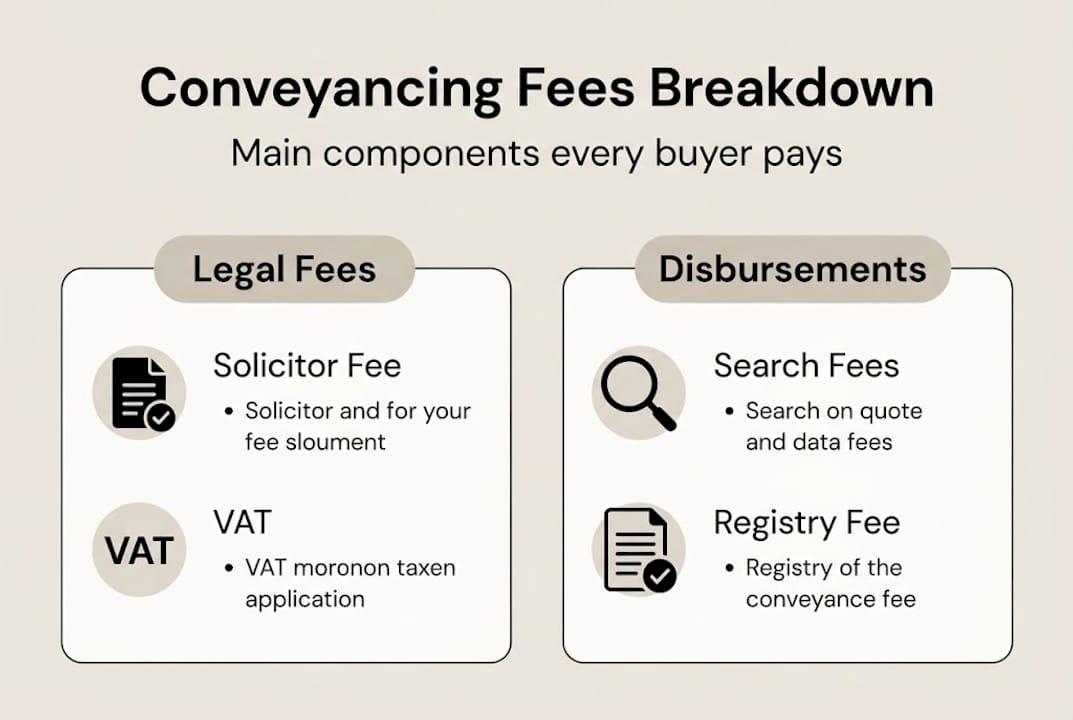
Professional legal fees are what you pay your solicitor or licensed conveyancer directly for their time and expertise. For a straightforward freehold purchase, these typically range from £800 to £1,800 plus VAT. Disbursements, on the other hand, are third-party costs that your solicitor pays on your behalf and then passes on to you. These are often where the surprises begin.
Here is a breakdown of the most common disbursements you should expect:
- Property searches (local authority, environmental, drainage): £250 to £700 depending on location and property type
- Land Registry registration fee: £20 to £910, scaled according to the purchase price of the property
- Bankruptcy and ID checks: £2 to £30 per person
- Bank transfer (CHAPS) fees: £20 to £45 plus VAT
- Stamp Duty Land Tax: always separate and calculated on the purchase price, not included in any conveyancing estimate
When you add the professional fee to all disbursements, the total typical cost for a straightforward freehold transaction falls between £1,200 and £2,500, excluding Stamp Duty. That is a meaningful range. Whether you land at the lower or upper end depends entirely on the complexity of your transaction, your location, and how thoroughly your solicitor itemised costs in the original quote.
| Fee category | Typical range |
|---|---|
| Solicitor professional fee | £800 to £1,800 + VAT |
| Property searches | £250 to £700 |
| Land Registry fee | £20 to £910 |
| ID and bankruptcy checks | £2 to £30 per person |
| CHAPS bank transfer | £20 to £45 + VAT |
| Total (excl. Stamp Duty) | £1,200 to £2,500 |
The reason quotes differ so substantially between firms comes down to what is included. Some solicitors provide a genuinely all-inclusive estimate. Others quote only their professional fee and list disbursements as separate, often approximate, additional costs. If you are going through a more complex transaction, such as using a conveyancing solicitor for divorce property matters, additional fees for specialist work will apply on top of this baseline. Understanding this distinction is the first step towards protecting yourself financially.
Where do ‘hidden fees’ in conveyancing appear?
Once you understand the structure of conveyancing costs, the next question is: which parts are most likely to catch you out? The answer is more nuanced than a simple list of charges. Hidden fees do not usually appear because solicitors are being deceptive. They arise because initial quotes are incomplete, circumstances change during the transaction, or clients do not know which questions to ask.
Common disbursements that may not feature prominently in an initial quote include:
- Local authority searches: £150 to £450 depending on the council
- Environmental searches: £30 to £60
- Water and drainage searches: £30 to £80
- Land Registry office copies: £6 to £30
- Bankruptcy and ID checks: £2 to £30 per person
- CHAPS bank transfer fees: £20 to £45 plus VAT
Critically, these disbursements are payable even if your transaction does not complete. If your purchase or sale falls through after searches have been ordered, those costs are gone. You will not recover them. That fact alone changes how you should think about instructing a solicitor on a property you are not yet certain about.
“Even if your property transaction does not proceed to completion, disbursements already incurred, including searches and Land Registry fees, remain payable in full.”
For those going through divorce, the picture becomes considerably more complicated. Beyond standard conveyancing costs, divorce property transfers typically involve Land Registry transfer fees of £150 to £300, potential remortgage fees of around £1,500, pension sharing orders costing £1,000 to £5,000, and forensic accountant fees of £2,000 to £10,000 where hidden assets are suspected. These are not small additions. They can fundamentally alter the financial outcome of a settlement if not planned for in advance.
Understanding the role in divorce property splits is therefore essential, not just for emotional clarity but for financial planning. Where business assets form part of the matrimonial estate, the situation can become even more layered, and a broader understanding of the commercial property divorce guide process may become relevant.
Pro Tip: Before you sign any letter of engagement, ask your solicitor to confirm in writing which elements of their quote are fixed and which are estimates. Specifically ask which disbursements will still be charged if the transaction does not complete.
How to compare conveyancing quotes and spot missing costs
Receiving three different quotes for the same transaction and finding they vary by hundreds of pounds is not unusual. It does not necessarily mean one firm is better value than another. It usually means they are quoting different things.

According to Q1 2026 data, the average conveyancing fee for purchase and sale transactions was £2,440, though there has been a 3% real-term fall in pricing. Despite that, four in ten buyers still choose the cheapest quote without fully investigating what it includes. That decision often leads to frustration later, because the top source of complaints to the Legal Ombudsman from residential conveyancing clients is poor communication and delays, accounting for 36% of cases. In many of those situations, the original quote was cheap. The experience was not.
Here is how a headline quote compares to a fully inclusive estimate:
| Cost element | Headline quote | Fully inclusive estimate |
|---|---|---|
| Solicitor professional fee | Included | Included |
| Property searches | Often excluded or approximate | Itemised clearly |
| Land Registry fee | Sometimes excluded | Included and scaled to price |
| CHAPS fee | Rarely shown | Shown per transfer |
| ID and bankruptcy checks | Often missing | Listed per person |
| Leasehold supplement | Not always flagged | Included if applicable |
When you are asking your solicitor for a quote, follow these steps to get a genuinely comparable picture:
- Ask for a written, itemised quote that separates professional fees from all anticipated disbursements.
- Confirm whether the quote includes VAT on both the professional fee and applicable disbursements.
- Ask whether a leasehold or new build supplement applies and if so, how much.
- Request clarification on bank transfer fees for each CHAPS payment your transaction will require.
- Ask whether the quote changes if the transaction becomes more complex, such as a delayed completion or title defect.
Pro Tip: Request quotes from at least three regulated firms. Then compare them line by line, not just by total. A firm that charges slightly more but itemises everything clearly is almost always a safer and cheaper choice in the long run.
How to reduce or avoid hidden conveyancing fees
Knowing where hidden fees appear is useful. Knowing how to prevent them from affecting you is far more valuable. Here are the most effective steps you can take, whether you are buying, selling, or navigating a divorce property transfer.
- Get an itemised written quote before instructing anyone. A professional, regulated solicitor will provide this without hesitation. Vague or verbal estimates are a warning sign.
- Confirm which fees are non-refundable if the transaction does not proceed. As noted above, disbursements are not refunded even where the sale collapses, whereas professional fees are often partly or fully refundable depending on the stage reached.
- Check for SRA or CLC regulation. Only instruct solicitors regulated by the Solicitors Regulation Authority or conveyancers licensed by the Council for Licensed Conveyancers. This gives you a regulatory framework to raise complaints if things go wrong.
- Look for CQS accreditation. The Conveyancing Quality Scheme is a Law Society mark that signals a firm meets high standards of client service and process management.
- Do not assume ‘no sale, no fee’ covers everything. This arrangement usually means you will not be charged the professional legal fee if the deal falls through. It does not mean your searches or Land Registry fees are covered. Clarify exactly what is included before relying on this promise.
- Keep written confirmation of anything variable. If your solicitor tells you a cost is an estimate, ask them to note what circumstances might increase it and by how much.
For those going through divorce, additional vigilance is needed. Be clear from the outset about what your solicitor’s role covers and what falls outside their remit. A conveyancing solicitor handling a transfer of equity following divorce is not the same as a family law solicitor advising on the terms of that transfer. Both may be needed. Both will carry costs. Understanding where one role ends and the other begins helps you plan accurately and avoid unexpected bills mid-process.
Aim to minimise surprise legal fees by engaging a firm that takes time to explain every cost before work begins, rather than one that provides a low headline figure and adds costs progressively throughout the transaction.
Pro Tip: Keep a written record of every verbal or email conversation where costs are discussed. If a fee is later added that was not mentioned, you have a clear basis to query or challenge it.
Our perspective: what most people get wrong about conveyancing fees
In our experience at Signature Law, the biggest mistake clients make when instructing a conveyancing solicitor is treating the process like an online price comparison. The focus goes entirely on the headline number, and important questions never get asked.
The result is that clients arrive at completion having paid more than they expected, or find themselves stuck mid-transaction when unexpected costs create a financial shortfall. Neither outcome is acceptable, and neither is inevitable.
The firms that consistently deliver the best client experience are not always the cheapest. They are the ones with clear, upfront communication, proper regulation, and the honesty to say “this is what we expect it to cost, and this is what could change that figure.” That transparency is not a courtesy. It is a professional standard.
The most costly mistakes we see arise when people do not ask about the “what if things go wrong” part of the fee structure. What happens if the buyer pulls out? What if a title defect is discovered? What if the chain collapses and you need to restart? Those scenarios are not unusual. Knowing their cost implications before you begin is not pessimism. It is sound planning.
For property and divorce guidance, this need for clarity is even more pronounced. Emotions are already running high. The last thing anyone needs is a financial surprise at the worst possible moment.
Get clear, transparent conveyancing support
At Signature Law, we believe that every client deserves to understand exactly what they are paying for, and why, before a single piece of work begins. Whether you are a first-time buyer finding your way through the property process for the first time, or someone managing a property transfer as part of a divorce, you deserve straightforward, honest advice from a regulated solicitor who has the time to explain things properly.
Our residential conveyancing experts provide fully itemised quotes, clear communication, and personal support throughout your transaction. For those in more complex situations, our clear conveyancing guidance and specialist divorce property help ensure you are never left uncertain about costs or next steps. Contact us today to speak with a member of our team.
Frequently asked questions
Which conveyancing fees can never be refunded if my sale falls through?
Disbursements such as searches, Land Registry fees, and bank transfer charges are non-refundable, even if your property transaction does not reach completion. Always confirm this with your solicitor before searches are ordered.
Are divorce-related property transfers more expensive than standard conveyancing?
Yes. Divorce property transfers typically involve additional costs including Land Registry transfer fees, remortgage legal work, pension sharing orders, and in some cases forensic accountant fees, which can collectively add thousands of pounds beyond the standard conveyancing bill.
Do all solicitors include the same disbursements in their quotes?
No. Disbursements can vary significantly between firms or be omitted from initial fee estimates entirely. Always request a fully itemised written breakdown before instructing a solicitor, and compare quotes line by line rather than by total.
What is the average conveyancing fee in 2026 for UK home buyers?
The average total fee for combined purchase and sale transactions in Q1 2026 was £2,440, according to the reallymoving index, though individual costs vary depending on property value, location, and transaction complexity.
Recommended
- Conveyancing Solicitors Harold Wood: Clear Guidance for a Smooth Property Journey | Signature Law
- Commercial conveyancing guide for separating couples 2026 | Signature Law
- How Much Does a Family Law Solicitor Cost in the UK? Comprehensive Guide to Fees and Savings | Signature Law
- Probate Costs UK 2026: What Families Must Know | Signature Law