





Family Law
Asset division in UK divorce settlements: what to expect

TL;DR:
- UK divorce asset division is based on fairness, not a fixed 50/50 split.
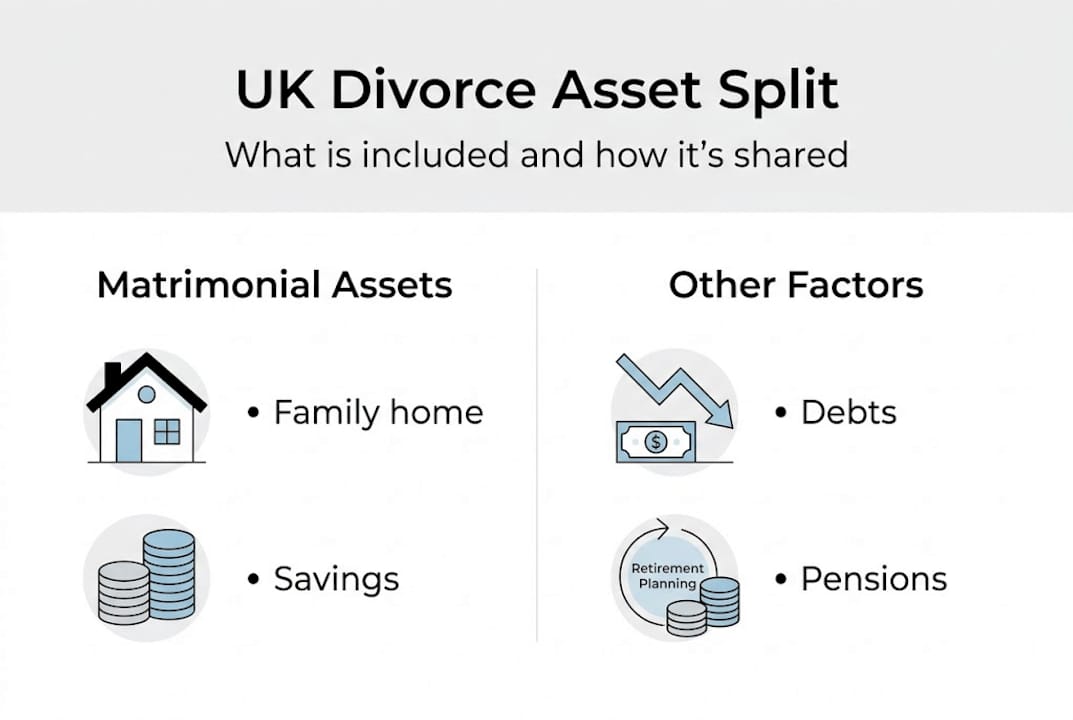
- Assets include property, savings, pensions, investments, business interests, and debts.
- Early legal advice and full disclosure improve chances of a fair settlement and financial security.
Mention divorce at any dinner table and someone will say it: “You’ll get half of everything.” It is one of the most persistent myths in family law, and it can lead to deeply unrealistic expectations on both sides. The truth is that UK courts do not follow a rigid 50/50 rule. Asset division in divorce is shaped by your individual circumstances, the needs of any children involved, and a legal principle of fairness rather than simple arithmetic. This guide explains what counts as an asset, how the law approaches division, and what practical steps you can take to protect your financial future.
Table of Contents
- What counts as an asset in a UK divorce?
- How does the UK legal system divide assets in divorce?
- Special considerations for ages 30–55: pensions, children, and earning capacity
- Securing a fair settlement: disclosure, negotiation, and clean breaks
- Why most people overlook the power of early financial planning in divorce
- Get expert guidance for your divorce settlement
- Frequently asked questions
Key Takeaways
| Point | Details |
|---|---|
| Assets are varied | Property, pensions, savings, and businesses may all be considered in UK divorces. |
| Fairness over equality | Courts prioritise family needs and fairness, not strictly a 50/50 split. |
| Full disclosure vital | Hiding assets can lead to legal penalties and unfair outcomes. |
| Children’s welfare counts | Housing and stability for children often influence how assets are divided. |
| Professional advice helps | Early, expert guidance improves your chance of a fair financial settlement. |
What counts as an asset in a UK divorce?
Before you can negotiate, you need to know what is actually on the table. In UK divorce proceedings, an ‘asset’ covers far more than just the family home.
The following are typically included in financial disclosure:
- Property: the matrimonial home, buy-to-let properties, and any land
- Savings and current accounts: bank balances held individually or jointly
- Pensions: occupational, private, and state pension entitlements
- Investments: shares, ISAs, bonds, and unit trusts
- Business interests: sole trader businesses, partnerships, and shareholdings in limited companies
- Personal belongings of significant value: jewellery, artwork, vehicles, and high-value collectibles
Debts matter just as much as assets. Mortgages, credit card balances, personal loans, and tax liabilities must all be declared. A court will look at your overall financial picture, not just the positive column.
One distinction that carries real legal weight is the difference between matrimonial and non-matrimonial assets. Matrimonial assets are those acquired during the marriage. Non-matrimonial assets, such as an inheritance received before or during the marriage, or property owned before you married, may be treated differently. They are not automatically excluded, but courts may give them less weight, particularly in shorter marriages. Understanding the full scope of assets covered in divorce from the outset will prevent costly surprises later.
| Asset type | Typically matrimonial? | Notes |
|---|---|---|
| Family home | Yes | Almost always included |
| Pre-marital savings | Often no | Context-dependent |
| Inherited property | Often no | May be ring-fenced |
| Pension built during marriage | Yes | Valued at point of divorce |
| Business interest | Depends | Valued by expert if disputed |
Full financial disclosure is required, with agreements reached through negotiation or mediation then formalised in a consent order approved by the court.
Pro Tip: Start building a full inventory of every asset and liability before any negotiations begin. Include account numbers, current valuations, and supporting documents. This preparation alone can save weeks of legal back-and-forth.
How does the UK legal system divide assets in divorce?
With a clear view of what assets are included, the next step is understanding how UK law approaches splitting them.
The legal framework rests on fairness, not equality. Judges are guided by Section 25 of the Matrimonial Causes Act 1973, which sets out a checklist of factors to consider. These include the length of the marriage, each spouse’s earning capacity, contributions made by each party (including non-financial contributions such as raising children), and the standard of living enjoyed during the marriage.
Here is how courts typically approach the process:
- Identify all assets and liabilities through mandatory financial disclosure from both parties
- Value each asset, using independent experts where needed for businesses, pensions, or property
- Assess each party’s needs, giving particular weight to housing requirements for any children
- Apply the Section 25 factors to determine a fair overall outcome
- Choose an appropriate mechanism to implement the settlement
The mechanisms used to divide assets matter enormously. Courts can order:
- Property transfer or sale, with proceeds split according to the agreed percentage
- Pension sharing orders, which divide a pension at source into separate pots
- Offsetting, where one party keeps one asset in exchange for the other receiving a greater share of another
For example, pension sharing orders are used in cases where offsetting, such as one party retaining a business while the other receives a larger share of the property or pension, is not appropriate or sufficient. Understanding the range of property division outcomes available can help you identify which approach best protects your position.
Most divorcing couples resolve financial matters outside of court, with agreements formalised through a consent order. Going to a final court hearing is the last resort, not the norm.
If your situation involves business shareholdings, trusts, or international assets, the process becomes more involved. Specialist guidance on divorces with complex assets is essential before you reach any agreement. To understand the full journey from first instruction to final order, a clear overview of the divorce settlement process is a useful starting point.
Special considerations for ages 30–55: pensions, children, and earning capacity
Though the process aims for fairness, your age and family circumstances can dramatically alter outcomes. This is especially true for people aged 30–55, who often face the most financially complex divorces of their lives.
At this life stage, assets tend to cluster around two major pillars:
- The family home, which is often the single most valuable asset and carries deep emotional significance
- Pensions, which are frequently the second largest asset after the property, with children’s housing needs prioritised, earning capacity and career sacrifices factored into final settlements
Other key considerations for this age group include:
- Children’s housing stability: courts will prioritise keeping children in a suitable home environment, which can significantly influence how the family property is dealt with
- Career sacrifices: if one partner reduced their working hours or paused their career to provide care, courts will factor in what that person gave up financially
- Earning capacity: what you could earn in the future matters, not just your current income. A solicitor or barrister may have been out of practice for five years raising children, but their future potential is still relevant
- Pension value: defined benefit pensions (sometimes called final salary pensions) can be worth far more than their headline figure suggests, and need specialist actuarial valuation
Ignoring pension entitlements at settlement is one of the most common and costly mistakes we see. You can read more about the specific rules around dividing pensions in divorce to understand the options available to you.

Pro Tip: Never agree to an asset split involving pensions or a business interest without taking specialist legal advice first. The headline figures can be deeply misleading, and an agreement made in haste can be very difficult to revisit once sealed by the court. If your spouse owns a business, dedicated negotiation tips for business owners will help you approach the process strategically.
Securing a fair settlement: disclosure, negotiation, and clean breaks
Understanding what influences asset division means you are better equipped to pursue what is fair. Here is how to put that knowledge into practice.
Step 1: Gather your records
Collect bank statements, mortgage statements, pension valuations, business accounts, and any other financial documentation. The more organised you are, the smoother and faster the process.
Step 2: Make full financial disclosure
Both parties are legally required to provide complete and honest disclosure using Form E, the standard financial disclosure document. Full disclosure is critical; non-disclosure risks serious sanctions, and courts take a very dim view of concealment. Agreements reached on incomplete information can later be set aside.
Step 3: Negotiate or mediate
Most couples resolve financial matters through solicitor-led negotiation or family mediation. Mediation involves a trained, neutral third party who helps both sides reach an agreement without going to court. It is often quicker, cheaper, and less adversarial.
Step 4: Seal the agreement in a court order
Whether you negotiate directly, use mediation, or attend a court hearing, the outcome must be approved by a court to be legally binding. A consent order, once sealed, provides certainty and prevents future claims.
Step 5: Consider a clean break
A clean break order severs all future financial ties between you. This means neither party can make further financial claims against the other after the settlement. Where children are involved, ongoing maintenance arrangements may sit alongside the clean break, but the capital settlement is finalised.
Pro Tip: Hiding assets is never worth the risk. Courts have the power to order disclosure of bank records, instruct forensic accountants, and impose severe penalties. Getting the right settlement solicitor advice early is the most effective way to secure your fair share.
Why most people overlook the power of early financial planning in divorce
Having worked with clients across a wide range of financial circumstances, one pattern stands out more than any other: the couples who secure the fairest outcomes are almost always those who sought legal advice before making any agreements, even informal ones.
It sounds obvious. But in practice, many divorcing couples make premature agreements over the kitchen table, driven by an understandable desire to keep things amicable. The problem is that those early agreements often miss hidden pension value, undervalue business interests, or fail to account for future earning capacity. By the time a solicitor is involved, one party has already conceded ground they should not have.
Transparent financial planning from the outset also protects your children’s stability. When both parties understand the full picture, there is less room for mistrust and more space for constructive negotiation. Seeking advice on complex asset strategies does not signal aggression. It signals that you are taking the process seriously. In our experience, early professional input consistently produces better outcomes, even in the most amicable of separations.
Get expert guidance for your divorce settlement
Navigating asset division during divorce is rarely straightforward. The stakes are high, the rules are nuanced, and the decisions you make now will shape your financial life for years to come. Working with a specialist family law solicitor means your interests are properly represented, your disclosure is complete, and no significant asset is left unconsidered.
At Signature Law, our team understands the emotional weight of this process alongside the legal complexity. We offer fixed-fee initial consultations, Legal Aid for eligible clients, and genuinely personalised support. Learn more about our approach to family law impact, or speak to a family lawyer who will listen carefully to your situation. When you are ready, arrange a consultation with our team today.
Frequently asked questions
Are business assets included in UK divorce settlements?
Yes, business interests owned by either spouse are typically treated as matrimonial assets and may be professionally valued. Offsetting is commonly used, where one spouse retains the business while the other receives a greater share of property or pension.
What happens if one partner hides assets?
Deliberate concealment can result in serious legal sanctions and may lead to a final settlement being overturned once the hidden assets are uncovered. Non-disclosure risks sanctions that courts take very seriously.
Who decides the asset split if we cannot agree?
If negotiation and mediation fail, a judge will determine asset division based on fairness, housing needs, earning capacity, and the full Section 25 framework of relevant factors.
Are pensions always divided in divorce?
Not automatically, but pensions are often the second largest marital asset. Pension sharing orders are used in a meaningful proportion of cases where offsetting is not sufficient or appropriate.
What does a ‘clean break’ mean in asset division?
A clean break order finalises all capital financial ties between ex-spouses, preventing either party from making future financial claims. Clean break orders are preferred by courts where the circumstances allow.
Recommended
- Property division in UK divorce: fair outcomes explained | Signature Law
- Types of assets in divorce: what UK settlements cover | Signature Law
- Divorce Settlement Explained – Fair Outcomes in 2026 UK | Signature Law
- Role of Financial Settlements in UK Divorce: 70% Settled Out of Court | Signature Law