





Family Law
Importance of child arrangement orders for UK parents

TL;DR:
- A child arrangement order is a legal court order that defines where a child lives and who they spend time with after separation. It provides enforceable protection, promotes stability, and minimizes conflict for the child’s welfare. Formalising agreements as consent orders is cost-effective and reduces long-term legal risks.
A child arrangement order is a legal court order, made under section 8 of the Children Act 1989, that sets out where a child will live and who they can spend time with after separation. Understanding the importance of child arrangement orders is not simply a legal exercise. It is the foundation of your child’s stability, routine, and emotional security when family life changes. Without a formal order in place, even the most carefully worded private agreement carries no legal weight and offers no real protection if things go wrong.
Why child arrangement orders matter for separated families
Child arrangement orders (commonly referred to as CAOs) are the primary legal mechanism through which UK courts define post-separation parenting. They replace the older terms “residence order” and “contact order,” which many parents still recognise. A CAO does two things: it specifies who a child lives with, and it sets out when and how the child spends time with the other parent or significant people in their life. The legal child arrangements created by a CAO carry the full authority of the court behind them. That authority is what separates a CAO from a handshake agreement or a typed-up parenting plan.
The Children Act 1989 places the child’s welfare as the paramount consideration in every decision. Courts do not issue orders to favour one parent over another. They issue orders because a clear, enforceable framework protects children from the uncertainty and conflict that so often follows separation. For parents who are struggling to agree, or who want to protect an agreement they have already reached, a CAO provides the legal structure that makes cooperation sustainable.
What does a child arrangement order actually cover?
A CAO addresses two distinct categories of arrangement, and understanding both helps you plan effectively.
Living arrangements specify which parent the child primarily lives with and where. This is sometimes called the “lives with” element of the order. It can name one parent or both, depending on what the court determines serves the child’s best interests.
Contact arrangements specify when the child spends time with the other parent, and in what form. This covers:
- Regular weekly or fortnightly contact visits
- Overnight stays and extended holiday periods
- Special occasions such as birthdays, Christmas, and school holidays
- Indirect contact, such as phone calls or video calls, where direct contact is not appropriate
- Supervised contact arrangements where safeguarding concerns exist
Who can apply for a CAO? The following people can apply to court without needing prior permission from the court:
- A parent or guardian of the child
- A person named in a previous order as someone the child should live with
- A spouse or civil partner of a parent, where the child has lived with them
Other individuals, such as grandparents or extended family members, may apply but must first obtain the court’s permission to do so. This distinction matters because it affects how quickly proceedings can begin.
The critical difference between a CAO and an informal agreement is enforceability. A private written agreement is not legally enforceable. No legal recourse exists to compel compliance immediately if one parent breaches it. A CAO, by contrast, carries the full force of the court.
Why legal enforceability of a CAO is critical
Relying on an informal arrangement is a risk that many parents only recognise after something goes wrong. The consequences can be serious and slow to resolve.
-
No immediate enforcement. If arrangements are not legally formalised, a parent must return to court to enforce them, which can take weeks or months. During that time, your child faces uncertainty and disruption.
-
Police cannot intervene. Police and enforcement agencies cannot act on private custody agreements. Only orders signed by a judge carry immediate enforceability. A private agreement, however detailed, has no authority in the eyes of the law.
-
Contempt of court applies to CAOs. Breaching a CAO is a serious matter. The court can impose fines, order make-up contact time, or modify the existing arrangements as a consequence. In the most serious cases, a breach can result in contempt of court proceedings.
-
Stability for your child. A legally binding order gives your child a predictable routine. Children thrive on consistency. When arrangements are clear and enforceable, parental conflict over day-to-day logistics reduces significantly.
The benefits of custody orders over informal arrangements are not theoretical. Consent orders transform voluntary agreements into binding legal instruments, meaning violations carry real consequences rather than simply creating another argument.
Pro Tip: If you and your former partner have already agreed on arrangements, do not assume that agreement is enough. Formalising it as a consent order costs far less, in time and money, than returning to court after a breakdown.
Informal parenting plans can help manage day-to-day cooperation, but they carry real risks without court enforcement authority. A consent order balances flexibility with legal protection, giving both parents and children the security they need.
How to create an effective child arrangement order
The process of creating a CAO depends on whether you and the other parent can agree or whether the court must decide. Either way, the quality of the order itself matters enormously.

Reaching agreement privately
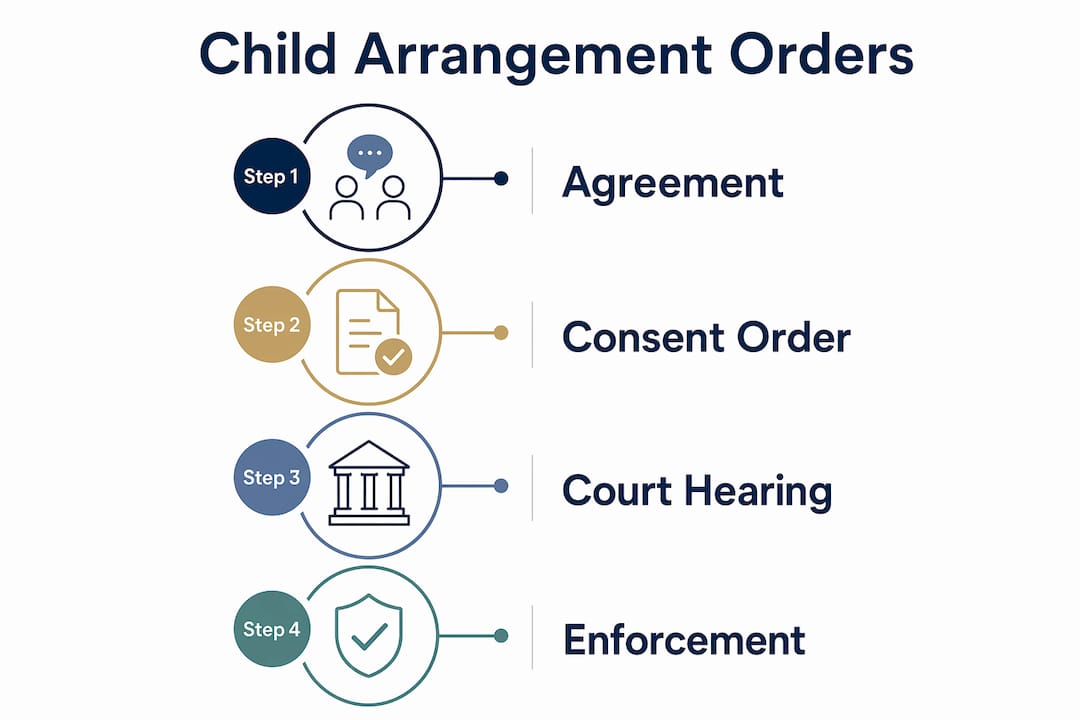
If you can agree on arrangements, the most cost-effective route is to formalise that agreement as a consent order. Vague agreements cause repeated litigation and undermine children’s welfare. A well-drafted order should specify:
- Exact days and times for handovers
- Holiday and school holiday rotations, named by period
- Arrangements for special occasions such as birthdays and bank holidays
- How changes to the schedule will be communicated and agreed
- A process for resolving future disputes without returning to court
Filing a consent order
Filing a consent order requires submitting the written agreement to the court along with a statement of the arrangements. In 2026, the consent order filing fee is £53. A judge reviews the order and, if the arrangements clearly serve the child’s welfare, approves it without requiring either parent to attend a formal hearing. Most consent orders are approved this way, making the process far less adversarial than many parents expect.
When agreement is not possible
Where parents cannot agree, either party can apply to the court for a CAO. Before doing so, most applicants are expected to attend a Mediation Information and Assessment Meeting (MIAM) to explore whether alternatives to court might resolve the dispute. Mediation is not always suitable, particularly where domestic abuse or safeguarding concerns exist, but it can save significant time and cost where it is appropriate.
Pro Tip: Specificity is your greatest protection. An order that says “reasonable contact” is almost useless in practice. An order that says “every other Saturday from 10AM to 6PM, with overnight stays on the first Saturday of each month” gives both parents and the court a clear reference point.
The most common mistake in drafting child arrangements is leaving key details undefined. Undefined arrangements create conflict. Conflict creates court applications. Court applications cost money and cause distress to children.
What factors do courts consider when approving a CAO?
When a court makes or approves a child arrangement order, it applies the welfare checklist set out in section 1(3) of the Children Act 1989. The child’s welfare is the paramount consideration, and the court holds no presumption in favour of either parent.
| Court consideration | What it means in practice |
|---|---|
| Child’s wishes and feelings | The court considers the child’s views, weighted by age and understanding |
| Physical, emotional, and educational needs | Arrangements must support the child’s development and schooling |
| Effect of change in circumstances | Courts assess how any change to current arrangements will affect the child |
| Age, background, and characteristics | The child’s individual circumstances inform what arrangements are appropriate |
| Risk of harm | Any history of abuse, neglect, or domestic violence is carefully assessed |
| Parental capability | Each parent’s ability to meet the child’s needs is evaluated |
The court also applies the “no order principle,” meaning it will only issue an order if doing so is better for the child than making no order at all. This reflects the court’s preference for parental cooperation over judicial intervention. Where parents can agree and demonstrate that their arrangements serve the child’s welfare, the court will generally support that agreement.
Courts also operate on the presumption that involvement from both parents is beneficial, unless there is evidence that such involvement would put the child at risk of harm. Understanding child custody arrangements within this framework helps parents approach proceedings with realistic expectations.
Key takeaways
A child arrangement order is the most reliable legal protection available to separated parents in the UK, because it combines enforceability with a child-centred framework that courts actively uphold.
| Point | Details |
|---|---|
| Legal enforceability is non-negotiable | Informal agreements carry no legal force; only a court order can be enforced immediately. |
| Specificity prevents future conflict | Orders must name exact times, dates, and processes to be effective in practice. |
| Consent orders are cost-effective | Formalising an agreed arrangement costs £53 in 2026 and avoids a contested hearing. |
| The welfare checklist guides every decision | Courts apply section 1(3) of the Children Act 1989, focusing solely on the child’s best interests. |
| Mediation should be considered first | A MIAM is required before most court applications and can resolve disputes without litigation. |
Why I believe the detail in your order is everything
In my experience, the parents who struggle most after separation are not those who disagree the most. They are the ones who agreed quickly, wrote something vague, and assumed goodwill would carry them through. It rarely does.
A child arrangement order that says “contact as agreed between the parties” is not an order. It is an invitation to argue. Every ambiguity becomes a battleground, and the child sits in the middle of it. I have seen parents return to court repeatedly over arrangements that could have been settled once, clearly, at the outset.
The parents who fare best are those who treat the drafting of their order as seriously as they would a contract. They specify the handover location, not just the day. They name the holidays by school term, not by season. They include a clause on how to handle illness or last-minute changes. That level of detail feels excessive until the moment it is needed, and then it is the only thing that matters.
Focusing on the child’s welfare, rather than on winning a point against the other parent, produces better orders and better outcomes. Why child arrangements matter for long-term family stability is something I feel strongly about, and the evidence from practice consistently supports it. A detailed, enforceable order is not a sign of distrust. It is a sign of care.
— George
How Signaturelaw supports parents through child arrangement orders
Signaturelaw’s family law team works with separated parents across the UK, including those in Romford, East London, and Essex, to create child arrangement orders that are clear, specific, and built to last. Whether you have already reached an agreement and want to formalise it as a consent order, or you need representation in contested proceedings, Signaturelaw provides expert guidance at every stage. The firm’s family law services cover the full range of child arrangement matters, from initial advice through to enforcement. Legal Aid is available for eligible clients. To speak to a family law solicitor, contact Signaturelaw today.
FAQ
What is a child arrangement order in the UK?
A child arrangement order is a court order made under section 8 of the Children Act 1989 that sets out who a child lives with and who they spend time with after separation.
How much does it cost to formalise a child arrangement order?
Where parents have already agreed on arrangements, filing a consent order costs £53 in 2026. A judge can approve it without a formal hearing if the arrangements meet the child’s welfare needs.
Can a parent ignore a child arrangement order?
Breaching a child arrangement order is a serious legal matter. The court can impose fines, order make-up contact time, or modify the existing arrangements, and in serious cases can pursue contempt of court proceedings.
Do I need to go to court to get a child arrangement order?
Not necessarily. If you and the other parent agree on arrangements, you can submit a consent order to the court for approval without attending a hearing. Mediation is also available as an alternative to contested court proceedings.
What happens if I only have an informal parenting agreement?
An informal agreement has no legal force. If the other parent does not comply, you have no immediate legal recourse and must apply to court, which can take weeks or months to resolve.
Recommended
- Child Arrangement Solicitors | Signature Law
- Why child arrangements matter for your children’s future | Signature Law
- Understanding Child Custody Arrangements
- Shared custody definition: what UK parents need to know | Signature Law