





Family Law
Reputation management in divorce: what UK divorcees must know

TL;DR:
- Reputation management in divorce involves controlling your behavior, communications, and online activity to protect your credibility. Social media posts, private messages, and public conduct can all be used as evidence in court and affect your reputation. Early, strategic action with legal and PR guidance helps preserve privacy and improves your chances of a favorable outcome.
Reputation management in divorce is the deliberate effort to protect your personal and public image throughout the legal process, reducing harm to your credibility, your finances, and your family relationships. The term covers everything from how you behave on social media to what you say to colleagues, and how your legal proceedings are conducted. In a UK family court context, your conduct and communications can directly influence a judge’s perception of you, the outcome of financial proceedings, and child arrangement decisions. Understanding what is reputation management in divorce, and acting on that understanding early, gives you a genuine advantage when it matters most.
What is reputation management in divorce and why does it matter?
Reputation management in divorce is defined as the conscious, measured control of your behaviour, communications, and public disclosures throughout the divorce process to preserve your credibility and protect your legal position. This is not about presenting a false version of yourself. It is about measured discretion and protecting credibility in court and public forums.
The impact of divorce on reputation can be significant and lasting. UK family courts consider conduct in certain financial remedy cases, and a judge who perceives you as unreasonable, vindictive, or dishonest may factor that into their decisions. Beyond the courtroom, your professional reputation, your relationships with mutual friends, and your standing in your community are all at risk if the divorce becomes publicly contentious.
Reputation management is not a luxury reserved for celebrities or high net worth individuals. Anyone going through a divorce in the UK can suffer reputational damage from a poorly handled separation. The good news is that most of the protective strategies are straightforward, and they align closely with sound legal advice.
How does social media activity affect your reputation during divorce?
Social media is one of the most significant reputation risks during divorce proceedings. Posts about relationships, travel, or expensive purchases can be used as evidence to challenge financial claims or parenting fitness in court. A photograph from a holiday posted in the same week you claim financial hardship can undermine your entire financial settlement position.

The risks extend beyond what you post yourself. Tags from friends, comments on others’ posts, and even private messages can be recovered and presented as evidence. Many people assume that tightening their privacy settings or deleting posts will protect them. It will not. Deleting social media posts does not protect against discovery, since all digital communications can be recovered and subpoenaed as evidence. Courts treat deletion as potentially suspicious behaviour.
The most protective approach is a deliberate digital pause. This means reducing or stopping social media activity entirely for the duration of proceedings. If you must remain active for professional reasons, apply strict filters to what you share.
- Avoid posting anything about your finances, lifestyle, or emotional state.
- Remove or restrict tagging permissions so others cannot post on your behalf.
- Do not discuss your spouse, the divorce, or legal proceedings on any platform.
- Review old posts that could be misrepresented and seek legal advice before removing anything.
- Avoid venting in private messages, as these can also be subpoenaed.
Pro Tip: Before your first court hearing, ask your solicitor to review your social media profiles. What seems harmless to you may carry legal risk in the context of your specific case.
Why does controlling your communications matter in divorce?
Every conversation you have about your divorce carries reputational risk. What you say to a mutual friend today can reach your spouse’s legal team tomorrow. Emotional disclosures, even in confidence, have a way of surfacing at the worst possible moment.
A short, neutral statement such as “It’s a difficult time” avoids spreading rumours and protects your reputation in social and professional circles. This approach minimises the information available to others and reduces the risk of gossip distorting your position. You do not owe anyone a detailed explanation of your marriage breakdown.
The risks of poor communication discipline are concrete and serious:
- Negative comments about your spouse, even in private, can be subpoenaed and used to challenge your credibility.
- Emotional outbursts shared with colleagues can affect your professional standing and reach the court’s attention.
- Detailed disclosures to family members can create witnesses who may be called to give evidence.
- Public arguments or confrontations with your spouse create a record of conflict that reflects poorly on both parties.
- Badmouthing your spouse in front of your children can influence child arrangement decisions significantly.
Extreme discretion and avoiding negative comments about a spouse, even in private communications, is critical because all correspondence can be subpoenaed and damage credibility. Judges notice when one party appears to have conducted themselves with composure throughout proceedings. That perception carries weight.
Communication discipline also strengthens your negotiating position. A party who appears measured and reasonable is easier to settle with. Solicitors on both sides recognise this, and it can translate directly into a more favourable financial settlement.
What legal strategies protect your reputation during a UK divorce?
The legal framework you choose for your divorce has a direct bearing on your reputational exposure. Contested court proceedings in England and Wales produce public records. Those records can be accessed by journalists, employers, and anyone with a legitimate interest. Litigated divorces tend to make court filings public, increasing reputational risk, whereas alternative dispute resolution methods can preserve confidentiality.
Mediation and collaborative law are the two primary alternatives to contested litigation. Both keep sensitive personal and financial details out of public court records. Alternative dispute resolution such as mediation or collaborative law helps keep sensitive divorce details out of public court records, preserving privacy. This matters particularly if your divorce involves business assets, property portfolios, or matters you would not want reported publicly.
The table below compares the two main approaches in terms of privacy and reputational risk.
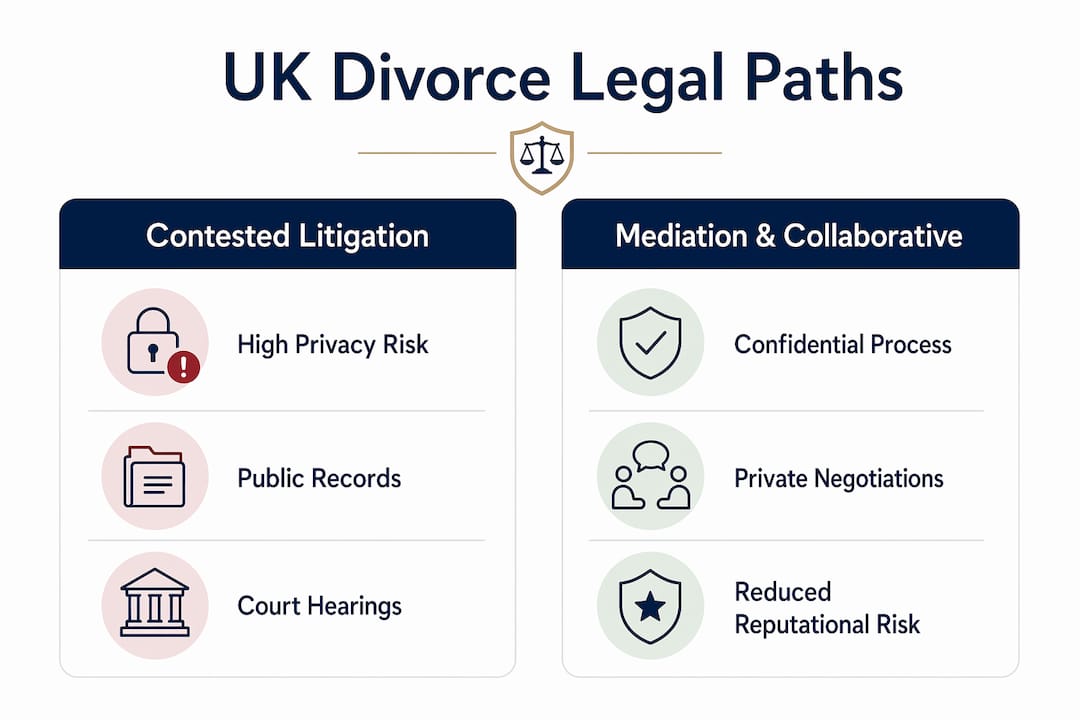
| Approach | Privacy level | Reputational risk | Typical use |
|---|---|---|---|
| Contested court litigation | Low. Filings are public record. | High. Details may be reported or accessed. | Parties cannot agree on terms. |
| Mediation | High. Sessions are confidential. | Low. No public record of discussions. | Parties willing to negotiate with support. |
| Collaborative law | High. Process is private by agreement. | Low. Legal teams commit to non-litigation. | Complex cases requiring legal input without court. |
Your solicitor plays a central role in integrating reputation management with your legal strategy. A good family law solicitor will advise you on which process suits your circumstances, how to conduct yourself throughout proceedings, and how to respond if false allegations arise. Legal and PR experts recommend early joint strategy to prevent damaging public narratives, particularly in cases involving business interests or public profiles. For those navigating complex financial matters, understanding high net worth divorce considerations is equally relevant to protecting both assets and reputation.
Common pitfalls and best practices for managing your reputation
The most common mistake people make during divorce is reacting emotionally rather than strategically. Anger is understandable. Acting on it publicly is damaging. Silence or extreme restraint is often the best response to provocation or negative publicity during divorce, as engaging publicly can escalate the dispute and harm your legal position.
The following pitfalls are the most frequently seen and the most avoidable:
- Deleting digital content. Courts treat deletion as potential evidence tampering. Seek legal advice before removing anything online.
- Involving children in adult disputes. Sharing details of the divorce with children, or allowing them to witness conflict, damages your credibility with the court and harms the children.
- Retaliating online. Responding to a spouse’s social media posts, even to correct inaccuracies, draws attention and creates a public record of conflict.
- Over-sharing with mutual contacts. Information shared informally travels quickly and rarely stays accurate.
- Assuming private messages are private. All digital communications, including WhatsApp and email, can be recovered through legal discovery processes.
Best practices for reputation protection during divorce centre on three principles: discretion, consistency, and professional guidance.
Discretion means saying less, not more. Consistency means your behaviour in private matches your behaviour in court. Professional guidance means working with a solicitor who understands that your conduct outside the courtroom shapes what happens inside it.
Pro Tip: If your divorce involves a public profile or business interests, consider consulting a PR professional alongside your solicitor from the outset. Joint legal and PR strategy from the beginning gives you far greater control over the narrative.
Key takeaways
Reputation management in divorce requires deliberate, consistent action across social media, communications, and legal strategy from the very first day of proceedings.
| Point | Details |
|---|---|
| Define your approach early | Reputation management must begin at the start of divorce, not after damage is done. |
| Social media carries legal risk | Posts, tags, and private messages can all be recovered and used as court evidence. |
| Silence is a legal asset | Measured restraint in communications protects both your credibility and your negotiating position. |
| Choose ADR where possible | Mediation and collaborative law keep sensitive details out of public court records. |
| Seek integrated professional advice | A solicitor who understands reputational risk will help you conduct yourself effectively throughout proceedings. |
What I have seen clients get wrong, and what actually works
Having worked alongside clients navigating some of the most emotionally charged divorces, the pattern I see most often is this: people underestimate how much their behaviour outside the courtroom shapes what happens inside it.
The client who sends an angry text at 11pm, or posts a photograph from a weekend away while claiming financial hardship, rarely does so with malicious intent. They are hurting. They are reacting. But those moments of reaction become evidence, and evidence shapes outcomes.
What actually works is treating every communication as if it will be read aloud in court. That sounds extreme, but it is a practical discipline that protects you. The clients who fare best are those who commit to neutrality early, who resist the urge to retaliate, and who trust their solicitor to fight their corner through the proper channels.
The other thing I would say is this: reputation management is not about winning a public relations battle with your spouse. It is about preserving your credibility with the people who matter most in this process, the judge, your children, and your professional network. Those three audiences deserve your best conduct, not your worst moments.
If you are considering divorce solicitors who understand the full picture, including the reputational dimension, that is the right instinct. Get that advice early.
— George
How Signaturelaw supports you through divorce
Signaturelaw combines over 15 years of family law experience with a genuinely personal approach to each client’s situation. Founded by solicitor Sital Somaiya, who has been featured on BBC and ITV, the firm understands that divorce affects far more than your legal status. It affects your finances, your family, and your reputation. Signaturelaw works with clients across the UK, including those with complex financial arrangements, to build legal strategies that protect privacy and credibility throughout proceedings. Fixed-fee initial consultations and Legal Aid for eligible clients mean that quality family law advice is accessible when you need it most. To speak to a family law solicitor, contact Signaturelaw today.
FAQ
What is reputation management in divorce?
Reputation management in divorce is the deliberate control of your communications, behaviour, and legal strategy to protect your personal and public image throughout proceedings. It covers social media conduct, private communications, and the choice of legal process.
Can social media posts be used against me in a UK divorce?
Yes. Posts about relationships, travel, or spending can be used as evidence to challenge financial claims or parenting fitness in court. Private messages and deleted content can also be recovered through legal discovery.
Does mediation protect my privacy better than going to court?
Mediation sessions are confidential and produce no public record. Contested court proceedings in England and Wales create public filings that can be accessed by third parties, increasing reputational exposure significantly.
Should I delete social media posts during my divorce?
No. Deleting digital content does not protect against discovery and may be treated as suspicious by the court. Seek legal advice before removing anything online.
How early should I start thinking about reputation management in divorce?
From the very first day. Legal and PR professionals recommend an integrated strategy from the outset to prevent damaging narratives from forming before you have had a chance to respond.
Recommended
- Essential divorce negotiation tips for UK business owners | Signature Law
- Your essential divorce checklist for the UK: Step-by-step guide | Signature Law
- Step-by-step UK divorce process: Essential guide for 2026 | Signature Law
- Property division in UK divorce: fair outcomes explained | Signature Law