





Family Law
Landlord tenant dispute guide for UK landlords 2026

TL;DR:
- In 2026, all UK landlord possession claims rely solely on Section 8 grounds following the abolition of Section 21 evictions. Proper legal compliance, thorough documentation, and procedural accuracy are essential to avoid court rejection and ensure successful enforcement. Early dispute resolution and systematic record-keeping significantly reduce the risk of costly legal failures.
A landlord tenant dispute guide is a structured legal framework that helps UK landlords resolve conflicts with tenants, recover possession lawfully, and protect their position throughout the process. The landscape changed fundamentally on 1 May 2026, when Section 21 ‘no-fault’ evictions were abolished in England under the Renters’ Rights Act 2025. Every landlord now depends entirely on Section 8 grounds to recover possession, making procedural accuracy and documentation more critical than ever. This guide covers the full picture: from identifying your grounds and serving valid notices, to managing disputes before they reach court and understanding what happens when they do.
What are the common types of landlord tenant disputes and legal grounds for possession?
Landlord and tenant disputes fall into several distinct categories, each carrying different legal weight and procedural requirements. Rent arrears remain the most frequent source of conflict, followed by antisocial behaviour, breach of tenancy terms, the landlord or a family member needing to move in, and the landlord’s intention to sell the property. Understanding which category applies to your situation determines which legal ground you rely on and how much notice you must give.

The legal authority for possession claims sits within Schedule 2 of the Housing Act 1988, as amended by the Renters’ Rights Act 2025. Grounds are divided into two types. Mandatory grounds require the court to grant possession if the ground is proved. Discretionary grounds give the court a choice, and courts apply a reasonableness test, meaning even a technically valid claim can be refused if deemed unfair. That distinction matters enormously when choosing your strategy.
The most commonly relied upon grounds include:
- Ground 8 (mandatory): At least two months’ rent arrears at the date of notice and at the date of the hearing. This is the strongest ground for rent arrears cases.
- Grounds 10 and 11 (discretionary): Some rent arrears or persistent delay in paying rent. These are weaker but useful alongside Ground 8.
- Ground 14 (discretionary): Antisocial behaviour or nuisance. Evidence of incidents, police reports, and neighbour complaints strengthens this claim.
- Ground 1A (mandatory): The landlord or a close family member intends to occupy the property as their only or principal home.
- Ground 1B (mandatory): The landlord intends to sell the property.
Notice periods vary by ground. For Ground 1A and Ground 1B, landlords must provide four months’ written notice. Ground 8 requires two weeks’ notice when arrears meet the threshold. Ground 14 for serious antisocial behaviour can carry a shorter notice period. Serving the wrong notice period is one of the most common errors that causes claims to fail at court.
| Ground | Type | Minimum notice period |
|---|---|---|
| Ground 8 (rent arrears) | Mandatory | 2 weeks |
| Ground 10 (some arrears) | Discretionary | 4 weeks |
| Ground 14 (antisocial behaviour) | Discretionary | Immediate to 2 weeks |
| Ground 1A (landlord moving in) | Mandatory | 4 months |
| Ground 1B (sale of property) | Mandatory | 4 months |
What compliance checks must you complete before serving a Section 8 notice?
Procedural compliance is not optional. Failure to provide a valid gas safety certificate, a current Energy Performance Certificate, deposit protection confirmation, or the government’s How to Rent guide at the start of the tenancy can result in the court dismissing your possession claim entirely. Courts treat these as prerequisites, not formalities.
Before serving any notice, work through the following checklist:
- Deposit protection: The deposit must be held in a government-approved scheme such as the Deposit Protection Service, MyDeposits, or the Tenancy Deposit Scheme. The prescribed information must have been served on the tenant within 30 days of receipt.
- Gas safety certificate: A valid certificate from a Gas Safe registered engineer must have been provided to the tenant at the start of the tenancy and renewed annually.
- Energy Performance Certificate: The EPC must have been provided before the tenancy began and must carry a minimum rating of E (or higher where required by current regulations).
- How to Rent guide: The current version of the government’s How to Rent guide must have been given to the tenant at the start of the tenancy. If the guide has been updated since, you may need to have re-served it.
- Evidence file: Gather all relevant documentation before serving notice. This includes rent statements, bank records, correspondence, photographs, and any written complaints or warnings already issued.
Lack of basic compliance documents at tenancy start jeopardises legal action under Section 8 even where the grounds themselves are strong. Courts will not overlook these gaps simply because the tenant’s conduct has been poor.
Pro Tip: Create a tenancy compliance folder at the outset of every tenancy. Store signed copies of all prescribed documents, proof of service, and deposit protection certificates in one place. If a dispute arises months or years later, this folder becomes your most valuable asset in court.
How do you serve a Section 8 notice and pursue possession through the courts?
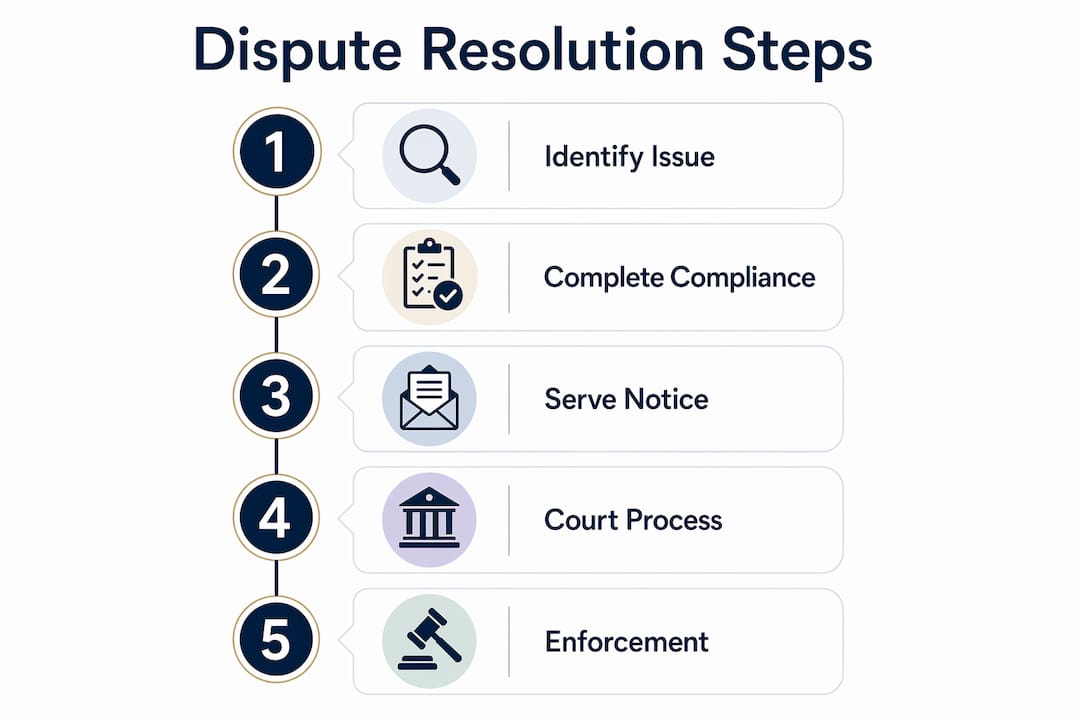
The eviction process under Section 8 follows a defined sequence. Each step must be completed correctly, because minor errors in Notice Form 3 or proof of service can derail the entire claim. The full process typically takes between five and nine months, with costs ranging from £4,000 to £15,000 when legal fees and lost rent are included. Patience and preparation are not optional.
Follow these steps in order:
-
Complete Form 3 accurately. Form 3 is the prescribed Section 8 notice. State the correct grounds, the precise notice period, and the date by which the tenant must vacate. Any error in the ground number, notice period, or property address can invalidate the notice.
-
Serve the notice correctly. Deliver the notice by hand and obtain a signed acknowledgement, or send it by first-class post and retain proof of postage. Some tenancy agreements specify a particular method of service. Follow the agreement’s terms precisely.
-
Wait out the notice period. Do not apply to court before the notice period expires. Use this time to continue gathering evidence and to attempt resolution through direct communication.
-
Apply for a possession order. Once the notice period has expired and the tenant has not vacated, apply to the County Court for a possession order. For straightforward rent arrears cases, the accelerated possession procedure may be available. For contested or discretionary grounds, a full hearing will be listed.
-
Attend the possession hearing. Present your evidence clearly and concisely. The judge will consider whether the ground is proved and, for discretionary grounds, whether it is reasonable to grant possession. Courts typically set the tenant’s vacate date 14 days after the possession order, though this can extend to 42 days if the tenant demonstrates exceptional hardship.
-
Apply for a warrant of possession if necessary. If the tenant does not leave by the date set in the possession order, apply for a warrant of possession. A County Court bailiff will then be authorised to enforce the order and remove the tenant.
A critical warning: Self-help eviction is illegal. Changing the locks, removing the tenant’s belongings, or cutting off utilities without a court order exposes you to criminal prosecution under the Protection from Eviction Act 1977 and civil claims for damages. Enforcement must only be carried out by authorised court officers acting under a valid warrant.
You can find a clear overview of the legal eviction process on the Signaturelaw website, which sets out each stage in plain terms.
How can you resolve disputes before they escalate to court?
Court action is expensive, slow, and uncertain. The most effective landlord tenant dispute resolution begins well before a solicitor drafts a notice. Early, clear communication is the single most reliable way to prevent a manageable problem from becoming a costly legal battle.
Maintaining professional, factual communication and documented timelines is recognised best practice before escalating to court. This means every conversation of significance should be followed up in writing, referencing the relevant clause of the tenancy agreement and the date of the exchange. Verbal agreements and informal understandings carry little weight in proceedings.
When a dispute arises, consider the following approach:
- Issue a formal demand letter. A formal demand letter that clearly describes the problem, states the action required, and sets a firm deadline helps avoid unnecessary legal escalation. It also creates a written record that demonstrates you acted reasonably before resorting to court.
- Reference the tenancy agreement. Every request or complaint should cite the specific clause being breached. This removes ambiguity and signals to the tenant that you are prepared to enforce the agreement.
- Consider mediation. Where the relationship has not completely broken down, mediation through a service such as the Property Redress Scheme or a private mediator can resolve disputes at a fraction of the cost of litigation. Understanding the difference between mediation and litigation is worth considering before committing to court action.
- Set clear timelines. Give the tenant a reasonable but firm deadline to remedy the breach. Document when that deadline passes without resolution.
Pro Tip: Keep a chronological dispute file from the moment a problem first arises. Number each entry, include the date, the method of communication, and a factual summary of what was said or agreed. A well-documented communication trail strengthens your position significantly if the matter reaches court.
Key takeaways
Resolving a landlord tenant dispute in 2026 requires procedural precision, full compliance with prescribed documentation, and a methodical approach from the first sign of conflict through to court enforcement if necessary.
| Point | Details |
|---|---|
| Section 21 is abolished | All possession claims must now rely on Section 8 grounds under the Renters’ Rights Act 2025. |
| Compliance is a prerequisite | Missing gas safety, EPC, deposit protection, or How to Rent documentation can invalidate your claim. |
| Notice periods vary by ground | Ground 1A and 1B require four months’ notice; Ground 8 requires two weeks at the arrears threshold. |
| Court timelines are long | The full eviction process takes five to nine months and can cost between £4,000 and £15,000. |
| Early communication reduces risk | A formal demand letter and documented correspondence can resolve disputes before court action becomes necessary. |
Why procedural discipline defines landlord success in 2026
From my experience working with landlords through possession proceedings, the cases that fail almost never fail because the landlord lacked a valid ground. They fail because of paperwork. A gas safety certificate that was not formally served. A deposit protected on time but with prescribed information sent a day late. A Form 3 with the wrong notice period written in by hand. These are not obscure technicalities. They are the points courts examine first, and they are entirely within a landlord’s control.
The abolition of Section 21 has shifted the burden considerably. Landlords who relied on no-fault evictions as a backstop now face a process that demands they prove their case on the merits, with every document in order. That is not an unreasonable ask, but it does require a different level of preparation than many landlords have previously applied.
The landlords I see navigate this well are those who treat compliance as an ongoing obligation rather than a one-off task at tenancy start. They renew gas safety certificates on time, keep copies of everything, and address problems in writing from the outset. When a dispute arises, they already have the foundation in place. Those who do not are often spending the first weeks of a dispute scrambling to locate documents that should have been filed two years earlier.
My honest advice is this: invest time in your systems before a dispute arises, not after. The cost of getting organised is a fraction of the cost of a possession claim that fails on a technicality.
— George
How Signaturelaw supports landlords through disputes and possession proceedings
Signaturelaw has extensive experience supporting landlords across England through every stage of the landlord and tenant dispute process, from reviewing compliance documents before a notice is served to representing clients at possession hearings. The firm’s approach is direct and practical. Signaturelaw identifies the strongest available grounds, prepares notices correctly, and guides landlords through court proceedings with clarity and confidence. Whether you are dealing with rent arrears, antisocial behaviour, or a complex contested claim, the team provides tailored advice rather than a one-size-fits-all response. To discuss your situation with a solicitor who understands the 2026 legal framework, contact Signaturelaw today at https://signaturelaw.co.uk/contact-us/.
FAQ
What replaced Section 21 evictions in England?
Section 21 was abolished on 1 May 2026. Landlords must now rely solely on the Section 8 grounds set out in Schedule 2 of the Housing Act 1988, as amended by the Renters’ Rights Act 2025.
How long does the eviction process take in 2026?
The full process from serving a Section 8 notice to physical enforcement by bailiffs typically takes between five and nine months, with total costs often falling between £4,000 and £15,000 including legal fees and lost rent.
Can a court refuse a mandatory possession ground?
No. If a mandatory ground such as Ground 8 is proved at the hearing, the court must grant possession. Discretionary grounds are different: courts apply a reasonableness test and can refuse possession even where the ground is technically established.
What happens if I change the locks without a court order?
Changing locks or removing a tenant’s belongings without a court order constitutes an illegal eviction under the Protection from Eviction Act 1977. This exposes you to criminal prosecution and civil damages claims. Enforcement must only be carried out by authorised court bailiffs acting under a valid warrant.
Do I need a solicitor to serve a Section 8 notice?
You are not legally required to use a solicitor, but given that minor errors in Form 3 or proof of service can invalidate the entire claim, professional advice is strongly recommended. Signaturelaw offers tailored support at every stage. Contact the team at https://signaturelaw.co.uk/contact-us/ to discuss your circumstances.
Recommended
- Understanding the role of landlord solicitors in UK housing | Signature Law
- Clear guidance on the legal eviction process in the UK | Signature Law
- Landlord & Tenant Disputes | Signature Law
- Family disputes in probate explained: a UK legal guide 2026 | Signature Law