





Family Law
Family disputes in probate explained: a UK legal guide 2026

Applications to block probate reached an all-time high in the final quarter of 2024, signalling a troubling trend for families across the UK. When a loved one passes away, the last thing most families expect is a legal battle over their estate. Yet probate disputes are becoming increasingly common, driven by complex family dynamics, economic pressures, and poorly drafted wills. Understanding the causes, trends, and legal processes surrounding family disputes in probate can help you navigate these challenges with greater confidence and compassion.
Table of Contents
- What Causes Family Disputes In Probate In The UK?
- Trends And Statistics: The Rising Numbers And What They Mean
- How Legal Challenges To Wills Work And Risks To Consider
- Navigating Family Disputes In Probate: Practical Steps And Support
- Support From Expert Family And Probate Solicitors
- Frequently Asked Questions About Family Disputes In Probate
Key takeaways
| Point | Details |
|---|---|
| Rise in probate disputes | Applications rose from 7,574 in 2014 to 10,409 in 2023, reflecting growing legal and social complexity. |
| Common reasons for disputes | Perceived unfair inheritance, poorly drafted wills, and mental capacity concerns drive most conflicts. |
| Risks of unsupported challenges | Challenging wills without evidence can lead to costly penalties and court disapproval. |
| Younger adults more likely to dispute | Those aged 25 to 34 are notably more inclined to initiate will challenges. |
| Early legal advice is crucial | Seeking expert guidance early reduces stress, costs, and the risk of prolonged conflict. |
What causes family disputes in probate in the UK?
Family disputes in probate rarely emerge from a single cause. Instead, they reflect a combination of emotional, financial, and legal factors that converge after someone’s death. 38% of people would dispute a will if they believed the inheritance was unfair, highlighting how perceptions of fairness fuel conflict. This statistic underscores the deeply personal nature of probate disputes, where family members often feel entitled to a larger share or question the deceased’s intentions.
Longer life expectancy has introduced new complications. As people live longer, concerns about mental capacity at the time of making or updating a will become more frequent. Families may question whether the deceased fully understood the implications of their decisions, especially if dementia or cognitive decline was present. These concerns are not always unfounded, but they require substantial evidence to support a legal challenge.
Economic pressures also play a significant role. Rising property values, inflation, and the cost of living mean inheritances carry greater financial weight than in previous generations. When estates include valuable assets like family homes, disputes over who receives what can become particularly intense. Blended families, where remarriages create step-siblings and step-parents, add further complexity. Children from a first marriage may feel overlooked if a parent leaves the bulk of their estate to a new spouse.
Poorly drafted or outdated wills remain a leading cause of confusion and conflict. Ambiguous language, missing signatures, or failure to update a will after major life events can leave families uncertain about the deceased’s true wishes. Without clear guidance, disagreements escalate quickly. Even well-meaning families can find themselves at odds when a will lacks precision or fails to address specific assets.
Younger adults aged 25 to 34 are notably more likely to challenge wills, possibly reflecting generational shifts in attitudes towards inheritance and fairness. This age group may be more willing to question traditional family hierarchies or seek legal remedies when they perceive injustice. Understanding these causes helps families anticipate potential disputes and take proactive steps, such as reviewing a probate checklist UK 2026 or clarifying differences between probate and wills to reduce confusion.
Pro Tip: Open conversations about inheritance while the person is still alive can prevent misunderstandings and reduce the likelihood of disputes after their death.
Trends and statistics: the rising numbers and what they mean
The data paints a clear picture: probate disputes in the UK are on an upward trajectory. The number of probate disputes increased 37% over the past decade, reaching 10,409 in 2023. This growth reflects broader social and economic changes, including longer lifespans, complex family structures, and greater awareness of legal rights. Families are more informed about their options and more willing to pursue legal action when they believe an estate has been unfairly distributed.
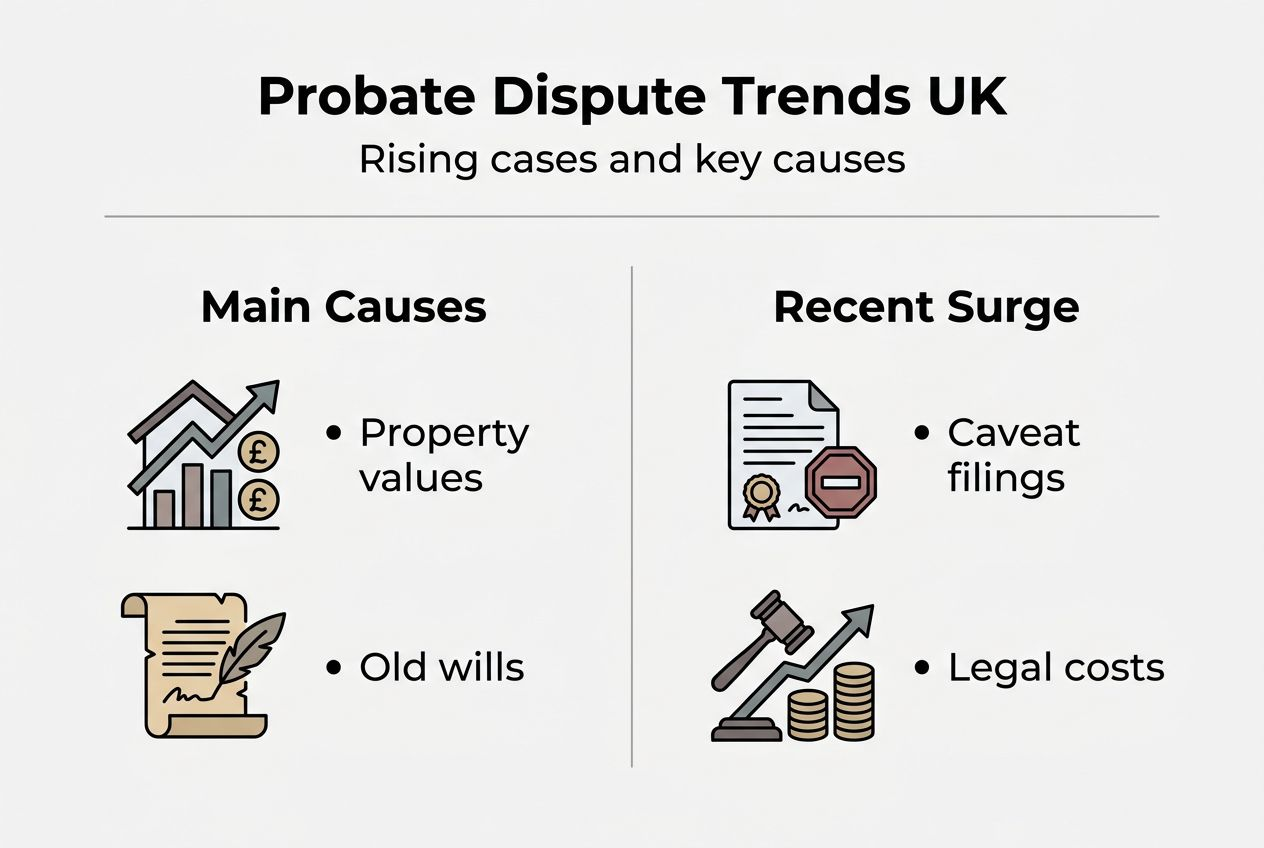
Applications to enter caveats, which temporarily block probate, reached record levels in late 2024. A caveat is a legal notice that prevents the grant of probate from being issued, giving the objector time to gather evidence or negotiate. The surge in caveats signals that more families are taking formal steps to challenge wills or estate administration, often as a first move in a longer dispute.
The following table illustrates the steady increase in caveat applications over recent years:
| Year | Total caveat applications |
|---|---|
| 2010 | 6,358 |
| 2015 | 8,120 |
| 2020 | 9,874 |
| 2024 | 11,362 |
This upward trend shows no signs of slowing. Legal experts predict that probate disputes will continue to rise as societal factors persist. Blended families, second marriages, and estranged relationships contribute to a landscape where traditional inheritance expectations no longer apply. Additionally, the rising value of estates, particularly property, means more is at stake financially.
The emotional and financial burden of these disputes falls heavily on families. Legal costs can escalate quickly, and prolonged conflicts drain both resources and relationships. Many families find themselves locked in disputes that last months or even years, causing stress and delaying the distribution of assets. Understanding the scale of the problem is the first step towards addressing it effectively.
For families navigating probate, awareness of probate costs UK 2026 and the probate process step by step can provide clarity and help manage expectations. Recognising the trends and statistics behind probate disputes empowers you to take informed action, whether that means seeking early legal advice or exploring alternative dispute resolution methods.
Key factors driving the increase:
- Longer lifespans leading to capacity concerns
- Complex family structures and remarriages
- Rising property and asset values
- Greater public awareness of legal rights
How legal challenges to wills work and risks to consider
Challenging a will is a serious legal step that requires clear grounds and robust evidence. Courts do not overturn wills lightly, as they respect the deceased’s right to distribute their estate as they see fit. Legal challenges typically allege one of several grounds: lack of mental capacity, undue influence, fraud, or failure to meet formal requirements such as proper witnessing.
Lack of mental capacity is the most common ground. To make a valid will, the person must understand the nature of their actions, the extent of their estate, and the claims of potential beneficiaries. If you believe the deceased lacked capacity due to dementia or illness, you must provide medical evidence and witness testimony to support your claim. Courts examine the evidence carefully and will not overturn a will based on speculation alone.

Undue influence occurs when someone pressures or manipulates the deceased into changing their will. This is difficult to prove, as it requires evidence that the deceased’s free will was overborne. Similarly, claims of fraud or forgery demand concrete proof, such as handwriting analysis or testimony from those present when the will was signed.
The risks of pursuing an unsupported challenge are significant. Challenging a will without solid evidence can lead to financial penalties, as demonstrated in the case of Burgess v Whittle. In this case, the claimant pursued a challenge despite lacking credible evidence, and the court imposed costs as a deterrent against frivolous claims. This serves as a stark reminder that legal challenges must be grounded in fact, not emotion or disappointment.
Before initiating a challenge, consider the following steps:
- Gather all relevant documents, including the will, medical records, and correspondence.
- Consult a solicitor who specialises in probate disputes to assess the strength of your case.
- Explore alternative dispute resolution, such as mediation, which can resolve conflicts without court proceedings.
- Weigh the financial and emotional costs of pursuing a challenge against the potential outcomes.
Pro Tip: Always seek legal advice before challenging a will. A solicitor can help you evaluate whether your concerns have legal merit and guide you through the process.
Understanding how legal challenges work and the risks involved helps you make informed decisions. If you believe a will is invalid, acting with caution and proper legal support is essential. Resources like the estate administration guide 2026 and probate solicitors can provide the guidance you need to navigate these complex issues.
Navigating family disputes in probate: practical steps and support
When a family dispute arises during probate, taking practical and thoughtful steps can make a significant difference. Early action reduces stress, limits costs, and increases the likelihood of a fair resolution. The first and most important step is seeking legal advice as soon as concerns emerge. A solicitor experienced in probate disputes can assess your situation, explain your options, and help you understand the legal and financial implications of different courses of action.
Mediation and alternative dispute resolution offer valuable alternatives to court proceedings. Mediation involves a neutral third party who helps family members communicate and negotiate a settlement. This approach is often faster, less expensive, and less adversarial than going to court. It also allows families to maintain relationships, which can be important when children or other dependents are involved. Many disputes can be resolved through mediation if all parties are willing to engage in good faith.
Keeping communication respectful and documenting key conversations is essential. Emotions run high during probate disputes, but maintaining a calm and professional tone can prevent conflicts from escalating. Write down important discussions, keep copies of emails and letters, and avoid making accusations without evidence. Clear documentation also supports your case if the dispute progresses to legal action.
Weighing the pros and cons of pursuing a legal challenge is crucial. The following table summarises key considerations:
| Approach | Advantages | Disadvantages |
|---|---|---|
| Legal challenge | Potential to overturn unfair will | High costs, lengthy process, risk of penalties |
| Mediation | Faster, less expensive, preserves relationships | Requires cooperation from all parties |
| Negotiation | Flexible, informal, lower stress | May not achieve full desired outcome |
Gathering all relevant documents and evidence is a practical step that strengthens your position. This includes the will itself, any previous versions, medical records, correspondence with the deceased, and witness statements. Thorough preparation demonstrates seriousness and helps your solicitor build a strong case.
Pro Tip: Keep a detailed timeline of events leading up to and following the deceased’s death. This can help identify inconsistencies or support your claims.
Families facing disputes should also be aware that upward trend in probate disputes is likely to continue due to social and economic factors. This means that proactive planning and early intervention are more important than ever. Resources like navigating wills and probate solicitors and family law solicitors London offer expert support tailored to your needs.
Practical steps to take:
- Seek legal advice early to understand your rights and options
- Consider mediation before pursuing court action
- Document all communications and gather evidence
- Weigh the financial and emotional costs of different approaches
- Stay informed about the probate process and your legal obligations
Support from expert family and probate solicitors
Navigating family disputes in probate requires more than just legal knowledge. It demands compassion, patience, and a deep understanding of the emotional challenges families face during these difficult times. Professional solicitors who specialise in family law and probate provide guidance tailored to your unique situation, helping you make informed decisions that protect your interests and preserve family relationships where possible.
Expert support can make a profound difference in the outcome of a probate dispute. Solicitors experienced in this area understand the nuances of UK probate law and can help you assess whether a legal challenge is worthwhile or if alternative approaches like mediation might achieve a better result. They also manage the administrative burden, allowing you to focus on grieving and supporting your family.
Contacting a solicitor early often leads to better outcomes and less stress. Early intervention allows you to explore all available options before positions harden and disputes escalate. Whether you need help understanding your rights, challenging a will, or resolving a conflict through negotiation, professional legal advice provides clarity and confidence. Signature Law’s family law solicitors London and wills and probate solicitors Romford offer the compassionate, authoritative support you need. Understanding the family law impact in the UK can also help you appreciate the broader legal context.
Frequently asked questions about family disputes in probate
How can I dispute a will if I believe it’s unfair?
You can dispute a will by demonstrating legal grounds such as lack of mental capacity, undue influence, or failure to meet formal requirements. You must gather evidence and consult a solicitor who specialises in probate disputes. Courts require strong proof, so acting without legal advice increases the risk of failure and financial penalties.
What evidence is needed to challenge a will successfully?
Successful challenges require robust evidence, including medical records showing lack of capacity, witness testimony, correspondence, and expert reports. The burden of proof lies with the challenger, so thorough documentation is essential. Without credible evidence, courts will uphold the will, and you may face costs.
Can families resolve probate disputes without going to court?
Yes, mediation and alternative dispute resolution offer effective ways to resolve probate disputes without court proceedings. These approaches are faster, less expensive, and less adversarial. They also help preserve family relationships, which can be important for ongoing family dynamics and future interactions.
What happens if a will challenge fails?
If a will challenge fails, the court typically orders the challenger to pay legal costs, which can be substantial. This serves as a deterrent against frivolous claims. The original will remains valid, and the estate is distributed according to its terms. Seeking legal advice before challenging a will helps you assess the risks.
When should I seek legal advice about probate disputes?
Seek legal advice as soon as concerns arise, ideally before taking any formal action. Early consultation helps you understand your rights, evaluate the strength of your case, and explore all available options. Delaying legal advice can limit your options and increase stress. Resources like the estate administration guide 2026 provide additional support.
Recommended
- Probate checklist UK 2026: essential guide to navigate probate | Signature Law
- Signature Law Blog: Legal Insights & Updates (2026)
- Probate Costs UK 2026: What Families Must Know | Signature Law
- How to Handle Probate UK: Complete Step-by-Step Guide | Signature Law