





Family Law
Will disputes explained: your UK legal rights guide

TL;DR:
- Will disputes challenge the validity, fairness, or interpretation of a deceased person’s will, often requiring court intervention. They include validity challenges, family provision claims, executor disputes, and asset disagreements, each with different legal rules and deadlines. Prompt legal advice, early evidence gathering, and mediation significantly increase chances of resolution while reducing costs and emotional strain.
A will dispute is a formal legal challenge to the validity, interpretation, or fairness of a deceased person’s will, and it requires either negotiated settlement or court intervention to resolve. In England and Wales, these disputes arise more frequently than most families expect, triggered by concerns ranging from whether the deceased had the mental capacity to make a will, to whether a close family member has been left without adequate financial provision. Understanding will disputes explained in plain terms is the first step towards protecting your legal rights and making informed decisions during what is already an extraordinarily difficult time.
What are the common types of will disputes in the UK?

Correctly identifying which type of dispute applies is the single most important factor in determining your legal strategy. Confusing a validity challenge with a financial provision claim is a common and often fatal error in estate litigation.
Will disputes fall into four broad categories:
- Validity challenges. These disputes argue that the will itself is legally defective. Grounds include lack of testamentary capacity (the deceased did not understand what they were signing), undue influence (someone coerced them), fraud or forgery, and improper execution (the will was not signed and witnessed correctly under the Wills Act 1837).
- Family provision claims. Under the Inheritance (Provision for Family and Dependants) Act 1975, eligible individuals can apply to court for reasonable financial provision even when the will is technically valid. Eligible claimants include spouses, former spouses, cohabitants of at least two years, children, and financial dependants.
- Executor disputes. These arise when beneficiaries believe the executor is mismanaging the estate, failing to act promptly, or has a conflict of interest. Courts can remove or replace an executor where there is sufficient evidence of misconduct or incapacity.
- Asset-specific disagreements. These disputes concern particular items within the estate, such as a jointly owned property, a business interest, or a personal possession. They often arise where the will’s wording is ambiguous or where assets were held outside the estate entirely.
Each category carries different legal tests, different time limits, and different remedies. A claim under the Inheritance Act 1975, for example, must generally be brought within six months of the grant of probate. A validity challenge operates under different procedural rules entirely.
Pro Tip: Before taking any formal steps, write down a clear timeline of events: when the will was made, who was present, and any changes in the deceased’s behaviour or circumstances in the months beforehand. This record becomes valuable evidence regardless of which type of dispute you pursue.
What are the legal grounds for contesting a will?
Validity challenges require demonstrating a specific flaw in the will, and the burden of proof rests with the person bringing the challenge. Courts apply a preponderance of evidence standard, meaning you must show it is more likely than not that the flaw existed.
The recognised legal grounds are as follows:
- Lack of testamentary capacity. The deceased must have understood the nature of making a will, the extent of their estate, and the claims of those who might reasonably expect to benefit. Medical records, GP notes, and witness statements are the primary evidence here.
- Undue influence. Proving undue influence requires demonstrating that the testator’s free will was completely overborne by another person, not merely that they were persuaded or pressured. Courts look for a pattern of isolation, dependency, and control by someone who disproportionately benefits from the estate changes.
- Fraud or forgery. This covers situations where the deceased was deceived into signing a document they did not understand, or where the signature itself is not genuine. Handwriting experts and forensic document analysis are commonly used.
- Improper execution. Under the Wills Act 1837, a will must be signed by the testator in the presence of two independent witnesses who also sign. Any deviation from this process can render the will invalid.
A common misconception is that feeling the will is “unfair” constitutes a legal ground for challenge. It does not. Dissatisfaction with the outcome is not, by itself, a basis for a validity claim. That is precisely why the Inheritance Act 1975 exists as a separate route for those who have been inadequately provided for.
On no-contest clauses: Some wills include a clause stating that any beneficiary who challenges the will forfeits their inheritance. These clauses are designed to deter disputes, but they are narrowly construed and often unenforceable where no alternate beneficiary is named. Critically, if the challenge succeeds and the will is invalidated, the no-contest clause is voided along with the rest of the document.
Standing to contest a will is also limited. Only beneficiaries named in the will, beneficiaries under a prior will, and those who would inherit under the rules of intestacy have the legal right to bring a claim. Distant relatives or friends without a direct financial interest generally cannot contest.
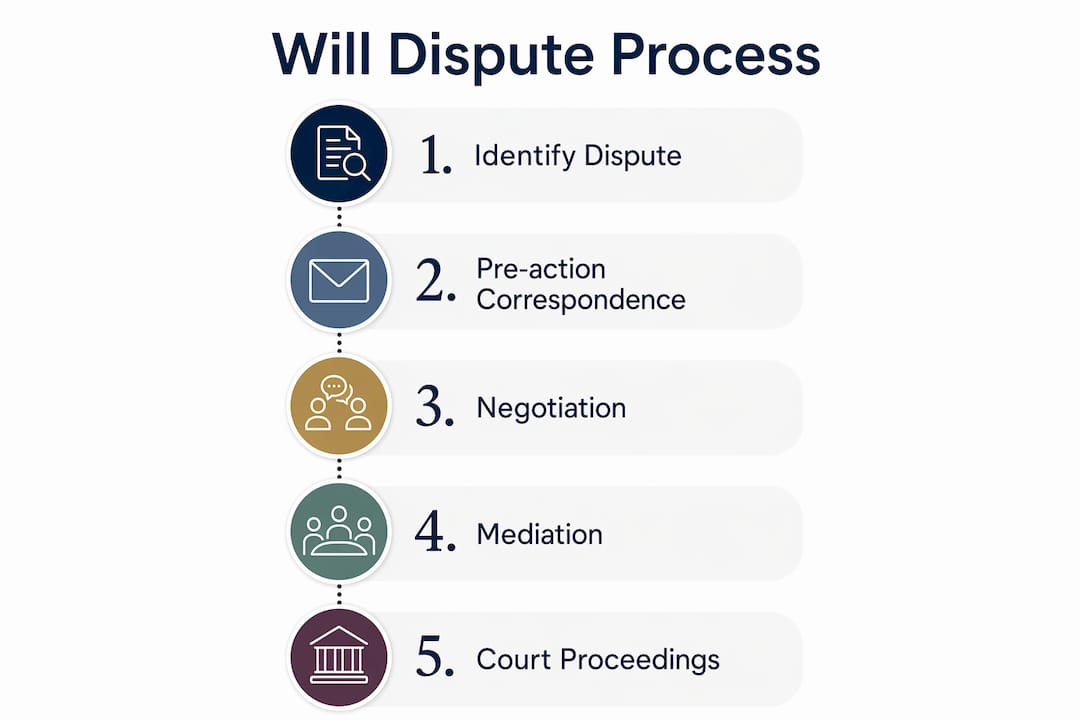
How does the will dispute process work in practice?
Once a dispute arises, estate distribution freezes until the matter is resolved. The executor shifts from distributing assets to preserving them, and no beneficiary receives anything during this period. This can stretch from several months to several years, depending on the complexity of the case and whether it proceeds to trial.
The process typically follows these stages:
| Stage | What happens |
|---|---|
| Pre-action correspondence | Solicitors exchange letters setting out each party’s position and evidence before formal proceedings begin. |
| Filing a claim | The claimant issues proceedings in the Chancery Division of the High Court or, for smaller estates, the County Court. |
| Disclosure and evidence | Both sides exchange documents, witness statements, and expert reports such as medical or handwriting evidence. |
| Mediation | Most disputes are referred to mediation before trial. Mediation carries a high settlement rate and allows creative solutions that a court verdict cannot provide, including structured payments or agreed asset divisions. |
| Trial | If mediation fails, the matter proceeds to a judge. The outcome is binding and all-or-nothing. |
The financial consequences of litigation are significant. Costs in will disputes can range from tens to hundreds of thousands of pounds, with each party generally bearing their own legal fees unless the court orders otherwise. These costs accrue against the estate itself, meaning the longer the dispute runs, the less there is for anyone to inherit.
Pro Tip: Request a costs estimate from your solicitor at the outset and compare it against the value of what you stand to gain. A dispute over a £40,000 share of an estate that costs £35,000 to litigate is rarely worth pursuing through the courts. Mediation typically costs a fraction of trial costs and should always be considered first.
For a clearer picture of how the probate application process interacts with estate disputes, Signaturelaw’s detailed guide walks through each procedural step.
What practical steps can you take to resolve or avoid will disputes?
Resolving a will dispute well requires both legal precision and emotional intelligence. The following steps apply whether you are already in a dispute or trying to prevent one.
- Seek legal advice immediately. Time limits are unforgiving. Missing the deadline to bring a claim under the Inheritance Act 1975, which is generally six months from the grant of probate, extinguishes your right to claim entirely. A solicitor can assess your position and advise on the strongest route before deadlines pass.
- Gather evidence early. Medical records, correspondence, bank statements, and witness accounts deteriorate or become harder to obtain over time. Secure what you can as soon as a dispute becomes likely.
- Consider mediation before litigation. Mediation allows parties to control outcomes, preserve family relationships, and reach agreements that a court cannot impose. It is private, faster, and significantly less expensive than a full trial.
- Communicate clearly with the executor. Many disputes escalate because beneficiaries feel excluded from the administration process. Requesting regular updates and formal accounts from the executor is entirely within your rights and often resolves concerns before they become formal claims.
- For those writing or updating a will: attach a letter of wishes explaining your reasoning, particularly where you are departing from what family members might expect. This does not form part of the legal will, but it provides context that can significantly reduce the prospect of a challenge after your death. Solicitors also recommend that the will-making process is documented carefully, including notes on the testator’s capacity and instructions at the time of signing.
Understanding the relationship between probate and wills is also worth your time, as many disputes arise from confusion about what probate actually authorises an executor to do.
Key takeaways
Will disputes are legally complex, financially costly, and emotionally draining. Identifying the correct type of claim and acting within the relevant time limits are the two factors that most determine whether a dispute succeeds or fails.
| Point | Details |
|---|---|
| Identify the dispute type first | Confusing a validity challenge with an Inheritance Act claim leads to the wrong legal route and failed outcomes. |
| Evidential bar is high | Undue influence and lack of capacity require specific, documented evidence, not general dissatisfaction with the will. |
| Time limits are strict | Inheritance Act claims must generally be brought within six months of the grant of probate. |
| Costs erode the estate | Legal fees in contested estates can reach hundreds of thousands of pounds, reducing what all parties ultimately receive. |
| Mediation resolves most disputes | The majority of estate disputes settle through mediation, which is faster, cheaper, and preserves relationships better than trial. |
What I have seen working through estate disputes
Will disputes are among the most emotionally charged legal matters I encounter. Families arrive already grieving, and then find themselves in conflict with the very people they expected to grieve alongside. That combination of loss and legal pressure is genuinely difficult to manage, and I think it is worth being honest about that.
What I have observed consistently is that the disputes which escalate to full litigation are rarely the ones with the strongest legal merits. They are the ones where communication broke down early, where someone felt dismissed or excluded, and where no one stepped in with clear, calm legal guidance before positions became entrenched. A solicitor’s letter sent at the right moment, or a single mediation session before proceedings are issued, resolves more disputes than any court hearing.
I also want to address the no-contest clause directly, because it causes a great deal of unnecessary anxiety. Many people read such a clause and assume they have no options. In practice, these clauses are far less powerful than they appear. If the will is successfully challenged and set aside, the clause disappears with it. If you have genuine grounds to contest, a no-contest clause should not deter you from taking legal advice.
The most important thing you can do right now, if you are facing a dispute, is to speak to a solicitor who understands both the legal framework and the human reality of what you are going through. Do not wait. Time limits in this area of law are unforgiving, and the earlier you act, the more options you have.
— George
How Signaturelaw can help with will disputes
Signaturelaw is a UK law firm with deep expertise in wills, probate, and family law matters, founded by solicitor Sital Somaiya, who has over 15 years of experience and has been featured on BBC and ITV. If you are facing a dispute over a will or estate, the team provides clear, personalised legal advice tailored to your specific circumstances. Whether you need to understand your rights under the Inheritance Act 1975, challenge a will’s validity, or resolve an executor dispute, Signaturelaw offers fixed-fee initial consultations and multilingual support. Explore the firm’s wills and probate services or contact Signaturelaw today to speak with a specialist.
FAQ
What is a will dispute?
A will dispute is a formal legal challenge to the validity, fairness, or interpretation of a deceased person’s will. It may involve questioning the testator’s mental capacity, alleging undue influence, or claiming inadequate financial provision under the Inheritance (Provision for Family and Dependants) Act 1975.
Who can contest a will in the UK?
Standing to contest is limited to beneficiaries named in the will, beneficiaries under a previous will, and those who would inherit under intestacy rules. Distant relatives or individuals without a direct financial interest generally cannot bring a claim.
How long does a will dispute take to resolve?
Will disputes can take anywhere from several months to several years, depending on complexity and whether the matter proceeds to trial. Most disputes settle through mediation before reaching a courtroom, which significantly reduces both the time and cost involved.
What is the time limit for contesting a will?
Claims under the Inheritance Act 1975 must generally be brought within six months of the grant of probate. Validity challenges do not carry a fixed statutory deadline in England and Wales, but courts expect claimants to act promptly once they become aware of the grounds.
How much does it cost to dispute a will?
Costs in will disputes can range from tens to hundreds of thousands of pounds, with parties typically bearing their own legal fees unless the court directs otherwise. Seeking early legal advice and pursuing mediation before litigation is the most effective way to manage costs.
Recommended
- Types of divorce settlements: UK guide to fair solutions | Signature Law
- Understanding Financial Settlement Agreements: A Comprehensive Guide for UK Divorce | Signature Law
- Difference Between Mediation and Litigation: Comprehensive Comparison and Guidance for UK Clients
- Property division in UK divorce: fair outcomes explained | Signature Law