





Family Law
Landlord tenant law in the UK: your 2026 guide

TL;DR:
- Landlord-tenant law in the UK governs the rights and responsibilities of landlords and tenants, with recent reforms strengthening tenant protections. Since 2026, landlords cannot evict without valid grounds, must register properties, and follow strict repair deadlines, while tenants have clear rights against unfair rent increases and unsafe housing. Proper documentation and early legal advice are crucial, as the law now heavily favors those who can demonstrate their actions and compliance.
Landlord-tenant law is the set of legal rules governing the relationship between landlords and tenants in the UK rental sector, defining rights, responsibilities, and protections for both parties. Understanding what is landlord tenant law matters more than ever in 2026, because the Renters’ Rights Act has fundamentally reshaped how tenancies work, how evictions proceed, and what landlords must do to stay on the right side of the law. Whether you rent a flat in Romford or manage a portfolio of properties across Essex, these rules apply to you directly. Getting them wrong carries real financial and legal consequences.
What is landlord tenant law and how does it work in the UK?
Landlord-tenant law is the body of legislation and common law that regulates private rented sector relationships in England and Wales. The formal term used in legal practice is “residential tenancy law,” though landlord-tenant law is the phrase most people search for and use in everyday conversation. Both terms refer to the same framework.

The core legislation includes the Housing Act 1988, the Landlord and Tenant Act 1985, and most recently the Renters’ Rights Act, which came into force on 1 May 2026. These statutes set out the baseline rules that every tenancy must follow, regardless of what a written agreement says. Legal rights regarding eviction, rent, and access are now non-negotiable baseline protections that override contradictory tenancy agreement clauses.
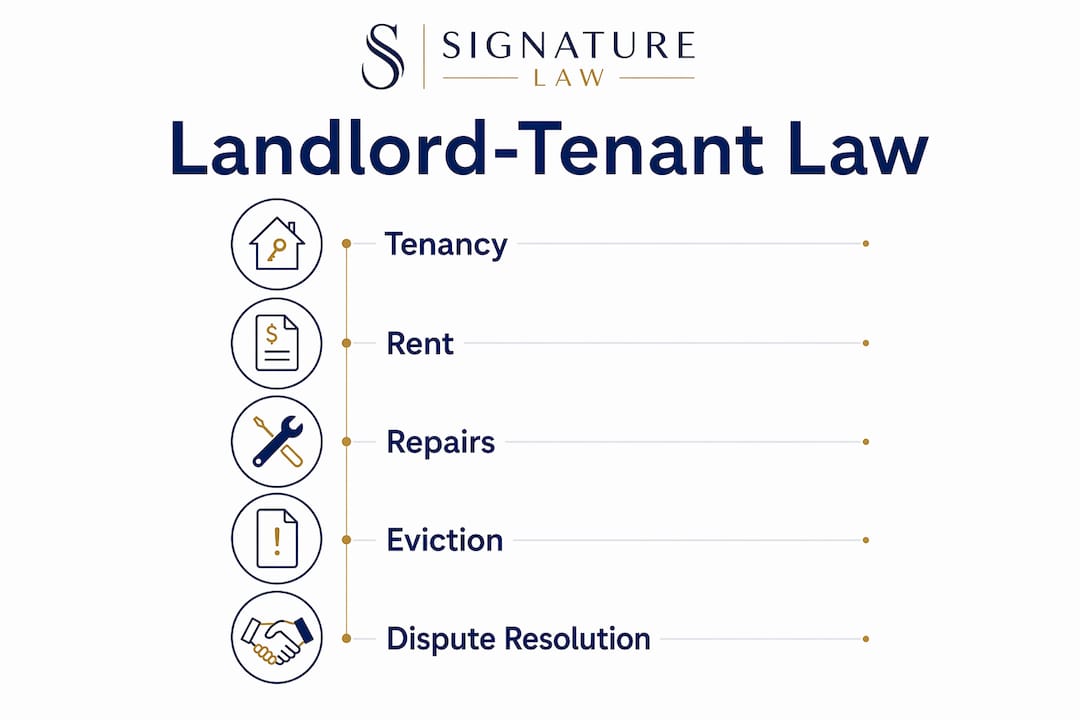
The law covers five main areas: tenancy agreements, rent, repairs and safety, eviction, and dispute resolution. Each area carries specific obligations for landlords and specific protections for tenants. No private agreement between a landlord and tenant can lawfully remove those protections.
What are tenant rights and responsibilities under UK law?
Tenants in the UK private rented sector hold a defined set of legal rights. Understanding them gives you the confidence to act when something goes wrong.
Your core rights as a tenant include:
- The right to a safe and habitable home that meets the Decent Homes Standard, which sets minimum conditions for heating, structural integrity, and freedom from serious hazards.
- Protection from unfair eviction. Section 21 no-fault evictions were abolished from 1 May 2026, meaning a landlord cannot ask you to leave without a valid legal reason.
- The right to receive a written tenancy agreement and a mandatory Information Sheet explaining your rights under the Renters’ Rights Act.
- Protection against unlawful rent increases. The Renters’ Rights Act limits rent increases to once per year and prohibits any increase during the first 12 months of a tenancy.
- The right to challenge excessive rent increases through the First-Tier Tribunal.
- Protection against being asked to pay rent before signing a tenancy agreement. Landlords cannot request rent before a formal agreement is in place.
Your responsibilities as a tenant are equally clear. You must pay rent on time, keep the property in reasonable condition, report repairs promptly, and not cause damage beyond fair wear and tear. Failing to meet these obligations gives a landlord legitimate grounds to seek possession.
Pro Tip: Keep a written record of every repair request you make, including the date and method of contact. This evidence is critical if a dispute reaches the First-Tier Tribunal.
What are the legal duties of landlords in the UK rental sector?
Landlord obligations under UK law are extensive, and the 2026 reforms have added several new compliance requirements that carry serious penalties for non-compliance.
-
Provide a written tenancy agreement. Every tenancy must be documented in writing. Since 1 May 2026, no new fixed-term assured shorthold tenancies are permitted. All new tenancies must be periodic, meaning they run on a rolling basis rather than for a fixed term.
-
Deliver an Information Sheet. Landlords must provide tenants with a legally mandated Information Sheet explaining their rights. For existing tenancies that converted automatically on 1 May 2026, landlords must provide this sheet by 31 May 2026.
-
Register on the Private Rented Sector Database. Landlords must register their properties on the new PRS Database. Failure to register may invalidate eviction notices and result in fines.
-
Meet Awaab’s Law repair deadlines. Under Awaab’s Law, landlords face strict timescales for hazard repairs: 24 hours to respond to emergencies, 14 days to investigate reported hazards, and 7 days to begin remediation. Failure to comply carries significant penalties.
-
Follow lawful rent increase procedures. Landlords must give at least 2 months’ notice of any rent increase using Form 4A. Increases above the advertised rent are prohibited, and landlords cannot encourage or accept offers above the listed price.
-
Comply with Making Tax Digital. Landlords with property income over £50,000 must report income digitally under Making Tax Digital for Income Tax. This threshold reduces to £30,000 in 2027.
-
Maintain property safety. Gas safety certificates, electrical installation condition reports, and energy performance certificates remain mandatory. Meeting the Decent Homes Standard is now a legal requirement across the private rented sector.
Pro Tip: Register on the PRS Database as a priority. An unregistered landlord cannot lawfully serve an eviction notice, which means any possession proceedings you start may be thrown out by the court.
How have eviction laws changed, and what must landlords do?
The abolition of Section 21 is the single most significant change to UK eviction law in a generation. Before 1 May 2026, a landlord could serve a Section 21 notice to end a tenancy without giving any reason. That route no longer exists.
Landlords must now use expanded Section 8 grounds and provide a valid legal reason for seeking possession. Common grounds include significant rent arrears, breach of tenancy terms, the landlord wishing to sell the property, or the landlord or a close family member needing to move in. Each ground carries its own notice period and evidential requirements.
The practical steps for a lawful eviction now look like this:
- Identify the correct Section 8 ground and confirm it applies to your situation.
- Serve the correct statutory notice with the required notice period.
- Apply to the court for a possession order if the tenant does not vacate voluntarily.
- Attend the possession hearing and present documented evidence of the breach or ground.
- Obtain a warrant for possession if the tenant remains after the court order.
Tenants retain strong protections throughout this process. A court will not grant possession on rent arrears grounds unless the arrears meet the statutory threshold. Tenants can also dispute the landlord’s stated reason at the hearing.
For landlords, the key lesson is documentation. Evictions require specific grounds backed by clear evidence and statutory notice periods. A landlord who cannot produce a paper trail of the tenant’s breach will struggle to succeed in court. Signaturelaw’s guide to the legal eviction process sets out each step in plain terms.
How are landlord and tenant disputes resolved in the UK?
When a dispute arises between a landlord and tenant, several resolution routes are available. The right route depends on the nature of the dispute and how far it has escalated.
| Dispute type | Resolution route | Key outcome |
|---|---|---|
| Excessive rent increase | First-Tier Tribunal application | Tribunal sets a fair market rent |
| Landlord offences (e.g. unlicensed property) | Rent Repayment Order via tribunal | Tenant reclaims up to 2 years’ rent |
| Disrepair or hazard | Local authority enforcement | Landlord fined or improvement notice issued |
| Tenancy agreement disagreement | Mediation or county court | Binding settlement or court order |
| Unlawful eviction | County court injunction | Tenant reinstated; landlord liable for damages |
Rent Repayment Orders are one of the most powerful tools available to tenants. Tribunals can order landlords to repay up to 2 years’ rent where the landlord has committed offences such as failing to licence a property or carrying out an unlawful eviction. This is a significant financial deterrent.
Local councils hold enhanced investigatory powers and can enforce penalties against landlords who breach tenancy laws. Tenants can report concerns directly to their local authority without needing to go to court first.
Mediation is a faster and less costly alternative to litigation for disputes over repairs, deposits, or tenancy terms. Both parties agree to work with a neutral third party to reach a settlement. Mediation does not produce a legally binding order unless both parties sign a formal agreement, but it resolves the majority of disputes before they reach a tribunal.
Pro Tip: Before any dispute escalates, compile a clear file: tenancy agreement, correspondence, photographs, repair requests, and payment records. A well-organised file shortens tribunal hearings and strengthens your position considerably.
What do landlord tenant agreements legally require?
A tenancy agreement is the written contract that governs the rental relationship. Since 1 May 2026, most assured shorthold tenancies converted automatically to assured periodic tenancies. No new fixed-term assured shorthold tenancies can be created.
A lawful tenancy agreement must cover the following:
| Agreement term | Legal requirement |
|---|---|
| Rent amount and payment date | Clearly stated; increases only via Form 4A with 2 months’ notice |
| Deposit amount and protection scheme | Must be registered with a government-approved scheme within 30 days |
| Landlord’s name and contact address | Mandatory for service of legal notices |
| Property address and description | Required for identification and legal proceedings |
| Tenant obligations | Repairs, conduct, subletting restrictions |
| Landlord access rights | Minimum 24 hours’ written notice required |
The Renters’ Rights Act strengthens written contractual standards by abolishing informal tenancy arrangements and requiring formal written documentation for every tenancy. Any clause in a tenancy agreement that attempts to remove a tenant’s statutory rights is unenforceable. A landlord cannot, for example, include a clause waiving the tenant’s right to challenge a rent increase.
The shift towards periodic tenancies also changes how tenancies end. Either party can end a periodic tenancy by giving the correct statutory notice. Tenants must give at least 2 months’ notice. Landlords must use a valid Section 8 ground and follow the full possession process.
Key takeaways
The most important thing to understand about UK landlord-tenant law in 2026 is this: the Renters’ Rights Act has made formal, documented compliance the legal baseline for every landlord, and has given tenants enforceable protections that no tenancy agreement can override.
| Point | Details |
|---|---|
| Section 21 abolished | Landlords must use valid Section 8 grounds and follow the full possession process to evict. |
| Rent increases restricted | Increases are limited to once per year, with 2 months’ notice via Form 4A. |
| PRS Database registration required | Unregistered landlords risk invalid eviction notices and financial penalties. |
| Awaab’s Law sets repair deadlines | Landlords have 24 hours for emergencies, 14 days to investigate, and 7 days to remediate. |
| Rent Repayment Orders protect tenants | Tenants can reclaim up to 2 years’ rent where a landlord has committed a qualifying offence. |
My view on the 2026 reforms and what they mean in practice
The 2026 reforms represent the most significant rebalancing of landlord and tenant rights in England in over three decades. Having worked through the practical implications of the Renters’ Rights Act with clients on both sides of the landlord-tenant relationship, I have seen how the shift catches people off guard, particularly landlords who relied on Section 21 as a routine management tool.
The uncomfortable truth is that many landlords used Section 21 not because tenants had done anything wrong, but because it was simply easier than building a documented case. That option is gone. Landlords who have not yet adapted their record-keeping, their tenancy agreements, and their repair response processes are already exposed.
For tenants, the reforms are genuinely protective. But rights only work if you know about them and act on them. A tenant who does not challenge an unlawful rent increase, or who does not report a hazard in writing, loses the evidential foundation they need if the matter escalates.
My strongest advice to both landlords and tenants is the same: treat every communication as a potential exhibit. Write things down. Respond in writing. Keep copies. The law now strongly favours those who can demonstrate what happened and when. Those who cannot are at a serious disadvantage, regardless of which side of the tenancy they sit on.
Seeking legal advice early, before a dispute hardens into litigation, almost always produces a better outcome. The landlord tenant dispute guide for UK landlords 2026 from Signaturelaw is a practical starting point for anyone trying to understand where they stand.
— George
How Signaturelaw can help with landlord and tenant matters
Signaturelaw advises landlords and tenants across the UK on the full range of residential tenancy issues, from drafting compliant tenancy agreements to representing clients in possession proceedings and Rent Repayment Order applications. The firm’s landlord and tenant disputes service covers everything from unlawful eviction claims to rent increase challenges, with tailored advice that reflects the 2026 legal landscape. Where a tenancy dispute intersects with a family law matter, such as a separation affecting a jointly rented property, Signaturelaw’s expertise across both practice areas means you receive joined-up advice from one team. To speak to a solicitor about your situation, contact Signaturelaw today at signaturelaw.co.uk/contact-us.
FAQ
What is landlord tenant law in the UK?
Landlord-tenant law is the body of legislation governing the rights and responsibilities of landlords and tenants in the UK private rented sector. It covers tenancy agreements, rent, repairs, eviction, and dispute resolution.
Can a landlord still evict a tenant without a reason in 2026?
No. Section 21 no-fault evictions were abolished on 1 May 2026. Landlords must now use a valid Section 8 ground and obtain a court possession order to lawfully evict a tenant.
How often can a landlord increase rent under the Renters’ Rights Act?
Landlords can increase rent once per year at most, and not at all during the first 12 months of a tenancy. They must give at least 2 months’ written notice using Form 4A.
What is a Rent Repayment Order and who can apply?
A Rent Repayment Order is a tribunal award that requires a landlord to repay up to 2 years’ rent to a tenant where the landlord has committed a qualifying offence, such as operating an unlicensed property or carrying out an unlawful eviction. Tenants apply directly to the First-Tier Tribunal.
What should I do if my landlord is not carrying out repairs?
Report the repair in writing and keep a copy of your communication. If the landlord fails to respond within the timeframes set by Awaab’s Law, you can report the matter to your local council, which has enforcement powers to compel repairs and issue financial penalties.
Recommended
- Landlord tenant dispute guide for UK landlords 2026 | Signature Law
- Clear guidance on the legal eviction process in the UK | Signature Law
- Understanding the role of landlord solicitors in UK housing | Signature Law
- Landlord’s role in divorce: Rights for UK tenants | Signature Law