





Family Law
What is a matrimonial home? Your UK rights explained

TL;DR:
- Matrimonial home rights allow spouses or civil partners to occupy the family residence, regardless of ownership. Registering these rights at HM Land Registry protects against third-party buyers or lenders, but they do not confer ownership. These rights end upon divorce, dissolution, or death, and legal advice is crucial to safeguard one’s position.
A matrimonial home is defined as the family residence where married spouses or civil partners live together, and under English and Welsh law, the legal focus falls on occupation rights rather than ownership. This distinction matters enormously. You may not be named on the mortgage or the title deeds, yet the law still protects your right to stay in that home. Those protections come from the Family Law Act 1996, and understanding them is the first step towards safeguarding your position, whether you are separating, divorcing, or simply planning ahead.
What are matrimonial home rights and how do they protect you?
Matrimonial home rights, sometimes called marital home rights or home rights, are the legal entitlement of a spouse or civil partner to occupy the family home even if they hold no ownership interest in it. Shelter explains that home rights mean you can live in the family home even if you are not the tenant or owner. That is a powerful protection, and one that many people do not realise they already have.

The practical effect of home rights is significant. If your spouse or civil partner owns the property solely in their name, they cannot simply change the locks and force you out. Home rights prevent forced removal without a proper court order. That means you have a legal basis to remain in your home while separation or divorce proceedings are under way.
Home rights also carry a financial obligation. To maintain your right to occupy, you must continue paying rent or mortgage contributions where applicable. Failing to do so can weaken your position in any subsequent legal proceedings.
Home rights begin the moment you marry or enter a civil partnership. They apply to the property that serves as your family residence at the time of separation. The rights are personal to you and cannot be transferred or sold.
Key protections under matrimonial home rights include:
- The right to remain in the family home without the owning spouse’s consent
- Protection against eviction without a court order
- The ability to pay rent or mortgage directly to the landlord or lender if the owning spouse stops paying
- The right to apply to court for an occupation order if you are excluded from the property
- Protection that applies regardless of whether the property is owned outright, mortgaged, or rented
Pro Tip: If you are unsure whether your home qualifies as the matrimonial home, the key test is whether it was occupied as the family residence at the time of separation. A second property or holiday home does not attract the same automatic protection.
How do you register matrimonial home rights in the UK?
Knowing your rights exist is one thing. Protecting them against third parties requires a further step: registration. Legal practitioners separate the factual question of what constitutes the family residence from the registration of home rights, which offers tangible protection against buyers, lenders, and other third parties.
Registering home rights creates a legal charge on the property. That charge warns any potential buyer or mortgage lender that a spouse’s occupation rights exist. Without registration, a buyer who purchases the property without notice of your rights may not be bound by them.
The process for registering home rights on a registered title is straightforward:
- Obtain form HR1 from HM Land Registry or download it from GOV.UK.
- Complete the form with details of the property and your marriage or civil partnership.
- Submit the form to HM Land Registry, either by post or through a solicitor.
- Once registered, the notice appears on the title register and binds any future buyer or lender.
- No fee is payable for registering a home rights notice on a registered title.
The registration does not grant you ownership. It records a charge that protects your right to occupy. That distinction is critical and is addressed in more detail below.
If the property is unregistered land, the process differs slightly. You register a Class F land charge at the Land Charges Department rather than at HM Land Registry. The protective effect is the same.
Pro Tip: Register your home rights as soon as separation becomes a possibility. Once a property is sold to a buyer without notice of your rights, it becomes very difficult to enforce your occupation claim. Speed matters here.
When do matrimonial home rights end?
Home rights do not last indefinitely. Home rights last only during the subsistence of the marriage or civil partnership. When that legal relationship ends, the rights ordinarily cease with it.
The events that bring home rights to an end include:
- Decree absolute in divorce proceedings (or a final order under the Divorce, Dissolution and Separation Act 2020)
- Dissolution of a civil partnership
- The death of either spouse or civil partner
- Sale of the property with the court’s approval
- A court order specifically terminating the occupation rights
The timing here carries real practical weight. If you are going through divorce proceedings, your home rights remain in place until the final order is granted. That gives you a window of protection during what can be a lengthy legal process.
Courts have the power to extend occupation rights beyond the end of a marriage or civil partnership. Under section 33(5) of the Family Law Act 1996, a court can order that home rights continue even after divorce or dissolution. This power exists to protect vulnerable spouses who would otherwise face immediate homelessness. The decision about seeking court orders to continue home rights after separation is often a narrow window issue requiring careful timing and strategy.
The contrast between home rights and property ownership becomes most visible at this point. Ownership survives the end of a marriage. Home rights, by default, do not. A spouse who owns the property retains that ownership after divorce. A spouse who held only home rights loses their automatic occupation protection unless a court order preserves it or a financial settlement transfers an ownership share.
This is why the matrimonial home sits at the centre of so many property and divorce disputes. The stakes are high, and the legal position changes quickly once proceedings conclude.
Does the matrimonial home affect ownership and financial outcomes in divorce?
This is the question that causes the most confusion, and the answer is clear: matrimonial home status does not automatically give you an ownership share. Matrimonial home protection is a right to occupy, recorded as a charge in the land register, rather than an automatic proprietary interest. Ownership disputes require separate legal remedies.
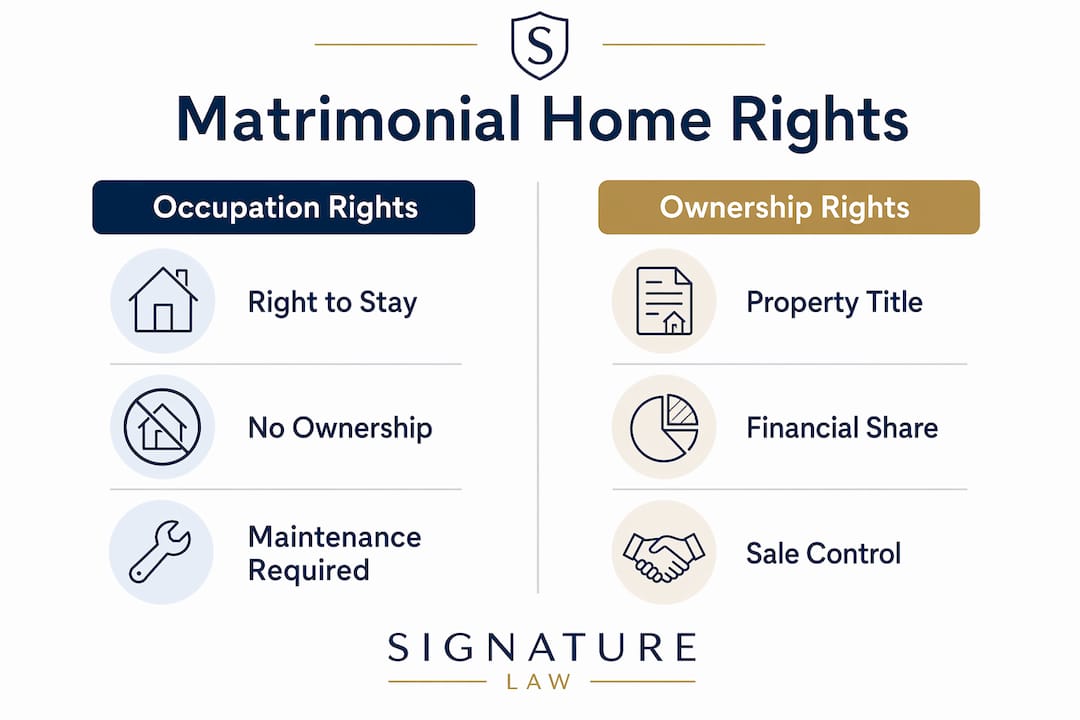
The table below sets out the key differences between occupation rights and ownership rights in the context of the matrimonial home.
| Aspect | Occupation rights (home rights) | Ownership rights |
|---|---|---|
| Who holds them | Non-owning spouse or civil partner | Person named on title deeds or mortgage |
| Legal basis | Family Law Act 1996 | Land Registration Act 2002, trust law |
| How they are protected | HR1 notice at HM Land Registry | Registered title or overriding interest |
| Duration | During marriage or civil partnership (extendable by court) | Indefinite unless transferred or sold |
| Effect on sale | Buyer takes subject to registered notice | Owner controls sale subject to court orders |
| Financial value | No direct equity share | Reflects equity in the property |
The financial division of the matrimonial home in divorce falls under a separate set of proceedings. Courts consider factors including the length of the marriage, the needs of any children, and each party’s financial contribution when deciding how to divide the property. The asset division in UK divorce settlements process is distinct from the question of who has the right to live there during proceedings.
A common scenario illustrates this clearly. Suppose one spouse purchased the family home before the marriage and holds the sole legal title. The other spouse has never been named on the mortgage. During the marriage, both spouses occupy the home as their family residence. On separation, the non-owning spouse has home rights under the Family Law Act 1996 and can register those rights to prevent a sale. However, whether that spouse receives a share of the equity depends on financial remedy proceedings, not on the existence of home rights alone.
The matrimonial home is also treated differently from other assets in financial proceedings. Courts generally prioritise the housing needs of any children, which can result in one spouse remaining in the property for a defined period even where the other holds a greater ownership share. Understanding this distinction between occupation and ownership is the foundation of any sensible approach to property division in UK divorce.
Key takeaways
The matrimonial home is defined by occupation as the family residence, and legal protection under the Family Law Act 1996 centres on the right to occupy rather than the right to own.
| Point | Details |
|---|---|
| Definition centres on occupation | The matrimonial home is the property occupied as the family residence, regardless of who holds legal title. |
| Home rights protect non-owners | A spouse not named on the deeds can still remain in the home and cannot be evicted without a court order. |
| Registration is essential | Filing an HR1 notice at HM Land Registry protects your occupation rights against buyers and lenders. |
| Rights end with the marriage | Home rights cease on divorce or dissolution unless a court order extends them under the Family Law Act 1996. |
| Ownership requires separate proceedings | Home rights do not grant an equity share; financial remedy proceedings determine how the property is divided. |
Why timing and registration are the two things most people get wrong
Having advised on family law matters for many years, the pattern I see most often is this: people know they have rights, but they do not act on them quickly enough. By the time a client comes to us, the owning spouse has sometimes already placed the property on the market or remortgaged it. At that point, the options narrow considerably.
The second misconception I encounter regularly is the belief that living in the matrimonial home automatically means you own part of it. That is not how the law works. Matrimonial home law focuses primarily on occupation rights rather than ownership, and conflating the two leads people to make poor decisions about whether to pursue financial remedy proceedings.
What I find most striking about the Family Law Act 1996 framework is how well it protects vulnerable spouses when used correctly. The HR1 registration process is free, relatively quick, and creates a genuine legal barrier against a rushed sale. Yet many people going through separation never take that step because they simply do not know it exists.
My honest view is that the matrimonial home is the single most contested asset in most divorces, not because the law is unclear, but because emotions run high and people delay taking advice. The law gives you tools. The question is whether you use them before the window closes. Seeking specialist legal advice at the earliest opportunity is not just sensible. It is often the difference between protecting your home and losing your position entirely.
— George
How Signaturelaw supports you with matrimonial home and family law matters
Signaturelaw is a specialist family law firm founded by solicitor Sital Somaiya, who has over 15 years’ experience and has been featured on BBC and ITV. The firm advises clients across the UK on matrimonial home rights, occupation orders, financial settlements, and family law solicitors London matters. Whether you need to register home rights urgently, apply for an occupation order, or understand your position in financial remedy proceedings, Signaturelaw provides clear, personal advice without the factory firm approach. Legal Aid is available for eligible clients. Fixed-fee initial consultations are offered so you know exactly where you stand from the outset. To speak to a family law solicitor, contact Signaturelaw today.
FAQ
What is a matrimonial home in UK law?
A matrimonial home is the property occupied as the family residence by married spouses or civil partners. Under the LexisNexis legal glossary, the key criterion is ordinary occupation at the time of separation, not legal ownership.
Can I stay in the matrimonial home if I am not on the mortgage?
Yes. Home rights under the Family Law Act 1996 entitle a non-owning spouse or civil partner to remain in the family home and prevent eviction without a court order.
How do I register my matrimonial home rights?
Submit form HR1 to HM Land Registry to register a notice of home rights on the property title. This is free of charge and protects your occupation rights against potential buyers and lenders.
Do matrimonial home rights give me a share of the property?
No. Home rights protect your right to occupy the property but do not grant an ownership share. A financial share of the equity requires separate financial remedy proceedings during divorce.
What happens to matrimonial home rights after divorce?
Home rights end when the final divorce order is granted. However, under section 33(5) of the Family Law Act 1996, a court can extend occupation rights beyond the end of the marriage to protect a vulnerable spouse.
Recommended
- Property division in UK divorce: fair outcomes explained | Signature Law
- Types of assets in divorce: what UK settlements cover | Signature Law
- Commercial property in UK divorce: Step-by-step guide | Signature Law
- Landlord’s role in divorce: Rights for UK tenants | Signature Law