





Family Law
Probate vs Wills: Why Clarity Matters in the UK

Every family deserves certainty about their future, yet sorting out what happens to your home and savings after death can feel confusing. If you do not have a will, the law decides who inherits—often leaving unmarried partners vulnerable and causing hardship for those you care about most. A will is your voice, ensuring your loved ones are protected and your wishes respected. This guide breaks down what a will truly achieves, why proper planning matters, and how to avoid costly legal pitfalls.
Table of Contents
- What Is a Will and What Does It Do?
- Probate Explained: The Legal Process
- Key Differences Between Wills and Probate
- Common Myths and Mistakes to Avoid
- Legal Implications for UK Families
Key Takeaways
| Point | Details |
|---|---|
| Importance of a Will | A will ensures your assets are distributed according to your wishes rather than strict intestacy laws. |
| Role of Probate | Probate is necessary to legally validate a will and manage the deceased’s estate, ensuring proper asset distribution. |
| Consequences of Not Having a Will | Without a will, unmarried partners have no inheritance rights, and intestacy rules may lead to outcomes that contradict your intentions. |
| Need for Professional Guidance | Complex estates may require professional legal advice to prevent costly mistakes and ensure all aspects are correctly addressed. |
What Is a Will and What Does It Do?
A will is a legal document that sets out your wishes for what happens to your money, property, and possessions after you die. Without one, the law decides who inherits—and that may not align with your actual intentions.
Think of a will as your voice speaking after you’re gone. It lets you control who gets what, rather than leaving those decisions to intestacy rules (the legal defaults). For most people, this control matters deeply.
Why a Will Matters
Here’s what a will accomplishes:
- Protects your family: You decide who inherits your estate, not the government
- Arranges guardianship: You can nominate guardians for your children
- Reduces inheritance tax: Strategic wills can help minimise the tax burden on your beneficiaries
- Avoids disputes: A clear will prevents family conflict and legal challenges
- Names an executor: You choose who manages your estate, ensuring someone you trust handles it
Without a will, unmarried partners receive nothing under UK law—even if you’ve been together for decades. Married couples and children have some protection, but the distribution follows rigid rules that may not reflect your wishes.
The Legal Importance
Making a will is important for ensuring your money, property, and possessions go to the people you choose. A valid will must meet specific legal requirements: it must be in writing, signed by you, witnessed by two independent witnesses, and made when you have mental capacity.
If your will doesn’t meet these requirements, it’s invalid. Your estate then goes through intestacy, which can cost more, take longer, and cause family tension.
DIY vs Professional Help
You can write a straightforward will yourself using standard templates. However, professional legal advice is worth considering if your situation involves:
- Multiple properties or significant assets
- Business interests
- Blended families or complex relationships
- Minor children needing guardianship arrangements
- Inheritance tax planning concerns
Even small mistakes in a homemade will can invalidate it or trigger costly disputes. A solicitor catches these problems upfront.
A professionally drafted will costs significantly less than the legal fees and family conflict caused by an invalid or ambiguous document.
Pro tip: Review your will every 3–5 years or after major life changes (marriage, children, property purchase, divorce) to keep it current and legally sound.
Probate Explained: The Legal Process
Probate is the legal process that gives an executor or administrator authority to deal with a deceased person’s estate. This includes their property, money, and possessions. Without probate, you cannot legally access or distribute these assets.

The process sounds formal because it is. You’re essentially proving to the court that a will is valid (or that intestacy rules apply) before you can touch anything. This protection exists to safeguard beneficiaries and creditors.
What Probate Actually Involves
Applying for probate gives you legal authority to handle the deceased’s affairs. The main steps include:
- Obtain a grant: You apply for a grant of probate (with a will) or letters of administration (without one)
- Value the estate: Calculate the total worth of all assets
- Pay debts and taxes: Settle inheritance tax, funeral costs, and outstanding bills
- Distribute assets: Hand over what remains to beneficiaries according to the will or intestacy rules
The entire process typically takes weeks to several months, depending on complexity and how quickly institutions respond.
When You Actually Need Probate
Not every estate requires probate. If assets pass automatically to surviving joint owners—like a joint bank account or property held “joint tenants”—probate isn’t needed for those specific assets.
However, probate is essential if the estate includes significant assets solely in the deceased’s name. Banks, building societies, and property registries won’t release funds or transfer ownership without it.
The Authority It Provides
Probate gives you the legal right to act. Without it, you’re simply a grieving family member with no official standing.
Some institutions will release small amounts without formal probate (under £5,000, depending on their rules), but this is discretionary. Once you have the grant, organisations cannot refuse you access.
Why This Matters Now
Understanding probate early helps you prepare. If you’re dealing with an estate, starting the application promptly prevents delays. If you’re writing your will, understanding how your executor will need to work through probate shapes clearer decisions about asset structure and beneficiary arrangements.
Pro tip: Keep a detailed inventory of all assets (bank accounts, property deeds, insurance policies) and store it somewhere your executor can find it—this dramatically speeds up the probate process.
Key Differences Between Wills and Probate
Wills and probate are often confused because they’re linked—but they’re fundamentally different. A will is a document you create during your lifetime. Probate is a legal process that happens after you die.
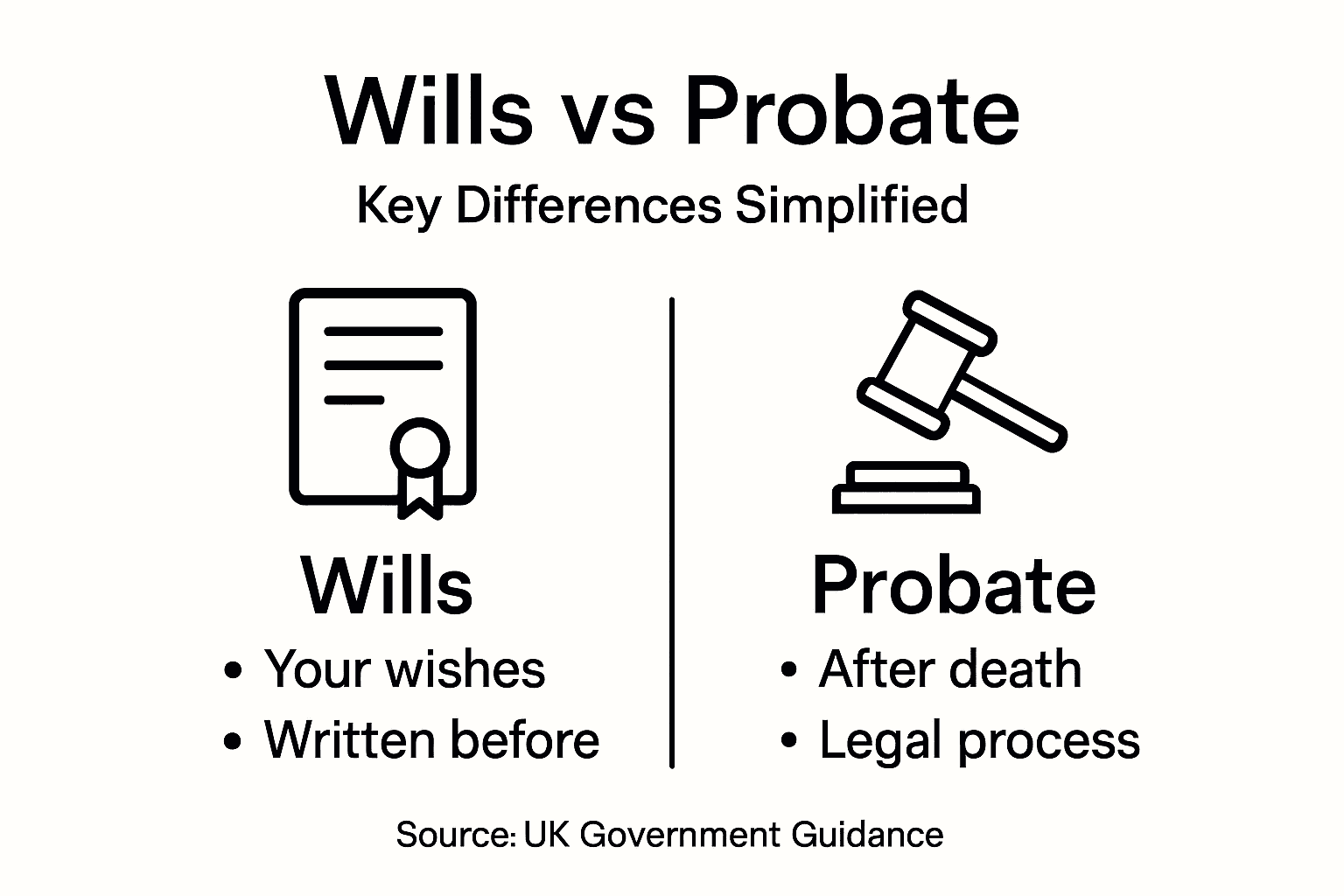
Think of it this way: your will is your instruction manual. Probate is the court’s way of executing those instructions. One without the other creates problems.
Timing: When They Happen
A will exists while you’re alive. You write it, sign it, store it safely. It only becomes relevant after you die.
Probate kicks in after death. The executor applies for legal authority to act on the will’s instructions. This can take weeks or months.
Purpose: What Each Does
Your will sets out:
- Who inherits your assets
- Who guardians your children
- Who manages your estate (the executor)
- How you want specific items distributed
Probate’s job is different. It:
- Proves the will is valid
- Gives executors legal authority
- Settles debts and taxes
- Transfers assets to beneficiaries
Control: Who Has Power
While you’re alive, you control your will. You can change it, rewrite it, destroy it entirely. Only you decide what happens to your estate.
After death, the executor controls the process through probate. The court oversees them to ensure they follow your will and the law.
Cost and Complexity
Writing a will costs very little—sometimes nothing if you use a template. Probate costs significantly more. Understanding probate costs helps you plan for the financial burden your family will face.
A complicated estate can make probate lengthy and expensive. A clear will makes probate straightforward.
To clarify the differences between wills and probate, see the comparison below:
| Aspect | Will (UK Context) | Probate (UK Context) |
|---|---|---|
| When It Applies | During lifetime and after death | Only after death |
| Main Purpose | Outlines asset distribution wishes | Grants legal authority to execute |
| Who Initiates | The individual making the will | Executor or administrator |
| Legal Effect | Sets instructions for estate | Enables asset transfer |
| Can Be Amended By | Testator (while alive) | Court oversight |
The Real Risk
A will without proper probate planning is incomplete. A will written carelessly can trigger expensive probate disputes.
If your will is ambiguous or doesn’t follow legal rules, probate becomes contentious. Beneficiaries argue. Costs spiral. Your executor gets stuck managing conflict instead of distributing your estate.
Pro tip: When writing your will, ask a solicitor to review it for potential probate complications—a small investment upfront prevents thousands in legal fees later.
Common Myths and Mistakes to Avoid
People make costly assumptions about wills and probate. These misconceptions delay estates, increase costs, and frustrate families when they’re grieving. Knowing what’s actually true protects your loved ones.
The most dangerous mistakes happen because people don’t ask for advice. They assume they know the rules, then discover they were wrong after it’s too late to fix things.
Myth 1: You Don’t Need a Will if You’re Married
Wrong. Your spouse doesn’t automatically inherit everything. If you have significant assets or children, intestacy rules can override what your spouse expects.
Your spouse inherits part of your estate. The rest goes to your children, parents, or siblings depending on the value. Without a will, your family follows rigid legal formulas, not your wishes.
Myth 2: Probate Always Requires a Solicitor
Not always true—but it often does. Simple, straightforward estates sometimes proceed without professional help. Complex estates almost always need legal guidance.
Common probate pitfalls include incorrect asset valuations, delayed documentation, and improper tax payments. These errors drain thousands from estates.
Common Mistakes That Cost Money
People regularly make these errors:
- Waiting too long before applying: Delays compound. Interest accumulates. Assets sit frozen.
- Getting asset values wrong: HMRC scrutinises this. Undervaluing creates tax issues. Overvaluing wastes time.
- Forgetting about debts: Mortgages, credit cards, and funeral costs come first. Beneficiaries don’t get paid until debts are settled.
- Not understanding if probate is needed: Some assets pass automatically. Others require the full formal process.
- Writing an ambiguous will: Vague language triggers disputes, legal costs, and years of family conflict.
The Real Cost of Carelessness
A £5,000 mistake in asset valuation can cost £2,000 in unnecessary accountancy fees and tax penalties.
Small errors compound. A will that forgets to mention one asset creates arguments. An executor who doesn’t understand the process delays distribution by months. An unmarried partner with no will receives nothing.
What Actually Matters
Your job is simple: write a clear will, understand whether you need probate, and make sure your executor knows where everything is stored. That’s 80% of the battle.
Pro tip: Have your will reviewed by a solicitor before finalising it—catching one mistake early costs less than managing probate chaos later.
Legal Implications for UK Families
Without clarity on wills and probate, families face serious legal and financial consequences. The law treats different family structures differently—and what you assume will happen often doesn’t.
Your choices today affect what your family can and cannot do after you die. These aren’t theoretical concerns. They’re real legal barriers that cost money, cause conflict, and sometimes leave people with nothing.
The Unmarried Partner Problem
This is the most painful scenario. An unmarried partner—even after decades together—has no automatic inheritance rights under UK law. If you die without a will, they receive nothing.
Your spouse or children inherit instead. Your partner must then challenge the will through expensive legal proceedings, proving they were financially dependent on you. This rarely succeeds and always costs thousands.
Intestacy Rules Override Your Wishes
Inheritance laws in the UK dictate exactly how assets distribute if you die without a will. The order is fixed by law, not by what your family needs.
If you’re married with children, your spouse gets the first £322,000 plus a share of anything above that. The rest goes to your children. If you wanted your spouse to have everything, that doesn’t happen.
Tax Liabilities and Family Disputes
Ambiguous wills create legal battles. When beneficiaries disagree about what you meant, they hire solicitors. Court costs mount rapidly.
Inheritance tax also hits harder without planning. A clear will with proper structuring can minimise tax significantly. A rushed or unclear will might cost your family thousands in unnecessary tax bills.
Complex Assets Need Special Attention
If your estate includes:
- Overseas property
- Business shares or partnerships
- Investment portfolios
- Multiple properties
- Pension schemes with nomination rights
These require careful legal planning. Standard wills don’t address them properly. The tax implications alone justify professional advice.
Children’s Protection and Guardianship
Without a will naming guardians, the court decides who raises your children if both parents die.
The court might not choose who you would have chosen. Your children could end up with relatives you’d never want caring for them. A will lets you decide.
What Happens Without Clarity
Unclear wills lead to:
- Executor confusion and delays
- Beneficiary arguments and litigation
- Unnecessary tax payments
- Assets frozen for months or years
- Family relationships destroyed
- Unmarried partners losing everything
Pro tip: Document your wishes clearly and discuss them with your executor and key family members—transparency now prevents legal chaos and heartbreak later.
Here is a summary of key legal risks UK families face without proper will and probate planning:
| Legal Risk | Possible Outcome | Estimated Cost or Impact |
|---|---|---|
| No will (intestacy) | Assets distributed by fixed legal rules | Unmarried partners inherit £0 |
| Invalid or unclear will | Family disputes, delayed estate release | Thousands in legal fees |
| Poor tax planning | Higher inheritance tax liability | Tax bills up to 40% of estate |
| Missing guardianship clause | Court decides child guardianship | Emotional and financial stress |
Secure Your Family’s Future with Clear Wills and Probate Guidance
Understanding the difference between wills and probate is crucial for protecting your loved ones and avoiding costly delays or disputes. Many families face confusion and stress when an unclear will complicates the probate process. Without clarity, your estate could be tied up for months, beneficiaries may fight, and unmarried partners might unexpectedly receive nothing.
At Signature Law, we specialise in providing compassionate, expert support for wills, probate, and estate planning. We help you create a clear, legally valid will and guide your executor through probate smoothly to reduce stress and protect what matters most. Whether you need assistance with Will Writing, applying for a Grant of Probate, or managing Estate Administration, our team is here to help.
Don’t wait for uncertainty to leave your family vulnerable. Start your estate planning enquiry today and gain peace of mind knowing your wishes will be respected and your loved ones supported every step of the way.
Frequently Asked Questions
What is the difference between a will and probate?
A will is a legal document created during your lifetime that outlines how your assets should be distributed after your death, while probate is the legal process that validates the will and allows the executor to manage and distribute the deceased’s estate according to the will’s instructions.
Why is having a will important?
Having a will ensures that your wishes regarding the distribution of your money, property, and possessions are followed after your death, providing clarity for your loved ones and reducing potential disputes and confusion among beneficiaries.
How can I avoid probate disputes?
To avoid probate disputes, ensure your will is clear, legally valid, and specific about the distribution of your assets. It’s also wise to consult with a solicitor to review the document and avoid ambiguities that could lead to disagreements among beneficiaries.
When is probate necessary?
Probate is necessary when the deceased’s estate includes significant assets that are not jointly owned. It grants the executor legal authority to manage and distribute the estate in accordance with the will or intestacy rules if no will exists.
Recommended
- Probate Costs UK 2026: What Families Must Know | Signature Law
- How to Handle Probate UK: Complete Step-by-Step Guide | Signature Law
- Estate Planning in Divorce – Protecting Your Children | Signature Law
- Estate Administration Explained – Managing Loss in Romford | Signature Law