





Family Law
UK surrogacy law: six week rule, parental orders, solicitor checklist

Surrogacy is legal in the UK, but every surrogacy agreement remains unenforceable in a court of law. The surrogate is the child’s legal mother at birth, whatever the genetics say, which means intended parents must apply for a parental order to become legal parents. Commercial brokering and advertising for surrogacy are criminal offences; only reasonable expenses may change hands.
TL;DR:
- Parental orders must be applied for when the child is at least six weeks old and completed within six months of birth, requiring specific forms and assessments.
- Only reasonable expenses for surrogacy are legal; paying a surrogate a fee or engaging in commercial negotiations are criminal offenses under UK law.
- UK law regards the surrogate as the child’s legal mother at birth, and her consent remains unbinding until a parental order is granted, allowing her to change her mind freely.
- International surrogacy involves higher legal complexity, requiring notarized consent and potential High Court involvement due to recognition issues and foreign legal differences.
- Early preparation of documentation, including proof of genetic link, domicile, and surrogate consent, significantly reduces delays during the parental order application process.
Table of Contents
- What does surrogacy law in the UK actually say?
- How does the parental order process work after birth?
- Who is eligible to apply for a parental order?
- What payments are legal in a UK surrogacy arrangement?
- What extra steps apply to international surrogacy?
- What should you prepare before applying for a parental order?
- What rights does the surrogate keep during and after pregnancy?
- Are surrogacy agencies regulated in the UK?
- What disputes commonly arise in surrogacy arrangements?
- Is UK surrogacy law about to change?
- Do intended parents and surrogates need counselling support?
- Publisher perspective: why early legal advice matters
- How Signature Law supports your surrogacy journey
- Sources
What does surrogacy law in the UK actually say?
UK surrogacy law rests on two pieces of legislation: the Surrogacy Arrangements Act 1985 and the Human Fertilisation and Embryology Act 2008. Neither treats a surrogacy agreement as a contract you can enforce. If a surrogate changes her mind during pregnancy or after birth, no court will force her to hand the child over, and no intended parent can be compelled to take the child either.
That single fact catches a lot of intended parents off guard. You can have a beautifully drafted agreement, months of planning, and a genuine relationship of trust with your surrogate, and none of it carries legal weight if things go wrong. The Surrogacy Arrangements Act 1985 makes this explicit, and it goes further: it criminalises commercial negotiation and advertising for surrogacy arrangements in the UK.
The practical offences to know about:
- Negotiating a surrogacy arrangement for payment, or on a commercial basis
- Advertising that you are seeking a surrogate, or that you are willing to act as one
- Taking a fee (beyond reasonable expenses) for arranging a surrogacy match
Reasonable expenses only, never a fee. Courts have granted parental orders even where payments went beyond a strict expenses list, but that discretion exists precisely because the default rule is strict.
GOV.UK publishes the surrogacy pathway guidance, which sets out the statutory forms and process in detail, and it is worth reading before you make any arrangement, not after.
How does the parental order process work after birth?
A parental order transfers legal parenthood from the surrogate to the intended parents. It is not automatic, and it is not optional if you want full legal recognition, including a birth certificate naming you as parents.
The process follows a fairly predictable sequence:
- Wait for the six-week window. Applications can only be made once the child is at least six weeks old, giving the surrogate time to confirm her decision.
- File the application, normally within six months of birth. GOV.UK’s own guidance confirms this timing, and courts are reluctant to accept late applications without good reason.
- Submit the correct forms. You will need Form C51 to apply for the order, Form C52 to serve notice on other parties, and Form A101A to record the surrogate’s formal consent.
- Cafcass appoints a Parental Order Reporter. This independent officer meets the parties and assesses whether the order is in the child’s welfare interests, mirroring the role Cafcass plays in child arrangement cases.
- Attend the court hearing. Most cases proceed without dispute once the reporter’s assessment is filed.
- Receive the order and a new birth certificate. The child is legally reissued a birth certificate naming the intended parents, and parental responsibility transfers in full.
Timescales vary by court, but reporter allocation and assessment work typically take several weeks, with the full process to a final order commonly taking several months. Build that into your planning early, particularly around childcare, schooling, or travel decisions that depend on legal parenthood being settled.
Who is eligible to apply for a parental order?
Not every intended parent automatically qualifies, and the rules trip people up more often than you’d expect.
- Genetic link: at least one intended parent must be genetically related to the child, usually through egg or sperm used in conception.
- Single applicants allowed since 2019: you no longer need to apply as a couple; a sole intended parent can apply, provided the genetic link condition is met.
- Domicile test: at least one applicant must be domiciled in the UK, the Channel Islands, or the Isle of Man, not merely resident.
- Child must live with you: the court expects the child to already be living with the applicants at the time of the application.
- Age requirement: applicants must be at least 18 years old.
If you cannot meet the genetic link or domicile requirement, a parental order will not be available to you, and adoption may be the more realistic route to legal parenthood instead.
What payments are legal in a UK surrogacy arrangement?
The line between a lawful payment and an illegal one comes down to intention and scale, not the amount alone.
Expenses courts have accepted as reasonable typically include:
- Loss of earnings during pregnancy or recovery
- Travel costs to appointments, clinics, or between homes
- Maternity clothing and related pregnancy costs
- Health insurance or medical costs not covered by the NHS
What tips into illegality is commercial negotiation: paying someone to broker a match, advertising a surrogacy arrangement, or paying a surrogate a fee structured as profit rather than compensation for genuine costs. The Surrogacy Arrangements Act 1985 criminalises exactly this behaviour.
Courts have shown flexibility with overseas commercial payments at the parental order stage, sometimes authorising them retrospectively where the intended parents acted in good faith and can show the payment reflected the child’s welfare rather than exploitation.
Pro Tip: Keep every receipt and a simple dated log of time off work, travel, and related costs from day one. There is no fixed tariff for “reasonable”, so the strength of your paper trail is often what persuades the court.
What extra steps apply to international surrogacy?
International surrogacy adds a layer of complexity that catches many intended parents unprepared. The UK does not automatically recognise a foreign birth certificate or a foreign court order naming you as the legal parents, regardless of what the arrangement said in that country.
That means you still need a UK parental order after bringing the child home, and the evidence bar is higher.
- Notarised or consular-witnessed consent: because the Parental Order Reporter cannot interview an overseas surrogate in person, her consent must be witnessed by a notary public or British consular official, ideally arranged before you travel back.
- High Court involvement: more complex international cases, particularly where consent or parentage is contested, may need to go through the High Court rather than the family court.
- Passport and immigration steps: nationality and travel documents for the child need separate handling, and timing matters if you want to bring the child to the UK promptly.
GOV.UK’s guidance for foreign agencies sets out exactly what UK authorities expect from overseas arrangements, and it is worth sharing with any agency or clinic you work with abroad.
What should you prepare before applying for a parental order?
Most delays in parental order applications come down to missing paperwork rather than legal disputes, so preparation before birth saves real time afterwards.
Gather these documents as early as possible:
- The child’s full birth certificate
- Evidence of the genetic link (clinic or laboratory records)
- Proof of domicile in the UK, Channel Islands, or Isle of Man
- Form A101A recording the surrogate’s consent
- Itemised receipts and a log covering all expenses paid to the surrogate
A few habits make the process smoother:
- Keep a running spreadsheet of every payment, dated and described, rather than reconstructing it later.
- Draft a written surrogacy agreement even though it will not be enforceable. Hospitals and clinics rely on it for clarity during pregnancy and birth.
- Speak to a specialist family solicitor before conception if possible, not after birth. Ask directly: do we meet the genetic link and domicile tests, and what does our expense record need to look like?
What rights does the surrogate keep during and after pregnancy?
The surrogate retains full legal and medical autonomy throughout the pregnancy, whatever the surrogacy agreement says. She makes every decision about her own healthcare, including choices around antenatal care, birth method, and any medical intervention, and intended parents have no legal standing to override those decisions.
At birth, she is automatically the child’s legal mother, and if she is married or in a civil partnership, her spouse or civil partner is treated as the second legal parent unless he or she formally withdraws consent. This remains true even if the intended parents provided the egg and sperm and have no genetic connection to the child themselves.
Crucially, the surrogate can decide to keep the child. It happens rarely, but the law protects her right to change her mind right up until a parental order is granted, precisely because her consent is not binding until then. Her consent to the parental order itself cannot be given until the child is at least six weeks old, giving her time to be certain of her decision away from the pressure of the arrangement.
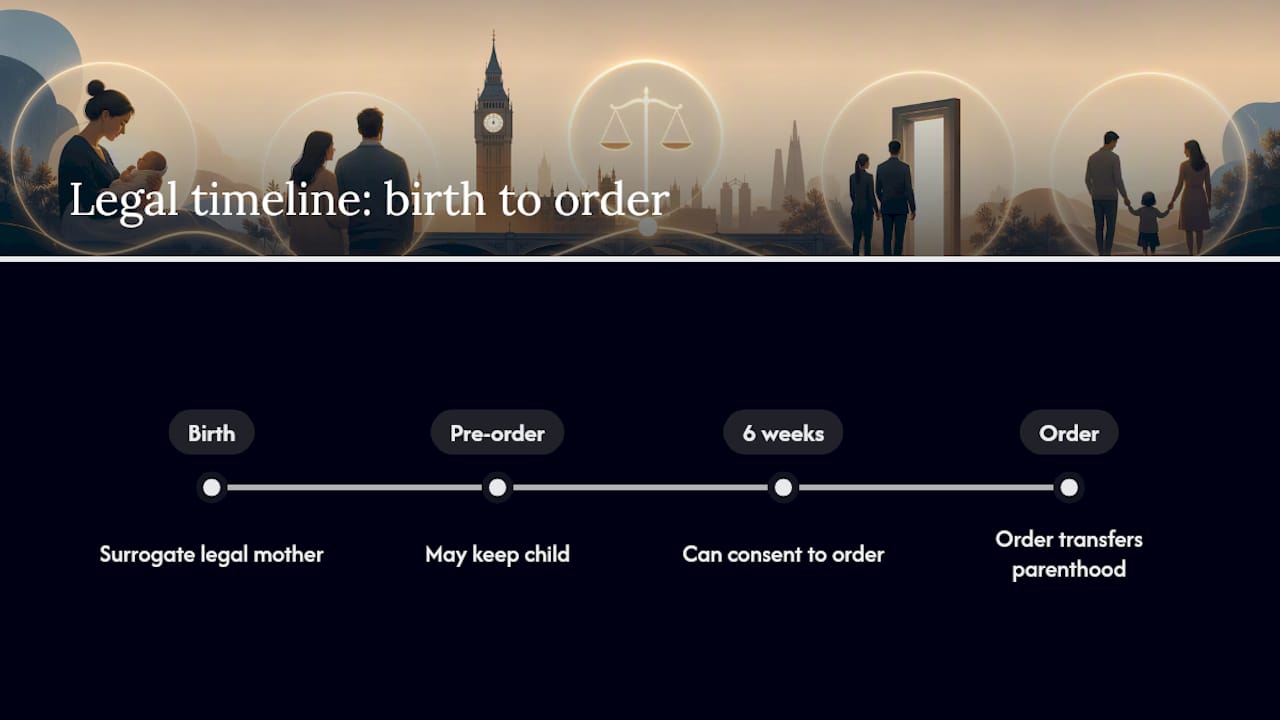
After birth, she has no ongoing financial or caregiving responsibility toward the child once a parental order transfers parenthood, and no automatic right to contact unless the parties agree to one separately. Most surrogacy arrangements include informal understandings about future contact, but these sit outside the legal framework entirely, resting instead on trust between the parties involved.
Are surrogacy agencies regulated in the UK?
Surrogacy agencies operate in a genuinely unusual legal position: they can help match intended parents with surrogates, but they cannot do so for profit. The Surrogacy Arrangements Act 1985 bans commercial brokering, so any UK organisation supporting surrogacy arrangements must operate on a non-profit basis.
A handful of established non-profit organisations have operated in this space for years, offering matching services, peer support, and guidance through the legal process. They are not regulated by a dedicated statutory body in the way solicitors or fertility clinics are, which means the quality and rigour of support can vary considerably between organisations.
Fertility clinics themselves are a different matter. Any clinic carrying out IVF or embryo transfer as part of a surrogacy arrangement must be licensed by the Human Fertilisation and Embryology Authority, and that licensing covers the medical and consent processes involved in treatment, not the surrogacy arrangement itself.
This gap matters practically. An agency can introduce you to a surrogate and offer emotional support through the process, but it cannot draft your legal documents, advise you on parental order eligibility, or represent you in court. Those tasks sit with a solicitor, and intended parents who treat agency involvement as a substitute for independent legal advice often discover the gap too late, usually at the point a parental order application reveals a documentation problem that a solicitor would have caught months earlier.
What disputes commonly arise in surrogacy arrangements?
Most surrogacy arrangements in the UK proceed without serious conflict, but when disputes do arise, they tend to fall into a small number of recurring patterns.
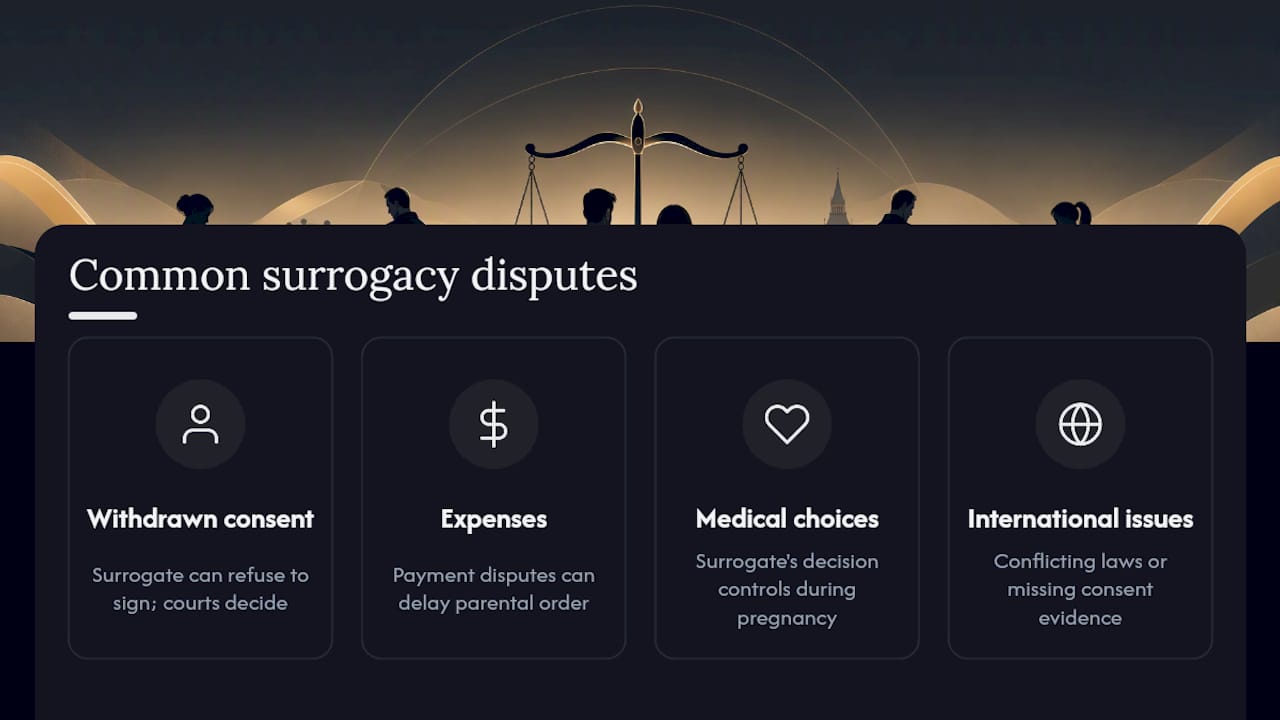
Withdrawn consent is the most serious. Because agreements are unenforceable, a surrogate who decides to keep the child, or who refuses to give consent to the parental order, cannot be legally compelled to hand the child over or to sign. Courts then have to resolve parentage and residence through ordinary family law principles, focused on the child’s welfare rather than the terms of the original arrangement.
Disputes over expenses are more common and usually less dramatic, but they can still derail an application. If intended parents and a surrogate disagree about what was promised or paid, and the paperwork is thin, a court may query the payments during the parental order hearing rather than granting the order smoothly.
Disagreement over medical decisions during pregnancy occasionally surfaces, particularly around screening or intervention choices, and the legal answer is unambiguous: the surrogate’s decisions govern, full stop, because she retains full bodily autonomy throughout.
International complications account for a growing share of contested cases, often involving conflicting laws between the UK and the country of birth, or difficulty obtaining consent evidence from a surrogate abroad.
Where a genuine dispute cannot be resolved between the parties, it goes to the family court, and increasingly, complex international or contested cases are directed to the High Court. Early, honest conversations, backed by clear written records even if they are not legally binding, prevent the majority of these situations from escalating that far.
Is UK surrogacy law about to change?
The Law Commission published a full reform report and draft Bill in March 2023, and it proposes a genuinely significant shift: a new pathway that would make intended parents legal parents from the moment of birth, provided strict safeguards are met, rather than requiring a parental order afterwards.
The proposal also recommends a regulator for surrogacy organisations, clearer rules on payments, and better recognition of international arrangements. It is a sensible piece of work, built on years of consultation, and it addresses several of the practical problems this article has already covered, particularly the awkward gap where a child’s legal parentage sits with the surrogate for weeks or months after birth.
None of it is law yet. Parliament has not scheduled the Bill for debate, let alone enacted it, and there is no fixed timetable for that to change. Intended parents planning a surrogacy arrangement now need to proceed entirely under the existing framework: unenforceable agreements, a legal mother at birth who is not the intended parent, and a parental order process that takes the better part of a year to complete.
Keep an eye on developments if you are planning further ahead, but do not delay a current arrangement in the hope that reform arrives in time to simplify it.
Do intended parents and surrogates need counselling support?
Fertility clinics licensed by the HFEA are required to offer counselling to anyone undergoing licensed treatment as part of a surrogacy arrangement, covering the emotional and psychological implications of the process for both intended parents and surrogates. This is separate from, and in addition to, any legal advice either party takes.
The reasoning behind it is straightforward once you consider what is actually being asked of everyone involved. Surrogates are agreeing to give up legal and emotional claims to a child they will carry and give birth to. Intended parents are handing over control of pregnancy decisions to someone else entirely, often after years of fertility struggles. Both situations carry real psychological weight, and counselling exists to surface concerns before they become problems mid-pregnancy.
Independent, non-clinic-based counselling is also worth considering, particularly for surrogates working outside a formal clinic pathway, or for intended parents navigating an international arrangement where the emotional stakes are compounded by legal uncertainty. Support does not need to be extensive or ongoing, but a handful of structured sessions before conception, and access to support during the parental order wait, tend to make the process considerably less stressful for everyone involved.
Courts and Parental Order Reporters do take note of how well-supported all parties appear to have been, since it feeds directly into their assessment of the child’s welfare and the stability of the arrangement.
Publisher perspective: why early legal advice matters
At Signature Law, we see the same pattern again and again: intended parents get the medical and emotional planning right, then treat the legal side as paperwork to sort out later. Consent timing, expense records, and domicile checks all need attention before conception, not after birth. With fixed-fee consultations and Legal Aid checks for eligible clients, we help intended parents get the parental order process right from the start, including liaison with the court and Cafcass where needed.
— George
How Signature Law supports your surrogacy journey
Unlike a surrogacy agency, which can introduce you to a surrogate but cannot advise on your legal position, Signature Law’s surrogacy solicitors handle the parental order application itself, from checking your eligibility against the genetic link and domicile rules through to preparing Form A101A and liaising with your Cafcass-appointed reporter. We offer fixed-fee initial consultations and check Legal Aid eligibility for family law clients where it applies, so you know your costs before you commit. For international arrangements, we help gather the notarised consent and consular evidence the court will expect, and we represent you at the hearing itself. If you are planning a surrogacy arrangement or already expecting a child through one, get in touch with our family law team to talk through your situation and your next practical step.
This article is general information, not a substitute for advice from a qualified lawyer. Consult a qualified legal professional about your own circumstances before acting on anything here.