





Family Law
Why child arrangements matter for your children’s future

TL;DR:
- Child arrangements determine where a child lives and who they spend time with after separation, prioritizing the child’s welfare. Courts decide these arrangements based on the child’s best interests when parents cannot agree, emphasizing clarity and early legal guidance.
Child arrangements are formal plans that define where a child lives and who they spend time with after their parents separate. Under the Children Act 1989, these plans carry legal weight and place the child’s welfare above all other considerations. The term “custody” no longer appears in UK family law. Instead, the law uses “child arrangements” to reflect a more balanced, child-centred approach. Getting these arrangements right is not simply a legal formality. It directly shapes your child’s emotional security, daily routine, and long-term well-being. If parents cannot agree, a court will decide. That reality alone makes understanding why child arrangements matter one of the most pressing tasks any separating parent faces.
What are the key elements of child arrangements?
Child arrangements cover two core questions: where a child primarily lives, and how much time they spend with each parent. These are sometimes called “lives with” and “spends time with” orders under UK law. UK law emphasises continuity with both parents wherever it is safe and practical to do so.
Several practical factors shape what arrangements look like in reality.
- The child’s age and stage of development. Younger children often need more frequent but shorter contact with the non-resident parent. Teenagers may have stronger views that carry more weight in any decision.
- School location and routine. Arrangements must work around term times, school runs, and extracurricular activities. Disrupting a child’s school life creates unnecessary stress.
- Distance between parents’ homes. Long distances make shared care more difficult and can increase the burden on the child.
- Each parent’s work schedule. Realistic arrangements account for working hours, shift patterns, and childcare availability.
- The child’s own wishes. Courts consider a child’s views in proportion to their age and maturity. An older child’s preference carries genuine weight.
The welfare checklist within the Children Act 1989 guides both parents and courts when assessing what arrangements serve a child best. It covers the child’s physical, emotional, and educational needs, the likely effect of any change in circumstances, and any harm the child has suffered or is at risk of suffering.
Pro Tip: Write down your child’s current weekly routine before any legal discussions begin. A clear picture of school times, activities, and social commitments helps you propose arrangements that are genuinely workable rather than theoretically fair.
Why formal child arrangements reduce conflict and protect well-being
Child arrangements focus on durable routines rather than on parents winning or losing rights. That distinction matters enormously. When parents treat arrangements as a competition, children pay the price.
Parental conflict is the primary source of emotional harm to children after separation. Research is clear on this point. Children exposed to sustained parental conflict show higher rates of anxiety, behavioural difficulties, and problems at school. The arrangement itself matters less than the level of conflict surrounding it.
Formal, written agreements address this directly. Written plans minimise repeated conflict about logistics and routines by removing ambiguity. When both parents know exactly what is agreed, there is less room for misunderstanding and less reason to argue.
Here are the most common mistakes parents make, and why they matter:
- Relying on verbal agreements. Informal verbal agreements often fail because memories fade and circumstances change. Without a written record, disputes escalate quickly and leave children caught in the middle.
- Treating arrangements as permanent from day one. Children’s needs change as they grow. An arrangement that works for a five-year-old will not suit a twelve-year-old. Building in review points prevents future conflict.
- Prioritising parental fairness over the child’s routine. Courts reject this approach consistently. The child’s school commitments, friendships, and emotional stability take precedence over equal time splits.
- Delaying formalisation. Parents often assume goodwill will last. When relationships deteriorate, the absence of a formal agreement leaves everyone vulnerable.
Joint physical custody is linked to fewer socioemotional problems in children compared to sole custody arrangements. This benefit holds even when family structures become more complex through new partnerships. The evidence supports shared care where it is safe and practical.
Pro Tip: Once you have reached an agreement, consider applying for a Consent Order through the court. This converts your agreement into a legally enforceable document without the need for contested proceedings.
How do courts decide child arrangements when parents cannot agree?
When parents cannot reach agreement, the Family Court steps in. The court’s sole focus is the child’s best interests. Courts have no presumption favouring either parent, whether mother or father, and no automatic preference for equal time. Every decision is made on the specific facts of each child’s life.
The court applies two key principles alongside the welfare checklist.
| Principle | What it means in practice |
|---|---|
| The no order principle | A court will only make an order if doing so is better for the child than making no order at all. |
| The delay principle | Delay in resolving arrangements is generally harmful to children, so courts aim to resolve matters promptly. |
| The welfare checklist | The court considers the child’s wishes, physical and emotional needs, likely effect of change, and any risk of harm. |
| Paramount consideration | The child’s welfare is the court’s single overriding concern in every decision. |
The reality of court proceedings is sobering. Court resolution typically takes around 10 months and places significant emotional and financial strain on both parents. That duration is not simply an inconvenience. It means months of uncertainty for your child, during which routines remain unsettled and anxiety can build.
“The money, time, and emotional costs of court battles usually cause long-term damage to co-parenting relationships and should be avoided where possible.” — Advicenow
Court is a last resort, not a first step. Mediation, solicitor-assisted negotiation, and collaborative law all offer routes to agreement that preserve the co-parenting relationship. A damaged co-parenting relationship harms children long after any court order is made. The process of fighting in court often entrenches positions and makes future cooperation harder.
Practical steps for establishing effective child arrangements
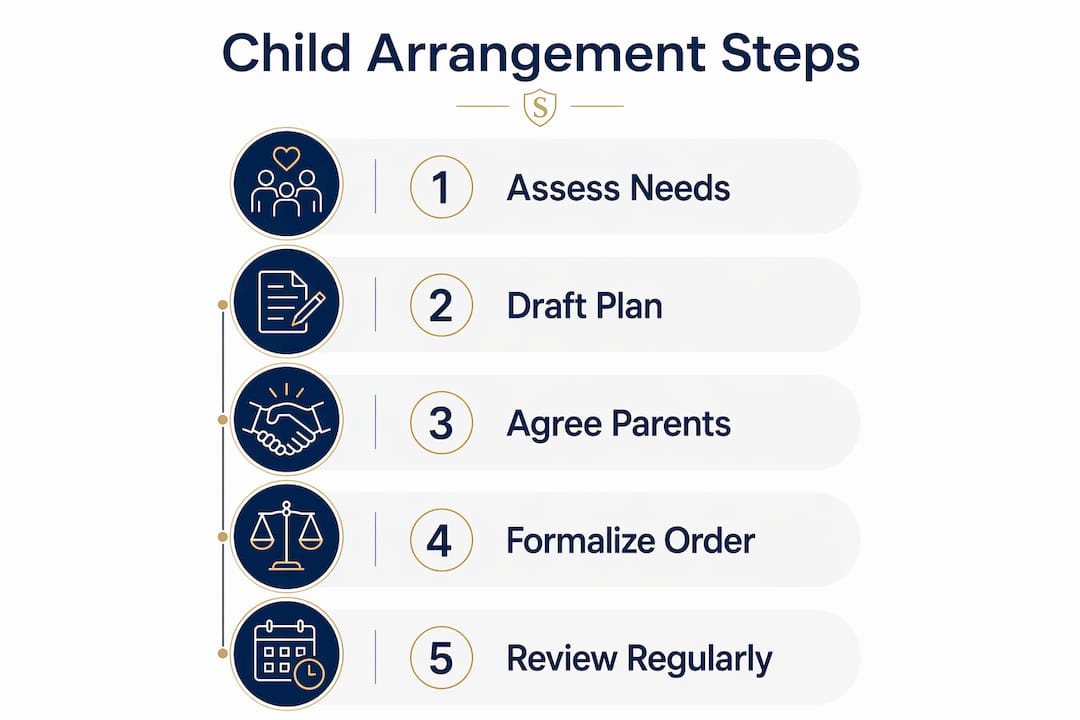
The most effective child arrangements are created early, written down clearly, and built around the child’s life rather than parental preferences. These steps give you the best foundation.
- Start with the child’s routine, not your own. Map out school days, activities, friendships, and medical appointments. Build the arrangement around what already works for your child.
- Communicate in writing where possible. Email or a dedicated co-parenting app creates a clear record and reduces the risk of disputed conversations.
- Build in flexibility with clear boundaries. Life changes. Arrangements that allow for reasonable adjustments, with a clear process for agreeing them, reduce future conflict.
- Keep proximity in mind for shared care. Children who move between two homes benefit when those homes are close enough to maintain friendships and school attendance without excessive travel.
- Use mediation before going to court. A trained mediator helps both parents focus on the child’s needs rather than their own grievances. Mediation is faster, cheaper, and less damaging than contested proceedings.
- Take legal advice early. A family law solicitor can help you understand your position, draft a formal agreement, and apply for a Consent Order if needed.
- Review arrangements as your child grows. Build in annual reviews or agree that either parent can request a review when circumstances change significantly.
The goal is an arrangement that your child barely notices because it simply feels like normal life. Predictability and consistency are what children need most after separation. When arrangements work smoothly, children can focus on being children rather than managing the tension between their parents.

Key takeaways
Child arrangements are the single most important decision separating parents make, because they directly determine a child’s daily security, emotional health, and long-term stability.
| Point | Details |
|---|---|
| Formal agreements prevent conflict | Written child arrangements remove ambiguity and reduce repeated disputes about routines and logistics. |
| Joint care benefits children | Research links joint physical custody to fewer socioemotional problems, even in complex family situations. |
| Courts focus solely on the child | No presumption favours either parent; the welfare checklist and the child’s best interests guide every decision. |
| Court is a last resort | Proceedings take around 10 months on average and can damage co-parenting relationships long term. |
| Early legal advice protects everyone | Formalising arrangements early, with solicitor support, gives children security and parents legal clarity. |
What I have seen working with families through separation
After years of working alongside families navigating separation, one pattern stands out above all others. The parents who protect their children most effectively are not the ones who fight hardest for their own position. They are the ones who step back earliest and ask: what does my child actually need right now?
That sounds straightforward. In practice, it is one of the hardest things a parent can do when they are hurt, frightened, and uncertain about their own future. Separation is genuinely painful. The instinct to protect yourself is natural. But children read the atmosphere in a room. They absorb parental anxiety and conflict even when adults believe they are hiding it well.
The families I have seen struggle most are those who delay formalising arrangements, assuming goodwill will hold. It often does not. When circumstances change or relationships deteriorate further, the absence of a clear written agreement leaves children exposed to months of instability while parents argue over what was originally agreed.
The families who fare best act early. They take legal advice before positions harden. They use mediation to reach agreements they can both live with. They put the child’s school routine and friendships at the centre of every decision. And they accept that an arrangement does not need to feel perfectly fair to both parents. It needs to feel normal and safe to the child.
Good child arrangements do not erase the pain of separation. They do something more practical. They give your child a stable platform to grow from, regardless of what has changed at home. That is worth every effort it takes to get right.
— George
Signaturelaw is here to help you get this right
Separating parents face enough uncertainty without navigating child arrangements alone. Signaturelaw specialises in family law across the UK, with particular expertise in child arrangements, Consent Orders, and Child Arrangement Orders. The firm’s solicitors provide clear, practical advice tailored to your child’s specific circumstances, not a one-size-fits-all approach. Legal Aid is available for eligible clients, and fixed-fee initial consultations mean you can get expert guidance without financial uncertainty. Whether you are at the very start of the process or facing a dispute over existing arrangements, Signaturelaw offers the support you need to protect your child’s future. Contact Signaturelaw today to speak with a family law solicitor.
FAQ
What is a child arrangement order in the UK?
A Child Arrangement Order is a court order that sets out where a child lives and who they spend time with. It replaces the old terms “residence order” and “contact order” under the Children Act 1989.
Do courts favour mothers over fathers in child arrangement decisions?
Courts have no presumption favouring either parent. Every decision is based solely on the child’s welfare and the specific circumstances of that child’s life.
How long does it take to resolve child arrangements through court?
Court proceedings typically take around 10 months to resolve. This is one of the strongest reasons to reach agreement outside court through mediation or solicitor-assisted negotiation.
Are verbal agreements about child arrangements legally binding?
Verbal agreements are not legally enforceable. Informal agreements often break down when memories differ or circumstances change. A written Consent Order approved by the court provides legal protection for both parents and the child.
What should I do if my child arrangement order is not being followed?
If the other parent is not complying with a court order, you can apply to the court for enforcement. Speaking to a child arrangement solicitor at the earliest opportunity gives you the clearest picture of your options.
Recommended
- Child Arrangement Solicitors | Signature Law
- Estate Planning in Divorce – Protecting Your Children | Signature Law
- Inheritance planning for divorce and separation UK | Signature Law
- 7 Types of Family Law Agreements Every Parent Should Know | Signature Law