





Family Law
Conveyancing solicitor’s role in divorce property splits

Separating from a partner is rarely straightforward, and when property is involved, the stakes rise considerably. Many people assume that dividing a jointly owned home is simply a matter of reaching an agreement and signing a few forms. In reality, the legal process is far more involved, and the risks of getting it wrong can be financially devastating. A conveyancing solicitor plays a central, regulated role in ensuring that property transfers during divorce are handled correctly, protecting your interests at every stage. This guide explains exactly what that role looks like and why it matters so much.
Table of Contents
- What is a conveyancing solicitor and when do you need one?
- The conveyancing process in a divorce: step by step
- Key duties and protections offered by your solicitor
- Conveyancing solicitor vs. other professionals: who does what?
- Managing emotional stress and communication during property transfer
- Why expert conveyancing support makes all the difference
- Get clear, expert support for your property and divorce needs
- Frequently asked questions
Key Takeaways
| Point | Details |
|---|---|
| Conveyancer role is vital | A qualified solicitor protects your property rights and prevents costly legal mistakes during divorce. |
| Process has clear steps | The conveyancing process for divorce follows defined legal stages to ensure a valid property transfer. |
| Safeguards for both parties | Solicitors provide checks and fair negotiation to safeguard the interests of all parties involved. |
| Expert help reduces stress | Having a solicitor manage the process eases emotional strain and helps avoid communication breakdowns. |
What is a conveyancing solicitor and when do you need one?
A conveyancing solicitor is a qualified legal professional who manages the transfer of property ownership from one party to another. Their work is regulated by the Solicitors Regulation Authority, which means they are bound by strict professional standards and obligations to their clients. In the context of divorce or separation, their involvement is not optional. As confirmed by the solicitor’s role in divorce property transactions, a conveyancing solicitor is legally required to manage property sales in the UK.
During a divorce, there are several situations where you will need a conveyancing solicitor:
- Selling the matrimonial home and dividing the proceeds between both parties
- Transfer of equity, where one spouse buys out the other’s share and takes sole ownership
- Removing a name from a mortgage, which requires lender consent and legal documentation
- Transferring ownership as part of a court-ordered financial settlement
- Dealing with leasehold properties, which carry additional legal obligations
“Attempting to transfer property without proper legal representation during divorce is one of the most common and costly mistakes we see. The paperwork alone is complex, but the legal risks are far greater.”
If you proceed without a solicitor, you risk invalid transfers, unresolved mortgage liabilities, and disputes that can resurface years later. Our property and divorce guidance sets out clearly why professional support is essential from the outset.
The conveyancing process in a divorce: step by step
Once you understand when a conveyancing solicitor is needed, it is useful to see how the process unfolds during a divorce. The steps broadly follow those of a standard property transaction, but with additional layers of complexity because of the emotional and legal context involved.
- Instruction — You formally instruct your solicitor, who takes your details, confirms the nature of the transaction, and carries out identity checks.
- Title and ownership checks — The solicitor reviews the Land Registry title to confirm ownership, any charges on the property, and whether there are restrictions on transfer.
- Mortgage lender liaison — If there is an existing mortgage, the solicitor contacts the lender to obtain consent for transfer or to arrange redemption.
- Drafting legal documents — Key documents include the TR1 form (the standard transfer deed), DS1 (mortgage discharge), and any supplementary agreements required by the financial settlement.
- Exchange and completion — Once all parties are satisfied, contracts are exchanged and the transfer is completed. The Land Registry is updated to reflect the new ownership.
As our legal insights on conveyancing process confirm, conveyancing solicitors oversee key legal steps from contract to completion, ensuring nothing is missed.
| Stage | Key document | Solicitor’s responsibility |
|---|---|---|
| Ownership checks | Land Registry title | Verify ownership and charges |
| Mortgage liaison | Mortgage offer or redemption | Obtain lender consent |
| Transfer | TR1 form | Draft and execute deed |
| Discharge | DS1 form | Confirm mortgage cleared |
| Registration | HMLR application | Update official records |
Pro Tip: Ask your solicitor to confirm the exact timeline for each stage in writing. Delays in mortgage lender responses are common in divorce cases, and knowing the expected timeframe helps you plan accordingly. Our guidance for a smooth property journey explains what realistic timelines look like.
Key duties and protections offered by your solicitor
Now that you are familiar with the process, it is worth examining how a good conveyancing solicitor actively protects your interests beyond the paperwork.
Their core duties include:
- Due diligence — Checking for outstanding charges, restrictions, or third-party interests registered against the property
- Document drafting — Preparing legally sound transfer documents that accurately reflect the agreed financial settlement
- Negotiation support — Liaising with the other party’s solicitor to resolve disputes over terms, timelines, or conditions
- Financial arrangements — Ensuring proceeds are distributed correctly and any outstanding mortgage is redeemed or transferred
- Land Registry registration — Submitting the completed transfer for official registration, which is the final legal step
Solicitors also provide legal safeguards and expert mediation on disputes, particularly where one party is reluctant to cooperate or where there are concerns about undue pressure being applied.

For vulnerable clients, such as those leaving a controlling relationship, a solicitor can identify clauses in agreements that may be unfair or legally unenforceable. They can also flag situations where a forced sale may not be in your best interest and advise on alternatives.
Pro Tip: Always ask your solicitor to check both the legal title and the mortgage conditions before agreeing to any transfer. Some mortgages include early repayment charges or conditions that can significantly affect the financial outcome. Our team regularly assists clients with navigating property division after divorce and identifying these risks early.
If you are facing a property dispute as part of your separation, specialist guidance on property disputes can help you understand your options before committing to any course of action.
Conveyancing solicitor vs. other professionals: who does what?
Many clients are confused about which professional does what during a divorce. It is a fair question, because several different experts may be involved at the same time.
| Professional | Primary role | Involved in property transfer? |
|---|---|---|
| Conveyancing solicitor | Legal transfer of property ownership | Yes, directly |
| Family law solicitor | Divorce, financial settlements, child arrangements | Advises on terms, not transfer |
| Mediator | Facilitates agreement between parties | No legal authority |
| Estate agent | Markets and sells the property | No legal role |
| Mortgage broker | Advises on new or existing mortgage | Financial only |
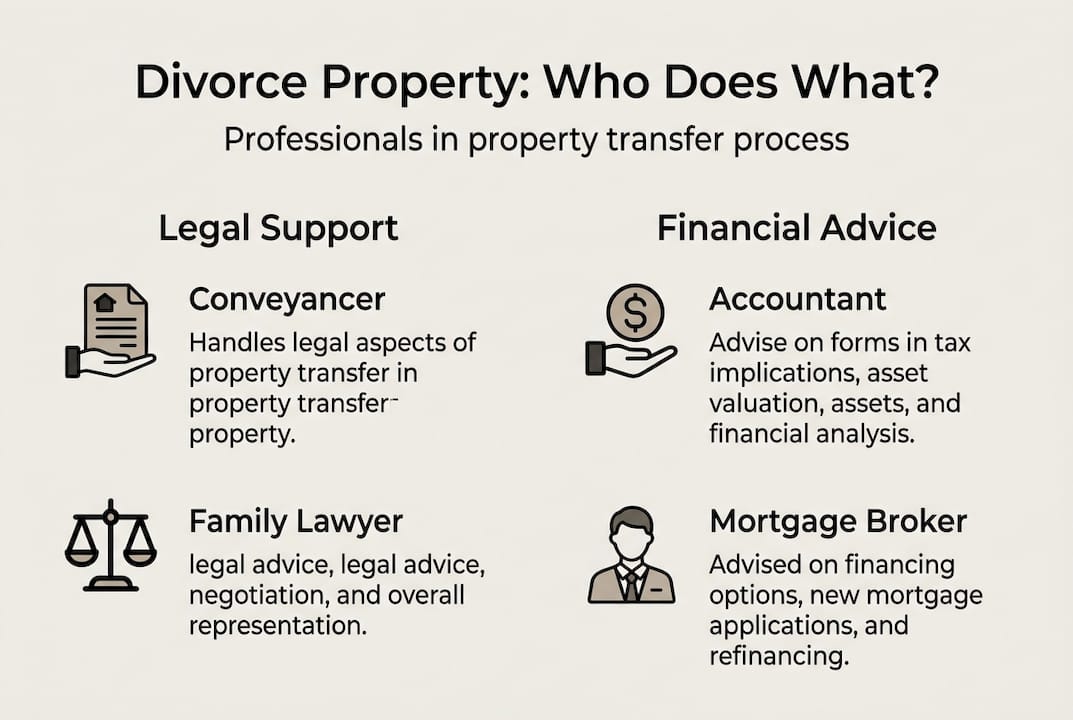
As family solicitor roles confirm, different professionals play distinct roles in divorce property matters, and understanding who does what prevents costly duplication or dangerous gaps.
In many divorce cases, you will need both a family law solicitor and a conveyancing solicitor working in parallel. Your family solicitor negotiates and formalises the financial settlement, including what happens to the property. Your conveyancing solicitor then executes that settlement legally.
Communication between your professionals is critical. If your family solicitor agrees terms that your conveyancing solicitor cannot legally implement, the process stalls. Always ensure both are briefed on the full picture from the start.
- Instruct your conveyancing solicitor as soon as a property decision is likely
- Share all relevant financial settlement documents with both solicitors promptly
- Ask both professionals to liaise directly where possible to avoid miscommunication
Managing emotional stress and communication during property transfer
Beyond legal duties, the emotional realities of divorce can make property transfers genuinely difficult. When communication between separating parties has broken down, even straightforward decisions can become protracted disputes.
One of the most valuable things a conveyancing solicitor does is act as a buffer. Rather than you having to negotiate directly with your ex-partner over timelines, conditions, or financial arrangements, your solicitor handles that communication professionally and without the emotional charge that often derails progress.
“Having a solicitor manage communications during a property transfer can reduce conflict significantly. It keeps the process focused on facts and legal requirements rather than personal grievances.”
As noted in our emotional aspects of property division guidance, solicitors can act as neutral communicators to reduce emotional strain throughout the process.
Effective communication strategies your solicitor can use include:
- Corresponding exclusively in writing to create a clear, documented record
- Setting agreed timelines and holding both parties to them professionally
- Drafting neutral, factual correspondence that avoids inflammatory language
- Escalating unresolved issues to the court only when genuinely necessary
- Signposting clients to counselling or wellbeing services when emotional distress is affecting progress
It is worth remembering that your solicitor’s job is not just to complete a transaction. It is to help you reach a resolution that you can move forward from with confidence and clarity.
Why expert conveyancing support makes all the difference
Having supported many UK families through property transfers during divorce, we have seen first-hand what happens when people attempt to manage this process without specialist legal support. The results are rarely positive.
The most common misconception is that an amicable agreement removes the need for formal legal process. It does not. Even when both parties are cooperative, the legal requirements remain the same. Errors in transfer documentation, missed mortgage conditions, or incomplete Land Registry applications can invalidate an agreement entirely, sometimes years after the fact.
Conveyancing solicitors are, in many ways, the quiet peacekeepers of the divorce process. They absorb complexity, translate legal obligations into plain language, and ensure that what was agreed in principle is actually delivered in practice. Without that expertise, well-intentioned agreements frequently unravel.
We have seen clients return to us after attempting DIY transfers, facing disputes over ownership that could have been avoided entirely. The cost of fixing those mistakes almost always exceeds the cost of getting proper legal support from the outset. Our legal insights from our perspective reflect the patterns we see repeatedly across divorce property cases.
If there is one piece of advice we would offer, it is this: do not underestimate the complexity of what appears to be a simple transfer. The emotional weight of divorce is already significant. Adding avoidable legal risk to that burden is never worth it.
Get clear, expert support for your property and divorce needs
At Signature Law, we understand that divorce is one of the most challenging experiences you can face, and that property decisions carry long-term financial consequences. Our team provides clear, jargon-free advice tailored to your specific situation, whether you are selling the family home, arranging a transfer of equity, or navigating a contested property dispute.
We work closely with our family law team to ensure your conveyancing and financial settlement are fully aligned, reducing delays and protecting your position at every stage. You can explore the broader family law impact in the UK or speak directly with our expert conveyancing solicitors for property-specific guidance. When you are ready to take the next step, speak to a solicitor today for a fixed-fee initial consultation.
Frequently asked questions
Can my ex-partner and I use the same conveyancing solicitor during our divorce?
Generally, both parties must use separate legal representation to avoid conflicts of interest, as a single solicitor cannot act impartially for two parties with potentially competing interests.
How long does divorce conveyancing usually take in the UK?
Divorce-related property transactions typically take 8 to 12 weeks, though this can extend if mortgage lenders are slow to respond or if one party is uncooperative.
Do I need a conveyancing solicitor if we agree on how to split the property?
Yes. Even in amicable splits, a solicitor ensures the legal transfer is valid, properly registered, and that both parties are fully protected under the terms agreed.
What documents will my conveyancing solicitor need from me?
You will typically need to provide proof of identity, evidence of ownership, mortgage account details, and a copy of your financial settlement agreement as confirmed by the court or your family solicitor.
Recommended
- Solicitor’s role in divorce property transactions UK 2026 | Signature Law
- Property division in UK divorce: fair outcomes explained | Signature Law
- Benefits of using a probate solicitor during divorce | Signature Law
- Property and Divorce | Signature Law