





Family Law
What is a grant of probate? Key steps for UK executors

When someone passes away and leaves a will, you might assume probate is always necessary. It’s not. A Grant of Probate is a legal document issued by the Probate Registry that confirms your authority as executor to manage and distribute the deceased’s estate. Not every estate requires it. Small estates or jointly held assets often bypass probate entirely. This guide explains what a Grant of Probate is, when you need one, how to apply, typical timeframes, costs, and whether you should handle it yourself or instruct a solicitor.
Table of Contents
- Understanding the grant of probate
- When is a grant of probate required?
- The probate process: steps to obtain a grant
- How long does probate take and what does it cost?
- Potential challenges: disputes, caveats, and will problems
- DIY probate vs using a solicitor: pros and cons
- Navigating probate with confidence and support
- Frequently asked questions
Key Takeaways
| Point | Details |
|---|---|
| Essential legal document | A Grant of Probate confirms your authority to manage and distribute an estate with a valid will. |
| Not always required | Small estates or jointly held assets may bypass the need for probate depending on circumstances. |
| Clear application steps | Gather documents, report assets, pay any inheritance tax, then apply either online or by post for quicker results. |
| Seek help if unsure | DIY can work for simple cases, but complex or disputed estates should use professional guidance to avoid risks. |
Understanding the grant of probate
A Grant of Probate is your legal proof that you can act on behalf of the deceased. Without it, banks, property registries, and other institutions won’t release assets or allow transfers.
The Probate Registry in England and Wales issues the grant. It certifies that the will is valid and that you, as the named executor, have the authority to administer the estate. If there’s no will, a different document called Letters of Administration is required instead.
Who applies for probate?
- Executors named in the will
- If no executor is available, beneficiaries can apply for Letters of Administration with Will Annexed
- If there’s no will at all, the next of kin applies under intestacy rules
Many people assume probate is automatic. It’s not. You must apply for it, and in some cases, you don’t need it at all. Understanding the difference between probate and wills helps clarify your responsibilities.
“A Grant of Probate confirms the executor’s authority to administer the deceased’s estate when there is a valid will.”
The grant itself is a single-page document, but obtaining it involves valuing the estate, reporting to HMRC, and submitting formal applications. It’s a legal gateway, not just a formality.
When is a grant of probate required?
You don’t always need probate. Whether you do depends on the size and type of assets in the estate.
Probate is typically required when:
- The deceased owned property in their sole name
- Bank accounts or investments exceed the institution’s threshold (often £5,000 to £50,000)
- Shares or stocks are held solely by the deceased
- The estate includes significant personal assets like vehicles or valuable collections
Probate may not be needed if:
- The estate value is below the financial threshold set by each bank or institution
- Assets were held jointly and pass automatically to the surviving owner
- The deceased had nominated beneficiaries on accounts or policies
- Everything was held in trust
Small estates may not require probate if total assets fall below £5,000 to £50,000, depending on the institution. Each bank sets its own limit, so you’ll need to check individually.
If there’s no valid will, you’ll need Letters of Administration instead. The process is similar, but executors named in the will have priority. If none are available, beneficiaries or next of kin can apply.
“Not always needed: small estates, joint assets passing automatically, or assets below institutional thresholds may bypass probate entirely.”
If you’re unsure whether probate is necessary, a checklist for probate steps can help you assess your situation.
The probate process: steps to obtain a grant
Applying for probate involves several stages. Here’s the process broken down.
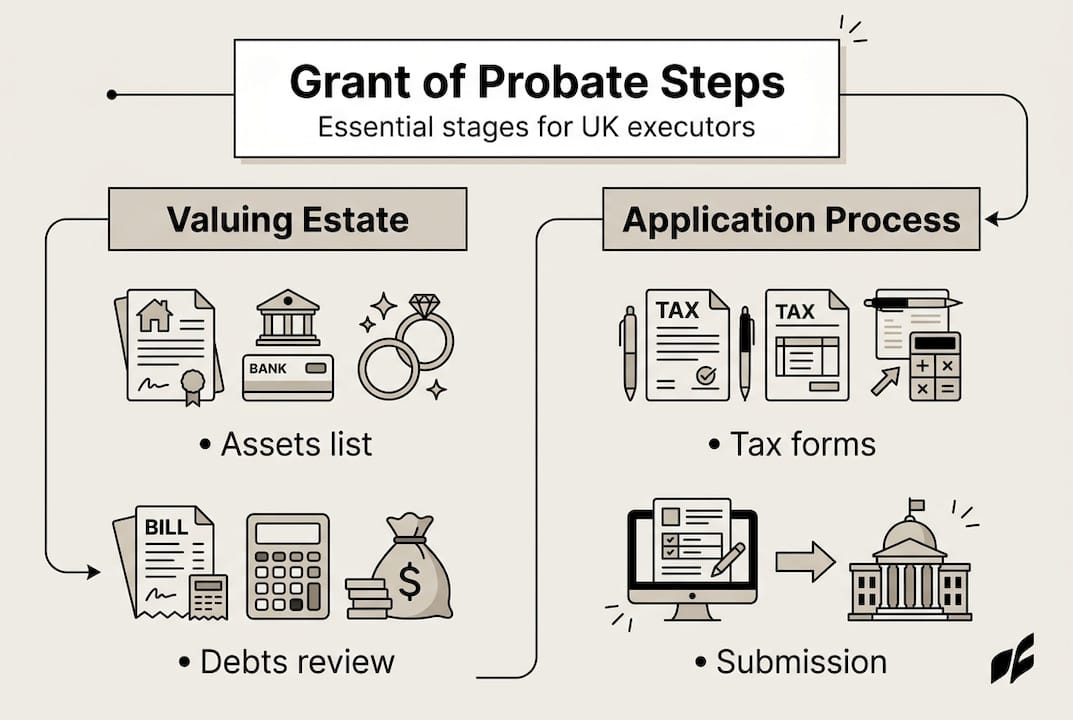
1. Value the estate
List all assets and liabilities. This includes property, bank accounts, investments, pensions, debts, and funeral costs. You’ll need accurate valuations for everything.
2. Report to HMRC
Complete the relevant Inheritance Tax (IHT) forms. For estates under the IHT threshold, you’ll use form IHT205. For larger estates, form IHT400 is required. Pay any tax due before applying for probate.
3. Complete the probate application
Use form PA1P if applying by post, or apply online through the government portal. You’ll need the original will and death certificate.
4. Submit your application
Send your forms, supporting documents, and payment to the Probate Registry. Online applications are faster and reduce delays.
5. Receive the grant
Once approved, the Probate Registry issues the Grant of Probate. You’ll receive the original will back with an official court seal.

| Document | Purpose |
|---|---|
| Original will | Proves testamentary intent |
| Death certificate | Confirms the death |
| Estate valuation | Shows total assets and liabilities |
| IHT forms | Reports inheritance tax position |
| PA1P or online application | Formal request for probate |
The application process requires you to value the estate, report to HMRC, pay tax if due, and submit the PA1P form or apply online with the original will and death certificate.
Pro Tip: Using the digital application reduces processing time significantly. Respond promptly to any queries from the Probate Registry to avoid further delays.
For a detailed breakdown, see our step-by-step probate process guide. If you’re unsure which forms to use, our probate forms explained resource clarifies each requirement.
How long does probate take and what does it cost?
Timeframes and costs vary depending on the complexity of the estate and how you apply.
Typical waiting times:
- Online applications: 4 to 8 weeks
- Postal applications: 8 to 12 weeks
- Full estate administration: 6 to 18 months
Processing time typically takes 4 to 12 weeks for online or postal applications as of 2025 to 2026. Full estate administration can take 6 to 18 months depending on complexity.
In early 2025, the average time to receive a grant was five weeks, with the majority of applications now submitted digitally.
Costs:
- Probate application fee: £300 for estates over £5,000 (free for estates under £5,000)
- Extra copies of the grant: £1.50 each
- Inheritance tax: varies based on estate value
- Solicitor fees: typically 2% to 5% of the estate value if you instruct a professional
| Application method | Speed | Complexity | Risk of error |
|---|---|---|---|
| Online | Faster | Moderate | Lower |
| Postal | Slower | Moderate | Higher |
Common reasons for delay:
- Missing or incomplete forms
- Incorrect valuations
- Queries from HMRC
- Disputes or caveats lodged by family members
- Lost or unclear wills
To understand the full timeline, review our complete probate timeline guide. If you’re managing the process yourself, our navigating workflow resource helps you stay on track.
Potential challenges: disputes, caveats, and will problems
Not every probate case is straightforward. Legal complications can arise, delaying or blocking the grant.
Common challenges:
- Family disputes over the will’s validity or distribution
- Caveats lodged to halt probate while disputes are resolved
- Missing or lost original wills
- Challenges to the deceased’s mental capacity or claims of undue influence
- Creditor claims after the grant is issued
A caveat is a legal notice that prevents probate from being granted. Anyone with an interest in the estate can lodge one, typically to dispute the will or raise concerns about the executor’s conduct.
If the original will is missing, you may need to prove a copy. This involves rebutting the legal presumption that the deceased destroyed the will intentionally.
Edge cases include situations where there’s no original will, requiring proof of a copy and rebuttal of revocation presumption. Caveats can halt probate for disputes, and will contests based on capacity or undue influence can occur before or after the grant.
“Challenges to a will can be raised before or after probate is granted, based on claims of lack of capacity, undue influence, or fraud.”
Pro Tip: After receiving the grant, place a statutory notice in The Gazette and a local newspaper. This protects you from unknown creditor claims by setting a deadline for claims to be made.
If you’re facing complications, our handling probate issues guide provides practical advice. For will disputes, see our resource on challenging a will.
DIY probate vs using a solicitor: pros and cons
You can apply for probate yourself or instruct a solicitor. Each option has benefits and risks.
DIY probate:
- Lower cost (you only pay the £300 application fee and any IHT due)
- Full control over the process
- Suitable for simple estates with no disputes
- Risk of errors, delays, or missed legal obligations
Using a solicitor:
- Professional guidance reduces risk
- Faster resolution of complex issues
- Solicitor fees typically range from 2% to 5% of the estate value
- Essential for estates with disputes, foreign assets, or high value
DIY probate is viable for simple estates to save solicitor fees, which typically range from 2% to 5% of estate value. Use professionals for complexity or disputes.
| Factor | DIY probate | Probate solicitor |
|---|---|---|
| Cost | Low (£300 + IHT) | Higher (2-5% of estate) |
| Speed | Depends on your efficiency | Often faster |
| Risk | Higher if errors occur | Lower with professional oversight |
| Complexity | Suitable for simple estates | Essential for complex estates |
When to use a solicitor:
- The estate includes business interests or foreign assets
- There are disputes among beneficiaries
- The will is unclear or contested
- You’re unfamiliar with legal or tax obligations
- The estate value is high and IHT planning is required
Pro Tip: Even for straightforward estates, a legal review can identify hidden issues before they become costly problems.
If you’re considering professional support, learn about using a probate solicitor and the benefits of legal support during estate administration.
Navigating probate with confidence and support
Obtaining a Grant of Probate is a legal responsibility that requires accuracy, patience, and attention to detail. Whether you’re managing a straightforward estate or facing complications, understanding the process helps you fulfil your duties as executor with confidence.
At Signature Law, we support executors and families through every stage of probate and estate administration. Our Wills & Probate team provides clear, compassionate guidance tailored to your circumstances. From valuing the estate and completing applications to resolving disputes and managing complex assets, we’re here to help you navigate the process with confidence.
If you’re unsure whether probate is required, facing delays, or dealing with contested wills, we can provide the legal support you need. Our fixed-fee consultations give you clarity on your options and next steps without financial uncertainty.
Start your estate planning enquiry today: https://signaturelaw.co.uk/contact-us/
Frequently asked questions
Can you sell a house before obtaining probate?
You can market a property, but contracts can only be exchanged and completion occur after probate is granted.
How many copies of a grant of probate should you order?
Order at least one copy for every major asset holder and for your own records. Extra copies cost £1.50 each.
What happens if there is no will?
Letters of Administration are issued instead following strict legal priority. The grant is called Grant of Letters of Administration.
How do you avoid probate delays?
Use the online application for speed and respond quickly to all queries from the Probate Registry.
Recommended
- How to Handle Probate UK: Complete Step-by-Step Guide | Signature Law
- Navigate the probate application workflow in UK 2026 | Signature Law
- Probate Process Step By Step UK 2026: 92% Online Success | Signature Law
- How to apply for probate: step-by-step UK guide | Signature Law