





Family Law
Navigate the probate application workflow in UK 2026

Handling probate after losing a loved one feels overwhelming. You’re grieving whilst simultaneously managing complex legal responsibilities that may be entirely unfamiliar. The probate application workflow can seem daunting, but understanding each stage transforms this administrative burden into a manageable series of clear steps. This guide walks you through the entire UK probate application process for 2026, offering practical insight to help you fulfil your duties as executor with confidence and clarity during this difficult time.
Table of Contents
- Understanding Probate And When You Need To Apply
- Preparing Your Probate Application Step By Step
- Submitting The Probate Application And What To Expect Next
- After The Grant: Managing The Remaining Probate Workflow Stages
- How Signature Law Can Support Your Probate Journey
Key takeaways
| Point | Details |
|---|---|
| Digital applications accelerate processing | Online probate applications now take 4-6 weeks, with some simple cases completed in 2-4 weeks |
| Most executors succeed independently | 92% of applicants successfully apply digitally without solicitor assistance |
| Common errors cause delays | Submitting wrong inheritance tax forms or undervaluing estates significantly extends processing times |
| Asset thresholds trigger probate | Property in sole ownership requires probate regardless of value, whilst other assets need probate above £5,000-£50,000 |
| Full estate settlement takes months | Complete probate processes typically span 6-24+ months from death to final distribution |
Understanding probate and when you need to apply
Probate is the legal process that confirms your authority as executor to administer someone’s estate after their death. The grant of probate is the official court document proving you have the right to access the deceased’s assets, pay their debts, and distribute what remains to beneficiaries according to the will.
You’ll need probate if the deceased owned property in their sole name, regardless of value, or if they had solely owned assets worth more than £5,000 to £50,000, depending on the institution’s threshold. Banks, building societies, and investment firms each set their own limits for releasing funds without probate. Even modest estates often require this legal authorisation.
Joint assets passing automatically to surviving owners typically avoid probate. Similarly, assets held in trust or with nominated beneficiaries usually transfer without court involvement. However, most executors discover they need probate when they begin contacting financial institutions and property registries.
Before starting your application, gather essential documentation:
- Original death certificate (you’ll need multiple certified copies)
- The original will and any codicils
- Complete asset valuations including property, bank accounts, investments, and personal possessions
- Details of all debts and liabilities
- Inheritance tax reference numbers if applicable
Pro Tip: Avoid submitting the wrong inheritance tax forms to prevent delays. The form you need depends on estate value and complexity. Estates under £325,000 typically use form IHT205, whilst larger or more complex estates require IHT400. Choosing incorrectly adds weeks to your timeline.
Start by creating a detailed probate checklist UK 2026 to track every document and deadline. This organisation prevents overlooked requirements that could stall your application later.
Preparing your probate application step by step
Thorough preparation makes the actual application straightforward. Begin by registering the estate with HMRC for inheritance tax purposes, even if no tax is due. You’ll receive a unique reference number essential for your probate forms.
Follow these preparation steps:
- Value the entire estate accurately, including property, savings, investments, vehicles, and personal belongings
- Identify and document all debts, including mortgages, loans, credit cards, and utility bills
- Calculate the net estate value by subtracting total debts from total assets
- Determine which inheritance tax form you need based on estate size and complexity
- Complete the inheritance tax forms thoroughly, double checking every figure
- Gather original documents: death certificate, will, and supporting valuations
- Complete the probate application form (PA1P if there’s a will, PA1A if not)
The probate application form asks detailed questions about the deceased, the will, executors, and estate value. Answer every question precisely. Incomplete or unclear responses trigger requests for additional information, delaying your grant.
When completing valuations, err on the side of accuracy rather than speed. Submitting incorrect inheritance tax forms or undervaluing the estate are common mistakes that significantly delay the probate process and incur additional costs. HMRC may investigate discrepancies, extending your timeline by months.

| Submission method | Processing time | Cost | Best for |
|---|---|---|---|
| Online application | 2-6 weeks | £273 (£155 for estates under £5,000) | Straightforward estates with digital literacy |
| Paper application | 8-15 weeks | £273 (£155 for estates under £5,000) | Complex estates or preference for physical documents |
Pro Tip: Check valuation carefully to avoid undervaluing estate assets and unexpected delays. Professional valuations for property and specialist items provide defensible figures if HMRC queries your submission. Spending £200-£500 on professional valuations often saves thousands in penalties and months in delays.
Understanding how to handle probate UK processes thoroughly before submitting prevents costly mistakes that extend your administrative burden during an already difficult period.
Submitting the probate application and what to expect next
Once your paperwork is complete, choose your submission method carefully. Online applications offer significant advantages in 2026. Digital submissions now take 4-6 weeks to process, with many simple cases receiving grants within 2-4 weeks when documents are complete. The government’s recent improvements have substantially reduced backlogs.
Paper applications take considerably longer, often requiring 8-15 weeks for processing. Postal delays, manual data entry, and physical document handling all extend timelines. However, complex estates with numerous assets or legal complications sometimes benefit from paper submission’s ability to include extensive supporting documentation.
The success rate for digital applications is remarkable. 92% of applicants successfully apply digitally without solicitor assistance, demonstrating that the online system works well for most executors. The digital platform guides you through each question, reducing errors that delay processing.
After submission, expect these processing stages:
- Acknowledgement of receipt (usually within 1-2 weeks)
- Initial review of forms and supporting documents
- Requests for additional information if needed (this extends your timeline)
- Final review and grant preparation
- Issue of grant of probate
Simple estates with straightforward assets, clear wills, and accurate valuations typically receive grants within the standard timeframe. Complex estates involving business interests, overseas assets, disputed wills, or inheritance tax investigations can extend processing to 16-20 weeks or longer.
Watch for these signs your application needs attention:
- Requests for additional documentation or clarification
- Queries about asset valuations or inheritance tax calculations
- Notices about will validity or executor authority questions
- Delays beyond standard processing times for your submission method
You can track your application status through the online portal if you submitted digitally. Paper applications require telephone follow up with the probate registry. Don’t hesitate to contact the registry if your application exceeds expected processing times, but allow the full standard period before enquiring.
To avoid common submission mistakes:
- Submit complete documentation the first time
- Ensure all forms are signed and dated correctly
- Include all required supporting evidence
- Pay the correct probate fee before submission if using the paper process
- Keep copies of everything you submit
Following the detailed probate process step by step UK 2026 guidance ensures you complete each stage correctly, minimising delays and reducing stress during estate administration.
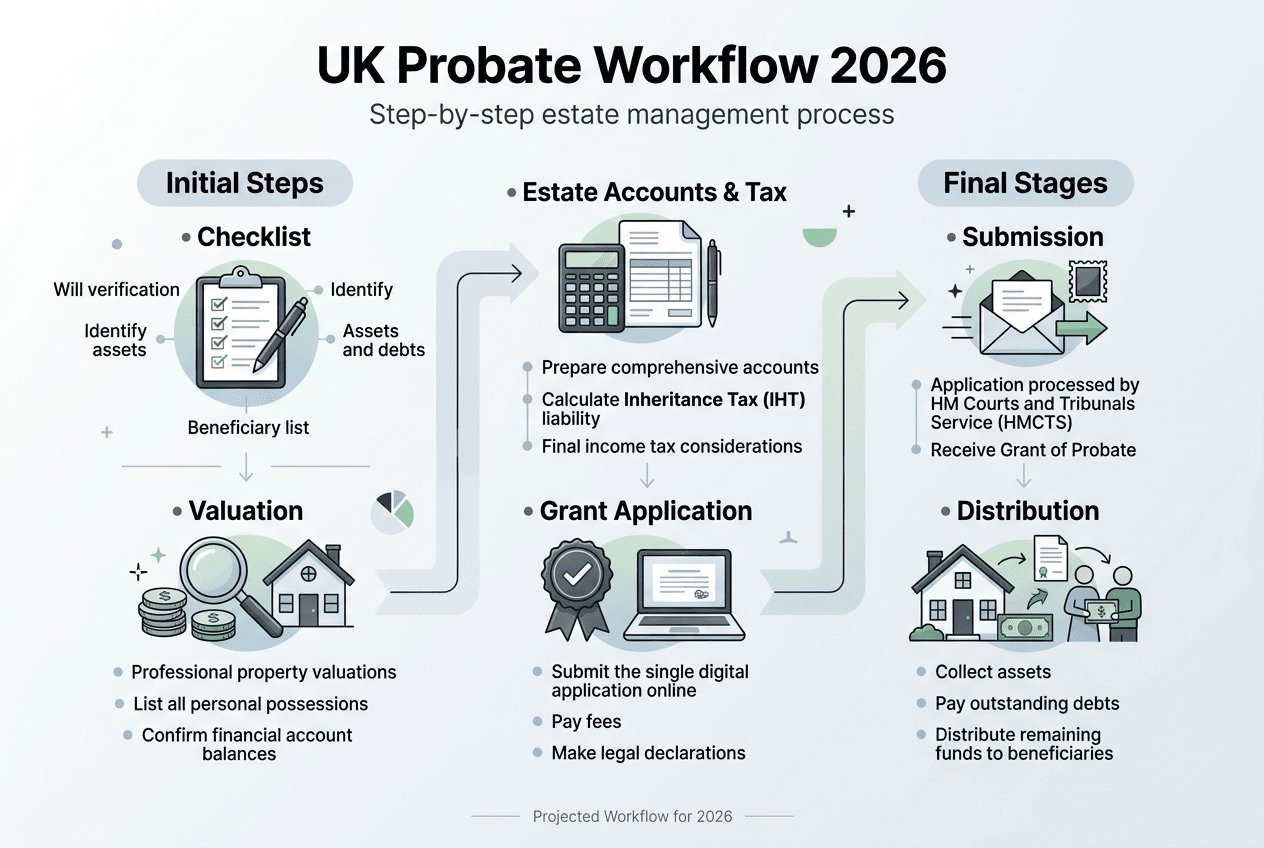
After the grant: managing the remaining probate workflow stages
Receiving the grant of probate marks an important milestone, but it’s just one stage in a longer journey. The grant authorises you to begin administering the estate, not to complete it. Understanding what follows helps you manage beneficiary expectations and plan your timeline realistically.
Your key duties after receiving the grant include:
- Notify all banks, building societies, and financial institutions of the death and provide grant copies
- Close or transfer accounts as appropriate
- Sell property if required by the will or to pay debts
- Pay all outstanding debts and liabilities
- Settle any inheritance tax due
- Prepare estate accounts showing all assets, debts, and distributions
- Distribute assets to beneficiaries according to the will
- Obtain receipts from all beneficiaries confirming distribution
- Finalise tax returns for the estate
- Close the estate formally
Property sales often extend estate administration significantly. Marketing, conveyancing, and completion typically add 3-6 months to your timeline. Investment liquidation, business asset sales, or overseas property disposal can take even longer.
Maintain meticulous records throughout. Document every transaction, communication, and decision. These records protect you if beneficiaries question your administration and provide evidence for tax authorities if required.
Communicate regularly with beneficiaries about progress and expected timelines. Transparency prevents misunderstandings and reduces complaints. Explain that the entire probate process typically takes 6-24+ months depending on complexity, helping beneficiaries understand why distribution isn’t immediate.
Common post grant challenges include:
- Unexpected debts or claims against the estate
- Property sales taking longer than anticipated
- Beneficiary disputes about asset distribution
- Complex tax calculations requiring professional assistance
- Difficulty locating or valuing certain assets
Don’t hesitate to seek professional help when issues arise beyond your expertise. Inheritance tax specialists, estate accountants, and probate solicitors can resolve specific problems whilst you continue managing routine administration.
Set realistic expectations for yourself and beneficiaries. Simple estates with liquid assets and cooperative beneficiaries may close within 6-9 months. Complex estates involving property sales, business interests, or international assets often require 12-24 months or longer.
Understanding the complete UK probate timeline from start to finish helps you plan effectively and communicate realistic expectations to everyone involved in the estate settlement.
How Signature Law can support your probate journey
Navigating probate whilst grieving challenges even the most organised executors. Whilst many estates proceed smoothly using the guidance above, complex situations benefit enormously from professional legal support tailored to your specific circumstances.
Signature Law’s experienced wills and probate solicitors Upminster team understands the emotional and practical challenges executors face. We provide compassionate, clear guidance through every stage of estate administration, from initial probate applications through final distribution.
Our expert probate solicitors in Romford handle complex estates involving business assets, international property, inheritance disputes, and intricate tax planning. We also support executors managing estates alongside other family law UK impact matters, providing coordinated legal support during life’s most challenging transitions.
Whether you need comprehensive estate administration support or guidance on specific probate challenges, Signature Law offers fixed fee consultations to discuss your situation and explore how we can help ease your burden during this difficult time.
FAQ
How long does the probate application take in the UK?
Online probate applications typically take 4-6 weeks to process in 2026, with some straightforward cases receiving grants within 2-4 weeks when all documentation is complete and accurate. Paper applications take considerably longer, often requiring 8-15 weeks for processing. Complex estates involving business interests, overseas assets, or inheritance tax investigations may require 16-20 weeks or more for the grant application alone, before estate administration even begins.
Can I apply for probate without a solicitor?
Yes, 92% of UK probate applicants successfully apply digitally without solicitor assistance. Simple estates with straightforward assets, clear wills, and accurate valuations are excellent candidates for independent probate applications. The online system guides you through each required step, and government resources provide detailed instructions. However, complex or contested estates, significant business interests, overseas assets, or inheritance tax complications benefit substantially from professional legal support to avoid costly mistakes and delays.
What common mistakes delay the probate process?
Submitting incorrect inheritance tax forms or undervaluing the estate are the most frequent issues causing significant delays. Paying probate fees prematurely, before completing all required forms, also creates complications. Not gathering complete documentation before submission triggers requests for additional information, extending processing times by weeks or months. Inaccurate asset valuations invite HMRC investigations that can delay grants substantially. Finally, incomplete or unclear probate application forms require clarification, adding unnecessary time to an already lengthy process.
Who must apply for probate?
Typically, the executor named in the will applies for probate and receives the grant authorising estate administration. If the will names multiple executors, they can apply jointly or authorise one executor to act on behalf of all. If no executor is named in the will, or if the named executor cannot or will not act, a close relative or beneficiary may apply for letters of administration instead. The person applying must be over 18 and have legal capacity to manage the estate’s affairs.
Recommended
- Probate checklist UK 2026: essential guide to navigate probate | Signature Law
- Probate Process Step By Step UK 2026: 92% Online Success | Signature Law
- How to Handle Probate UK: Complete Step-by-Step Guide | Signature Law
- Signature Law Blog: Legal Insights & Updates (2026)