





Family Law
What happens without a will? Essential guide for UK families
TL;DR:
- Many UK adults die without a will, causing their estates to be distributed by strict legal rules.
- Intestacy often leaves modern, blended, or cohabiting families unprotected and may lead to disputes.
- Making a will ensures asset distribution aligns with personal wishes and protects loved ones.
Most people assume that when someone dies, their assets will naturally find their way to the right people. That assumption is wrong, and it can cost families dearly. Around 56% of UK adults currently have no will in place, which means the law, not their wishes, decides who inherits their home, savings, and possessions. If you are between 30 and 55, own property, have a partner, or have children, this is not an abstract risk. It is a very real one that affects families across the UK every single day.
Table of Contents
- What does dying without a will mean?
- Intestacy rules in the UK: who inherits and how
- Missing wills in modern families: common pitfalls and real impacts
- The probate process without a will
- Why making a will is the best way to protect your loved ones
- Why everything you’ve heard about dying without a will is missing the point
- How expert support can safeguard your family’s future
- Frequently asked questions
Key Takeaways
| Point | Details |
|---|---|
| Intestacy risks | Dying without a will means the law decides who inherits, often not as you intend. |
| Family complications | Modern families and unmarried partners can be left out entirely under intestacy rules. |
| Longer delays | Dealing with an estate without a will typically takes significantly more time and effort. |
| Simple solution | Making a will gives you control and protects your loved ones from stress and disputes. |
What does dying without a will mean?
When someone dies without a valid will, they are said to have died intestate. Intestacy is the legal term for this situation, and it triggers a fixed set of rules that determine who receives what from the deceased person’s estate. These rules do not consider the wishes of the person who has died, the nature of their relationships, or the particular needs of those left behind.
“Dying intestate does not mean your estate goes into limbo. It means the law takes over, and the law does not know your family the way you do.”
Intestacy is becoming increasingly common in the UK. In 2024, 51,258 letters of administration were granted, representing a 40% rise from 2020. That figure reflects a growing number of families left to navigate legal processes that could have been avoided entirely.
The people most commonly affected include:
- Parents who have not specified a guardian for their children
- Cohabiting partners who are not married or in a civil partnership
- Blended families with children from previous relationships
- Individuals who have separated but not divorced
If you have not yet considered the need for a will, now is the time to do so. The consequences of inaction are not just logistical. They are deeply personal and, for many families, deeply painful.
Intestacy rules in the UK: who inherits and how
UK intestacy law follows a rigid hierarchy of inheritance. The rules differ depending on whether you were married, had children, or had both. Understanding how these rules operate is essential, because the outcomes can be very different from what you might expect.
Here is a summary of the key scenarios:
| Situation | Who inherits |
|---|---|
| Married, no children | Spouse or civil partner inherits the entire estate |
| Married with children | Spouse receives possessions, £322,000, and half the remainder |
| Unmarried with children | Children inherit everything equally |
| Unmarried, no children | Parents, then siblings, then extended relatives |
| No surviving relatives | Estate passes to the Crown |
To be precise about the most common scenario: if you are married or in a civil partnership with no children, your spouse inherits everything. However, if you have children, the rules become more layered. Your spouse receives all personal possessions, the first £322,000 of the estate (known as the statutory legacy), and half of whatever remains above that threshold. Children share the remaining half equally, and crucially, those funds are held in trust until each child reaches the age of 18.
The numbered steps below illustrate how the inheritance hierarchy operates in practice:
- Spouse or civil partner is assessed first
- Children (biological and legally adopted) are next
- Parents of the deceased follow if there are no children
- Full siblings, then half-siblings, are considered next
- Grandparents, aunts, uncles, and cousins follow in sequence
- If no eligible relatives exist, the estate passes to the Crown
Pro Tip: If you are thinking about making a will in the UK, do not delay simply because your situation feels straightforward. The hierarchy above shows how quickly things can become complicated if your circumstances fall outside the standard married-with-children scenario.
One detail that surprises many people is that step-children are not included in the intestacy hierarchy unless they were legally adopted. A person who has raised a step-child for decades would leave that child nothing under intestacy rules. That is not an edge case. It is a common reality for many modern families in the UK.
Missing wills in modern families: common pitfalls and real impacts
UK intestacy law was originally designed for a more traditional family structure. It struggles significantly to reflect the reality of modern life. Today, around 3.6 million couples in the UK cohabit without being married or in a civil partnership. Under intestacy rules, those partners receive absolutely nothing from each other’s estates, regardless of how long they have been together or what they have built together.

Consider a couple who have lived together for fifteen years, bought a home, and raised children. If one partner dies without a will, the surviving partner has no automatic right to the property, the savings account, or any other asset held solely in the deceased’s name. That is not a hypothetical. It happens regularly, and the results are devastating.
The most common pitfalls for modern families include:
- Cohabiting partners receiving nothing and facing potential homelessness
- Children from a previous relationship competing with a current spouse for assets
- Step-children being entirely excluded despite years of family life together
- Estranged relatives inheriting ahead of close friends or unmarried partners
- Disputes between siblings over personal possessions and sentimental items
“Intestacy does not account for the life you actually lived. It applies a generic template to a unique human situation.”
The impact is not only financial. Family probate disputes arising from intestate estates can fracture relationships between surviving family members, sometimes permanently. Siblings who might otherwise have supported one another through grief instead find themselves in legal conflict over assets.
Here is a practical illustration of the financial stakes involved:
| Estate value | Statutory legacy (spouse) | Children’s share (held in trust) | Surviving partner’s shortfall if unmarried |
|---|---|---|---|
| £400,000 | £322,000 | £39,000 each (2 children) | £400,000 (receives nothing) |
| £700,000 | £322,000 | £189,000 each (2 children) | £700,000 (receives nothing) |
| £1,000,000 | £322,000 | £339,000 each (2 children) | £1,000,000 (receives nothing) |
The issue of children’s inheritance is also worth examining closely. When a child inherits under intestacy, their share is held in trust until they turn 18. At that point, they receive the full lump sum. There is no flexibility, no consideration of whether an 18-year-old is ready for that level of financial responsibility, and no mechanism for a parent or guardian to manage the funds differently. If you have concerns about inheritance after separation or how assets are distributed between children of different relationships, a will gives you the control that intestacy simply does not.
The probate process without a will
When someone dies with a valid will, the executor named in that will applies for a Grant of Probate. This is the legal authority to administer the estate. It is a structured process, but it is made considerably easier by the fact that someone has already been nominated to lead it.
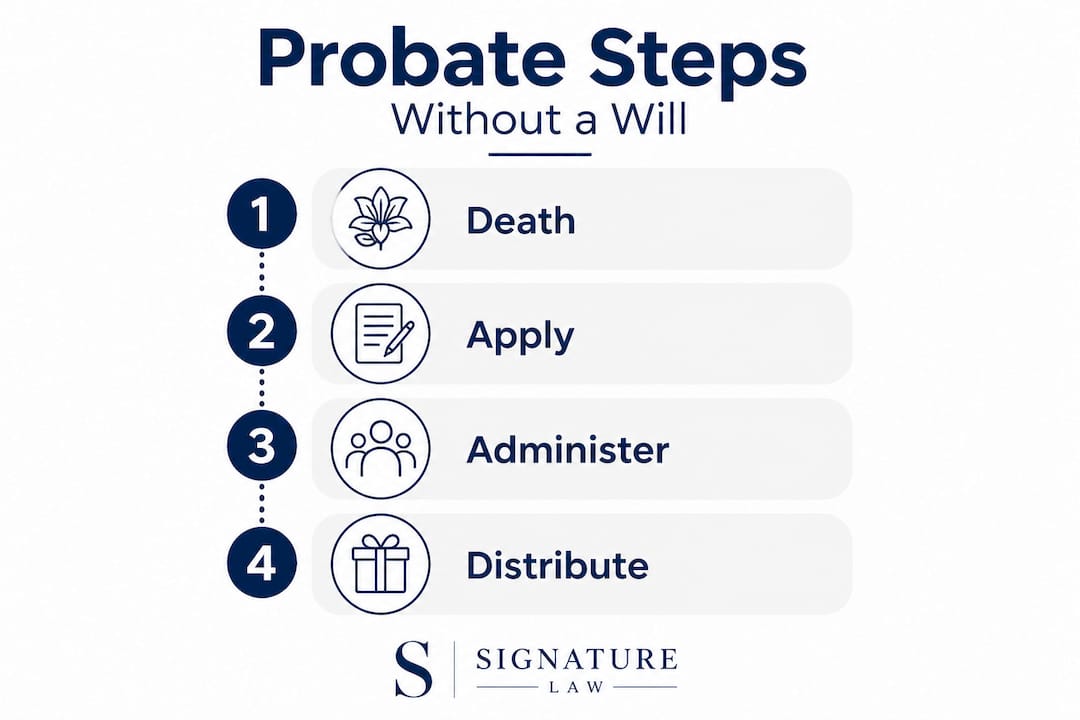
Without a will, there is no named executor. Instead, a close relative must apply to the court for Letters of Administration, which grant them the authority to manage the estate. The distinction matters enormously in practice.
The steps involved in administering an intestate estate typically follow this sequence:
- The death is registered and a death certificate obtained
- A close relative identifies themselves as the administrator
- An application for Letters of Administration is submitted to the Probate Registry
- The court assesses the application and grants authority if everything is in order
- The administrator gathers and values all assets
- Outstanding debts, taxes, and funeral expenses are settled
- The remaining estate is distributed in line with intestacy rules
On average, Letters of Administration take 8.7 weeks to process, compared to just 5.2 weeks for a standard Grant of Probate. That additional delay, nearly four weeks on average, can have real consequences. Bank accounts may be frozen. Property cannot be sold. Bills continue to arrive. Surviving family members may face financial pressure during an already difficult time.
Pro Tip: If you are currently managing an estate and are unsure where to begin, a structured probate checklist can help you understand the steps involved and avoid common administrative errors that cause further delays.
It is also worth noting that the administrator appointed under Letters of Administration does not have to be the person best placed to manage the estate. The law prioritises the closest surviving relative, which may not align with the practical realities of the family’s situation. A will allows you to choose the right person for the role, not simply the nearest one by blood.
Why making a will is the best way to protect your loved ones
After understanding the risks of intestacy, the case for making a will becomes clear. A will is not simply a legal document. It is a direct expression of your intentions and your values. It is the mechanism through which you protect the people who matter most to you.
Experts consistently urge individuals with assets, partners, or children to have a valid will in place, particularly for its ability to support tax efficiency, appoint guardians, and provide specific protections for blended families. The benefits of making a will include:
- Appointing a guardian for minor children, so that their care is not decided by the courts
- Protecting a cohabiting partner who would otherwise receive nothing under intestacy rules
- Reducing inheritance tax liability through careful estate planning and specific bequests
- Specifying wishes for personal possessions, sentimental items, and family heirlooms
- Preventing disputes between family members by leaving clear, legally binding instructions
- Supporting charities or individuals outside the standard family hierarchy
For blended families in particular, a will is the only way to ensure that step-children, close friends, or unmarried partners are included. Without one, those relationships are legally invisible.
Investing time in estate planning advice tailored to your circumstances is one of the most meaningful things you can do for those you love. It removes uncertainty at the worst possible moment and replaces it with clarity. If you are ready to take that step, securing your family’s future starts with a simple, honest conversation about what matters most to you.
Why everything you’ve heard about dying without a will is missing the point
Most conversations about intestacy focus on the legal mechanics. Who inherits what. Which rules apply. How long the process takes. Those things matter, but they do not capture the deeper issue.
The uncomfortable truth is that most people who die without a will did not do so out of ignorance. They did so because making a will feels like confronting mortality. It requires difficult conversations about money, relationships, and what happens after you are gone. For many people, avoidance is simply easier.
But intestacy law ignores the realities of modern life entirely. It does not know that you have been with your partner for twelve years, even though you never married. It does not know that you are estranged from a sibling who would otherwise inherit alongside your children. It does not know that you want your best friend to have a particular item that carries enormous sentimental value. The law applies a template. Your life does not fit a template.
For those aged 30 to 55, the stakes are particularly high. This is typically the stage of life when assets are most significant, family structures are most complex, and the consequences of intestacy are most severe. A mortgage. A pension. Children from a previous relationship. A partner who is not yet a spouse. Each of these elements represents a vulnerability that only a will can address.
Making a will is not an act of pessimism. It is an act of care. It is the clearest way of saying: “I have thought about you, and I have made sure you are protected.” That matters far more than most people realise until it is too late. Understanding the real purpose of estate planning shifts it from a task on a to-do list into something genuinely meaningful.
How expert support can safeguard your family’s future
If this article has prompted you to think seriously about your own situation, you do not have to navigate the next steps alone. At Signature Law, our wills and probate experts work with individuals and families across the UK to create clear, legally sound wills that reflect the realities of modern life. Whether you are in a blended family, cohabiting, or simply want peace of mind, we provide bespoke advice tailored to your specific circumstances. If you are unsure about understanding wills and probate and how they interact, we can explain everything in plain terms. Contact us today at https://signaturelaw.co.uk/contact-us/ to take that first step with confidence.
Frequently asked questions
If I die without a will, does my partner automatically inherit?
Only a married spouse or civil partner has automatic inheritance rights under UK law. Cohabiting partners, even those in long-term relationships, may receive nothing from the estate unless they are specifically named in a valid will.
How long does it take to deal with an estate without a will?
Dealing with an intestate estate takes longer because a relative must apply for Letters of Administration rather than using a named executor. This process averages 8.7 weeks, compared to 5.2 weeks for standard probate, creating delays that can place financial strain on the surviving family.
Do children always get their inheritance straight away if there’s no will?
No. Under intestacy rules, children’s shares are held in trust until they reach the age of 18, at which point they receive the full amount with no flexibility over how or when it is paid.
What happens if there are no close relatives and no will?
If no eligible relatives can be identified under the intestacy hierarchy, the entire estate passes to the Crown under the legal doctrine of bona vacantia. This means the state inherits everything, regardless of any relationships or intentions the deceased may have had.
Recommended
- Why make a will? Secure your family’s future in the UK | Signature Law
- Types of Wills UK: 4 Key Options to Secure Your Family in 2026 | Signature Law
- How to write a will: secure your assets and legacy | Signature Law
- Estate planning guide UK: secure your family’s future in 2026 | Signature Law