





Family Law
Legal Aid for Divorce in the UK – Eligibility, Benefits and How It Works

Who Qualifies for Divorce Legal Aid Under the Means and Merits Tests
Many people believe legal aid for divorce is simply available to anyone who cannot afford a solicitor. That’s wrong. In reality, 32% of divorce cases qualify for support, governed by strict financial and case-related tests. Eligibility hinges on income, capital, and whether your case involves children or domestic abuse. This guide explains who qualifies, what legal aid covers, how to apply, and what limitations you should expect in 2026.
Table of Contents
- Understanding Legal Aid For Divorce In 2026
- Eligibility Criteria: Means And Merits Tests
- Legal Aid And Child Arrangements
- High Net Worth Considerations And Legal Aid Limitations
- Applying For Legal Aid: Process And Timelines
- Limitations Of Legal Aid In Divorce Cases
- Common Misconceptions About Legal Aid
- Get Expert Family Law Support With Signature Law
- Frequently Asked Questions
Key takeaways
| Point | Details |
|——-|———||
| Legal aid has strict eligibility criteria | You must pass both means and merits tests based on income, capital, and case complexity. |
| Priority cases receive funding | Domestic abuse and child safeguarding matters are prioritised for legal aid support. |
| Coverage excludes some financial matters | Legal aid typically covers advice and representation but not complex asset protection strategies. |
| Application decisions take 10 working days | Complete applications with accurate financial documentation receive faster decisions. |
| Legal aid improves access to justice | It ensures vulnerable clients receive fair representation, especially in child welfare cases. |
Understanding legal aid for divorce in 2026
Legal aid provides government-funded legal help for individuals unable to afford private representation. It covers role of legal aid in UK divorce including advice, mediation, and court representation in family law matters. The system prioritises cases involving children or domestic abuse, where fair outcomes depend on professional legal support.
Approximately one-third of divorce cases meet the stringent eligibility requirements. Funding availability depends on passing both a means test, which assesses your finances, and a merits test, which evaluates whether your case justifies public funding based on its complexity or vulnerability factors.
Legal aid aims to ensure fairness by providing representation to clients who would otherwise face the legal system alone. Key areas covered include:
- Divorce proceedings involving child welfare concerns
- Cases where domestic abuse is evidenced
- Child arrangement orders and residency disputes
- Safeguarding matters requiring urgent court intervention
- Legal advice on family law rights and options
Without legal aid, vulnerable clients often struggle to protect their interests or their children’s welfare. The system exists to level the playing field, ensuring access to justice regardless of financial means.
Eligibility criteria: means and merits tests
To qualify for legal aid, you must pass two separate assessments. The means test examines your financial situation, whilst the merits test evaluates whether your case warrants public funding.
The means test considers your gross and disposable income, savings, and capital assets. For 2026, applicants with disposable income around £733 per month typically fall within the threshold. Capital limits also apply, excluding equity in your main residence up to a certain value.
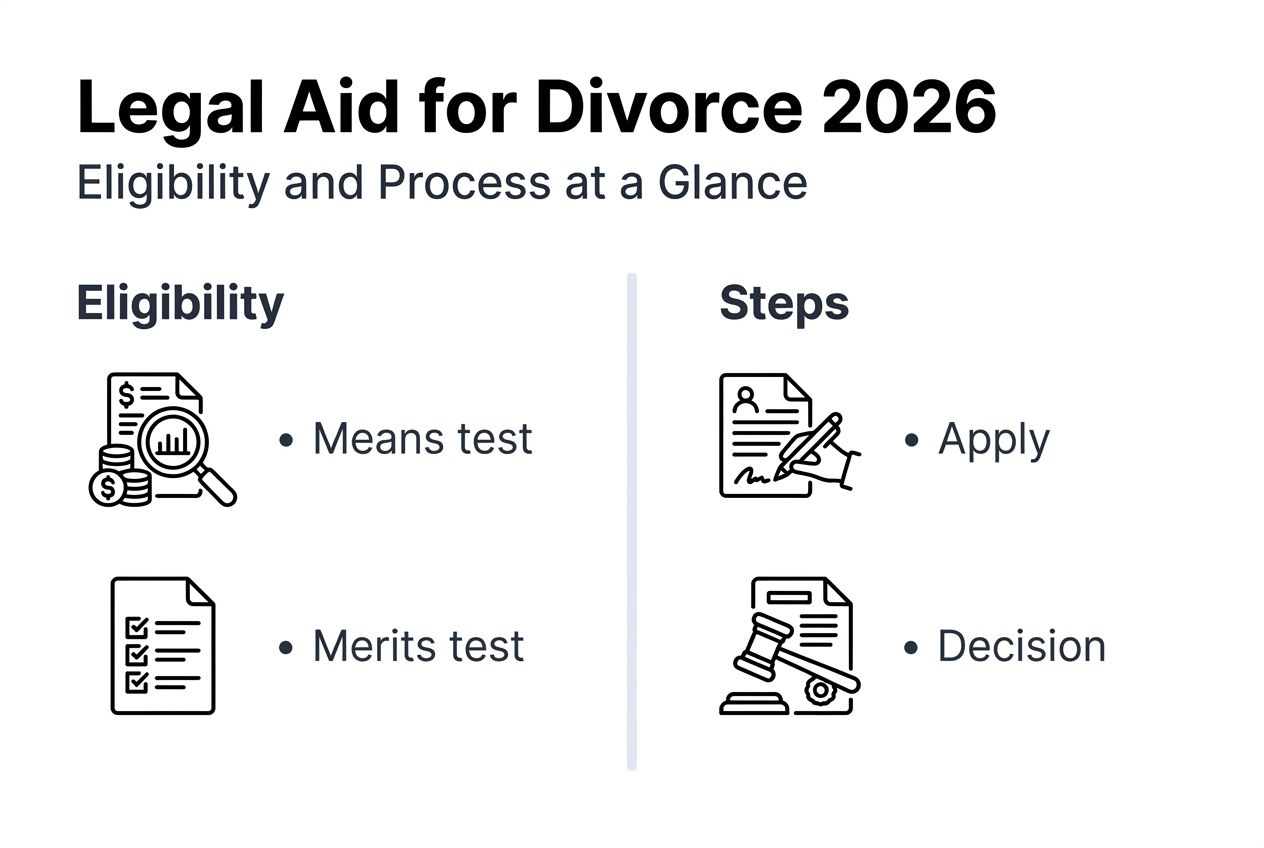
The merits test assesses case complexity and vulnerability. Cases involving domestic abuse, child safeguarding, or significant risk to children receive priority. Your solicitor presents evidence demonstrating why legal funding is justified, such as police reports, medical records, or social services involvement.
Key factors affecting eligibility:
- Gross monthly income and how it compares to threshold limits
- Capital and savings, excluding your home up to specified equity limits
- Evidence of domestic abuse or child welfare concerns
- Complexity of legal issues requiring professional representation
- Likelihood of a successful outcome if funding is granted
Financial thresholds update annually, so checking current limits with legal aid family law UK guidance is essential. Missing documentation or inaccuracies delay decisions, so prepare thoroughly.
Pro Tip: Gather three months of bank statements, payslips, benefits letters, and proof of capital before applying. Accuracy speeds up the process and avoids frustrating delays.
| Test type | What it assesses | Key threshold (2026) |
|---|---|---|
| Means test | Income and capital | Disposable income ~£733/month |
| Merits test | Case complexity and vulnerability | Priority for abuse/child cases |
If your income exceeds the threshold, you will not qualify unless exceptional circumstances apply. The legal aid divorce workflow UK guide provides detailed steps to navigate these tests effectively.
Legal aid and child arrangements
Legal aid plays a critical role in cases involving children. When parents cannot agree on residency, contact arrangements, or care decisions, child arrangement solicitors help secure fair outcomes that prioritise the child’s welfare.

Funding covers legal advice, negotiation, and court representation in disputes over where a child lives or how much time they spend with each parent. Cases involving safeguarding concerns, such as risk of harm or abduction, receive priority.
Domestic abuse cases involving children are particularly well-supported. Legal aid ensures the abused parent can access representation without financial barriers, protecting both parent and child from further harm. Evidence such as police reports, medical records, or refuge referrals strengthens the merits test.
Benefits of legal aid in child arrangement cases:
- Professional representation ensures children’s voices are heard in court
- Reduces the risk of unfair outcomes due to power imbalances
- Supports safeguarding by providing legal protection quickly
- Enables vulnerable parents to challenge unsafe arrangements
- Improves compliance with court orders through clear, enforceable agreements
“Legal aid is essential in protecting children’s welfare during divorce. It ensures parents facing abuse or financial hardship can still access justice and secure safe, stable arrangements for their children.”
Citizens Advice and other organisations confirm that legal aid significantly improves child welfare outcomes. Without it, many vulnerable families would face the courts unrepresented, risking decisions that do not serve the child’s best interests.
High net worth considerations and legal aid limitations
High net worth individuals rarely qualify for legal aid due to financial thresholds. If your income or capital exceeds the limits, you must fund your divorce privately, even if the case involves children or abuse.
Legal aid typically excludes complex financial settlements, asset protection strategies, and detailed property division. It focuses on immediate welfare issues rather than dividing substantial estates or protecting business interests. High net worth divorce solicitors handle these cases through private funding.
Exceptions exist when domestic abuse or child safeguarding concerns override financial limits. If you can evidence serious risk, legal aid may be granted despite higher income or assets. However, this remains rare and requires compelling evidence.
Pro Tip: If you own significant assets but face domestic abuse, gather evidence early. Legal aid may still apply if the merits test demonstrates urgent risk to you or your children.
| Client type | Legal aid availability | Alternative options |
|---|---|---|
| Low income, no assets | Likely eligible if case merits | Legal aid application |
| Moderate income, some assets | May qualify if under thresholds | Legal aid or fixed-fee consultation |
| High net worth | Generally ineligible | Private solicitor funding |
| High net worth with abuse evidence | Possible exception | Evidence-based legal aid application |
Understanding these limitations helps you plan realistically. If you do not qualify, exploring fixed-fee consultations or payment plans with private solicitors ensures you still receive quality representation.
Applying for legal aid: process and timelines
Applying for legal aid requires careful preparation. The process involves gathering financial documentation, completing an application, and awaiting a decision from the Legal Aid Agency.
Follow these steps:
- Consult a legal aid solicitor who assesses your eligibility and case merits.
- Gather financial evidence including three months of bank statements, payslips, benefits letters, and proof of capital.
- Complete the legal aid application form accurately, providing all requested details.
- Submit evidence supporting the merits test, such as police reports or medical records for abuse cases.
- Await the decision, which typically takes up to 10 working days if documentation is complete.
- Respond promptly to any requests for additional information to avoid delays.
Incomplete applications cause significant delays, sometimes extending timelines by weeks. This impacts court dates and increases stress. Accuracy and thoroughness are critical.
Pro Tip: Keep copies of all submitted documents and maintain regular contact with your solicitor. Proactive communication prevents misunderstandings and speeds up the process.
The legal aid divorce workflow UK guide provides detailed step-by-step instructions. For broader context on timelines, see the family law proceedings timeline to understand how legal aid decisions fit into the overall divorce process.
If your application is refused, you can request a review or appeal, though this adds further time. Understanding the legal aid application process helps you prepare effectively and avoid common pitfalls.
Limitations of legal aid in divorce cases
Legal aid does not cover every aspect of divorce. Understanding exclusions helps you plan for additional costs or alternative dispute resolution methods.
Common exclusions include:
- Straightforward, uncontested divorces without child or abuse issues
- Complex financial negotiations involving business valuations or multiple properties
- Detailed asset protection strategies for high net worth individuals
- Extensive financial advice beyond basic legal representation
- Divorce petition filing fees and some administrative costs
Legal aid focuses on cases where there is a clear risk to welfare or where representation is essential for justice. If your divorce involves minimal conflict and no children, you may need to fund the process privately or use mediation services.
Mediation offers a cost-effective alternative for resolving disputes outside court. Some mediation services qualify for legal aid funding, especially when domestic abuse is not a factor. This reduces costs and speeds up resolution.
Understanding these boundaries early prevents frustration. Many clients mistakenly believe legal aid covers all divorce costs, only to discover exclusions late in the process. Clear knowledge allows you to seek timely alternative support, such as fixed-fee services or payment plans.
Common misconceptions about legal aid
Many people hold false beliefs about legal aid availability and coverage, leading to disappointment and confusion.
Misconceptions to avoid:
- Legal aid is available to everyone who cannot afford a solicitor. False. Strict income, capital, and case merit tests apply.
- Legal aid covers all financial and property issues in divorce. False. It focuses on welfare, abuse, and child matters, not complex asset division.
- Applying for legal aid guarantees funding. False. Only cases meeting both means and merits tests receive approval.
- Legal aid fully funds lengthy, complex divorces involving substantial assets. False. High net worth cases rarely qualify unless exceptional circumstances exist.
- All family solicitors accept legal aid cases. False. Many firms no longer offer legal aid due to funding constraints, so finding a provider requires research.
Informed understanding helps applicants seek correct support and avoid wasted effort. If you assume you qualify without checking criteria, you risk delays and unmet expectations. Always consult a legal aid specialist early to assess your situation realistically.
Get expert family law support with Signature Law
Navigating legal aid eligibility and divorce proceedings requires expert guidance. Signature Law’s experienced family law solicitors London team specialises in legal aid family law UK cases, helping clients secure funding and achieve fair outcomes.
Their solicitors understand the complexities of means and merits tests, providing personalised support tailored to your circumstances. Whether your case involves child arrangements, domestic abuse, or financial settlements, Signature Law offers compassionate, authoritative representation.
With over 15 years of experience and media recognition on BBC and ITV, founder Sital Somaiya leads a team committed to supporting you through emotionally challenging times. Fixed-fee consultations and multilingual advice ensure accessibility for all clients. Discover the family law UK impact of professional legal aid representation and start your enquiry today.
Frequently asked questions
What cases qualify for legal aid in divorce?
Cases involving domestic abuse or child welfare concerns often qualify if you meet financial criteria. You must pass both the means test, which assesses income and capital, and the merits test, which evaluates case complexity and risk factors.
How long does it take to get a legal aid decision?
Decisions are typically made within 10 working days if your application is complete and accurate. Delays occur when additional documents or clarifications are needed, so thorough preparation speeds up the legal aid application timeline.
Can high net worth individuals get legal aid for divorce?
Most high net worth individuals are ineligible due to income and capital exceeding financial limits. Exceptions apply if your case involves serious domestic abuse or child safeguarding concerns, supported by compelling evidence.
What should I prepare before applying for legal aid?
Gather three months of bank statements, payslips, benefits letters, proof of capital, and evidence supporting your case merits, such as police reports or medical records. Accuracy and completeness prevent delays and ensure faster decisions.
Recommended
- Role of legal aid in UK divorce: 32% qualify for support | Signature Law
- Legal Aid Divorce Workflow: Step-by-Step Guide for UK Clients | Signature Law
- Legal Aid in Family Law – Who Qualifies and How it Works | Signature Law
- Divorce Settlement Explained – Fair Outcomes in 2026 UK | Signature Law