





Family Law
Inheritance planning for divorce and separation UK

TL;DR:
- Divorce does not automatically revoke inheritance provisions in wills or update beneficiaries.
- Timely legal advice is essential to update wills, pensions, and trusts post-separation.
- Proper estate planning safeguards children’s inheritance and reduces legal risks during divorce.
Many people assume that once a divorce is finalised, their inheritance is automatically protected and their estate will pass exactly as they intend. That assumption can be costly. In England and Wales, separating from a spouse does not instantly rewrite your will, remove them from pension beneficiary forms, or shield assets from court scrutiny. For families in Romford and Essex navigating separation, the gap between what people believe is protected and what the law actually provides can leave children and loved ones exposed. This guide walks you through the key risks, practical steps, and legal realities you need to understand.
Table of Contents
- Why inheritance planning matters during and after divorce
- Key steps to update your will and protect your family
- Inheritance, divorce and the UK courts: what you need to know
- Inheritance tax and gifting: what changes after divorce?
- Child arrangements, inheritance and safeguarding children’s future
- Our perspective: what most parents miss about inheritance planning post-divorce
- Get inheritance planning guidance tailored to your family’s needs
- Frequently asked questions
Key Takeaways
| Point | Details |
|---|---|
| Wills require updating | Divorce voids ex-spouse’s share but does not revoke an entire will—always review yours. |
| Separate assets for protection | Clearly documenting asset ownership and beneficiary changes keeps inheritance secure for your children. |
| Plan for tax changes | After divorce, you lose IHT spousal allowances, making planning essential for high-value estates. |
| Legal advice matters | Getting specialist help prevents costly mistakes and ensures wishes are fulfilled. |
Why inheritance planning matters during and after divorce
Divorce reshapes almost every aspect of your financial life, yet inheritance planning is frequently the last thing people address. The emotional weight of separation can make it easy to defer practical decisions, but delay carries real risk.
One of the most persistent misconceptions is that divorce cleanly severs all ties with a former spouse in legal terms. It does not. As UK legal guides confirm, divorce does not automatically revoke provisions for ex-spouses in a will, which can lead to partial intestacy or assets passing to unintended beneficiaries. If you made your will during the marriage and named your spouse as the primary beneficiary, that provision is voided by divorce in England and Wales, but the rest of the will stands. That sounds reassuring until you realise the remainder of your estate may then pass under intestacy rules rather than your actual wishes.
Pensions are another area where people are routinely caught out. Many assume their pension provider will automatically update beneficiary records after divorce. They will not. You must contact each scheme directly and submit a formal nomination change.
“A Nuffield study found that 63% of divorcing couples have assets under £500,000, and pensions are among the most commonly overlooked elements in financial settlements.”
For families in Romford and Essex, the practical consequences are stark. A parent who dies without updating their will and pension nominations could inadvertently leave a former spouse in control of significant assets, while children receive far less than intended. Understanding inheritance protection during divorce is not optional. It is essential.
Common pitfalls to address immediately after separation:
- Failing to rewrite or update your will
- Ignoring pension and life insurance beneficiary designations
- Overlooking jointly held assets and how they pass on death
- Not seeking specialist advice on estate planning support during the divorce process
- Assuming the financial settlement covers all inheritance matters, when probate and divorce interact in ways that often surprise people
The benefits of using a probate solicitor during divorce are significant, particularly when estates involve property, pensions, or business interests.
Key steps to update your will and protect your family
With the risks clearly in view, the next priority is taking deliberate, structured action. The good news is that the steps are straightforward when approached with proper legal guidance.
As estate planning specialists advise, a post-divorce will review is essential to ensure assets pass as intended, particularly to children. Here is a clear sequence to follow:
- Rewrite your will entirely. Do not simply amend an existing will. A fresh will drafted post-separation removes ambiguity and reflects your current wishes clearly. Specify guardians for minor children and name the beneficiaries you intend.
- Update your lasting power of attorney (LPA). If your former spouse is named as your attorney under an existing LPA, that authority does not automatically end at divorce. Review and revoke it immediately, then appoint someone you trust.
- Change all pension and life insurance beneficiary nominations. Contact every scheme and policy provider in writing. Keep copies of confirmation letters.
- Consider setting up a trust for minor children. A discretionary trust, for example, allows you to ring-fence assets for your children and appoint trustees to manage them responsibly. Trusts protect children’s inheritance from future claims and provide a structured mechanism for managing funds until children reach adulthood.
- Review jointly owned property. If you own property as joint tenants, it passes automatically to the surviving owner. Severing the joint tenancy and holding as tenants in common gives you the ability to leave your share in your will.
For those protecting children’s inheritance after separation, the trust route is often the most effective. A solicitor experienced in both family law and estate planning can coordinate these steps, and the solicitor’s role in divorce property transactions often extends naturally into post-settlement estate planning.
For local expertise in will writing and inheritance tax planning, firms such as F Barnes in Essex offer specialist guidance alongside family law support.
Pro Tip: Choose a solicitor who offers a fixed-fee initial consultation. This removes the financial barrier to getting early advice, which is when the guidance is most valuable and the risks are highest.
Inheritance, divorce and the UK courts: what you need to know
Even with a carefully updated will and revised beneficiary nominations, the family court retains significant powers to intervene in how assets are distributed. Understanding how courts treat inherited assets is essential.

Inherited assets are generally treated as non-matrimonial property, meaning they sit outside the pool of assets to be divided. However, this is not an absolute rule. Courts may use inherited assets to meet children’s needs, particularly if the inheritance was received during the marriage or was used to fund the family home.
The table below illustrates how different circumstances affect the court’s approach:
| Scenario | Likely court treatment |
|---|---|
| Inheritance received before marriage | Usually treated as non-matrimonial; stronger protection |
| Inheritance received during a long marriage | May be treated as matrimonial if mingled with joint assets |
| Inheritance used to buy the family home | Likely included in the matrimonial pot |
| Inheritance received after separation | Stronger protection; less likely to be divided |
| Short marriage, large inheritance | Courts more likely to ringfence the inheritance |
Documentation matters enormously here. Separating your assets clearly and aligning your records with your financial settlement strengthens your position considerably. Keep inherited funds in separate accounts. Avoid mixing them with joint finances. Written agreements, such as a consent order approved by the court, provide a further layer of protection.
For those dealing with complex assets in family law, including business interests, property portfolios, or significant inherited wealth, early specialist advice is not a luxury. It is a necessity. The inheritance division process in divorce is nuanced, and outcomes vary considerably based on the specific facts of each case.
Inheritance tax and gifting: what changes after divorce?
Once the legal structures are in place, your tax position deserves careful attention. Divorce changes your inheritance tax (IHT) position significantly, and many people are unaware of the impact until it is too late.
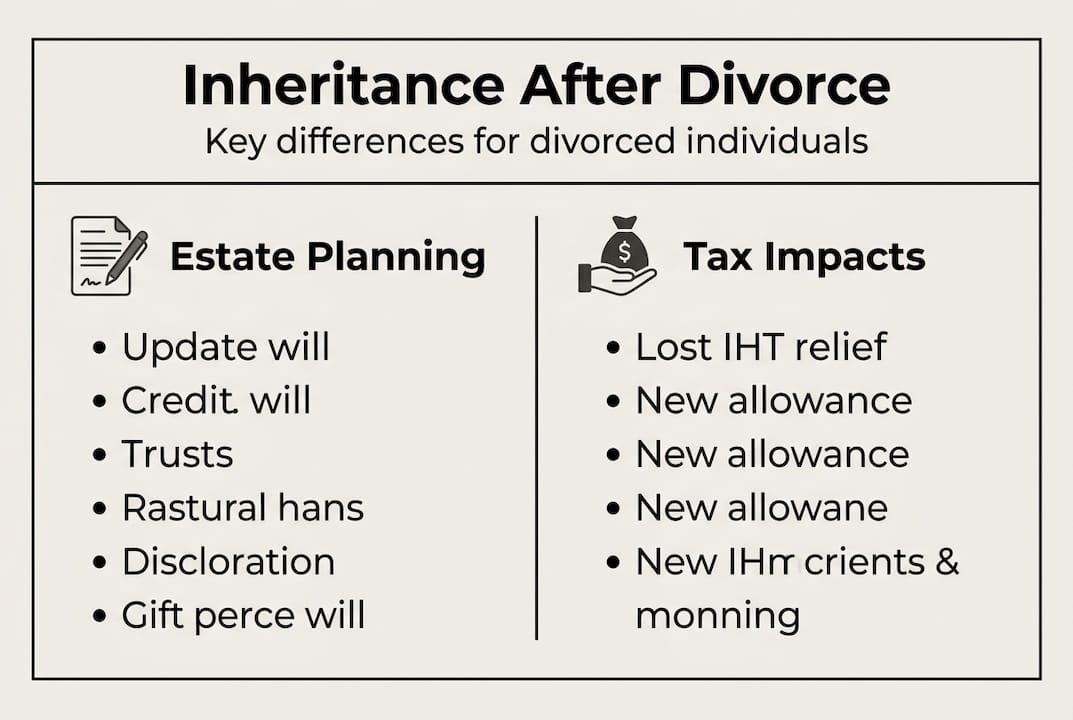
During marriage, transfers between spouses are exempt from IHT. After divorce, that spousal exemption disappears. You also lose access to the transferable nil-rate band, which allows a surviving spouse to inherit their late partner’s unused IHT threshold. As a divorced individual, your estate is assessed solely against your own allowances.
The current 2026 IHT thresholds and reliefs for divorced individuals are as follows:
| Allowance | Amount |
|---|---|
| Nil-rate band (NRB) | £325,000 |
| Residence nil-rate band (RNRB) for home to direct descendants | £175,000 |
| Combined maximum threshold | £500,000 |
| Annual gifting allowance | £3,000 per year |
| Small gift exemption | £250 per person per year |
| Wedding or civil partnership gift to a child | Up to £5,000 |
As HMRC guidance confirms, once the spousal exemption and transferable nil-rate band are lost after divorce, your IHT threshold becomes £325,000 plus the £175,000 residence nil-rate band if your home passes to direct descendants.
Gifting during your lifetime is one of the most tax-efficient ways to support your children. Regular gifts from surplus income, for example, can be entirely exempt from IHT if properly documented. Understanding capital gains tax on separation is equally important when transferring assets as part of a settlement.
Pro Tip: Use the GOV.UK IHT calculator to estimate your new tax position post-divorce. Even if your estate falls well below the threshold, the exercise clarifies where your planning gaps are. Reviewing probate versus wills with a specialist ensures your estate plan is coherent from every angle.
Statistic to note: the Nuffield research indicates that most divorcing families hold assets under £500,000, meaning many will fall beneath the IHT threshold. But planning still matters, because without a valid will and updated nominations, the wrong people may inherit regardless of tax liability.
Child arrangements, inheritance and safeguarding children’s future
For parents, the most pressing concern during separation is almost always the welfare of their children. Child arrangements orders, which specify where children live and how much time they spend with each parent, are central to that process. However, they do not automatically protect your children’s financial future.
As specialist family law guidance confirms, child arrangements orders specify residence and contact arrangements, and parental responsibility endures after divorce. The welfare checklist used by courts focuses on the child’s physical and emotional needs, not their inheritance. That gap must be filled by deliberate estate planning.
Legal guardianship and trust arrangements work together to provide genuine security. If you appoint a guardian in your will and establish a trust for your children’s benefit, you create a framework that operates independently of any court order. This is particularly important if you have concerns about how assets might be managed by the other parent.
A checklist for safeguarding your children’s inheritance:
- Name a guardian for minor children in your will
- Establish a discretionary trust with carefully chosen trustees
- Update pension nominations to reflect your children as beneficiaries
- Review life insurance cover and ensure it is written in trust
- Consider a letter of wishes alongside your will to guide trustees
- Discuss property rights after divorce with a solicitor to ensure the family home is handled correctly
For families in Romford and Essex dealing with complex child arrangements alongside inheritance concerns, coordinating legal advice across both areas is essential. The Advice Now survival guide offers a useful starting point, but tailored legal advice from a local solicitor will always provide more reliable protection.
Our perspective: what most parents miss about inheritance planning post-divorce
In our experience working with families across Romford and Essex, the single most common mistake is not updating documents quickly enough. People focus, understandably, on the immediate pressures of separation: where the children will live, how the mortgage will be managed, what the financial settlement will look like. Inheritance planning gets pushed to the back of the queue.
The consequence is that outdated wills and unchanged pension nominations remain in place for months, sometimes years, after separation. Only 33% of divorcing couples obtain court orders, and 12% seek no legal advice at all. That leaves the majority making decisions without adequate guidance, often at precisely the moment when the stakes are highest.
Emotional decision-making also plays a role. Anger, grief, and exhaustion after separation can lead people to make hasty choices or avoid difficult conversations entirely. Neither serves your children’s interests.
Our view is straightforward: even if your estate is modest, the absence of a clear, updated will and proper beneficiary nominations creates risk that is entirely avoidable. Engaging a specialist for estate planning support during or immediately after divorce is not an extravagance. It is the most practical thing you can do to protect your family.
Get inheritance planning guidance tailored to your family’s needs
If you are going through separation in Romford or Essex and want to ensure your inheritance plans genuinely protect your children and your estate, Signature Law is here to help. Our team coordinates updated wills, trust arrangements, and inheritance protection as part of a joined-up approach to family law and estate planning. Whether you need a family law solicitor in Romford to guide you through the divorce process or specialist support from our wills and probate solicitors, we provide personalised advice rather than a one-size-fits-all approach. To arrange a consultation and review your inheritance planning, contact Signature Law today.
Frequently asked questions
Does divorce automatically revoke my will in the UK?
No. In England and Wales, divorce voids ex-spouse provisions in a will but does not revoke the entire document, which means your estate may pass under partial intestacy rules unless you rewrite your will promptly.
How is children’s inheritance kept safe during a separation?
Setting up a discretionary trust and naming your children as beneficiaries in a revised will are the most effective steps, as trusts ring-fence assets from future claims and provide structured management until children reach adulthood.
What is the inheritance tax threshold for divorced individuals in 2026?
The threshold is £325,000 plus a further £175,000 residence nil-rate band if your main home passes to direct descendants, as post-divorce IHT rules remove the spousal exemption and transferable nil-rate band entirely.
Does a child arrangements order affect inheritance?
A child arrangements order governs where children live and contact arrangements only; it does not determine inheritance, so a separate will and trust remain essential to protect your children’s financial future.
Should I consult a solicitor for inheritance planning after separation?
Yes, strongly so. Specialist legal advice prevents the most common and costly errors, particularly around pension nominations, trust structures, and ensuring your will accurately reflects your intentions after divorce.
Recommended
- Estate Planning in Divorce – Protecting Your Children | Signature Law
- Property division in UK divorce: fair outcomes explained | Signature Law
- Understanding the probate process: divorce and separation | Signature Law
- Signature Law Blog: Legal Insights & Updates (2026)