





Family Law
Investment property law in UK family disputes explained

TL;DR:
- Courts treat investment properties as financial assets, considering value, income, and ownership during divorce.
- Fairness, not automatic equal split, guides property division, influenced by marriage duration and contributions.
- Early valuation, full disclosure, and expert tax advice are crucial for fair settlement outcomes.
When a relationship breaks down and investment properties are involved, many people assume the law will simply split everything down the middle. That assumption is wrong, and acting on it can cost you dearly. Whether you own rental flats, holiday lets, or commercial premises, the way courts approach these assets during divorce or family disputes is nuanced, fact-specific, and often surprising. Understanding how investment property law actually works gives you a genuine advantage when protecting your financial position and, crucially, your children’s futures.
Table of Contents
- What is investment property law in the context of family disputes?
- How courts approach division of investment properties
- Special legal protections for children and vulnerable parties
- Practical steps for managing investment properties in family law cases
- What most guides miss about investment property during family breakdown
- Expert help for investment property and family law disputes
- Frequently asked questions
Key Takeaways
| Point | Details |
|---|---|
| No guaranteed 50/50 split | Investment property division is based on fairness and individual needs, not a strict formula. |
| Children’s needs come first | Courts always prioritise the housing and welfare of children when dividing properties. |
| Urgent protection available | Occupation orders can remove an abusive party from any family or investment property for safety. |
| Early valuation saves trouble | Getting properties valued and tax advice early prevents costly mistakes later on. |
| Professional guidance matters | Seeking legal advice ensures your rights and interests are protected in complex cases. |
What is investment property law in the context of family disputes?
Investment property, in family law terms, refers to any property held primarily to generate income or capital growth rather than as a primary family home. This includes buy-to-let residential properties, commercial units, holiday rental properties, and land held for development. Each of these carries its own financial profile, income stream, and tax position, which means the legal treatment during a family dispute can differ significantly from the straightforward division of a matrimonial home.
Courts do not treat investment properties the same way they treat the family home. The family home carries emotional weight and is tied directly to housing needs, particularly for children. Investment properties, by contrast, are treated more like financial assets, though they are never assessed in isolation. Their value, the income they generate, the mortgage liabilities attached to them, and their ownership structure all matter.
When assessing how to deal with types of assets in divorce, the court looks at the full financial picture. Investment properties sit within that picture alongside pensions, savings, business interests, and other capital assets. The key factors courts weigh include:
- The current market value of each property and any outstanding mortgage
- Rental income generated and how it has been used during the marriage
- Whether the property was owned before the marriage or acquired jointly during it
- Capital gains tax and other tax liabilities that would arise on sale or transfer
- Whether the income from the property contributes to either party’s living costs
“The Section 25 MCA 1973 checklist governs how property is considered in divorce, focusing on fairness and needs rather than a rigid formula of equal division.”
There is no presumption that investment properties will be split equally. Fairness is the governing principle, and what is fair depends entirely on your circumstances.
How courts approach division of investment properties
Understanding the legal framework helps you prepare for negotiations and, if necessary, court proceedings. The Section 25 MCA 1973 checklist is the primary tool judges use to assess financial claims on divorce. It does not produce automatic outcomes. Instead, it directs the court to weigh a range of factors before making any order.
The checklist includes:
- The income, earning capacity, property, and financial resources of each party now and in the foreseeable future
- The financial needs, obligations, and responsibilities of each party
- The standard of living enjoyed by the family before the breakdown of the marriage
- The age of each party and the duration of the marriage
- Any physical or mental disability of either party
- The contributions each party has made, including non-financial contributions such as caring for children
- The conduct of each party, where it would be inequitable to disregard it
- The value of any benefit, such as a pension, that either party will lose the chance of acquiring
Courts place children’s welfare at the very top of the agenda. If investment property income supports the family, or if one party relies on that income after separation, the court will factor this into the overall settlement.
| Scenario | Likely approach |
|---|---|
| Short marriage, one party owned the property before marriage | Court may ring-fence the asset or award a smaller share to the other party |
| Long marriage, investment property built jointly | Court more likely to treat it as a shared matrimonial asset |
| Children require housing from rental income | Income considered in maintenance calculations; property retention may be ordered |
| Both parties contributed to acquisition and management | Broader, more even division is more likely |
The table above illustrates why no two cases produce the same result. Context is everything. For a fuller understanding of how courts approach property division in UK divorce, the principles extend well beyond investment assets alone.
Courts strongly encourage parties to negotiate and reach an agreement rather than litigate. Financial proceedings in court are costly, time-consuming, and stressful. A negotiated agreement, properly drafted and approved by the court as a consent order, offers certainty and saves both parties significant expense. That said, where agreement cannot be reached, the court will impose a solution based on the Section 25 factors.
Pro Tip: Even if you and your former partner agree on how to divide investment properties, you must formalise that agreement in a legally binding financial order. Without one, either party can return to court years later to make further financial claims.
When approaching asset division in divorce, investment properties often require expert valuation evidence and, in complex cases, input from accountants or tax specialists before a fair outcome can be determined.
Special legal protections for children and vulnerable parties
If children are involved, or if domestic abuse is a feature of the breakdown, the law provides specific protections that can directly affect investment property. These protections are important to understand, especially if you are in an urgent or unsafe situation.

The welfare of children is the court’s primary consideration in any proceedings that affect them. This extends to housing. If a rental property could be used to provide suitable accommodation for a parent and children, or if rental income is needed to fund housing costs, the court can and will take this into account when structuring a financial settlement.
| Legal protection | What it does | Who it applies to |
|---|---|---|
| Occupation order | Restricts or removes an abusive party from a property | Victims of domestic abuse |
| Matrimonial home rights | Prevents a property being sold without notice | Non-owning spouse |
| Financial order for children | Can require investment income to be applied for children’s needs | Any parent |
| Injunction | Prevents dealing with or dissipating assets | Either party during proceedings |
Occupation orders can remove an abusive partner from a property temporarily if harm is likely. This applies even if the abusive partner is the legal owner of the property. The court’s power here is significant and can be exercised on an urgent basis, sometimes within hours in serious cases.
Matrimonial home rights deserve particular mention. If you are married but are not named on the title deeds of the family home, you still have the right to occupy that property. These rights should be registered as a notice at the Land Registry to protect your position, particularly if you are concerned that your spouse might attempt to sell or remortgage the property during proceedings.
When abuse is present, seeking legal advice immediately is critical. Courts have wide powers to protect vulnerable parties and children, but those protections must be actively applied for.
The connection between domestic abuse proceedings and property rights and divorce is close and complex. An occupation order in abuse cases can affect who lives in the property, who pays the mortgage, and how the property is ultimately divided in the financial settlement. Early advice from a specialist solicitor is not optional in these circumstances. It is essential.
Practical steps for managing investment properties in family law cases
Knowing your rights is one thing. Taking the right practical steps from the outset of a dispute is what actually protects your position. Here is what you should prioritise:
-
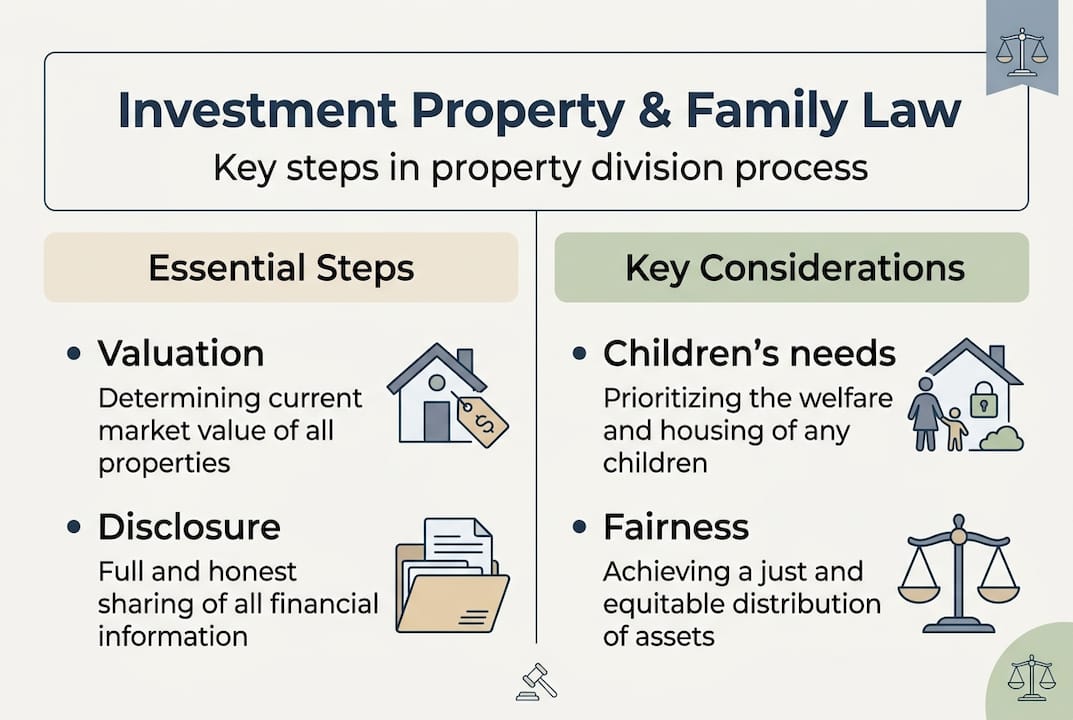
Obtain accurate valuations early. Investment properties should be formally valued by a qualified surveyor as soon as a dispute arises. Do not rely on estate agents’ informal estimates. Where the property generates income, you will also need documentation of rental yields and any associated costs.
-
Ensure full financial disclosure. Both parties are legally required to disclose all assets, liabilities, and income in financial proceedings. This includes investment properties, even those held in a company structure or through a trust. Failing to disclose assets is a serious matter and can result in the court setting aside any agreement reached.
-
Understand the tax position. Transferring or selling investment properties during a divorce can trigger capital gains tax (CGT) liabilities. Since April 2023, the rules around CGT on transfers between divorcing couples have changed, and some reliefs are available for a limited period after separation. Getting tax advice before agreeing to any transfer or sale is essential.
-
Consider rental income in maintenance calculations. If you or your former partner receives significant rental income from investment properties, this will be treated as income for the purposes of child maintenance and spousal maintenance assessments. Being transparent about this income avoids disputes later.
-
Explore settlement options before court. Mediation and collaborative law are both effective routes to resolving property disputes without the financial and emotional cost of litigation. A structured negotiation, supported by solicitors on both sides, can often produce a more creative and workable outcome than a court would impose.
Pro Tip: If you hold investment properties through a limited company, the legal treatment is more complex still. The court can look through a company structure to assess the true value of your interest. Specialist advice is essential in these cases.
For properties that are commercially owned or have mixed-use characteristics, our commercial property divorce guide provides detailed guidance on how these assets are handled. Understanding the solicitor’s role in property division can also help you understand what to expect at each stage of proceedings.
Early valuation and disclosure are critical. The courts expect both parties to approach financial proceedings with transparency and good faith. Those who attempt to conceal or undervalue investment assets risk adverse costs orders and findings of conduct that can affect the overall outcome.
What most guides miss about investment property during family breakdown
Most articles on this subject present the law as if it operates in a tidy, predictable sequence. Identify the assets, disclose them, apply the checklist, reach an outcome. In practice, it rarely works that way, and understanding where things can go wrong is as important as understanding the rules themselves.
One area that frequently catches people off guard is the tax cost of settlement. Agreeing that your former partner will transfer their share of a buy-to-let property to you sounds straightforward. But if the property has significantly increased in value since purchase, the disposal can trigger a substantial CGT liability that neither party anticipated. This is why tax advice is essential to prevent post-settlement burdens, and negotiation is usually best for business continuity.
Another overlooked area is timing. The longer financial proceedings drag on, the more the property market can shift. A property valued at a certain figure at the start of proceedings may be worth considerably more or less by the time an order is made. Agreeing to a settlement based on an out-of-date valuation can leave either party significantly disadvantaged.
We also see clients who assume that because a property was owned before the marriage, the court will simply hand it back to them. This is not always the case. If the property was used to generate family income, if the other spouse contributed to its management or improvement, or if it was mortgaged to fund family expenditure, the court may treat it as a matrimonial asset to some degree. Pre-marital ownership is a relevant factor, but it is not a decisive one.
The most important lesson we have drawn from years of experience in this area is that the quality of the outcome in investment property disputes depends almost entirely on the quality of the advice received at the outset. Clients who come to us early, with full documentation and a realistic understanding of what the law can and cannot do, consistently achieve better results. You can explore further legal insights on our blog, where we address some of the most common misconceptions in family property law.
Negotiated settlements, where both parties understand the full financial picture and receive independent legal advice, are far more likely to preserve business relationships, protect children’s stability, and allow both parties to move forward without the lasting damage that adversarial litigation can cause.
Expert help for investment property and family law disputes
Dealing with investment properties during a family breakdown is one of the most technically demanding areas of family law. The intersection of property valuation, tax liability, income assessment, and court procedure means that getting the right advice early can make a substantial difference to the outcome you achieve.
At Signature Law, we understand the emotional weight you are carrying alongside these legal and financial pressures. Our specialist solicitors handle investment property disputes with both the technical precision the law demands and the sensitivity your situation deserves. Whether you need urgent protection, support in negotiation, or clear guidance through court proceedings, we are here to help. Learn more about the family law impact in the UK and how specialist legal support makes a practical difference. Our London family law solicitors bring experience across a wide range of complex property and family matters. To discuss your position with a specialist, speak with our team today.
Frequently asked questions
Is there always a 50/50 split of investment property in divorce?
No. UK law provides no automatic 50/50 split; courts base decisions on what is fair for both parties, considering needs, contributions, and the welfare of any children involved.
Can an abusive partner be excluded from an investment property during a dispute?
Yes. Courts can issue occupation orders to temporarily remove an abusive partner for safety, even if they are the legal owner of the property in question.
Do investment properties affect child maintenance or financial orders?
Yes. Income from investment properties may be included in maintenance calculations and financial orders, making full and transparent disclosure of all rental income essential from the outset.
What if I need urgent access to an investment property for my child’s housing?
Courts can act quickly to prioritise children’s housing needs, and welfare of children is the first consideration in any family proceedings, including those involving property allocation.
Should I get valuation and tax advice before negotiating a settlement?
Absolutely. Early valuation and tax advice help you identify potential costs such as capital gains tax liabilities before agreeing to any transfer or sale, supporting a genuinely fair and sustainable outcome.
Recommended
- Property division in UK divorce: fair outcomes explained | Signature Law
- Signature Law Blog: Legal Insights & Updates (2026)
- Family Law Solicitor for Property Disputes London: Expert Guidance on Divorce and Financial Settlements
- Types of family law cases in the UK: your options 2026 | Signature Law