





Family Law
Landlord’s role in divorce: Rights for UK tenants

TL;DR:
- UK law protects tenants’ rights during divorce, preventing automatic eviction without proper legal process.
- Landlords cannot evict tenants solely due to divorce, requiring court orders and following eviction procedures.
- Family courts can transfer tenancy rights or issue occupancy orders considering children’s welfare and financial circumstances.
Divorce is rarely straightforward, and when you rent your home, the legal picture becomes even more layered. Many people assume that a change in marital status automatically gives a landlord the right to terminate a tenancy, or that the rented property will simply be caught up in the divorce settlement without any protections in place. Neither assumption is correct. UK law provides clear, structured safeguards for tenants going through a relationship breakdown. This guide covers what actually happens to your tenancy during divorce, how courts approach rented property, and the practical steps you can take to protect your housing security and wellbeing.
Table of Contents
- Setting the legal context: Divorce, tenancy, and the landlord’s position
- Eviction, notice periods, and tenant protections during divorce
- How the courts handle tenancy and property when couples split
- Communicating with your landlord: Practical steps and common pitfalls
- Why most divorcing tenants underestimate their legal rights
- Get expert help for property and divorce challenges
- Frequently asked questions
Key Takeaways
| Point | Details |
|---|---|
| Eviction not automatic | Landlords cannot evict tenants simply because of divorce and must follow the standard legal process. |
| Court prioritises children | When deciding tenancy transfers after divorce, courts focus on children’s housing needs above all else. |
| Tenancy often continues | Most rental agreements remain unchanged until properly terminated, regardless of relationship breakdown. |
| Communication is vital | Clear, written communication with your landlord, and early updates, prevent disputes and confusion. |
Setting the legal context: Divorce, tenancy, and the landlord’s position
When a marriage breaks down and the family home is rented, the first question most people ask is: can the landlord simply ask us to leave? The honest answer is no, not without following proper legal process. Marital status is not a valid ground for ending a tenancy in England, and landlords who attempt to act otherwise risk serious legal consequences.
A tenancy agreement is a contract. It exists independently of your relationship status. Whether you are joint tenants or one of you is the sole named tenant, the agreement continues on its existing terms unless lawfully brought to an end. The property division under the Matrimonial Causes Act provides the overarching legal framework that governs how assets, including rights over rented accommodation, are considered during financial proceedings.
Here is what that means in practice for tenants renting in England:
- Joint tenants both hold equal rights to occupy the property and are equally responsible for rent.
- Sole tenants hold the contractual right to remain, though a spouse may have home rights under the Family Law Act 1996.
- Neither party can be removed from the property without a court order or their own agreement.
- Landlords cannot simply issue notice because a couple is divorcing.
Family courts take a pragmatic and child-focused view when rented properties are involved. Where children are part of the picture, the court’s primary concern is continuity and stability of housing. For guidance on fair property division in divorce cases involving rented accommodation, specialist legal advice is essential from the outset.
‘A landlord must follow standard eviction procedures — such as serving a valid Section 21 notice with two months’ notice — and cannot terminate tenancy due to the tenants’ divorce.’
For a fuller picture of how rented and owned properties feature in divorce proceedings, our property and divorce guidance covers the key principles clearly.
Pro Tip: Always check whether your tenancy agreement is in both names. If it is not and you are the non-named spouse, take steps early to assert your home rights legally before the situation becomes contested.
Eviction, notice periods, and tenant protections during divorce
Understanding your eviction rights during a divorce is not just useful — it can be the difference between keeping your home and losing it unnecessarily. The law is unambiguous. Tenants cannot be evicted simply because they are separating or divorcing.
Landlords in England and Wales must follow a structured legal process before a tenant can be required to leave. Here is how that process works:
- Section 21 notice — A ‘no fault’ notice requiring at least two months’ notice, which can only be served if the fixed term has ended or permits it. This is currently the subject of legislative reform under the Renters’ Rights Bill 2025.
- Section 8 notice — Issued when a tenant has breached the tenancy agreement, most commonly through rent arrears of two months or more.
- Court proceedings — If a tenant does not vacate after notice expires, the landlord must apply to court. A bailiff warrant is then required to enforce possession.
- Enforcement — Only court-appointed bailiffs can physically remove tenants. A landlord acting without this authority commits illegal eviction.
Critically, tenants cannot be evicted because a landlord disapproves of the marital breakdown or because one party has left the property. As long as rent continues to be paid and the tenancy terms are met, the tenancy remains protected.

| Eviction ground | Notice required | Court order needed? |
|---|---|---|
| Section 21 (no fault) | Minimum 2 months | Yes |
| Section 8 (breach) | 2 weeks to 2 months | Yes |
| Illegal eviction | Not applicable | Landlord liable |
What happens if your landlord is the one divorcing? If the rental property forms part of the landlord’s own divorce proceedings and is sold as a result, your tenancy transfers automatically to the new owner. You do not need to leave. Your tenancy continues under the same terms until it lawfully ends.
For context on how these protections interact with divorce settlement outcomes, it is worth understanding that financial proceedings consider all housing arrangements, including tenancies. Our divorce negotiation tips offer further practical guidance on building a fair outcome.
Pro Tip: Keep all correspondence with your landlord in writing, whether by email or letter. Written records are your strongest protection if a dispute reaches mediation or court.
How the courts handle tenancy and property when couples split
When a divorcing couple cannot agree on who should remain in the rented property, the family court steps in. Courts have wide-ranging powers under the Family Law Act 1996, including the authority to transfer a tenancy from one party to the other, regardless of whose name originally appeared on the agreement.
‘Knowledge of your rights is your best shield — never assume a landlord can act on divorce without due legal process.’
The tenancy transfer in divorce can be ordered for married couples where it is fair and where children’s welfare requires it. Courts weigh up several factors before reaching a decision.
Factors courts consider when deciding tenancy outcomes:
- Children’s welfare — Stability of schooling, friendships, and routine carries significant weight.
- Financial circumstances — Relative income, ability to pay rent, and housing alternatives available to each party.
- History of residence — Who has been the primary occupier and for how long.
- Conduct — Behaviour relevant to the breakdown, particularly where domestic abuse is a factor.
Here is a clear comparison of the court-ordered tenancy outcomes that may arise:
| Outcome | Meaning | Typical scenario |
|---|---|---|
| Sole tenancy transfer | One party takes over the tenancy entirely | Children remain with primary carer |
| Joint tenancy maintained | Both parties remain on the agreement | Short-term arrangement during proceedings |
| Tenancy surrendered | Both parties vacate; tenancy ends | Neither party can afford or wishes to stay |
| Occupancy order | One party excluded from property | Domestic abuse or safety concerns |
Property division guided by Matrimonial Causes Act 1973 fairness principles applies even to rented accommodation, meaning neither party should be left without a viable housing option where children are involved. For more detail on rights in rented property post-separation, independent guidance confirms that children’s housing security consistently takes precedence over financial equalisation.
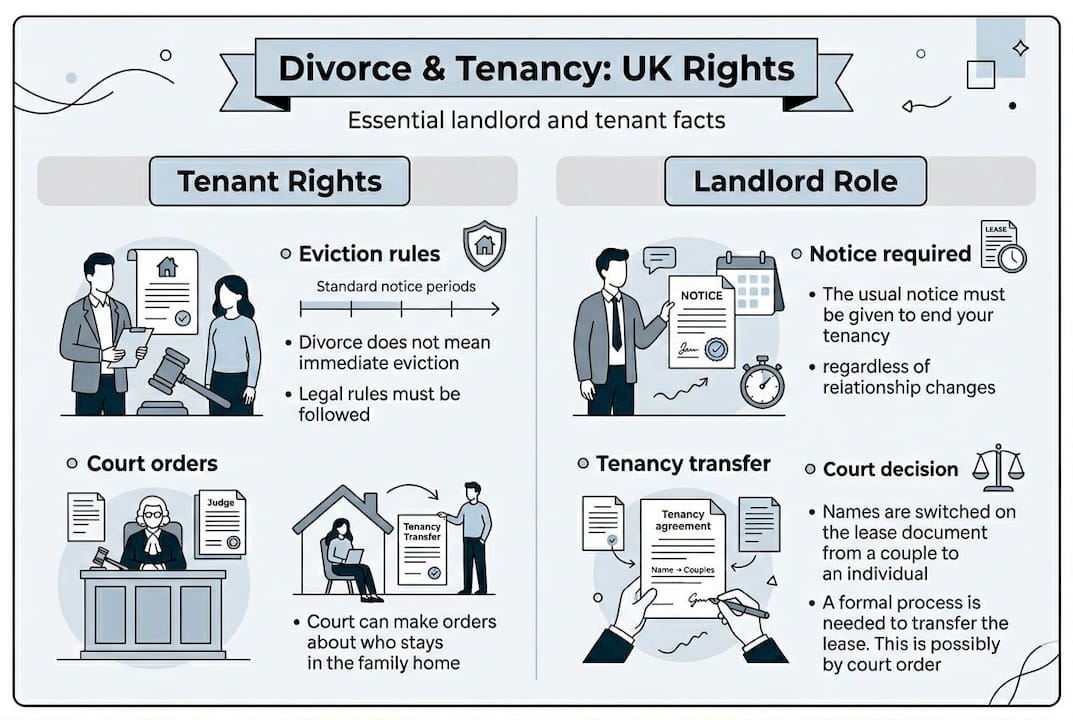
Understanding the role of solicitors in tenancies within divorce is important here. A solicitor can apply for an occupation order swiftly if you need legal protection to remain in the home. For a broader overview of fair division in divorce, including how tenancy rights interact with financial settlements, specialist guidance is always recommended.
Communicating with your landlord: Practical steps and common pitfalls
Once you understand your legal position, the next challenge is managing the practical reality of your tenancy during what is already an emotionally demanding time. How you communicate with your landlord can significantly affect the outcome.
Divorcing tenants should notify landlords of relevant changes and, where disputes arise over the tenancy, seek mediation before escalating to court. Early, transparent communication preserves your relationship with the landlord and often prevents unnecessary legal costs.
Here is a step-by-step approach to managing tenancy communication during divorce:
- Review your tenancy agreement — Identify who is named, what the notice requirements are, and whether there are clauses about assignment or subletting.
- Notify your landlord in writing — Inform them that your household circumstances are changing. You are not obliged to share full details, but a brief, factual update is courteous and avoids confusion over rent responsibilities.
- Seek mediation early — If you and your spouse disagree on who should remain, a professional mediator can help resolve the dispute without court intervention.
- Apply for a court order if needed — If mediation fails and the situation is unsafe or unresolved, a solicitor can apply for an occupation order or tenancy transfer through the family court.
- Update paperwork formally — If a tenancy transfer is agreed, ensure the landlord formally removes one party and amends the agreement in writing.
Common mistakes that make difficult situations worse:
- Delaying notification to the landlord, which can create confusion about who is responsible for rent.
- Leaving the property without legal advice, as this can be treated as abandonment and may affect your rights.
- Communicating aggressively or making threats in writing, which can be used as evidence against you in court.
- Assuming verbal agreements with a landlord are sufficient — they rarely are.
To stay organised during this process, our divorce checklist covers the key legal and practical steps from start to finish. Understanding the range of possible types of UK divorce settlements will also help you approach negotiations with clarity.
Pro Tip: Always confirm any changes to your tenancy in writing, signed by all parties including the landlord. A verbal agreement provides very little protection if a dispute arises later.
Why most divorcing tenants underestimate their legal rights
In our experience, the most common and costly mistake divorcing tenants make is not acting on misinformation. It is acting on no information at all. Fear drives people to vacate properties they had every legal right to remain in. Panic leads to rushed decisions that harm long-term housing security. And misplaced assumptions about what a landlord can and cannot do often go unchallenged until real harm is done.
The truth is that UK tenant protections during divorce are robust. Property division under the Matrimonial Causes Act 1973 fairness principles extend to rented homes, not just owned ones. Courts can act quickly. Solicitors can intervene effectively. The law is on your side, provided you know how to use it.
What changes everything is documentation and early advice. Tenants who keep records, communicate clearly, and seek legal support early are consistently better protected than those who wait. If you want to secure your fair share of housing stability during divorce, the first step is understanding that you have far more rights than you may realise.
‘Knowledge of your rights is your best shield — never assume a landlord can act on divorce without following due legal process.’
Do not wait until a dispute escalates. Act early, document everything, and take qualified legal advice as soon as possible.
Get expert help for property and divorce challenges
Navigating a rented tenancy during divorce is genuinely complex, but you do not have to face it alone. At Signature Law, we understand how distressing and disorienting this period can be. Our experienced solicitors provide clear, compassionate guidance on all aspects of property and family law, including tenancy rights, court applications, and financial settlements. Whether you need landlord and tenant legal advice or specialist support on the UK family law impact of your divorce, we are here to help. We also advise on the role of conveyancing in divorce where property ownership is also involved. Contact us today at signaturelaw.co.uk/contact-us to speak with a solicitor who will listen and advise with both authority and care.
Frequently asked questions
Can my landlord evict me if I get divorced?
No. Your landlord cannot terminate tenancy simply because you are divorcing. Standard legal procedures, including the correct notice and a court order, must be followed before any eviction can take place.
What happens to my tenancy if my spouse was the named tenant?
The court may order tenancy transfer to you under the Family Law Act 1996 if it is deemed fair and if children’s welfare supports you remaining in the property.
If my landlord is divorcing, do I need to move out?
No. If the landlord’s divorce leads to the property being sold, your tenancy automatically transfers to the new owner and continues under its existing terms until it lawfully ends or proper notice is served.
How does divorce affect rental property under UK law?
Rental property is addressed through Matrimonial Causes Act 1973 fairness principles, with courts prioritising children’s welfare and each party’s housing needs when deciding tenancy outcomes.
Recommended
- Understanding the role of landlord solicitors in UK housing | Signature Law
- Property division in UK divorce: fair outcomes explained | Signature Law
- Commercial property in UK divorce: Step-by-step guide | Signature Law
- Solicitor’s role in divorce property transactions UK 2026 | Signature Law